The Verdict: Is a High Mileage Used EV Worth Buying?
A high mileage used EV can absolutely be worth it, but only if you know what to look for. The critical question isn't whether the car has 80,000 or 120,000 miles on the odometer. It's whether the battery is still healthy, how well the previous owner maintained the vehicle, and whether you're prepared for out-of-warranty repair costs.
Electric vehicles age differently than petrol cars. A Tesla Model 3 with 100,000 miles might retain 85-90% of its original range, perfectly usable for daily driving. The same car with poor charging habits could be degraded to 70% capacity. That difference determines whether you're looking at a bargain or a liability.
In Kettering and across Northamptonshire, independent EV specialists like KMC Electric now offer battery health verification for buyers considering high-mileage vehicles. Getting a pre-purchase diagnostic costs far less than discovering a failed battery after purchase. This guide walks you through what actually matters when evaluating a used EV, how to assess battery degradation, and whether the savings justify the risks.
Battery Degradation: What Really Happens at High Mileage
Electric vehicle batteries don't suddenly fail at a certain mileage threshold. Instead, they lose capacity gradually over time and use. A lithium-ion battery in a Tesla typically retains 90% of its capacity after 160,000 miles. By 200,000 miles, most well-maintained batteries sit between 80-85% capacity.
The problem is that "well-maintained" carries weight. How the previous owner charged the vehicle, the climate where they lived, and how often they used fast charging fundamentally shape battery health.
Charging cycles and lithium-ion chemistry
Each charging cycle stresses the chemical compounds inside a lithium-ion battery. Fast charging at motorway services generates heat, which is the enemy of lithium-ion chemistry. A battery repeatedly rapid-charged will degrade faster than one charged primarily at home using standard AC charging.
Lithium Iron Phosphate (LFP) batteries, increasingly common in newer Tesla Model 3s, are more tolerant of thermal stress and fast charging than traditional NMC (nickel manganese cobalt) chemistry. If you're comparing two high-mileage used EVs, the one with LFP chemistry will likely have aged better.
Thermal management and real-world range loss
The thermal management system cools the battery pack during charging and driving, and heats it in cold weather. A failed thermal management system means the battery will degrade faster going forward.
Real-world range loss at high mileage varies depending on climate and usage. An EV driven primarily in cold regions will show more range loss than one driven in southern England. A vehicle used for frequent motorway journeys with repeated fast charging will degrade faster than one used for daily commuting with overnight home charging.
At 80,000 miles, expect 5-10% range loss on a well-maintained vehicle. At 120,000 miles, 10-15% is realistic.
How to Check Electric Car Battery Health Before You Buy
Before committing to a high-mileage used EV purchase, you need concrete data on battery state of health. This is the single most important inspection you can perform.
What state of health (SoH) means and why it matters
State of Health (SoH) is a percentage that represents how much usable capacity your battery retains compared to when it was new. A battery with 85% SoH can deliver 85% of the original kilowatt-hour capacity. On a Tesla Model 3 with a 50 kWh pack, 85% SoH means you've lost roughly 7.5 kWh of usable capacity.
SoH matters because it directly affects range and charging speed. A battery at 70% SoH won't charge as quickly as one at 95% SoH. Most EV buyers ignore SoH entirely, which is why so many high-mileage used EV purchases become regrettable. If you plan to keep the car for another 5-10 years, that degradation matters.
Diagnostic tools and pre-purchase inspection steps
Getting an accurate SoH reading requires specialised diagnostic equipment. Independent EV specialists in Northamptonshire and the East Midlands now use professional diagnostic equipment to pull battery data without visiting a Tesla service centre. KMC Electric, based in Kettering, offers pre-purchase battery health assessments that give you concrete SoH figures before you buy.
The inspection process involves:
Connect diagnostic equipment to the vehicle's OBD port, the same port used for MOT testing. This pulls real-time battery data including SoH, temperature, cell voltage balance, and charge cycles.
Run a charging cycle test, observe how quickly the battery charges from 20% to 80%.
Check thermal management system status, confirm the cooling system is functioning and there are no error codes related to battery temperature regulation.
Review service history, look for any previous battery-related repairs or replacements.
Assess charging habits from data logs, the battery management system records charging patterns.
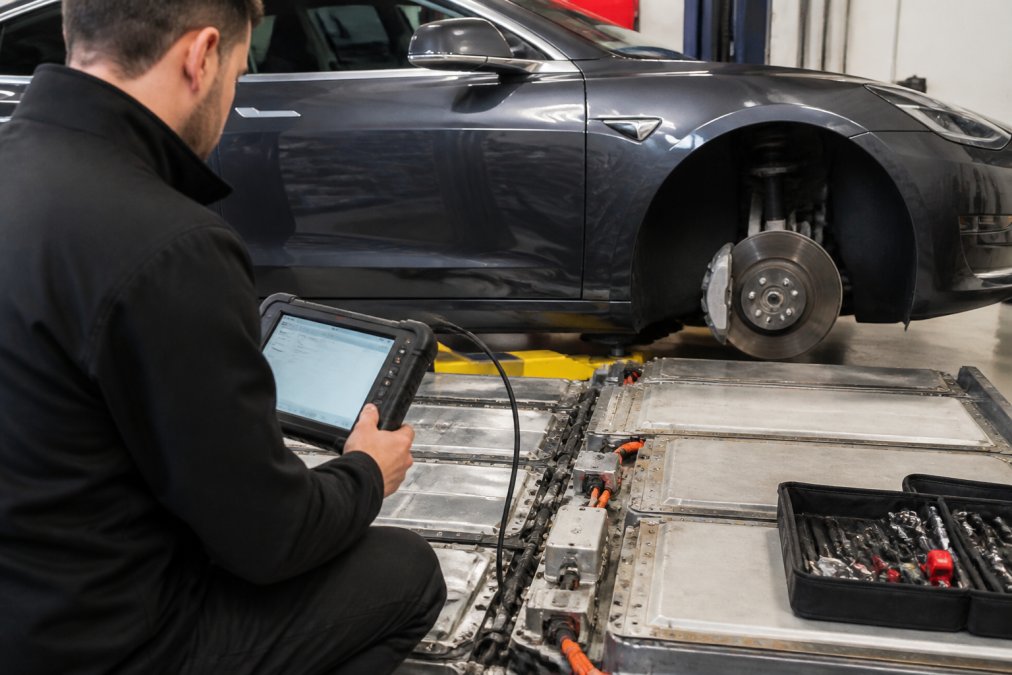
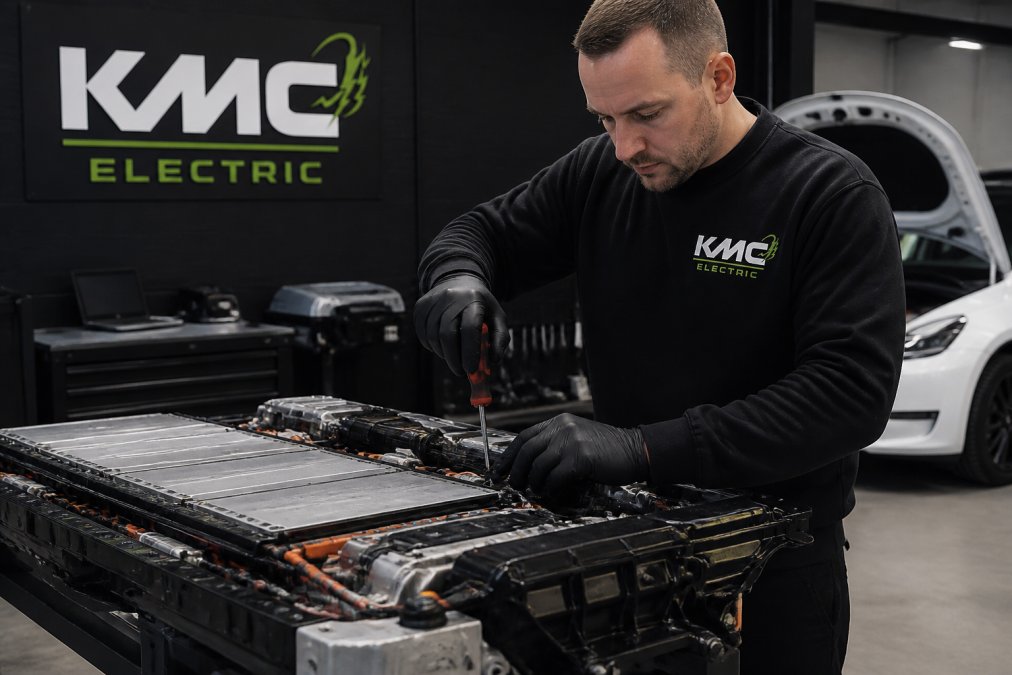
Professional technician using diagnostic equipment on a Tesla battery pack in a modern workshop, with specialist scan tools connected to the vehicle's OBD port and battery management system display visible on screen
Armed with this data, you can make an informed decision. If a high-mileage used EV shows 85%+ SoH with a clean service history and no thermal management issues, it's likely a solid purchase. If it's at 75% SoH with evidence of repeated fast charging, you're buying a vehicle that's already significantly degraded.
Mileage vs. Age: Which Matters More for Used EVs?
With a petrol engine, high mileage almost always means more wear. With an EV, age matters as much as mileage, sometimes more.
An EV parked in a garage for five years with only 20,000 miles might have a more degraded battery than one with 100,000 miles driven carefully over the same period. Battery degradation happens passively over time, even when the car isn't being used. Leaving a lithium-ion battery at full charge for months accelerates degradation.
What this means for your purchase decision: don't dismiss a high-mileage EV just because of the odometer reading. Instead, look at the combination of mileage, age, usage pattern, and most importantly, battery SoH. A 2018 Tesla Model 3 with 140,000 miles and 88% SoH is a better buy than a 2021 Model 3 with 50,000 miles and 82% SoH.
EV Battery Replacement Cost UK and What to Budget
Battery replacement is the repair that makes or breaks the economics of a high-mileage used EV purchase.
A complete battery pack replacement for a Tesla Model 3 costs between £8,000 and £15,000 depending on the model year and chemistry. For a Model Y, expect £12,000 to £18,000. For a Model S or Model X, costs can exceed £20,000.
These costs assume the battery pack itself is the only component that needs replacement. If the thermal management system has failed, costs climb further.
The critical insight: if you're buying a high-mileage used EV at £15,000, and the battery is at 70% SoH, you're potentially one major failure away from a total loss. Spending £200-300 on a battery health check saves you from a £10,000+ mistake.
For buyers in Kettering and Northamptonshire, KMC Electric provides independent battery replacement quotes and can source OEM or certified aftermarket battery packs.
Warranty Coverage and Out-of-Warranty Repair Costs
Most electric vehicles come with an 8-year, 100,000-mile battery warranty from the manufacturer. Once you exceed either threshold, you're on your own. For a high-mileage used EV, warranty status is critical.
If you're buying a used EV that still has remaining warranty coverage, that warranty typically transfers to you as the new owner, though some manufacturers impose conditions or charge a transfer fee.
Once the warranty expires, every battery-related repair becomes your responsibility. Out-of-warranty repair costs extend beyond the battery. The thermal management system, the battery management system, the high-voltage wiring, and the onboard charger can all fail independently. A thermal management system failure might cost £1,500-3,000 to repair. An onboard charger failure runs £800-1,500.
The warranty question shapes the entire economics of a high-mileage used EV purchase. A vehicle with 18 months of battery warranty remaining is fundamentally different from one with zero warranty.
Common EV Components Beyond the Battery That Wear With Mileage
High mileage doesn't just stress the battery. Other EV-specific components degrade with use.
Suspension, brakes, and drivetrain components
Electric vehicles are heavier than equivalent petrol cars, a Tesla Model 3 weighs about 200 kg more than a comparable petrol saloon. That extra weight stresses suspension components: bushings, control arms, and anti-roll bar links wear faster. High-mileage used EVs often need suspension work that petrol cars of similar age might avoid.
Brakes are different. Regenerative braking means the friction brakes are used less frequently than in a petrol car. An EV with 100,000 miles might still have original brake pads. However, when brake work is needed, the cost is similar.
The electric motor and single-speed transmission are simpler than a petrol engine and typically more durable. However, if the motor does fail, replacement costs are substantial: £3,000-6,000 depending on the model.
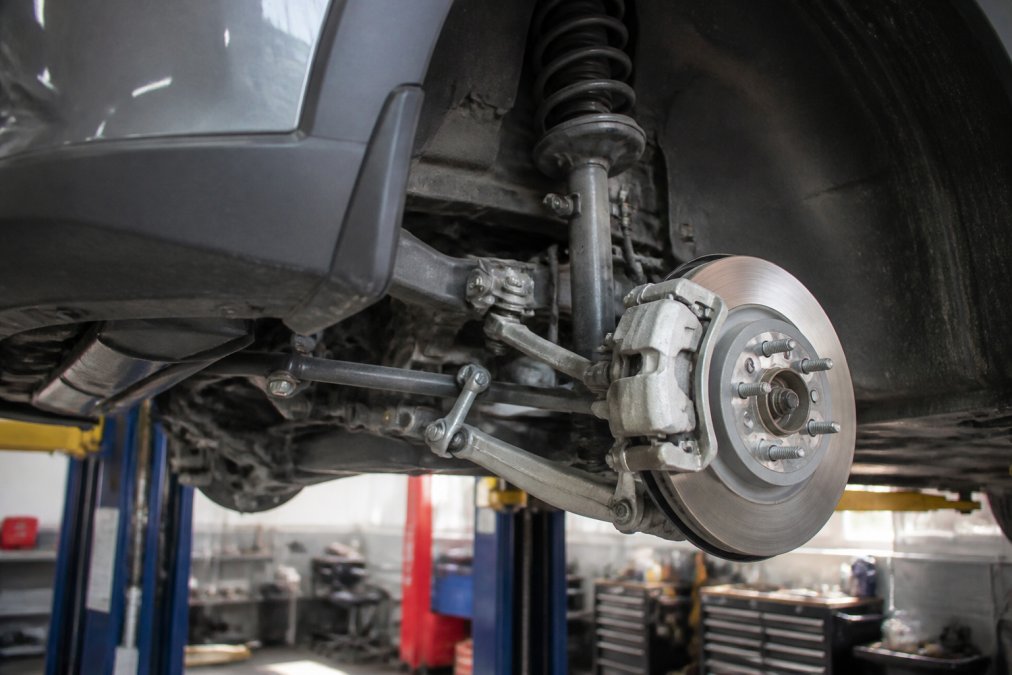
Close-up view of electric vehicle suspension components, control arms, and brake assembly in a service bay with diagnostic equipment visible
Software updates and battery management system health
The battery management system is sophisticated software that monitors thousands of data points across the battery pack. If this system develops faults, the car might limp-mode or refuse to charge properly.
Software updates are critical for EV longevity. Tesla regularly releases updates that improve battery efficiency, refine thermal management, and fix bugs in the battery management system. A high-mileage used EV that hasn't received updates in years might be operating with outdated firmware.
When you inspect a high-mileage used EV, check the software version. If it's more than a year out of date, that's a red flag. Battery management system faults show up as error codes. Common ones include thermal management errors, cell voltage imbalance warnings, and charge limit restrictions. These don't necessarily mean the battery is failing; sometimes they indicate a software glitch that an update resolves.
Cost-Benefit Analysis: High Mileage vs. Low Mileage Used EVs
The financial case for a high-mileage used EV depends entirely on the price differential and the battery condition.
Scenario 1: A 2019 Tesla Model 3 with 130,000 miles, 87% SoH, full service history costs significantly less than a comparable 2020 Model 3 with 45,000 miles and 94% SoH. If you plan to keep the car for four years and drive another 40,000 miles, the high-mileage option makes financial sense. You'll likely see another 5-8% battery degradation, landing you at 79-82% SoH, still perfectly usable.
Scenario 2: A 2019 Model 3 with 140,000 miles, 72% SoH, limited service history is significantly cheaper than the low-mileage option. However, the battery is already significantly degraded. Another 40,000 miles of driving will degrade it further, potentially making the vehicle difficult to sell.
In this scenario, the low-mileage option is the smarter buy. The extra cost buys you peace of mind and a vehicle with genuine longevity remaining.
The break-even point: if a high-mileage used EV is 40-50% cheaper than a comparable low-mileage alternative, and the battery SoH is above 80%, it's likely worth the risk. If it's cheaper but the battery is at 70% SoH or below, the savings don't justify the shortened remaining lifespan.
Factor
High-Mileage EV
Low-Mileage EV
Typical price
Baseline (lowest cost)
Higher
Battery SoH range
75-88%
92-98%
Warranty remaining
Often expired
3-5 years typical
Suspension/brake risk
Moderate to high
Low
Out-of-pocket repair risk
£2,000-£8,000
£500-£2,000
Resale value after 4 years
£8,000-£12,000
£15,000-£20,000
Best for
Budget-conscious buyers, short ownership
Long-term ownership, peace of mind
The honest answer to whether a high-mileage used EV is worth it: yes, if you're methodical about inspection and realistic about risks. No, if you're hoping to avoid the cost of diagnostics or underestimating the financial impact of a degraded battery.
Get a pre-purchase battery health check. Understand the SoH figure. Factor in remaining warranty coverage and realistic repair costs. Compare the savings against the risks. If the numbers work, a high-mileage used EV can deliver tremendous value.
For buyers in Kettering, Northamptonshire, and across the East Midlands, KMC Electric offers independent battery diagnostics and pre-purchase inspections that give you the data you need to make this decision confidently. With over 25 years of automotive experience and Level 4 Master Technician status in electric vehicles since 2016, the team understands EV battery chemistry, thermal management systems, and the real-world degradation patterns that determine whether a high-mileage used EV will serve you well or become an expensive mistake. Contact KMC Electric for a battery health assessment before you buy, and avoid the costly surprises that catch unprepared buyers.
Frequently Asked Questions
What mileage is too high for a used EV?
There's no single 'too high' figure, it depends on battery state of health (SoH) and vehicle age. A Tesla Model 3 with 80,000 miles at 6 years old may retain 85-90% battery capacity, while an older model at the same mileage could show 75% SoH. Always verify battery health independently before purchase. Most EVs with proper maintenance remain viable beyond 100,000 miles if the battery SoH is above 80%.
How does high mileage affect electric car battery degradation?
High mileage increases charging cycles, which gradually reduces lithium-ion battery capacity. Typical degradation is 2-3% per 100,000 miles under normal conditions, though thermal management system efficiency and charging habits significantly influence this rate. Fast charging and hot climates accelerate degradation. An independent electric car battery health check before purchase reveals the actual SoH and helps you understand remaining lifespan.
Should I prioritise age or mileage when buying a used EV?
Age and mileage both matter, but battery state of health is the deciding factor. A 5-year-old EV with 40,000 miles may have lower SoH than a 3-year-old with 80,000 miles, depending on charging habits and calendar ageing. Older vehicles experience battery degradation simply from sitting unused. Request a pre-purchase inspection that includes battery diagnostics to compare options fairly.
What's the typical EV battery replacement cost UK if the battery fails?
Out-of-warranty battery replacement costs £8,000-£15,000+ depending on model and battery chemistry (NMC vs. LFP). Smaller capacity batteries cost less; larger packs cost more. This is why verifying battery health before purchase is essential. Many high-mileage EVs still have sufficient SoH to avoid replacement for several years, making independent diagnostics a worthwhile investment.
Is it worth buying a 4-year-old electric car with high mileage?
Yes, if the battery SoH is above 80% and the service history is complete. A 4-year-old EV with 70,000-90,000 miles often offers excellent value because initial depreciation has already occurred. Verify battery health, check for software updates, and ensure the powertrain warranty status. Many owners find high-mileage used EVs more economical than new models, provided diagnostics confirm battery viability.