Buying a used Tesla without requesting a used tesla battery health report is one of the most expensive mistakes you can make in the EV market. The high-voltage battery pack is the single most valuable component in any Tesla, and its condition determines real-world range, charging behaviour, and long-term reliability. This guide from KMC Electric covers every method available in 2026 to assess battery health before you commit to a purchase, from reading the onboard diagnostics yourself to commissioning a professional inspection in Kettering, Northamptonshire. Below, we show you exactly how to interpret what you find, which third-party tools are worth using, and when the numbers should make you walk away.
Here is what most guides get wrong: they treat battery health as a single number. The reality is more nuanced. State of health (SoH) is the standardised measure of remaining battery capacity relative to the original specification, but SoH alone does not tell you whether the cells are balanced, whether the battery management system (BMS) has logged fault codes, or whether the pack has suffered thermal damage. A Tesla showing 92% SoH can hide serious problems that only a full diagnostic scan will reveal.
Why a Used Tesla Battery Health Report Should Be Your First Step
Skipping the battery health check is the used EV equivalent of buying a house without a survey. The high-voltage battery pack in a Tesla accounts for a substantial portion of the vehicle's total value, and capacity fade is irreversible without a full battery replacement. A used tesla battery health report gives you the objective data you need to negotiate price, reject a bad purchase, or plan for future costs.
Battery health is defined as the ratio of a battery's current usable energy storage capacity to its original rated capacity, expressed as a percentage. A new Tesla Model 3 Long Range ships with a rated capacity of approximately 75 kWh. If that pack now holds 68 kWh of usable energy, the state of health is roughly 91%.
What matters beyond that headline figure:
Charging cycle count and depth of discharge history
Voltage imbalance between individual cell groups
BMS fault history and active error codes
Thermal management system integrity
Charge limit behaviour and range estimation accuracy
According to Tesla's official battery warranty documentation, Tesla warrants that the battery will retain at least 70% of its original capacity within the warranty period for most models. Knowing where a specific vehicle sits relative to that threshold is critical before purchase.
Watch OutNever rely solely on the range estimate shown on the Tesla display. Range estimation is affected by driving style, temperature, and recent charging patterns. It is not a substitute for a proper SoH reading from the BMS.
Understanding Tesla Battery Degradation and State of Health (SoH)
Battery degradation is not a defect; it is a chemical inevitability. Every lithium-ion cell loses capacity over time as charging cycles cause structural changes at the electrode level, specifically, lithium plating on the anode, electrolyte decomposition, and the gradual loss of active lithium inventory. The question for used EV buyers is not whether degradation has occurred, but how much, at what rate, and crucially, why.
Tesla's battery management system continuously monitors the pack and updates its internal capacity estimate. That estimate is what third-party tools and service mode diagnostics read when generating a battery health report. Understanding how the BMS calculates SoH helps you interpret the numbers intelligently rather than accepting them at face value.
Capacity Fade vs. Power Fade: What Is the Difference?
Capacity fade is the gradual reduction in the total energy a battery can store, measured in kilowatt-hours (kWh). It is what most people mean when they talk about battery degradation, and it directly reduces driving range. Capacity fade is primarily driven by cycle count, depth of discharge, and sustained high-temperature operation.
Power fade is a separate phenomenon: the battery's ability to deliver or accept high current decreases, even if stored energy remains relatively stable. At the cell level, power fade is caused by increasing internal resistance, the growth of resistive films on electrode surfaces (the solid electrolyte interphase, or SEI layer) that impede ion flow. Power fade shows up as reduced acceleration response, slower Supercharging speeds, and the car throttling output during sustained high-demand situations. A battery can have acceptable capacity but significant power fade, making it feel sluggish and charge slowly.
Both forms of degradation matter for a used EV inspection. Capacity fade affects daily usability. Power fade affects performance and charging convenience. A thorough battery health report should flag both, and the two do not always move in lockstep.
How Regional Climate Produces Different Degradation Profiles on Identical Vehicles
This is the angle almost every used Tesla guide ignores, and it is one of the most practically important factors for buyers in specific markets.
Lithium-ion cells have a thermal comfort zone broadly between 15°C and 35°C for operation and storage. Outside that range, degradation accelerates through distinct mechanisms depending on which extreme is involved.
High-ambient-temperature climates (southern Europe, Middle East, parts of the US Sun Belt): Sustained heat accelerates electrolyte oxidation and SEI layer growth. A Tesla that has spent several summers parked in direct sun in a hot climate, even without being driven, accumulates thermal stress that a mileage figure alone will never reveal. Vehicles imported from hot-climate markets or previously operated as hire cars in warm regions frequently show SoH readings that are disproportionately low relative to their odometer reading. When reviewing a used Tesla from an unknown regional history, a SoH that is more than 3-4 percentage points below the typical curve for that mileage bracket is a signal worth investigating for thermal history.
Cold-climate operation (northern UK, Scandinavia, Canada): Cold temperatures suppress the battery's ability to accept charge efficiently. When a vehicle is charged at low temperatures without adequate pre-conditioning, lithium plating can occur on the anode, metallic lithium deposits that are electrochemically inactive and permanently reduce capacity. This is most common in vehicles that were regularly fast-charged in cold conditions without the battery being pre-warmed first. The BMS in modern Teslas includes thermal pre-conditioning for Supercharging, but older software versions and third-party fast chargers do not always trigger this. A vehicle with a history of cold-climate fast charging without pre-conditioning may show accelerated capacity fade that is structurally different from normal cycle-based degradation.
What this means in practice for UK buyers: A used Tesla sourced from a UK private owner with a documented home-charging history in a temperate region is, all else being equal, likely to show more predictable degradation than a vehicle imported from a hotter market or one that spent its early life as a fleet vehicle in a cold northern region with heavy Supercharger reliance. When you cannot verify regional history, the service mode cell voltage spread becomes especially important: thermally stressed packs frequently show wider cell group imbalance than cycle-degraded packs of equivalent SoH, because heat damage is rarely uniform across the pack.
Pro TipIf the seller cannot confirm where the vehicle was primarily operated, check the charging history in the Tesla app for Supercharger location data. A pattern of charges logged at locations in hot or cold climate regions, or a high proportion of charges at non-Tesla DC fast chargers (which do not trigger Tesla's thermal pre-conditioning), is worth factoring into your assessment.
How Charging Habits Compound Climate Effects
Climate and charging behaviour interact. A vehicle in a hot climate that was also regularly charged to 100% and depleted below 10% has experienced a compounding of two of the three primary degradation drivers simultaneously. The three drivers, temperature, charge level, and cycle depth, are not additive in a simple linear way; they interact, and their combined effect on a specific pack is part of what a professional BMS diagnostic can help untangle.
A vehicle with 40,000 miles driven gently, charged on AC overnight to 80-90%, and garaged in a temperate climate will typically show materially better SoH than an identical model with 30,000 miles used as a high-mileage taxi with daily Supercharging in a warm region. Mileage is a proxy for use, not a measure of battery stress. The battery health report is the measure of battery stress.
How to Run a Tesla Battery Degradation Test Using Service Mode
Tesla service mode is the onboard diagnostic interface built into every Tesla vehicle. Accessing it gives you direct visibility into BMS data, including raw capacity figures, cell voltage data, and logged fault codes. This is the closest a non-Tesla-technician can get to a factory-level battery diagnostic scan without specialist equipment.
Total Time: 10-15 minutes What You'll Need: The vehicle, owner credentials or seller present, and a fully charged battery (above 90% SoC for accurate readings)
Step-by-Step: Accessing Tesla Service Mode on the Display
Sit in the driver's seat with the vehicle powered on
Tap the Tesla logo in the top centre of the touchscreen
Enter the service mode access sequence: hold the brake pedal and tap the Tesla logo six times in quick succession (method varies slightly by software version)
Navigate to "Battery" within the service menu
Record the "Nominal Full Pack Energy" value in kWh
Compare this figure against the original rated capacity for that specific model and variant
Note any active or historical fault codes displayed in the BMS section
Check cell voltage spread: values should be tightly grouped, typically within 20-30mV of each other. A wide voltage imbalance indicates cell group degradation
Expected Result: You will see a kWh figure that, divided by the original rated capacity and multiplied by 100, gives you the SoH percentage. For a Long Range Model 3, an original capacity of approximately 75 kWh and a current reading of 71 kWh equates to roughly 95% SoH.
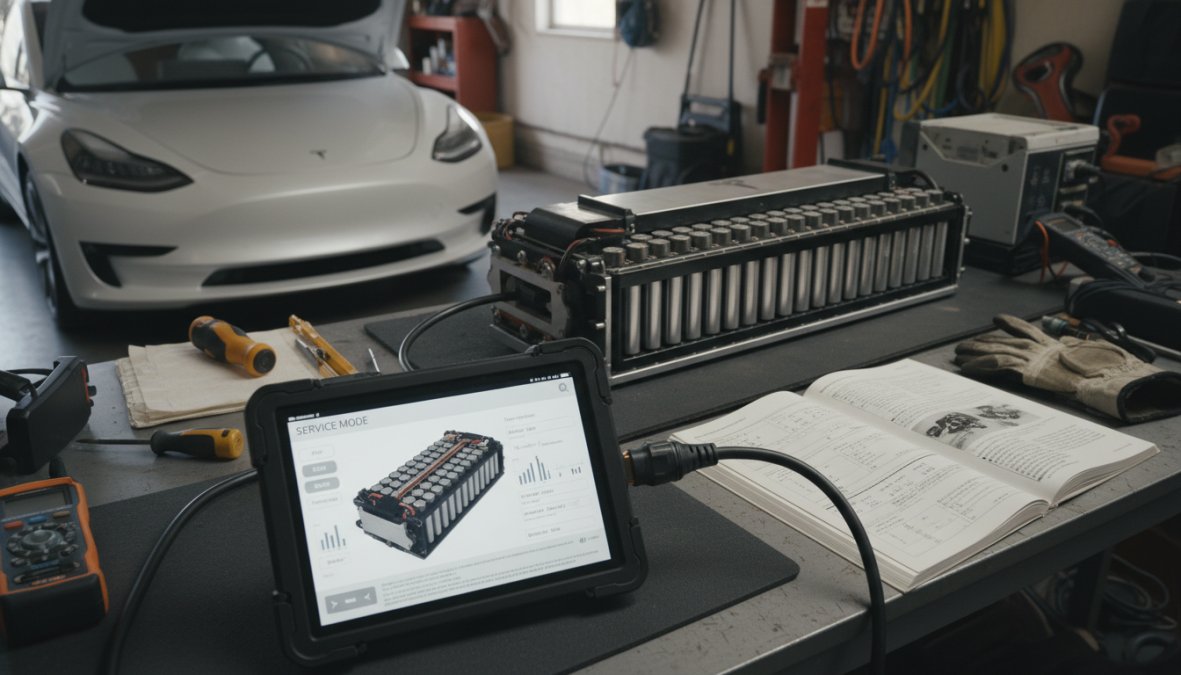
Step-by-step visual guide for Close, Tesla, Service Mode for used tesla battery health report
Watch OutService mode access procedures change with Tesla software updates. If the standard tap sequence does not work, the seller may need to contact Tesla support to enable temporary service access. A seller who refuses to allow service mode inspection should be treated as a red flag.
Third-Party Tesla Battery Health Check: Tools and Apps Compared
The onboard service mode gives raw BMS data, but third-party tools add context, historical tracking, and more accessible reporting. A third-party Tesla battery health check is particularly useful when you want to compare a vehicle's degradation rate against similar models or generate a shareable report for negotiation.
Recurrent Auto, TeslaFi, and OBD-Based Scanners: A Comparison Table
Tool
Method
Data Accessed
Best For
Limitations
Recurrent Auto
Tesla API (cloud)
SoH trend, range analysis
Pre-purchase report, no hardware needed
Requires owner API access, no BMS fault codes
TeslaFi
Tesla API (cloud)
Charging history, efficiency, SoH tracking
Long-term ownership monitoring
Historical data only; limited for one-off checks
OBD-based scanners (e.g., ScanMyTesla)
Bluetooth OBD2 adapter
Cell voltages, BMS faults, raw capacity
Deep diagnostic inspection
Requires physical adapter; some models restrict OBD access
Tesla Service Mode
Onboard display
Raw kWh capacity, cell voltage spread
Quick on-site check
No historical trend data; interpretation requires knowledge
According to Recurrent Auto's used EV buyer resources, vehicles with documented battery health histories sell with greater buyer confidence and tend to retain value more predictably than those without records.
The practical advice: use Recurrent Auto for a pre-visit screening, then verify with service mode or an OBD scan during the physical inspection. Neither method alone is sufficient. Combining cloud-based history with a live BMS read gives you the most complete picture.
VIN-Specific Battery Health Lookup and Service History Analysis
Every Tesla carries a unique Vehicle Identification Number (VIN) that links to Tesla's internal service records. A VIN-specific battery health lookup is one of the most underused tools available to used EV buyers, and it is where this guide goes beyond what most resources cover.
Tesla's service history, accessible via the Tesla app when linked to the vehicle, shows previous service visits, battery-related work orders, and any battery replacements. A vehicle that has already had a battery pack replaced is not necessarily a bad buy, but you need to know the replacement date, the reason for replacement, and the current age of the replacement pack.
Steps for a VIN-based service history check:
Ask the seller to log into their Tesla app and share the service history screen
Request any paperwork from Tesla Service Centre visits
Use a third-party VIN check service to cross-reference ownership history and any insurance write-off markers
Check whether any over-the-air software updates affecting battery management have been applied
As documented in the UK government's vehicle enquiry service, basic vehicle history including MOT records and mileage is publicly accessible using the registration number. For EVs, consistent mileage progression is a reasonable proxy for normal use patterns.
A vehicle with gaps in service history, inconsistent mileage reporting, or evidence of multiple short-term owners warrants extra scrutiny on the battery health report.
Tesla Battery Warranty Coverage for Used Vehicles
Tesla battery warranty coverage for used vehicles depends on the model, the original purchase date, and whether the vehicle was purchased from Tesla directly or through a private seller.
For most current Tesla models sold in the UK:
Model 3 Standard Range: 8 years or 100,000 miles, whichever comes first, with a minimum 70% SoH retention guarantee
Model 3 Long Range and Performance: 8 years or 120,000 miles
Model S and Model X: 8 years with unlimited mileage
Model Y: 8 years or 120,000 miles (Long Range and Performance)
Tesla's battery warranty is transferable to subsequent owners, which is significant. A used Tesla still within its warranty period retains the SoH guarantee, meaning if the battery drops below 70% of original capacity before the warranty expires, Tesla is obligated to service or replace the pack.
The critical check: verify the exact warranty expiry against the vehicle's first registration date, not the purchase date of the used vehicle. Many buyers assume the warranty clock restarts on their purchase. It does not.
Key TakeawayAlways calculate the remaining Tesla battery warranty before agreeing a price on a used vehicle. A car with three years of warranty remaining is materially different from one that expired last month, regardless of the current SoH reading.
DIY vs. Professional Inspection: Cost-Benefit Analysis of Battery Replacement
Knowing how to check battery health is only half the problem. The other half is knowing which level of inspection is actually warranted for the specific vehicle in front of you, and what the financial consequences look like if the battery is worse than it appears. This section gives you a decision framework for the first question and a realistic cost-benefit structure for the second.
Decision Matrix: When Is DIY Enough, and When Is a Professional Scan Mandatory?
Not every used Tesla purchase requires a paid professional inspection. The right level of scrutiny depends on the vehicle's age, mileage, warranty status, price, and what the initial checks reveal. Use the matrix below to calibrate your approach before committing time or money.
Scenario
Recommended Approach
Rationale
Vehicle within warranty, SoH above 88%, clean service history, cooperative seller
DIY (service mode + Recurrent report)
Warranty backstop limits downside; surface checks are sufficient to confirm no immediate issues
Vehicle within warranty, SoH 80-88%, or any active BMS fault codes visible
DIY plus OBD scan (ScanMyTesla or equivalent)
Fault codes and cell voltage spread need deeper reading before relying on warranty claim process
Vehicle outside warranty, under 60,000 miles, SoH above 85%
DIY with OBD scan; professional inspection optional but recommended
No warranty backstop; OBD scan adds cell-level data that service mode alone does not provide
Vehicle outside warranty, over 60,000 miles, or SoH below 85%
Professional inspection mandatory
Replacement cost risk is material; professional diagnosis is the only way to assess thermal history, power fade, and BMS fault severity accurately
Any vehicle with unknown regional history, import history, or multiple short-term owners
Professional inspection mandatory
Provenance gaps make surface checks unreliable; thermal damage and lithium plating are not visible in a basic SoH figure
SoH below 80% on any vehicle
Professional inspection mandatory, then cost-benefit analysis before purchase
Below 80% SoH, replacement planning is not hypothetical, it is a near-term financial event
Watch OutA seller who declines to allow either service mode access or a third-party OBD scan during a physical viewing should be treated as a hard red flag, regardless of how good the vehicle looks or how competitive the price appears. There is no legitimate reason to refuse a non-invasive diagnostic check.
The DIY Route: What It Costs and What It Misses
The DIY route for a used Tesla battery health report has real value for technically confident buyers. Service mode access costs nothing. A Bluetooth OBD adapter capable of running ScanMyTesla costs under £30. Recurrent Auto reports are available at low cost. For a straightforward vehicle with a clean history and a cooperative seller, a DIY check can give you enough confidence to proceed.
Where DIY falls short:
BMS fault code interpretation requires specialist knowledge. Seeing a fault code is easy; knowing whether it is a historical anomaly, an active problem, or a precursor to pack failure requires experience with Tesla-specific fault taxonomies.
Cell voltage imbalance context varies by model and age. A 30mV spread on a five-year-old Model 3 is different from the same spread on a two-year-old Model Y. Without reference data, the raw number is hard to interpret.
Thermal management system integrity cannot be assessed from software alone. A coolant leak, a degraded pump, or a partially blocked cooling circuit will not show up in a BMS capacity reading until it has already caused damage.
Power fade diagnosis requires a controlled load test, not just a capacity reading. SoH figures reflect stored energy, not the pack's ability to deliver that energy at high current.
Cost-Benefit Analysis: Battery Replacement vs. Purchase Price
This is the calculation most guides skip entirely, and it is the one that most directly affects whether a given used Tesla is actually good value.
If a battery health report reveals SoH below 80% on a vehicle outside warranty, the question is not just 'is this a bad battery?', it is 'what is the realistic cost of replacement, and does the purchase price reflect that risk?'
Tesla battery replacement costs vary significantly by model, whether a new OEM pack or a remanufactured/used pack is fitted, and the labour involved. As a general framework for planning purposes:
A new OEM battery replacement through Tesla Service is a major cost, for most Model 3 and Model Y variants, this represents a substantial five-figure sum that can approach or exceed the residual value of an older vehicle.
Remanufactured or salvage packs sourced through specialist EV repairers cost considerably less, but introduce their own risk: the health of the replacement pack needs independent verification, and BMS pairing and calibration add labour cost.
Labour for a Tesla battery swap at a qualified independent specialist typically runs several hours of skilled EV technician time.
Because specific replacement costs change with parts availability and market conditions, always obtain a current written quote from a qualified EV specialist before using a figure in a negotiation.
The risk-adjusted purchase price calculation:
The practical framework is straightforward. Establish the market value of the vehicle in good battery health (SoH above 85%). Then establish a realistic replacement cost for the battery in its current condition. The maximum rational purchase price for a vehicle with a degraded battery is:
Market value (good health) minus replacement cost minus a margin for the inconvenience and risk of the replacement process.
If the seller's asking price does not reflect this discount, you have a negotiation lever backed by objective data. If the seller will not negotiate to a price that accounts for realistic replacement costs, walking away is the financially rational decision.
Key TakeawayA used Tesla with 78% SoH outside warranty is not a bad vehicle, it is a vehicle with a known future cost. The battery health report converts that unknown risk into a calculable number. Use it as a negotiation tool, not just a pass/fail verdict.
When to Walk Away Entirely
Some combinations of factors make a purchase inadvisable regardless of price:
SoH below 70% on any vehicle (approaching Tesla's own warranty threshold for a pack that is no longer under warranty)
Active BMS fault codes that the seller cannot explain or that relate to cell group failures
Evidence of a previous thermal event (fire, flood, or extreme overheating logged in the BMS)
Cell voltage spread significantly outside the normal range for the model and age, combined with a history the seller cannot document
Any vehicle where the seller refuses diagnostic access and the price does not reflect a substantial unknown-condition discount
A professional inspection from a qualified EV specialist adds a layer of certainty that no app can replicate. At KMC Electric in Kettering, battery health assessments go beyond reading a number off a screen, BMS fault history, thermal management system condition, and power fade indicators are all part of a comprehensive independent report suitable for purchase negotiations or warranty claims.
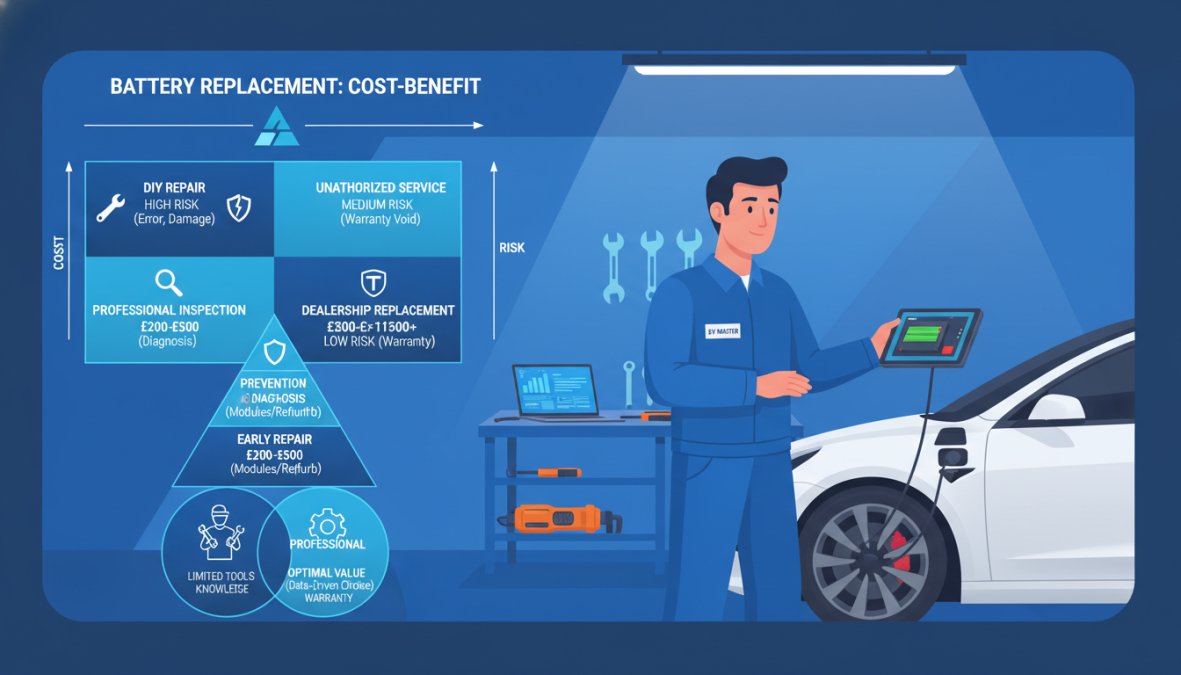
Side-by-side comparison of A Level, Tesla Model for used tesla battery health report
Cost comparison:
Approach
Typical Cost
Time Required
Depth of Diagnosis
Best Used When
DIY (service mode only)
Free
15 minutes
Surface level
Vehicle in warranty, SoH above 88%, clean history
DIY with OBD adapter
Under £30
30-45 minutes
Moderate, cell voltages, fault codes
Warranty vehicle with borderline SoH or any fault codes
Third-party report (Recurrent Auto)
Low cost
Remote, instant
Historical trend only
Pre-visit screening before physical inspection
Professional inspection
Variable, obtain current quote
1-2 hours
Comprehensive, capacity, power fade, thermal, BMS history
Out-of-warranty vehicle, SoH below 85%, unknown history, or any red flags from DIY checks
How to Get a Used Tesla Battery Health Report from KMC Electric in Kettering
For buyers and sellers in Kettering and across Northamptonshire, KMC Electric offers independent battery health verification as a standalone service. This is not a dealer inspection with a commercial interest in the sale; it is an objective technical assessment from a specialist with over 25 years of automotive experience and EV qualifications dating to 2016.
What the KMC Electric battery health assessment covers:
Full BMS diagnostic scan with fault code analysis
Raw capacity reading versus original specification (SoH calculation)
Cell voltage spread and balance assessment
Charging history review and Supercharging frequency analysis
Thermal management system check
Written report suitable for use in purchase negotiations
The service is relevant whether you are buying, selling, or simply want to understand the current condition of a vehicle you already own. For out-of-warranty vehicles in particular, an independent assessment from a specialist near Kettering is a cost-effective alternative to a main dealer visit, with the technical depth to match.
For anyone searching for a Tesla battery health check near me in the Northamptonshire area, KMC Electric provides the kind of independent, technically rigorous assessment that gives you real answers rather than a generic pass/fail.
Conclusion: What Good Battery Health Looks Like and When to Walk Away
A used tesla battery health report is not just a number. Good battery health for a used Tesla purchase means SoH above 85% for a vehicle under five years old, no active BMS fault codes, tight cell voltage spread, no evidence of thermal events, and a charging history consistent with the stated mileage. Below 80% SoH on a vehicle still within warranty is a warranty claim waiting to happen. Below 80% outside warranty is a negotiation lever or a reason to walk away.
The throughline of everything covered here is this: battery health data is available, accessible, and interpretable if you know where to look. The tools exist. The methods are documented. The only barrier is knowing how to combine them into a complete picture.
Buying or selling a used Tesla without independent battery verification is a risk that experienced EV owners simply do not take. KMC Electric provides professional diagnosis and independent battery health verification for Tesla vehicles across Kettering and Northamptonshire, backed by Level 4 Master Technician status in electric vehicles and over 25 years of hands-on automotive experience. Contact KMC Electric to arrange a pre-purchase inspection and get the objective data you need before any money changes hands.
Frequently Asked Questions
How do I check the battery health of a used Tesla?
You can check battery health several ways. On the Tesla display, navigate to the Energy app and review range versus rated range at a full charge. For deeper data, Tesla's Service Mode provides battery management system (BMS) readings including state of health (SoH) and kilowatt-hour capacity. Third-party tools such as Recurrent Auto or OBD-based diagnostic scanners can also produce a used Tesla battery health report. The most reliable method is a professional diagnostic inspection by a qualified EV technician.
Can you get an official battery health report from Tesla?
Tesla does not routinely issue a formal battery health certificate to private buyers. However, Tesla-certified service centres can run a diagnostic scan that produces internal SoH data. Independent specialists with professional diagnostic tools can generate an equivalent used Tesla battery health report, often at lower cost. This independent verification is particularly valuable for out-of-warranty vehicles where a main dealer inspection may not be cost-effective.
What is a good battery health percentage for a used Tesla?
Generally, a state of health (SoH) above 80% is considered acceptable for a used Tesla, and many well-maintained examples retain 85–90% capacity even after several years. Tesla's own battery warranty typically guarantees a minimum of 70% retained capacity over the warranty period, depending on the model. Anything below 75% warrants careful consideration, as battery replacement cost can be significant. Always assess SoH alongside mileage, charging history, and thermal management condition.
How much does a third-party Tesla battery health check cost?
Costs vary depending on the method. Basic app-based tools like Recurrent Auto offer free or low-cost reports using driving data, while OBD-based diagnostic scans typically cost between £50 and £150 depending on the provider. A full professional pre-purchase inspection from an independent EV specialist, which includes a detailed battery health report and vehicle assessment, generally ranges from £100 to £250. This investment is small relative to the potential cost of battery replacement, which can run into thousands of pounds.
Does battery degradation affect Tesla resale value?
Yes, meaningfully. A Tesla with a lower state of health (SoH) and reduced kilowatt-hour capacity will typically command a lower resale price, as reduced range directly impacts the vehicle's usability. Buyers increasingly request a used Tesla battery health report as part of the purchase process. Sellers with documented battery health data, particularly showing SoH above 85%, are in a stronger negotiating position. Significant capacity fade can reduce resale value by several thousand pounds depending on the model.
Does a Tesla battery health check using Service Mode require special equipment?
Accessing Tesla Service Mode itself requires only the vehicle's touchscreen and a specific button sequence or Tesla app access, so no external equipment is strictly needed. However, interpreting the raw BMS data — including voltage imbalance readings, cell chemistry metrics, and accurate kWh capacity figures — requires technical knowledge. For a meaningful Tesla battery degradation test, a professional technician with specialist diagnostic software will extract far more reliable and actionable data than a basic self-check.