Registration Accepted.
Password reset email sent.
Blog >
Common Tesla Model 3 Faults: 10 Issues & How to Fix Them Common Tesla Model 3 Faults: 10 Issues & How to Fix Them
May 13, 2026 by KMC Electric (Content Writer)
Table of Contents
Last Updated: May 13, 2026
The Tesla Model 3 is one of the best-selling electric vehicles on the market, but long-term owners know it comes with a specific set of recurring issues. Common tesla model 3 faults range from cosmetic build quality problems to more serious electrical and mechanical failures that can affect safety and reliability. This guide from KMC Electric covers every major fault category in detail, explaining what causes each problem, how to identify it early, and what your realistic options are for fixing it. Below, we'll show you exactly which faults affect which model years, what to inspect before buying used, and how to protect yourself from expensive surprises.
The throughline here matters: most Tesla Model 3 problems are not random. They cluster around specific systems and specific production years. Understanding that pattern changes how you approach ownership, inspection, and maintenance.
The Most Common Tesla Model 3 Faults Owners Report
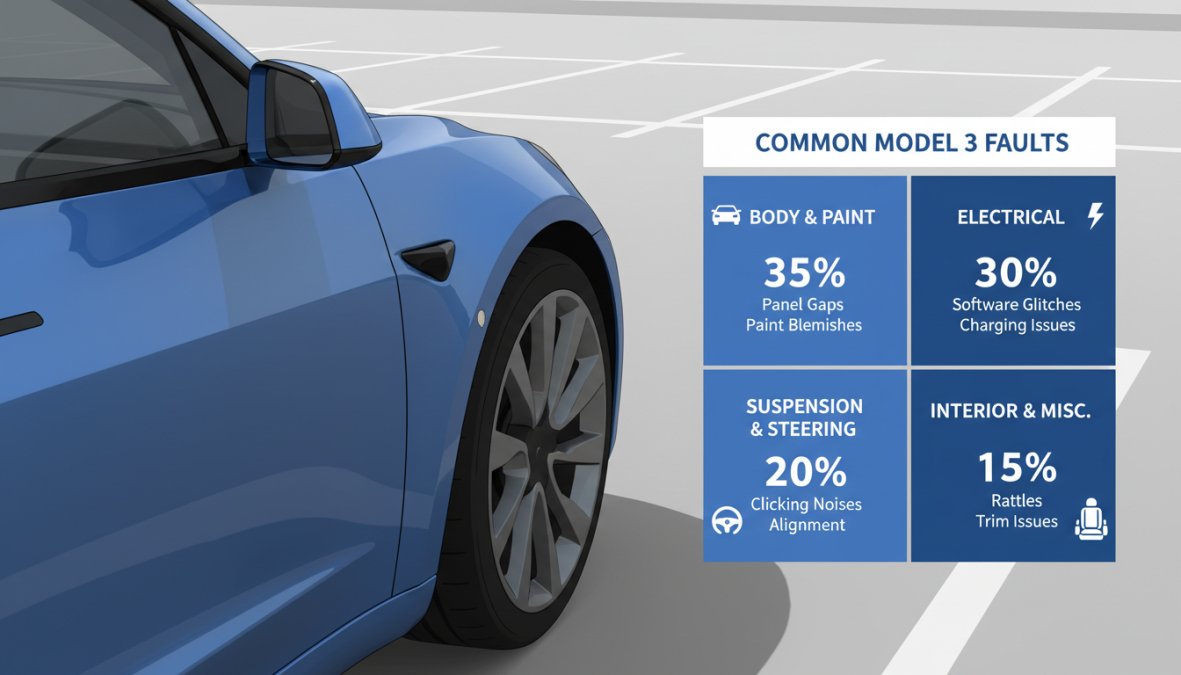
Tesla Model 3 faults are best understood as falling into three categories: build quality issues from the factory, software and electrical faults that emerge over time, and mechanical wear problems that develop with mileage and climate exposure. Knowing which category a fault belongs to tells you immediately whether it is a warranty claim, a software fix, or a hands-on repair job.
1. Panel Gaps and Paint Defects
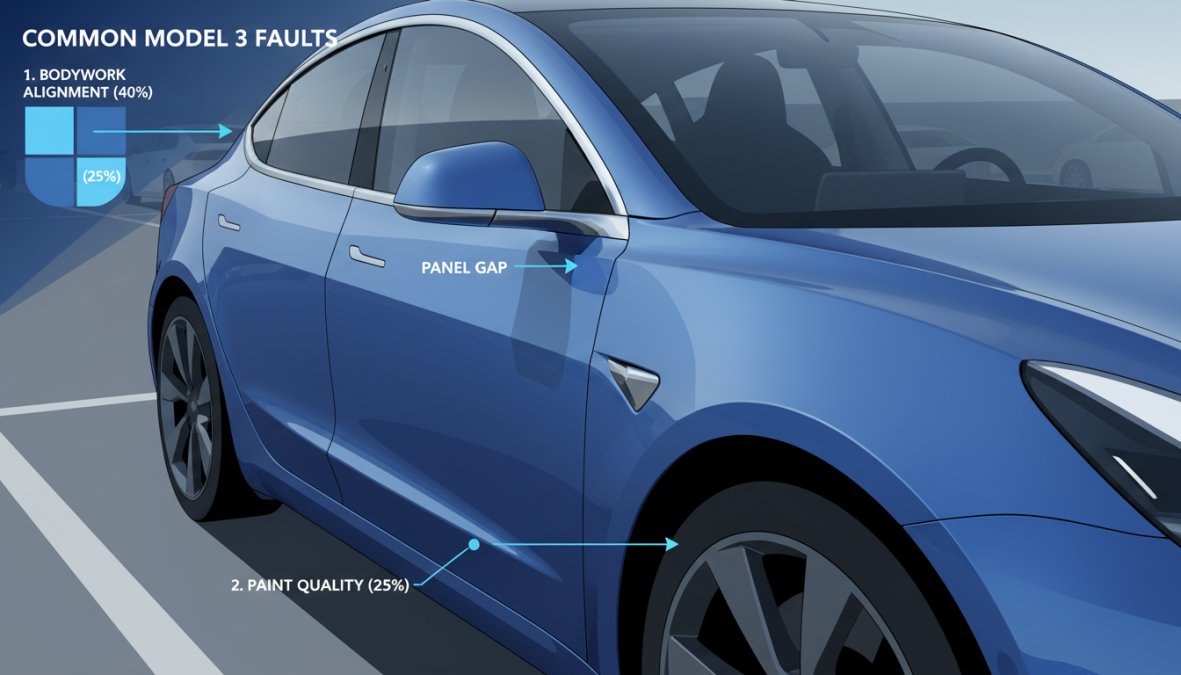
Panel gap inconsistency is the most widely reported build quality complaint across all Model 3 production years. Gaps between the bonnet, doors, boot lid, and body panels frequently exceed tolerances you would expect from a vehicle at this price point. Paint defects, including orange peel texture, thin coverage over edges, and stone chip vulnerability on the lower bumper and rocker panels, are common on pre-2022 builds.
The practical fix: inspect every panel gap at delivery or purchase using a business card as a rough gauge. Gaps should be consistent side to side. For paint protection, a custom-cut polyurethane film on the bonnet leading edge and front bumper is the most cost-effective long-term solution.
2. Wind Noise and Cabin Insulation Issues
Wind noise at motorway speeds is a persistent complaint, particularly around the A-pillar and door seals. The root cause is a combination of thin factory weather stripping and door alignment tolerances. Aftermarket rubber weather seal kits designed specifically for the Model 3 can reduce this noticeably without any permanent modification.
3. Charge Port Door Failures
The charge port door on the Model 3 is electrically actuated and fails more often than it should. Common symptoms include the door not opening on command, failing to latch after charging, or freezing shut in cold weather. A firmware update sometimes resolves the issue. If not, the actuator mechanism itself needs replacement.
Watch Out - Do not force a frozen charge port door open manually. Forcing it can shear the actuator linkage, turning a minor fault into a more expensive repair. Use the Tesla app or a gentle warm water pour instead.
4. Software Bugs, Firmware Glitches, and Autopilot Errors
Over-the-air updates are one of the Model 3's genuine advantages, but they also introduce new bugs. Owners regularly report touchscreen freezes, phantom Autopilot braking, incorrect range estimates after a firmware update, and Autopilot calibration errors following a windscreen replacement. Most software bugs resolve themselves within one or two update cycles. Persistent Autopilot faults require a service center diagnostic.
5. Brake Caliper Seizure and Fastener Corrosion
Rear brake calipers on the Model 3 are prone to seizing, particularly on vehicles driven primarily on short urban trips where the regenerative braking system rarely engages the friction brakes at all. Fastener corrosion around the caliper mounting points is a secondary issue in regions with road salt. Regular manual brake application and annual caliper inspection are the best preventive measures.
6. Steering Column and Portable Connector Faults
Steering column clunks and creaks under low-speed manoeuvring affect a subset of owners, particularly on early production cars. The portable charging connector is also a known weak point, with the thermal fuse inside failing after repeated use at high charge rates. Replacing the connector is straightforward and relatively inexpensive.
Tesla Model 3 Suspension Problems: Causes and Solutions
Suspension issues on the Model 3 are more common than the brand's marketing would suggest. The standard suspension setup uses aluminium control arms that are lightweight but susceptible to damage from potholes and kerb strikes, especially on the 19-inch and 20-inch wheel variants.
Identifying Suspension Arm and Clunking Noise Issues
A clunking or knocking noise from the front suspension under low-speed steering input or over speed bumps is the clearest sign of a worn ball joint or damaged lower control arm. Uneven tyre wear is the secondary indicator. According to NHTSA vehicle complaints database, suspension-related complaints are among the most frequently filed for the Model 3 in the United States, which reflects a genuine pattern rather than isolated incidents.
Diagnosis steps:
Drive slowly over a speed bump and listen for the location of the knock
With the car stationary, rock the steering wheel gently from lock to lock
Have a second person observe the front suspension components while you repeat step 2
Check for uneven tyre wear across the front axle
DIY vs. Service Centre: Cost and Risk Comparison
This is where the honest advice gets uncomfortable for some owners. Control arm replacement on the Model 3 requires proper wheel alignment immediately after the repair. Without alignment, tyre wear accelerates rapidly and handling becomes unpredictable.
Repair Route - Typical Cost - Alignment Included - Risk Level
Tesla Service Centre - Higher - Yes - Low
Independent EV Specialist - Moderate - Usually yes - Low
DIY without alignment - Parts only - No - High
General garage unfamiliar with EVs - Variable - Sometimes - Medium-High
The verdict: for suspension work, an independent specialist with EV-specific experience is the best balance of cost and safety. A general garage that rarely works on Teslas may not understand the specific torque specifications or the interaction between the suspension geometry and the Autopilot calibration.
Tesla Model 3 Battery Degradation: What to Expect Over Time
Tesla Model 3 battery degradation is the long-term ownership question that matters most for resale value and day-to-day usability. Battery degradation is the gradual reduction in a battery pack's maximum capacity compared to its original specification, measured as a percentage of the original range.
The good news: the Model 3's lithium-ion chemistry degrades more slowly than many early EVs. Many owners report retaining above 90% capacity after several years of regular use. The bad news: degradation is not uniform and depends heavily on how the battery is used and where the car is driven.
How Regional Climate Affects High-Voltage System Health
The high-voltage battery system in the Model 3 is most stressed by two conditions: sustained operation in extreme heat above 35°C and repeated fast charging in very cold temperatures below -10°C. Owners in warmer regions who rely heavily on DC rapid charging experience faster capacity loss than those in temperate climates who primarily charge at home overnight on AC.
The Northamptonshire climate is actually relatively favourable for battery longevity. Cold winters slow fast-charging efficiency temporarily, but the moderate summer temperatures reduce thermal stress on the battery pack compared to Mediterranean or Middle Eastern climates.
How to Monitor and Slow Battery Degradation
Monitoring tools like a Bluetooth OBD adapter paired with a Tesla-specific diagnostic app give owners access to real battery health data that the standard Tesla interface does not display by default. This is the single most useful thing any Model 3 owner can do to track long-term health.
Practical steps to slow degradation:
Charge to 80% for daily use, reserving 100% charges for long journeys
Avoid leaving the battery below 10% for extended periods
Pre-condition the battery before DC rapid charging sessions in cold weather
Avoid parking in direct sun for extended periods in summer
Pro Tip - Set your Tesla's daily charge limit to 80% in the vehicle settings and leave it there permanently. Most owners never need more than 80% for daily driving, and this single habit has a measurable long-term impact on battery health.
Year-Over-Year Build Quality: Which Model 3 Years to Avoid
Build quality improved meaningfully after Tesla's 2020 production changes and again following the 2021 refresh. The 2017 and 2018 production cars have the highest concentration of panel gap complaints, charge port door failures, and early suspension issues. The 2019 model year saw improvements to the interior fit and finish but retained some of the early electrical gremlins.
The 2021 Highland refresh brought revised interior materials, improved weather sealing, and better paint quality control. Post-2022 cars show a noticeably lower rate of build quality complaints across owner forums and independent reliability surveys. As documented in What Car reliability survey data, newer production years consistently score better than 2017-2019 builds on owner-reported fault rates.
If buying used, the sweet spot for value versus reliability is a 2021 or 2022 car with full service history and a pre-purchase inspection from a specialist.
Used Tesla Model 3 Inspection Checklist Before You Buy
Buying a used Tesla Model 3 without a proper inspection is a genuine financial risk. The absence of a traditional service history and the complexity of the high-voltage system mean that standard used car checks are not sufficient.
Pre-purchase inspection checklist:
Check all panel gaps with consistent measurement side to side
Inspect paint for orange peel, chips, and colour mismatch at panel joins
Test the charge port door through three open/close cycles
Connect to the vehicle via a diagnostic tool to read active fault codes
Request a battery health report showing current capacity versus original specification
Test Autopilot on a stretch of road with clear lane markings
Listen for suspension clunks over a speed bump at low speed
Check all four brake calipers for corrosion and free movement
Verify all over-the-air updates are current on the firmware version
Inspect the portable connector for heat damage or pin corrosion
Key Takeaway - A pre-purchase battery health check is non-negotiable on any used Model 3. A battery retaining only 78% of its original capacity significantly affects real-world range and resale value, and this information is not visible from a standard test drive.
The used EV buying market in Kettering and across Northamptonshire has grown rapidly. More buyers are purchasing Model 3s privately without any independent verification of battery health or fault history. That is a mistake that an independent specialist inspection can prevent for a fraction of the potential repair cost.
Tesla Model 3 Warranty Coverage and What It Leaves Out
Tesla's standard warranty covers the vehicle body for four years or 50,000 miles and the battery and drive unit for eight years or 100,000 to 150,000 miles depending on the variant. The battery warranty guarantees a minimum of 70% capacity retention over that period.
What the warranty does not cover is equally important:
Wear items: brake pads, tyres, wiper blades, and cabin air filters
Paint and cosmetic damage not attributed to a manufacturing defect
Suspension damage caused by road hazards or kerb strikes
Charging equipment and portable connectors after the first year
Software issues that Tesla classifies as "expected behaviour"
The practical implication is that many common tesla model 3 faults fall into grey areas. Panel gaps may be accepted as within tolerance. Brake caliper corrosion on a three-year-old car may be declined as a wear item. Owners who understand these boundaries before their warranty expires are in a much stronger position to get legitimate claims accepted.
According to UK Consumer Rights Act guidance on vehicle warranty claims, vehicles must be of satisfactory quality at the point of sale, which provides additional protection beyond the manufacturer's warranty for faults that emerge early in ownership.
For out-of-warranty vehicles, the cost gap between a Tesla service centre and a qualified independent specialist can be significant. This is where having access to a specialist who understands Tesla systems without the main dealer pricing structure makes a real difference.
How KMC Electric in Kettering Diagnoses and Fixes Common Tesla Model 3 Faults
KMC Electric is an independent EV specialist based in Kettering, Northamptonshire, with Level 4 Master Technician status in electric vehicles and EV qualifications dating back to 2016. That depth of experience matters specifically for Tesla diagnostics because the systems involved, from the high-voltage battery management to the Autopilot calibration and firmware fault codes, require specialist knowledge that most general garages simply do not have.
The diagnostic process at KMC Electric starts with a full vehicle health assessment using professional-grade diagnostic tools that access the same fault code data as Tesla's own Toolbox software. This means fault codes are read accurately, not guessed at. For battery health specifically, KMC Electric provides independent battery health verification reports, which are particularly valuable for owners approaching the end of their warranty period or buyers considering a used purchase.
For owners in Kettering and the wider Northamptonshire area searching for Tesla repair near me, KMC Electric offers a cost-effective alternative to main dealer pricing for out-of-warranty repairs. Suspension arm replacement, brake caliper servicing, charge port door repair, and pre-purchase inspections are all handled with the same technical rigour as a manufacturer service centre, without the manufacturer's labour rates.
The team also stocks Tesla-specific parts directly, including drive train oil for drivetrain servicing and the Tesla Model 3 and Model Y Hand Brake Motor for electric parking brake failures, reducing lead times on common repairs.
What most guides on common tesla model 3 faults miss is that the difference between a manageable fault and an expensive one is almost always timing. Catching a seizing brake caliper before it damages the disc, or identifying a battery degradation trend before the warranty expires, changes the financial outcome significantly. That is the practical value of a specialist inspection, not just at purchase but as a regular part of long-term ownership.
As noted in Electric Vehicle Association guidance on EV maintenance best practices, independent specialist garages with manufacturer-level diagnostic capability are increasingly recognised as a viable and cost-effective alternative to main dealer networks for out-of-warranty EV care.
Owning a Tesla Model 3 long-term means knowing which faults to watch for, when to act, and who to trust with the diagnosis. For owners and buyers in Kettering and across Northamptonshire, KMC Electric provides independent specialist diagnosis, battery health verification, and practical repairs backed by over 25 years of automotive experience and Level 4 Master Technician status in EVs. Get in touch with KMC Electric to book a pre-purchase inspection or vehicle health assessment before a minor fault becomes a costly one.
Frequently Asked Questions
What are the most common problems with the Tesla Model 3?
The most frequently reported common Tesla Model 3 faults include panel gaps and paint defects, wind noise from poor cabin insulation, charge port door failures, brake caliper seizure due to fastener corrosion, and software bugs affecting Autopilot or firmware. Suspension arm wear and steering column issues also appear regularly, particularly on earlier build-year cars. Most faults are manageable with timely diagnosis and the right specialist support.
Is the Tesla Model 3 reliable for long-term ownership?
The Tesla Model 3 is generally considered reliable for long-term ownership, particularly when over-the-air updates are applied promptly and the high-voltage system is well maintained. Battery degradation is gradual and manageable. Build quality improved noticeably from 2021 onwards. Owners who stay on top of maintenance, use independent diagnostic tools, and address fault codes early tend to experience far fewer costly repairs over time.
What should I check on a used Tesla Model 3 inspection checklist?
A thorough used Tesla Model 3 inspection checklist should cover: battery degradation and state of health, panel gaps and paint defects, suspension arm condition, brake caliper and fastener corrosion, charge port door operation, wind noise sealing, and any open recalls. Request a full diagnostic report showing fault codes and firmware history. An independent battery health verification from a specialist like KMC Electric provides an objective assessment before purchase.
Does Tesla Model 3 warranty coverage protect against these faults?
Tesla Model 3 warranty coverage includes a 4-year or 50,000-mile basic vehicle warranty and an 8-year battery and drivetrain warranty, though terms vary by variant. Build quality issues like panel gaps or wind noise are typically covered if reported early. Software bugs resolved by over-the-air updates are not chargeable. Out-of-warranty owners benefit from using an independent specialist, as service centre labour rates can be significantly higher for common repairs.
Which Tesla Model 3 years have the worst reliability?
Early production years, broadly 2017 to 2019, are most associated with quality control inconsistencies, including panel gaps, paint defects, and suspension arm issues. From 2021 onwards, Tesla made measurable improvements to build quality and cabin insulation. That said, no model year is entirely fault-free. A pre-purchase inspection with independent diagnostics remains the most reliable way to assess any specific vehicle regardless of its build year.