Tesla out of warranty repair costs are one of the most searched topics among EV owners, and for good reason: once your factory coverage expires, the financial landscape changes dramatically. This guide from KMC Electric, an independent Tesla specialist based in Kettering, Northamptonshire, breaks down exactly what you can expect to pay, which components fail most often, and how to keep costs under control without compromising on quality.
Here is what most guides get wrong: they treat Tesla ownership like traditional petrol car ownership. The reality is that EV maintenance costs are lower on average, but when something does go wrong, the repair bills can be significantly higher than anything you have experienced with a combustion engine vehicle. Below, we cover the most common failure points, real cost comparisons between Tesla service centres and independent mechanics, and practical strategies for reducing your out-of-warranty exposure.
What Tesla Out of Warranty Repair Costs Actually Look Like
Tesla out of warranty repair costs follow a pattern that catches many owners off guard. Routine maintenance is genuinely cheap. Then, without warning, a single component failure arrives with a bill that dwarfs anything you budgeted for.
Tesla's factory warranty structure is the starting point for understanding your exposure. The basic vehicle limited warranty covers four years or 50,000 miles. The battery and drive unit warranty extends to eight years, with mileage caps varying by model. Once these expire, every repair comes out of your pocket.
Annual Maintenance Cost Estimates by Model
Annual maintenance costs for out-of-warranty Teslas vary considerably by model, age, and usage pattern. Routine items, such as cabin air filter replacement, brake fluid checks, tyre rotation, and wiper blade replacement, tend to be predictable and modest. The unpredictable element is component failure.
Model
Typical Annual Routine Costs
Key Risk Components
Model 3
Low-moderate
12V battery, suspension bushings
Model Y
Low-moderate
Control arms, door handles
Model S
Moderate-high
Media centre, PCS, air suspension
Model X
High
Falcon wing door mechanisms, suspension
Model S and Model X owners generally face the highest annual spend once out of warranty. Both vehicles carry more complex suspension systems, more electronics, and parts that are harder to source independently. Model 3 and Model Y owners typically see lower routine costs, though they are not immune to spiky, unexpected bills.
According to Which? Electric Car Running Costs Analysis, EV owners spend considerably less on routine servicing than petrol or diesel drivers, but that gap narrows sharply when major components require attention.
Why Tesla Repair Bills Can Be Spiky and Unpredictable
The core issue is that Tesla vehicles concentrate expensive technology into relatively few components. A traditional combustion car might develop a hundred small faults over its life, each with a modest repair bill. A Tesla, by contrast, can run almost perfectly for years, then present a single repair that runs into thousands.
The high-voltage battery is the most obvious example. But it is far from the only one. The Power Conversion System (PCS), the media centre computer, and the suspension control arms on certain models all have the potential to generate bills that feel disproportionate to the age of the vehicle.
The other factor is parts availability. Tesla controls its own supply chain, which means OEM parts sourced through the Tesla service app or a Tesla service centre carry a premium. Independent garages with access to quality aftermarket parts can often reduce this cost substantially.
Most Common Out-of-Warranty Repairs and What They Cost
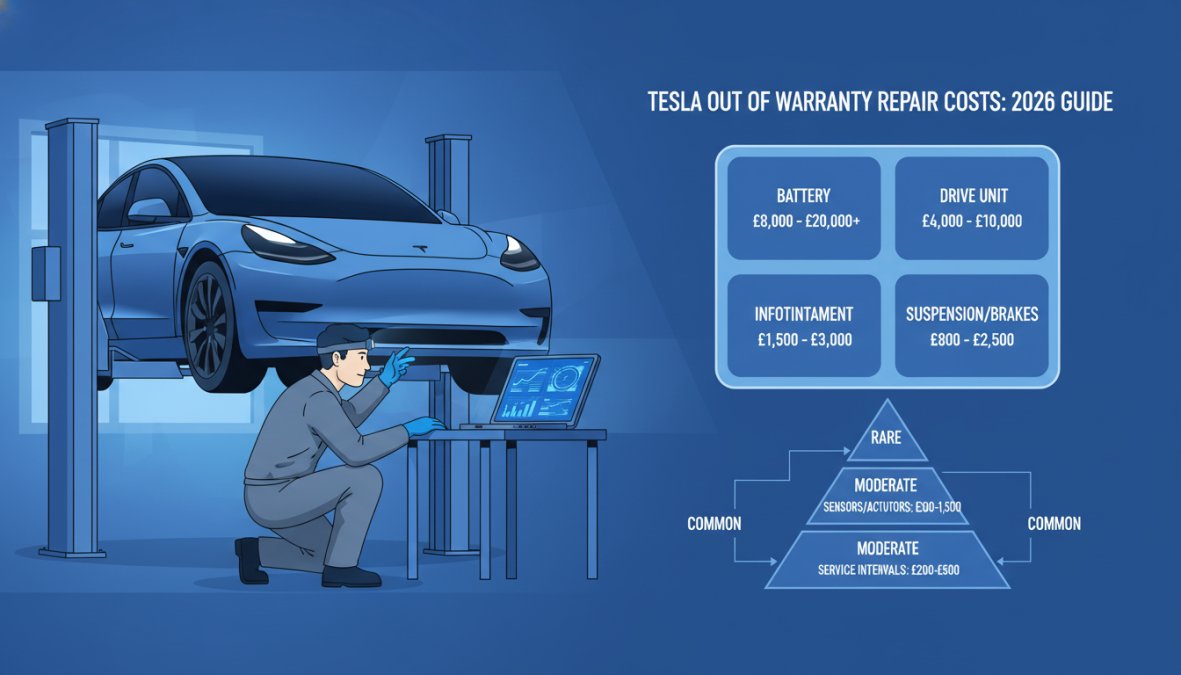
Understanding the most common out-of-warranty repairs is where practical planning begins. The components below represent the highest-frequency, highest-cost items that Tesla owners encounter once factory coverage expires. Unlike most guides that describe these failures in general terms, the ranges below reflect real-world independent specialist pricing in the UK market, broken out by parts and labour so you can see where the money actually goes.
Professional illustration showing tesla out of warranty repair costs
12V Battery Replacement
The 12V battery is the single most common out-of-warranty repair across all Tesla models. Unlike the main high-voltage battery, the 12V system powers ancillary electronics, door handles, the main computer boot sequence, and safety systems, and it degrades on a broadly similar timeline to a conventional car battery, typically between three and five years.
Typical UK cost range:
Parts (OEM or quality equivalent): £80-£180 depending on model
Labour at Tesla Service Centre: £100-£200 (plus any software reconfiguration time)
Labour at qualified independent specialist: £60-£120
Total independent specialist range: £140-£300
The job itself is mechanically straightforward, but Tesla's software integration means that on Model 3 and Model Y in particular, the vehicle requires a reconfiguration step after replacement to correctly recognise the new battery. A general garage without Tesla diagnostic access may fit the battery correctly but skip this step, leading to persistent warning messages or incorrect state-of-charge readings.
A common mistake is ignoring early warning signs: sluggish door handles, delayed screen boot times, or unexpected power warnings. These often point to a failing 12V battery before it causes a complete shutdown.
Pro TipIf your Tesla is approaching four years old, have the 12V battery tested proactively during your next service visit. Catching a failing 12V battery early prevents the more disruptive scenario of a vehicle that will not power on, and avoids the roadside recovery call that often accompanies a sudden failure.
Suspension and Control Arm Repairs
Suspension and control arm repairs represent one of the most significant tesla out of warranty repair costs for Model S and Model X owners, though Model 3 and Model Y are not exempt. Tesla's vehicles are heavier than equivalent combustion cars due to the battery pack, the Model 3 Long Range weighs approximately 1,800 kg compared to around 1,400 kg for a comparable BMW 3 Series, and that additional mass accelerates wear on suspension components, particularly lower control arm bushings and ball joints.
Typical UK cost range:
Control arm replacement (single, Model 3/Y): £200-£450 including alignment
Control arm replacement (single, Model S/X): £350-£700 including alignment
Air suspension strut replacement (Model S/X, per corner): £600-£1,200
Four-wheel alignment following suspension work: £80-£150
The alignment check is non-negotiable after any suspension work. The weight distribution on EVs makes precise alignment particularly important for tyre wear, and a misaligned Tesla will consume tyres at a rate that quickly outweighs any saving made on the suspension repair itself.
The real difference between a costly repair and a manageable one often comes down to catching wear early. A vehicle health assessment from an independent specialist can identify suspension wear, typically audible as a knock or clunk over uneven surfaces, before it progresses to a full control arm replacement.
Infotainment and Media Center Computer Failures
Infotainment and media centre computer failures are a known issue, particularly on Model S vehicles produced between 2012 and 2018. The root cause is well-documented: the eMMC (embedded MultiMediaCard) flash storage chip in the MCU1 (Media Control Unit version 1) has a finite number of write cycles. Tesla's software logs vehicle data continuously to this chip, and in high-mileage or older vehicles, the chip reaches its write limit and begins to fail.
Symptoms progress in a recognisable sequence: slow touchscreen response, failed backup camera display, loss of navigation, and eventually a completely unresponsive centre console. Tesla addressed this proactively under a NHTSA-driven recall for vehicles within warranty, but out-of-warranty owners face the full cost of replacement.
Typical UK cost range:
Tesla Service Centre MCU replacement (new unit): £1,500-£2,500 depending on specification
Independent specialist with quality refurbished MCU: £600-£1,200
eMMC chip-level repair (specialist only, not all cases suitable): £250-£500
The chip-level repair option is worth understanding. Some independent EV specialists with electronics capability can replace the eMMC chip itself rather than the entire media centre unit, which reduces cost substantially. Not every case is suitable, if the broader MCU board has secondary damage, a full unit replacement is the correct approach, but it is a question worth asking any specialist you consult.
Power Conversion System (PCS) and High-Voltage Battery Issues
The Power Conversion System (PCS) manages the conversion between AC and DC power during charging. PCS failures are less common than the items above, but when they occur, they are among the most expensive tesla out of warranty repair costs an owner will encounter.
Typical UK cost range:
PCS replacement (Model S/X): £1,800-£3,500
PCS replacement (Model 3/Y): £1,200-£2,500
High-voltage battery replacement (full pack, all models): £8,000-£20,000+ depending on model and capacity
Independent battery health assessment: £100-£250
High-voltage battery degradation is a separate concern from outright failure. Most Tesla batteries retain strong capacity well beyond 100,000 miles, Tesla's own data and independent fleet studies consistently show average degradation of around 10-15% at 150,000 miles, but cells do degrade over time, reducing usable range. A full high-voltage battery replacement is a significant investment that most owners will never need. The better approach, for the vast majority of owners, is an independent battery health assessment to understand actual degradation before making any decisions.
Watch OutNever ignore a persistent charging error or a sudden range drop of more than 10-15% that is not explained by cold weather or a change in driving pattern. These can indicate PCS or high-voltage battery issues that worsen if left undiagnosed, potentially turning a manageable repair into a full battery replacement.
Summary Cost Table: Common Out-of-Warranty Repairs
Repair
Tesla Service Centre (est.)
Independent Specialist (est.)
Potential Saving
12V Battery Replacement
£200-£380
£140-£300
£60-£150
Control Arm (Model 3/Y, single)
£350-£600
£200-£450
£100-£200
Control Arm (Model S/X, single)
£600-£1,000
£350-£700
£200-£400
Air Suspension Strut (per corner)
£1,000-£1,800
£600-£1,200
£400-£700
Media Centre (MCU replacement)
£1,500-£2,500
£600-£1,200
£700-£1,500
PCS Replacement
£2,000-£4,000
£1,200-£3,500
£500-£1,000
Brake Fluid Service
£100-£180
£70-£130
£30-£80
Ranges reflect UK market pricing. Labour rates vary by region, see the regional cost variance section below. All figures are estimates; obtain a written quote before authorising any repair.
Tesla Common Repairs After 100k Miles: What to Expect
Tesla common repairs after 100k miles shift in character compared to earlier ownership. The drivetrain and high-voltage battery typically remain in reasonable condition, but wear items accumulate.
Expect to address some or all of the following beyond 100,000 miles:
Brake fluid replacement: Often overdue by this point, as Tesla's regenerative braking reduces pad wear but does not eliminate the need for fluid maintenance
Cabin air filter: Should be replaced every two years regardless of mileage; many owners discover it has never been changed at this point
Tyre wear: Heavier than average due to vehicle weight and instant torque; budget for more frequent replacements than a comparable combustion vehicle
Door handle mechanisms: Particularly on Model S, the retractable handle system is a known wear point
Coolant system inspection: The thermal management system for the battery requires periodic checks on higher-mileage vehicles
The good news is that the absence of a traditional engine, gearbox, and exhaust system eliminates many of the expensive repairs that plague high-mileage combustion vehicles. The EV maintenance schedule for a 100,000-mile Tesla is genuinely lighter than for a petrol equivalent, provided the electrical systems remain healthy.
Tesla Extended Warranty Cost: Is It Worth It?
Tesla extended warranty cost is a legitimate consideration for any owner approaching the end of their factory coverage. Tesla offers an extended service plan for some models, though availability and pricing vary by model year and market, and the terms are worth reading carefully before committing. This section goes further than most guides: it breaks down how to evaluate Tesla's own offering against third-party vehicle service contracts (VSCs), and gives you a framework for deciding whether any extended coverage makes financial sense for your specific situation.
Tesla's Own Extended Coverage: What It Actually Offers
Tesla's extended warranty (where available) extends the basic vehicle limited warranty beyond the standard four-year or 50,000-mile term. Coverage typically mirrors the original factory warranty in scope, powertrain, electrical systems, and body components, but the specific terms, pricing, and model eligibility change periodically and must be confirmed directly with Tesla at the time of purchase.
Key limitations to understand before purchasing Tesla's own extended coverage:
It must generally be purchased before the original warranty expires. Once your factory coverage lapses, Tesla's own extended option is typically no longer available, which creates a hard deadline that catches many owners off guard.
It does not cover wear items. Tyres, brake pads, wiper blades, and cabin filters are excluded regardless of the plan tier.
Labour rates for covered repairs are still performed at Tesla Service Centre pricing. This matters because it affects how quickly the policy pays for itself relative to an independent specialist alternative.
For Model S and Model X owners, where repair costs tend to be higher and component failure more likely, Tesla's own extended coverage often makes financial sense if purchased proactively. For Model 3 and Model Y owners with lower mileage and a good maintenance history, the calculation is less clear-cut.
Third-Party EV Warranty and Vehicle Service Contracts: A Comparative Framework
Third-party vehicle service contracts (VSCs), commonly marketed as extended warranties, represent a genuine alternative to Tesla's own coverage, and this is the option most guides fail to analyse in any useful depth. The market for EV-specific VSCs has grown significantly as the EV parc has aged, but product quality varies enormously.
In the UK, VSCs sold by third parties are regulated as financial products under the Financial Conduct Authority framework, which provides some consumer protection but does not guarantee the quality or breadth of coverage. As documented in Association of British Insurers guidance on extended warranties, regulated status means the provider must handle claims fairly and maintain adequate reserves, it does not mean every claim will be approved without dispute.
What separates a strong VSC from a weak one:
Feature
Strong VSC
Weak VSC
High-voltage battery coverage
Included (with defined degradation threshold)
Excluded or heavily caveated
PCS and charging system
Included
Often excluded as 'electrical'
Approved repair network
Includes qualified independents
Main dealer or approved network only
Diagnostic fee coverage
Included
Excluded, owner pays to identify the fault
Consequential damage
Covered if caused by a covered component
Excluded
Claims process
Direct insurer payment to garage
Reimbursement model (owner pays first)
Excess per claim
Fixed, disclosed upfront
Variable or percentage-based
The reimbursement model versus direct payment distinction is particularly important. A VSC that requires you to pay the repair bill and then claim reimbursement creates a cash flow problem when the repair in question runs to several thousand pounds.
Key questions to ask any third-party warranty provider before purchasing:
Does the policy explicitly cover the high-voltage battery, and if so, what degradation threshold triggers a claim?
Are there mileage or age restrictions that limit or exclude coverage for your vehicle?
Is the policy valid at independent specialist garages with EV qualifications, or only at approved networks?
What is the claims process, does the provider pay the garage directly, or do you pay and claim back?
Is there an excess charge per claim, and is it fixed or variable?
Does the policy cover diagnostic fees, or only the repair itself once a fault is confirmed?
What is the financial strength rating of the underwriter behind the policy?
The Self-Insurance Alternative: When It Makes More Sense
For owners who find VSC premiums high relative to their vehicle's risk profile, a structured self-insurance approach is worth considering. This means setting aside a fixed monthly amount into a dedicated account to cover future repair costs, rather than paying a third party to manage that risk.
The self-insurance approach works best when:
The vehicle is a Model 3 or Model Y with under 80,000 miles and a documented maintenance history
The owner has the financial resilience to absorb a single large repair bill without the fund fully covering it
VSC premiums quoted are high relative to the vehicle's actual repair risk profile
It works least well for:
Model S or Model X owners, where the probability and cost of a significant repair is materially higher
Owners who would face genuine financial hardship from a single £2,000-£4,000 repair bill
Vehicles with unknown or incomplete service histories
The Pre-Warranty-Expiry Inspection: The Step Most Owners Skip
What most guides miss entirely is the importance of a pre-warranty-expiry inspection. Having an independent specialist assess the vehicle before factory coverage ends gives you two things: the opportunity to identify and claim any existing faults under the remaining warranty, and an accurate, documented picture of the vehicle's condition to inform your extended coverage decision.
A pre-expiry inspection from a qualified independent Tesla specialist typically costs £100-£250 and should include a battery health assessment, suspension check, brake fluid condition test, and a review of any stored fault codes. The value of identifying a single warranty-claimable fault, a developing suspension issue, an early-stage MCU fault, or a charging system anomaly, can easily exceed the cost of the inspection many times over.
Pro TipBook your pre-warranty-expiry inspection at least two to three months before your factory warranty end date. This gives you time to book a Tesla Service Centre appointment for any faults identified, which can have lead times of several weeks in busy periods.
Key TakeawayThe honest assessment: third-party EV VSCs are worth pursuing for older, higher-mileage vehicles, particularly Model S and Model X, where the statistical probability of a major repair is elevated. For newer Model 3 and Model Y vehicles with strong maintenance histories, a self-insurance fund combined with a pre-expiry inspection is often the more cost-effective approach. In either case, the pre-expiry inspection is the step that pays for itself regardless of which coverage route you choose.
Tesla Service Center vs Independent Mechanic: Cost Comparison
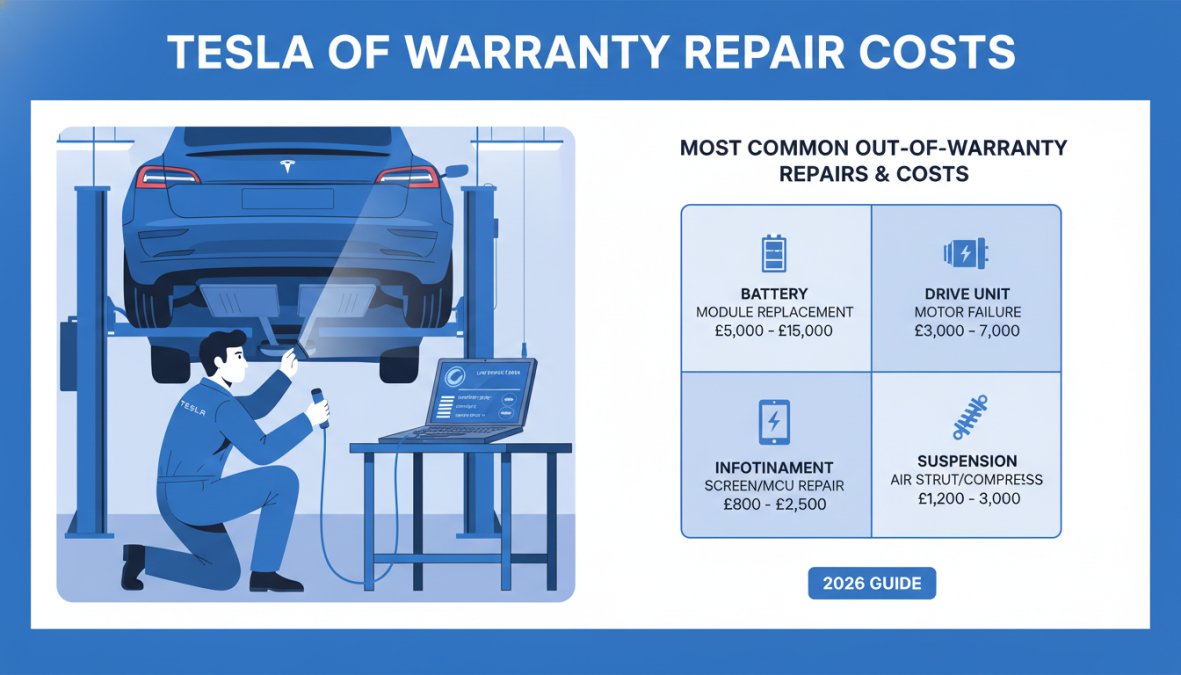
The choice between a Tesla service centre and an independent mechanic is where tesla out of warranty repair costs can diverge most significantly. Tesla service centres carry official OEM parts and factory-trained technicians, but their labour rates reflect that positioning.
Professional illustration showing tesla out of warranty repair costs
Independent specialists with genuine EV qualifications and Tesla-specific diagnostic capability can access the same technical data, perform the same repairs, and often source quality parts at lower cost. The labour rate differential between a Tesla service centre and a qualified independent garage in the Kettering and Northamptonshire area can be substantial.
Repair Type
Tesla Service Centre
Independent Specialist
Potential Saving
12V Battery Replacement
Higher
Lower
Moderate
Suspension Control Arm
Higher
Lower
Significant
Media Centre Replacement
Higher
Lower (refurb option)
Significant
Diagnostic Fee
Standard rate
Often lower
Moderate
Brake Fluid Service
Standard rate
Lower
Modest
The critical caveat: not all independent garages are equal. An independent mechanic without EV-specific training and Tesla diagnostic access is not a safe alternative. The savings only materialise when the independent specialist has the right qualifications.
How to Vet an Independent Tesla Repair Specialist
Finding a trustworthy independent Tesla repair specialist near me is the practical challenge most owners face. The following criteria separate genuine specialists from general mechanics who will attempt Tesla work without the right foundation:
EV-specific qualifications: Look for Level 4 Master Technician status in electric vehicles, or equivalent recognised EV training. This is not a standard MOT garage qualification.
Tesla diagnostic capability: The specialist should have access to Tesla-compatible diagnostic tools, not just generic OBD readers.
Experience with your specific model: Model S air suspension and Model X door mechanisms require hands-on familiarity, not just general EV knowledge.
Transparent parts sourcing: Ask whether they use OEM, quality aftermarket, or refurbished parts, and what the warranty terms are on fitted components.
Battery health assessment capability: Any serious Tesla specialist should be able to provide an independent battery health report.
KMC Electric, based in Kettering, holds Level 4 Master Technician status in electric vehicles and has held EV qualifications since 2016, backed by over 25 years of automotive industry experience. That depth of background is what separates a genuine specialist from a garage that has serviced one or two EVs.
Regional Cost Variance: What You Pay Depends on Where You Are
Tesla out of warranty repair costs vary meaningfully by region. Labour rates in London and the South East are typically higher than in the Midlands, which directly affects the total bill for any given repair.
For owners in Northamptonshire and the surrounding Midlands area, this regional dynamic works in their favour. Independent specialists in Kettering and nearby towns operate at lower overhead than city-centre garages, without any reduction in technical capability. The parts cost is the same wherever you go; it is the labour component where geography creates a real difference.
Owners travelling from further afield for specialist EV work are not unusual. A significant saving on a major repair can easily justify the additional distance.
DIY vs Professional Repairs: What Tesla Owners Can Realistically Do
The DIY vs professional repair question deserves an honest answer rather than a blanket recommendation either way.
Some tasks are genuinely accessible to a competent DIY owner:
Cabin air filter replacement
Wiper blade replacement
Tyre inflation and basic tyre maintenance
Cleaning and protecting exterior components
Tasks that require professional handling:
Anything involving the high-voltage battery or PCS
Suspension component replacement (alignment is required after)
12V battery replacement on models requiring software reconfiguration
Media centre replacement
Any work requiring Tesla diagnostic software access
The high-voltage system in any Tesla operates at voltages that are immediately life-threatening. This is not a risk to take for the sake of saving a labour charge. The line between DIY-accessible and professionally-required work is clearly drawn by the presence of high voltage.
Key TakeawayDIY maintenance on Teslas is viable for consumable items and cosmetic work. Any repair that involves the high-voltage system, suspension geometry, or Tesla software integration should go to a qualified specialist. The cost of getting it wrong far exceeds the cost of professional labour.
Factors That Affect Your Tesla Out of Warranty Repair Costs
Several variables determine where your specific repair bill lands, and understanding them helps with planning.
Model and age: Older Model S and Model X vehicles carry higher repair risk due to component complexity and parts availability. Newer Model 3 and Model Y vehicles are generally cheaper to maintain out of warranty.
Mileage and usage pattern: High-mileage vehicles accumulate wear on suspension components and thermal management systems faster than low-mileage equivalents. Frequent DC fast charging also accelerates battery degradation compared to regular AC home charging.
Maintenance history: A vehicle with a documented preventative maintenance schedule, including regular brake fluid changes, filter replacements, and alignment checks, is less likely to present with compounded failures.
Parts sourcing: OEM parts from Tesla carry a premium. Quality aftermarket parts, where available, can reduce component costs significantly without compromising on reliability. A specialist who knows which aftermarket parts are appropriate for Tesla systems adds real value here.
Diagnostic fees: Tesla service centres charge for diagnostic time, and so do independent garages. The difference is that a specialist who knows Tesla systems well typically reaches a diagnosis faster, which reduces the billable diagnostic time.
Location: As covered above, regional labour rates create meaningful cost differences for the same repair.
For owners in the Kettering and Northamptonshire area, having access to a local independent Tesla specialist with genuine EV credentials removes much of the uncertainty from this equation. You can plan maintenance proactively, get accurate cost estimates before committing to repairs, and avoid the premium that comes with every visit to an official Tesla service centre.
According to RAC guide to electric vehicle ownership costs, proactive maintenance and early fault identification remain the most effective strategies for managing long-term EV ownership costs.
The challenge with tesla out of warranty repair costs is that they are not inherently unmanageable; they just require a different approach to planning and servicing than most owners are used to. KMC Electric provides independent specialist diagnosis, repair, and maintenance for Tesla vehicles across all models, with Level 4 Master Technician EV qualifications, over 25 years of automotive experience, and the ability to carry out independent battery health assessments that give you a clear picture of your vehicle's condition. For Tesla owners in Kettering, Northamptonshire, and the wider Midlands region looking for a cost-effective alternative to main dealer pricing, contact KMC Electric to book a vehicle health assessment and take control of your out-of-warranty costs.
Frequently Asked Questions
How much does it cost to repair a Tesla out of warranty?
Tesla out of warranty repair costs vary widely depending on the component. Routine items like cabin air filter changes or brake fluid flushes are relatively affordable, while major repairs such as suspension control arm replacements, infotainment media center computer failures, or high-voltage battery work can run into the hundreds or thousands of pounds. Using an independent Tesla specialist rather than an official service center can meaningfully reduce labour rates and overall bills without compromising quality.
What common problems do Teslas have after 100,000 miles?
After 100,000 miles, Tesla owners commonly encounter worn suspension and control arms, 12V battery degradation, infotainment and media center computer faults, and Power Conversion System (PCS) issues. Models like the Model S and Model X may also see door handle mechanism wear. Preventative maintenance and a pre-100k health assessment from a qualified EV specialist can help identify these faults early and reduce the cost of repairs significantly.
Is it worth keeping a Tesla after the warranty expires?
For most owners, keeping a Tesla after warranty expiry is still cost-effective compared to buying new, particularly given lower EV running costs. The key is managing out-of-warranty repair costs proactively. Getting a battery health check, reviewing third-party extended warranty options, and switching to a specialist independent garage for servicing can all help control costs. Tesla's overall maintenance schedule remains simpler than petrol equivalents, which helps offset the risk of larger, spiky repair bills.
Can you get a Tesla repaired at a local independent mechanic?
Standard mechanical items like alignment, brake work, and suspension repairs can be handled by a qualified independent mechanic familiar with EVs. However, Tesla-specific systems — including the high-voltage battery, PCS, infotainment computer, and Tesla service app diagnostics — require specialist EV training and equipment. Always look for a technician with recognised EV qualifications, ideally Level 4 Master Technician status, and experience specifically with Tesla models such as Model 3, Model Y, Model S, and Model X.
Does Tesla offer a long-term maintenance plan or extended warranty?
Tesla does not currently offer a traditional long-term maintenance plan in the UK, and extended warranty options through Tesla are limited. Third-party EV warranty providers do offer cover for out-of-warranty Tesla repairs, but policies vary significantly in what they cover — particularly around high-voltage battery and PCS components. It is important to read exclusions carefully. An independent pre-purchase or pre-expiry inspection can help you decide whether extended cover represents good value for your specific vehicle.