Understanding Common Electric Vehicle Battery Problems
Common electric vehicle battery problems represent one of the most pressing concerns for EV owners in the Kettering area and across Northamptonshire. At KMC Electric, we've spent over two decades diagnosing and resolving these issues for Tesla owners and other EV drivers. Most battery problems develop gradually, often undetected until they significantly impact vehicle performance or resale value.
Many EV owners don't realise their battery is degrading until they experience unexpected range loss or warning lights on the dashboard. Understanding what causes these problems, how to spot early warning signs, and what your options are post-warranty can mean the difference between reliable long-term ownership and increasingly expensive maintenance.
Pro TipBattery diagnostics performed whilst your vehicle is still under warranty can identify potential faults before they become costly repairs. This is particularly important for used EV buyers in the Midlands evaluating vehicles approaching the end of their manufacturer warranty period.
Why Battery Health Matters for EV Owners
Your electric vehicle's battery is the foundation of everything your car can do. Unlike petrol engines, EV batteries operate within narrow performance windows. Once capacity drops below a certain threshold, the entire vehicle becomes less practical.
A vehicle with 85% state of health (SoH) will behave very differently from one at 70% SoH, yet both might appear identical on a test drive. A degraded battery doesn't just reduce range; it affects charging speed, thermal management, acceleration performance, and long-term reliability. For buyers purchasing used electric vehicles, independent battery health verification before purchase is essential due diligence.
Key TakeawayBattery health is the single most reliable predictor of an EV's long-term value and usability. A 10% drop in battery capacity can reduce vehicle range by 15-20% and increase charging times by 25-30%.
Battery Degradation and Capacity Loss in EVs
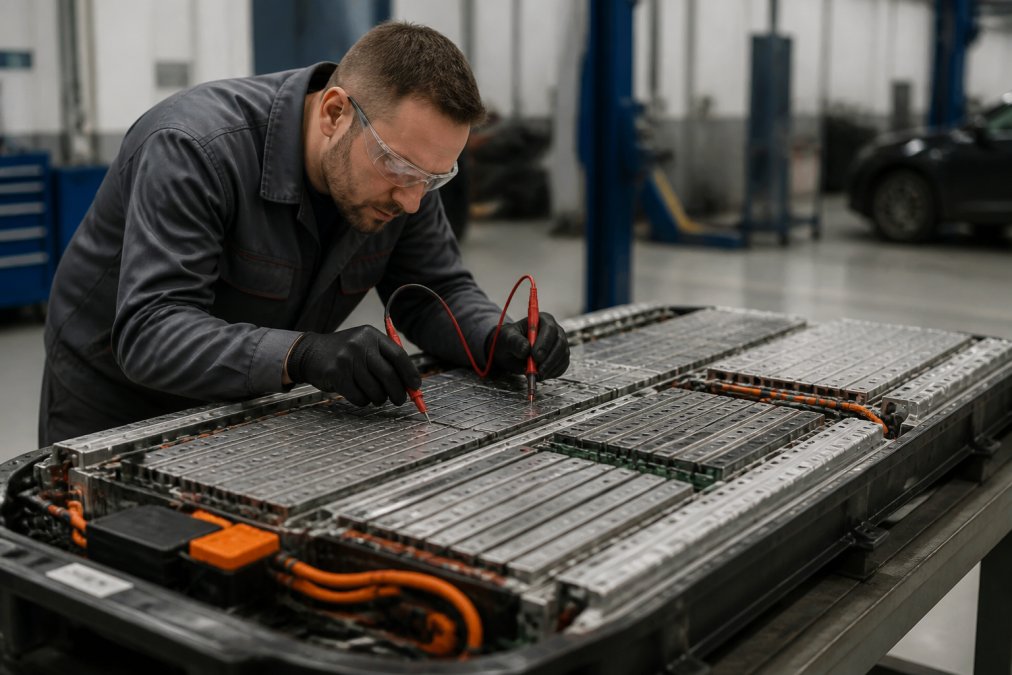
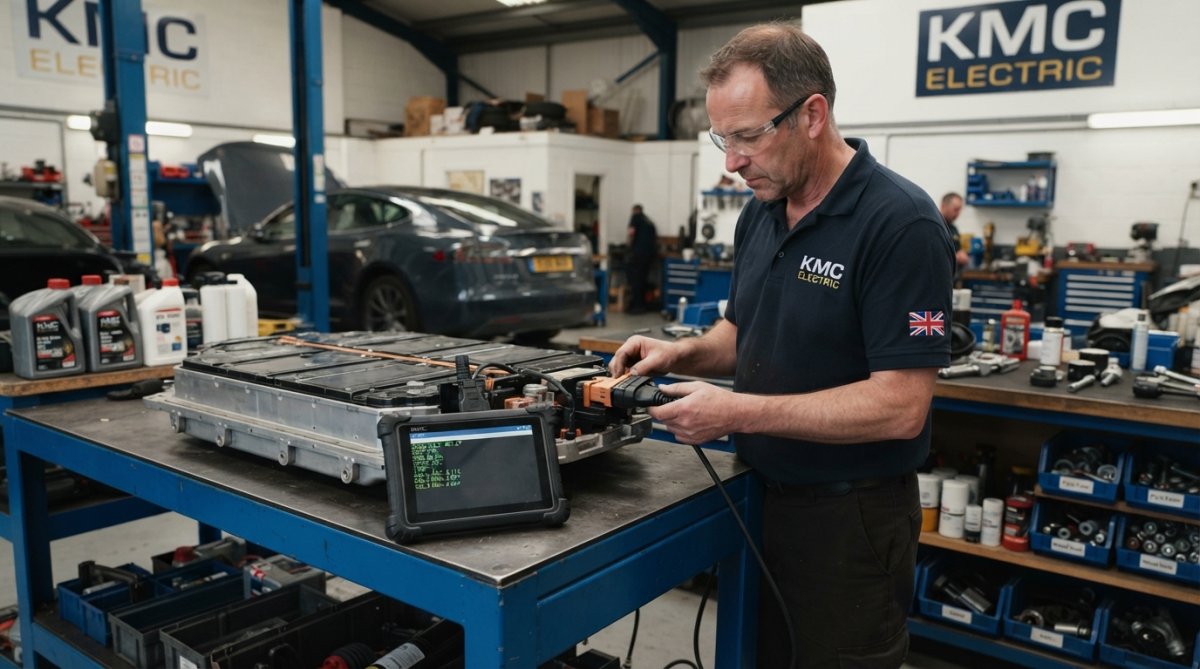
Close-up of a technician using diagnostic equipment on an electric vehicle battery pack in a professional workshop setting, with tools and testing apparatus visible
Lithium-ion battery degradation is an electrochemical process that happens continuously from manufacture. The primary culprit is the repeated insertion and removal of lithium ions from the battery's cathode and anode during charging and discharging cycles. Each cycle causes microscopic structural damage. Over time, internal resistance increases, charge capacity diminishes, and maximum output power declines.
For Tesla owners in Northamptonshire approaching warranty expiry, independent diagnostics become critical. The vehicle's battery management system monitors these changes, but information displayed to the driver is deliberately limited. You might see "Battery Available" without indication that capacity has dropped from 100% to 85% over three years.
State of health testing and diagnostics reveal what the dashboard won't tell you. A proper SoH assessment measures the battery's actual capacity against its original specification, calculates internal resistance, and projects future degradation rates. At KMC Electric, we use professional diagnostic tools to assess battery state of health independently from manufacturer systems, giving you transparency about your vehicle's true condition.
A used Model 3 with 80,000 miles might show 92% SoH, perfectly healthy for continued ownership. Another with identical mileage might show 78% SoH, suggesting accelerated degradation and potential future issues. Understanding your battery's current health allows informed decisions about whether to keep, sell, or address potential issues before they become catastrophic failures.
Watch OutRapid capacity loss (more than 3-5% per year) often indicates thermal management problems, manufacturing defects, or aggressive driving patterns. If diagnostics reveal accelerated degradation, address the underlying cause immediately.
Temperature-Related Performance Issues and Cold Weather Impact
Temperature is the enemy of lithium-ion batteries. Cold weather reduces battery performance immediately. Winter range loss of 20-40% is normal for EVs in the UK during December and January, but this is temporary. Hot weather degradation is permanent.
When a battery gets cold, chemical reactions slow down. Internal resistance increases dramatically, meaning less power output, slower charging, and reduced range. A Tesla Model 3 delivering 350 miles in July might deliver only 220 miles on a freezing February morning.
Thermal management systems are critical. Modern EVs use sophisticated heating and cooling systems to maintain batteries within an optimal temperature window, typically 15-35°C. These systems use energy from the battery itself, which is why rapid charging in cold weather is particularly inefficient.
For EV owners in the Kettering area, understanding this seasonal pattern prevents unnecessary panic. A 25% range reduction in January is expected. A 25% range reduction in July suggests a problem worth investigating.
Prolonged exposure to high temperatures causes accelerated degradation. Rapid charging generates heat. Summer heat in a parked vehicle generates heat. Batteries spending months at 40°C or above experience significantly faster capacity loss than identical vehicles in cooler regions.
Pro TipPrecondition your battery before rapid charging in cold weather. Most EVs allow you to set charging schedules that warm the battery whilst plugged in. This reduces charging time by 30-40% and protects battery longevity.
Charging Speed Problems and Battery Management System Failures
Slow charging is often the first sign that something is wrong with your battery or its management system. When you use a rapid charger (150kW or higher), the battery management system must carefully balance charge distribution across individual cells to prevent any single cell from overcharging. If the BMS detects that one cell is reaching full charge before others, it throttles the entire charging speed to protect that cell.
Voltage drop and slow charging diagnosis requires professional equipment. A significant voltage drop (more than 5%) after 24 hours of rest indicates internal resistance issues or cell imbalance. At KMC Electric, we've identified numerous cases where main dealers dismissed slow charging as "normal," when diagnostics revealed battery problems that worsened over time.
The battery management system itself can fail. Faulty temperature sensors, damaged cell monitoring circuits, or software glitches can cause the BMS to misread battery state and throttle charging unnecessarily. We've seen Tesla owners in Northamptonshire experience 50% charging speed reductions caused by a single failed sensor, a repair that prevented a significantly more expensive battery replacement.
Dashboard Warning Lights and Battery Error Codes Explained
Your dashboard tells a story if you know how to read it. Most EV owners ignore warning lights, assuming they're minor issues. Some are. Others indicate battery problems that will worsen without intervention.
Common Tesla fault codes vary by model and software version, but patterns emerge. A "Battery Thermal Management System Fault" indicates the vehicle can't regulate battery temperature properly, often a sensor failure. A "Charging System Fault" suggests the onboard charger or its connection to the battery has problems. "Battery Available" messages combined with reduced performance indicate the BMS has detected a cell issue and is protecting the battery by limiting power output.
Tesla's diagnostics are deliberately simplified for customer-facing displays. At KMC Electric, we retrieve the full error code history from Tesla vehicles, not just current warning lights. This reveals patterns. A vehicle throwing the same thermal management fault three times in two weeks has a different problem than one that threw it once during a cold snap.
When to seek professional diagnosis is straightforward: any battery-related warning light warrants investigation. For used vehicle buyers in the Midlands, any warning light related to the battery or charging system should trigger a pre-purchase inspection.
Watch OutIf your dashboard shows a battery warning light and you're within 6 months of warranty expiry, schedule diagnostics immediately. Some battery-related faults are warranty-covered, but only if documented before warranty ends.
Preventative maintenance and depth of discharge management are the two most important factors in extending battery life. Depth of discharge (DoD) refers to how deeply you discharge the battery between charges. Discharging to 0% every day accelerates degradation dramatically. Keeping your battery between 20% and 80% state of charge for daily use extends its lifespan by years.
Most EV manufacturers recommend setting your charge limit to 80% for daily driving. For long trips, you can charge to 100%, but doing this regularly stresses the battery unnecessarily. At KMC Electric, we've observed that Tesla owners who maintain 20-80% charge cycles see 15-20% less capacity loss over five years compared to those who regularly charge to 100%.
Software-based battery management and regenerative braking are where modern EVs excel. Regenerative braking captures energy that would otherwise be wasted as heat in traditional brake systems. This energy goes back into the battery. However, regenerative braking is only effective if the battery is in the right state of charge. If your battery is nearly full, the vehicle can't accept regenerated energy and must use friction brakes instead.
Understanding this changes how you drive. Anticipating stops and allowing the vehicle to coast and regenerate is more efficient than accelerating then braking hard. For drivers in Northamptonshire concerned about range anxiety, optimising regenerative braking can extend range by 10-15% in typical driving conditions.
Key TakeawayThe single most effective maintenance step is managing charge cycles. Charging to 80% daily and allowing occasional full charges for long trips can reduce degradation by 20% over the vehicle's lifetime compared to regular 100% charges.
Cost of EV Battery Replacement UK and Warranty Coverage
Battery replacement is the most expensive repair an EV owner might face. Costs vary widely depending on the vehicle and whether you're dealing with a main dealer or an independent specialist.
Post-warranty repair options and independent servicing are where significant savings emerge. Main dealers often insist on replacing entire battery packs when partial repairs might suffice. Independent specialists like KMC Electric can often diagnose and repair specific battery issues, failed BMS components, faulty sensors, or damaged cooling systems, without replacing the entire pack.
We've handled cases where a Tesla owner was quoted for a complete battery replacement at a main dealer, but diagnostics revealed the problem was a faulty BMS sensor. Fixing the sensor restored normal charging and performance. This is the value of independent diagnosis: you get an honest assessment of what's actually wrong, not an automatic recommendation for the most expensive solution.
For vehicles approaching or past warranty expiry, a vehicle with 85% state of health doesn't need a battery replacement; it needs monitoring. A vehicle with 70% state of health might benefit from targeted repairs to address the underlying cause of degradation, rather than immediate replacement.
Electric Car Battery Warranty UK and Manufacturer Coverage
Understanding your battery warranty is essential for protecting your investment. UK battery warranties are typically split into two components: capacity warranty and defect warranty.
What UK battery warranties cover varies by manufacturer but follows general patterns. Most manufacturers guarantee the battery will retain at least 70-80% of its original capacity for 8 years or 160,000 miles, whichever comes first. Separately, they guarantee the battery against manufacturing defects for a shorter period, typically 3-5 years.
The distinction matters. If your battery drops to 72% capacity after 7 years, you're still within warranty; the manufacturer must replace it. If a battery cell fails due to a manufacturing defect after 18 months, that's also covered. But if you've damaged the battery through misuse or accident, warranty doesn't apply.
For used vehicle buyers in the Midlands, warranty status is critical information. A used Model 3 purchased with 2 years of battery warranty remaining is very different from one with 6 months remaining. The remaining warranty period affects resale value and your protection against future issues.
Extended warranty options and independent verification are increasingly important as vehicles age. Some dealers offer extended battery warranties for used vehicles. These are only valuable if the battery is in good health when the extended warranty begins. This is why independent battery health verification before purchase is sensible.
At KMC Electric, we provide independent battery state-of-health assessments that give you confidence in your purchase decision.
Pro TipBefore purchasing extended warranty coverage on a used EV, request a battery health report. If the battery is already showing signs of accelerated degradation, extended warranty is more likely to be claimed and therefore more valuable.
Conclusion and Next Steps
The reality facing EV owners in Kettering and across Northamptonshire is straightforward: battery problems are manageable if you understand them and address them proactively. Ignoring warning signs, accepting slow charging without investigation, or assuming your battery is fine because the dashboard says so are recipes for expensive surprises.
Whether you're a Tesla owner approaching warranty expiry, a used vehicle buyer evaluating a potential purchase, or a dealership manager handling EV diagnostics, independent professional assessment is the foundation of good decision-making. KMC Electric brings Level 4 Master Technician expertise and over 25 years of automotive experience to EV battery diagnostics, offering cost-effective alternatives to main dealer assessments and transparent, real-world solutions for out-of-warranty vehicles.
Get in touch with KMC Electric for independent battery diagnostics and expert guidance on extending your vehicle's service life and protecting your investment.
Frequently Asked Questions
What are the most common signs of electric vehicle battery problems?
Common signs include reduced driving range, slower charging speeds, dashboard warning lights, and inconsistent battery percentage readings. Cold weather performance drops, unexpected voltage fluctuations, and thermal management issues are also typical indicators. If your EV shows these symptoms, professional diagnostic assessment is recommended to determine state of health and identify whether the issue is battery degradation, battery management system failure, or a software-related problem requiring calibration.
How much does EV battery replacement cost in the UK, and what are my options after warranty expires?
Battery replacement costs vary significantly depending on vehicle model and battery capacity, ranging from several thousand to over £15,000 for complete pack replacement. After manufacturer warranty expires, you have several options: dealership replacement, independent specialist repair (often more cost-effective), or targeted cell replacement if only partial degradation exists. Many independent specialists in the UK, including those with Level 4 Master Technician qualifications, offer post-warranty solutions that can extend vehicle life at a fraction of main dealer costs.
Does cold weather permanently damage my EV battery, and how can I protect it in winter?
Cold weather reduces battery performance temporarily but doesn't cause permanent damage if managed properly. Lithium-ion batteries lose efficiency in low temperatures due to slower chemical reactions and increased internal resistance. To protect your battery: precondition it before driving, avoid rapid charging in freezing conditions, maintain charge between 20-80% during winter, and use thermal management features if available. Professional diagnostic tools can verify whether winter-related range loss is temporary performance reduction or actual degradation requiring attention.
What should I look for when buying a used EV, and how can I verify battery health?
When purchasing a used electric vehicle, request an independent battery state-of-health assessment before committing. Key factors include: charging cycles completed, current capacity percentage, thermal management history, and any previous damage or repairs. Professional diagnostic testing reveals whether the battery is genuinely degraded or simply showing temporary performance issues. In the UK Midlands, independent specialists can provide detailed battery health verification reports, helping you avoid costly surprises and make informed decisions about used EV purchases.