Why Electric Cars Need Maintenance: Debunking the Zero-Service Myth
Electric cars absolutely require maintenance, just not in the way traditional petrol vehicles do. At KMC Electric, we've spent years working with Tesla owners and other EV drivers across Northamptonshire and Leicestershire, and we can tell you this misconception costs owners dearly. The difference between fewer moving parts and zero maintenance is critical. Electric vehicles have roughly 20 moving parts in their drivetrain compared to over 2,000 in internal combustion engines. Fewer moving parts means less can wear out, but fewer is not the same as none. A high-voltage battery, inverter, thermal management system, and regenerative braking components all require professional attention at specific intervals. Ignoring this is how owners end up with £10,000+ repair bills that could have been prevented with preventative maintenance.
Most EV manufacturers warrant their batteries for three to eight years, but many owners keep their vehicles well beyond that. When you're at 80,000 miles with an out-of-warranty Tesla, understanding what still needs servicing becomes essential. This guide explains exactly why electric cars need maintenance, what components require professional attention, and how to plan for long-term ownership without surprises.
The Difference Between Fewer Moving Parts and Zero Maintenance
When Tesla and other manufacturers claim their vehicles need less servicing, they're being technically accurate but strategically vague. Less is not none. The electric motor itself is remarkably simple, no spark plugs, no oil changes, no timing belts. However, the systems supporting that motor, the battery management system, inverter, thermal management network, and brake components, all age, degrade, and eventually fail.
Consider the regenerative braking system. It recovers energy when you slow down, which is why EV owners see such low brake pad wear. But that system has electronic components that monitor wheel speed, calculate deceleration rates, and modulate hydraulic pressure. When something goes wrong with that electronic brain, specialist equipment is needed to diagnose the issue.
Pro TipThe real maintenance difference: EVs don't need oil, spark plugs, or transmission fluid. They do need battery monitoring, thermal system checks, and high-voltage electrical diagnostics. This is why your local independent garage might not be equipped to service them, not because they're simpler, but because they're different.
Key Components That Still Require Service on Electric Vehicles
Several critical systems demand professional attention, and ignoring them is where owners get into trouble.
Battery management system and thermal management
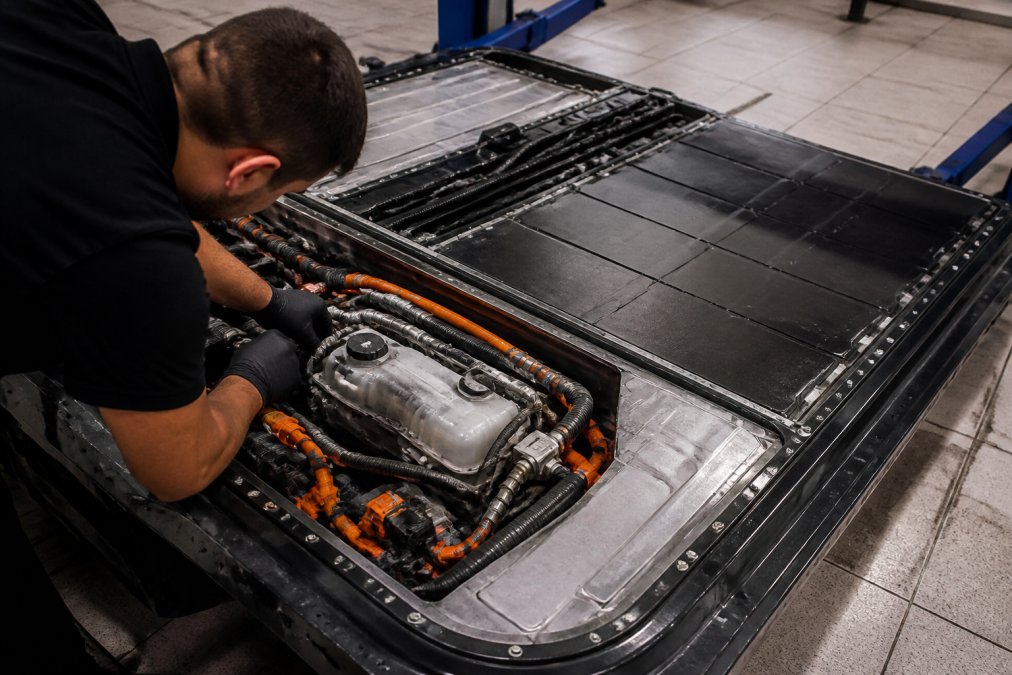
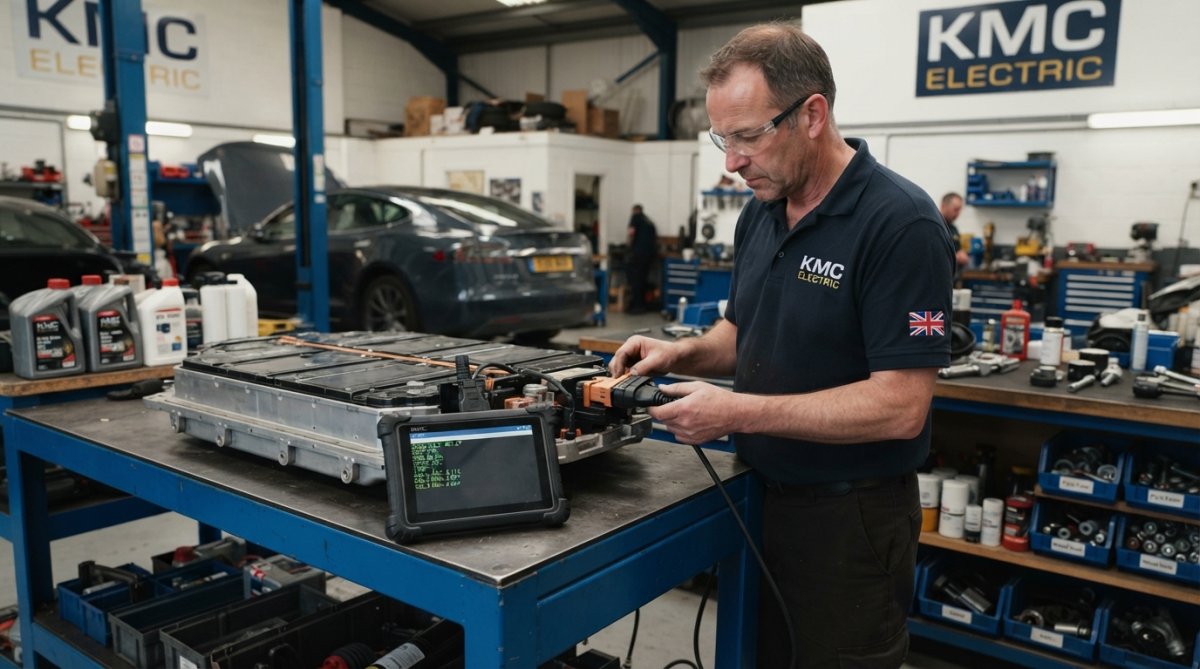
The lithium-ion battery pack is the most expensive component in any electric vehicle. The battery management system monitors individual cell voltages, temperatures, and charge states constantly. The thermal management system circulates fluid through the battery pack, inverter, and motor to keep the battery within its optimal temperature range. Over time, coolant degrades, thermal sensors fail, and pump bearings wear out. A coolant flush on an EV is preventative work that extends battery life by years.
Close-up of an electric vehicle's internal battery pack with thermal cooling tubes and monitoring sensors during professional inspection in a service bay
Inverter and power electronics
The inverter converts direct current from the battery into alternating current for the motor and back again during regenerative braking. It's a complex piece of power electronics that generates heat and experiences electrical stress every time you accelerate. The on-board charger is another power electronics component that wears out. If your car charges slowly, won't accept a charge, or triggers error codes during charging, specialist equipment is needed to diagnose the issue.
Drivetrain and electric motor components
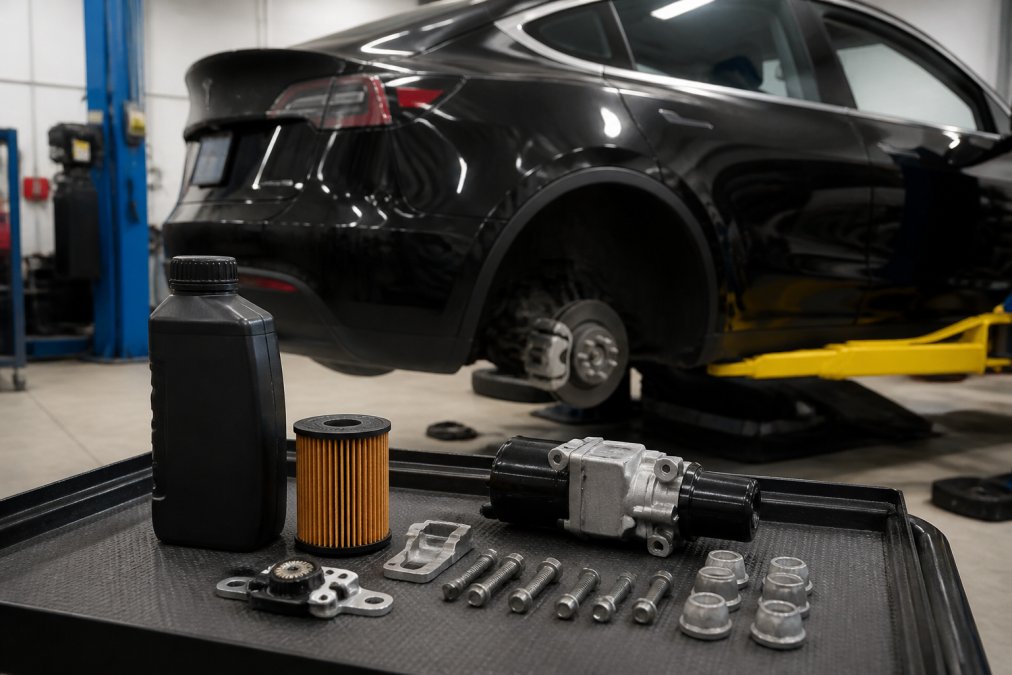
The electric motor itself is remarkably durable, but the drivetrain components around it need attention. The Tesla drive train parts require periodic inspection and fluid top-ups. The hand brake motor is a common failure point on Tesla vehicles. When it fails, you lose the ability to hold the car on an incline, which is a safety issue. KMC Electric stocks replacement Tesla Model 3 and Model Y hand brake motors and Tesla Model S and Model X hand brake motors at competitive prices.
Key TakeawayThe components that fail on EVs aren't the motor itself, they're the battery management system, thermal cooling, power electronics, and brake components. These are what separate a £5,000 service from a £15,000 emergency repair.
Electric Car Brake Maintenance and Regenerative Braking Systems
Regenerative braking is one of the genuine advantages of EV ownership. When you lift off the accelerator, the electric motor acts as a generator, slowing the car and recovering energy back into the battery. Traditional friction brakes engage only when you need hard deceleration. This is why EV owners often see brake pads lasting 100,000+ miles instead of 50,000.
But regenerative braking is a system, not magic. It has sensors, control modules, and hydraulic components. When that system fails, the car defaults to friction braking only, and your brake pads wear at normal rates again. Brake fluid still needs replacing every two years, regardless of how little you've used the brakes mechanically. Brake fluid is hygroscopic and absorbs moisture from the air. Over time, that moisture corrodes brake lines and reduces braking performance. Brake calipers can seize, brake discs can warp, and the electric brake booster can fail. These are standard wear items that cost more to diagnose when you don't have specialist equipment.
Electric Car Service Checklist UK: What's Actually Needed
Most manufacturers recommend servicing every 12 months or 15,000 miles, whichever comes first. A typical EV service checklist includes:
Battery health diagnostics (voltage, capacity, cell balance)
Thermal management system inspection (coolant level, temperature sensors, pump function)
Brake fluid replacement (every 2 years)
Cabin air filter replacement (annually or every 15,000 miles)
Brake pad and disc inspection
Tyre rotation and pressure check (every 6,000 miles)
Suspension and alignment inspection
High-voltage electrical safety check
Software updates and diagnostic scan for fault codes
At an independent specialist like KMC Electric in Kettering, we provide these services.
Cabin air filter and climate control maintenance
The cabin air filter traps pollen, dust, and particulates from outside air. On an EV, it's even more important because the climate control system works harder to manage cabin temperature. A clogged cabin filter reduces efficiency and increases energy consumption, which directly impacts range. The electric compressor, condenser, evaporator, and refrigerant lines can all fail. If your air conditioning is weak or your heating is sluggish, the climate control system is consuming battery energy inefficiently.
Tyre rotation, alignment, and suspension checks
Tyres wear faster on EVs because of the weight of the battery pack and immediate torque delivery from the electric motor. Rotating tyres every 6,000 miles extends their life. Alignment should be checked annually because poor alignment increases tyre wear and reduces range. Suspension components wear at similar rates to petrol cars, but on an EV they're carrying more weight, which affects the accuracy of the regenerative braking system.
EV Battery Health Check UK: Why Long-Term Battery Monitoring Matters
Lithium-ion batteries degrade gradually, losing capacity over time. A typical EV battery loses 2-3% of its capacity per year in the first five years. A battery with 300-mile range new might have 270-290 miles of range after five years. However, if the battery management system fails or thermal management breaks down, degradation can accelerate dramatically.
A professional battery state-of-health assessment reveals critical information that owners can't get from their vehicle's onboard diagnostics. A specialist battery assessment uses high-voltage diagnostic equipment to measure cell voltage balance, internal resistance, temperature stability, capacity retention, and projected remaining lifespan. This assessment is invaluable when buying a used EV or deciding whether to replace a degraded battery.
Watch OutIf you're buying a used EV without a [professional battery assessment](/page/pre-purchase-inspection), you're gambling. A battery that looks fine might have internal cell failures that will cost £10,000 to replace in two years. This is the single most important pre-purchase check for used EVs.
Most EV manufacturers warrant the battery for 8 years or 100,000-160,000 miles. Once that warranty expires, you're responsible for any battery work. A battery cell replacement costs £1,500-3,000 per module. A full battery pack replacement costs £8,000-15,000 depending on the vehicle and damage. However, not all battery problems require full replacement. A single failing cell can sometimes be isolated and replaced. A battery management system failure can be fixed without touching the cells. The key is getting a correct diagnosis early.
Electric Car Maintenance Cost UK: EV vs. Internal Combustion Engine
Over a vehicle's lifetime, an EV costs roughly 50% less to maintain than a comparable petrol car. No oil changes, spark plugs, air filters, transmission fluid, or traditional coolant flushes. The electric motor doesn't generate combustion byproducts that contaminate fluids. Brake pads last 2-3 times longer because of regenerative braking. For a vehicle driven 15,000 miles per year over eight years, that's roughly £1,200-1,600 in savings just from the absence of traditional engine maintenance.
However, hidden costs exist that owners don't anticipate. Thermal management system repairs cost £800-2,000. Inverter replacement costs £2,000-4,000. Battery thermal sensor failures cost £400-800 to diagnose and replace. These are uncommon, but when they happen, they're expensive.
Service Item
Petrol Car
Electric Vehicle
Oil and filter change
£40-80 (every 6,000 miles)
£0
Spark plugs
£150-300 (every 40,000 miles)
£0
Brake pads
£300-500 (every 50,000 miles)
£300-500 (every 100,000+ miles)
Coolant flush
£100-150 (every 2 years)
£200-300 (every 5 years, thermal fluid)
Air filter
£30-60 (annually)
£30-60 (cabin filter only)
Transmission servicing
£150-300 (every 60,000 miles)
£0
Annual inspection
£100-200
£150-250 (includes battery diagnostics)
The cost advantage is real, but once you're out of warranty, a single major component failure can negate years of savings. This is why preventative maintenance and early diagnosis matter so much.
DIY vs. Professional EV Service: When to Seek Certified Technician Support
Tasks you can handle safely at home on an EV are limited. You can check tyre pressure, rotate tyres with proper equipment, replace cabin air filters, and top up windscreen washer fluid. You can inspect brake pads visually and check for obvious leaks or corrosion.
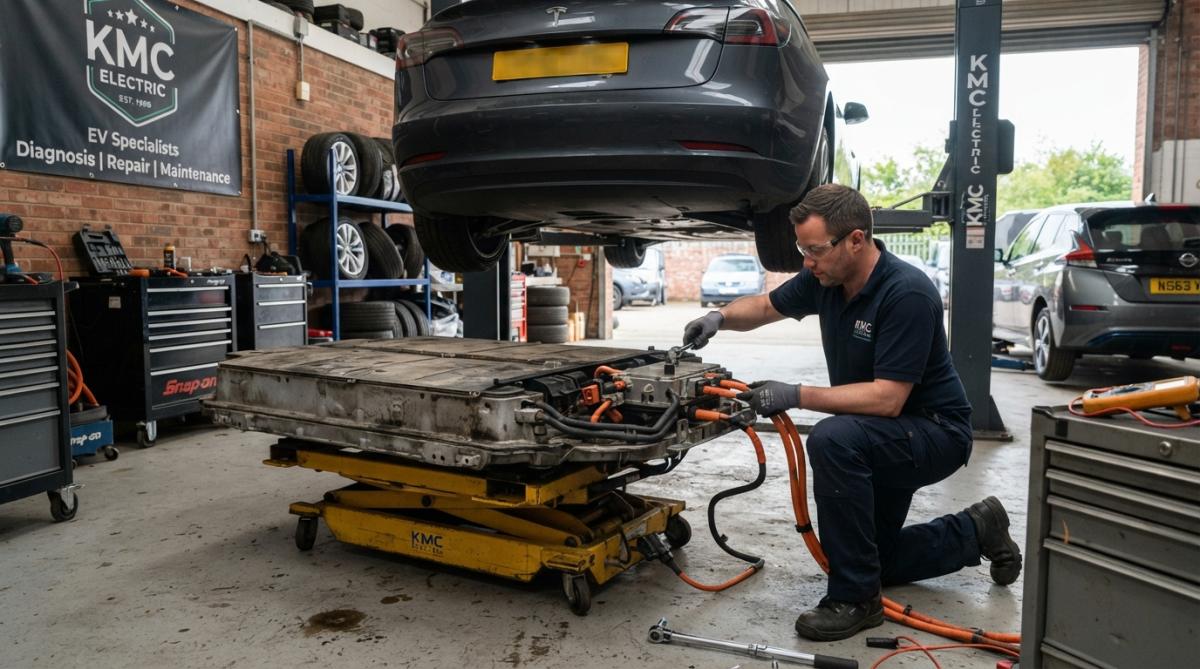
What you cannot do safely at home: anything involving the high-voltage battery system, thermal management circuit, inverter, or motor controller. These systems operate at 300-400 volts. A mistake doesn't just break the car, it can be fatal. The battery pack stores enough energy to cause serious injury or death if mishandled. The high-voltage cables are colour-coded orange specifically so technicians know to treat them with extreme caution.
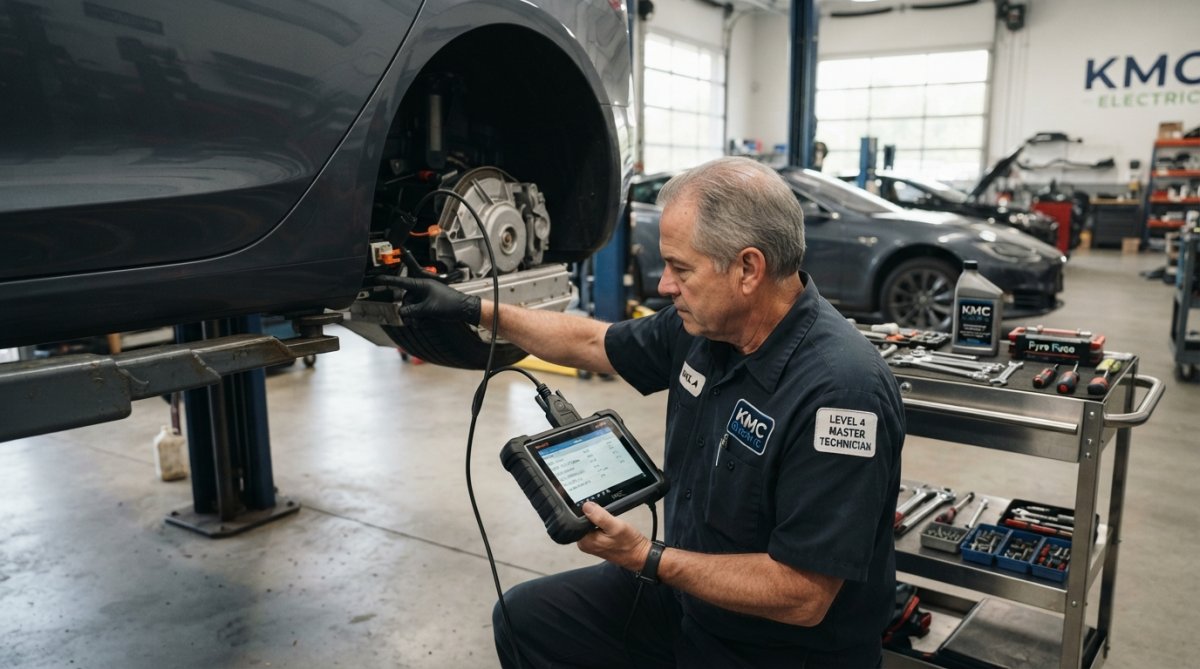
A certified EV technician has undergone training in electrical safety, has access to specialist diagnostic equipment, and carries insurance that covers high-voltage work. At KMC Electric, our team has Level 4 Master Technician status in electric vehicles and over 25 years of automotive experience. We've been qualified in EV systems since 2016. If it involves anything electrical, thermal, or high-voltage, use a professional. When in doubt, ask. A five-minute phone call to your EV specialist costs nothing and could save you thousands in damage.
Pro TipMany EV owners avoid servicing because they think they'll be overcharged. The reality: [independent specialists often provide a cost-effective alternative to main dealers](/blog/tesla-service-centres-vs-specialists-guide) for the same work, and they're more likely to find the actual problem instead of replacing expensive parts unnecessarily.
Long-Term EV Ownership (100,000+ Miles): Planning for Extended Service Life
Preventative maintenance is the difference between a 200,000-mile EV and one that fails at 120,000 miles. Keeping the battery cool, avoiding frequent fast charging, and maintaining consistent charge levels between 20-80% extends battery life significantly. A battery that's regularly charged to 100% and discharged to 0% degrades faster than one managed more conservatively.
Brake fluid replacement every two years prevents corrosion of brake lines. Tyre rotation every 6,000 miles prevents uneven wear. Software updates, when available, often improve battery management and thermal efficiency. Over-the-air updates on modern EVs can improve range, efficiency, and reliability without you visiting a service centre.
Regional and climate impacts on EV maintenance needs vary significantly. In the UK, winter cold reduces range and puts stress on the thermal management system. The battery works harder to stay warm. In summer, heat stress accelerates battery degradation if cooling is inadequate. Salt exposure near coastal areas accelerates corrosion of electrical connectors. Understanding your local climate and adjusting maintenance accordingly extends vehicle life.
Conclusion
Long-term EV ownership requires understanding that fewer moving parts doesn't mean zero maintenance. Battery health checks, thermal management servicing, and high-voltage diagnostics are where the real maintenance happens, and where independent specialists like KMC Electric deliver the most value. We've helped hundreds of EV owners in Kettering, Northamptonshire, and across the Midlands extend vehicle lifespan, identify faults before warranty expiry, and avoid unnecessary main dealer costs. If you're planning to keep your EV beyond the manufacturer warranty, a professional battery health assessment and preventative servicing plan will protect your investment and keep you on the road.
Frequently Asked Questions
Do electric cars really need less maintenance than petrol cars?
Yes, but not zero maintenance. EVs have fewer moving parts, no oil changes, spark plugs, or timing belts needed. However, the battery management system, inverter, thermal cooling, brake fluid, and cabin air filter still require regular attention. The key difference is that electric cars need maintenance differently, not that they don't need it at all. Preventative maintenance actually extends battery life and identifies faults before warranty expiry.
What's included in an electric car service checklist UK?
A comprehensive EV service includes: battery health diagnostics, thermal management system checks, brake fluid inspection (even though brake pad wear is reduced by regenerative braking), tire rotation and alignment, cabin air filter replacement, coolant flush for battery cooling circuits, suspension component inspection, and safety checks. Unlike petrol cars, you won't need oil changes or spark plug replacement. Many dealerships use over-the-air updates to address minor software issues without a garage visit.
How much does an EV battery health check cost, and why is it important before buying a used electric car?
A professional independent battery state-of-health assessment is essential when purchasing a used EV. It reveals the actual capacity and degradation of the lithium-ion battery, critical information the seller may not disclose. This check helps you avoid a £15,000+ battery replacement shortly after purchase. Independent specialists like KMC Electric provide detailed diagnostics that identify whether the battery is performing within warranty parameters or showing early signs of failure, giving you real confidence in your buying decision.
Can I do any EV maintenance myself, or do I need a certified technician?
Some tasks are safe for DIY: cabin air filter replacement, windscreen washer top-ups, and tire pressure checks. However, never attempt high-voltage work, anything involving the battery, inverter, power electronics, or thermal management system requires a Level 4 Master Technician with EV qualifications. Working on these systems without proper training risks electrocution and fire. For out-of-warranty repairs, independent certified specialists offer cost-effective alternatives to main dealers whilst maintaining safety standards.