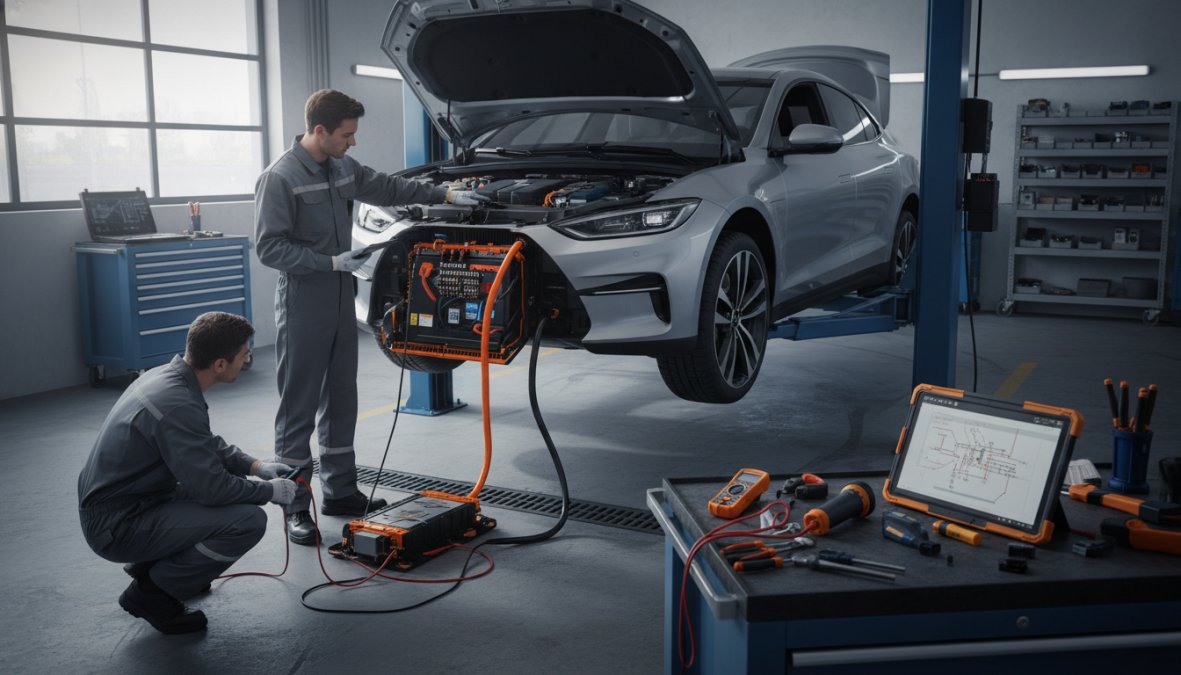
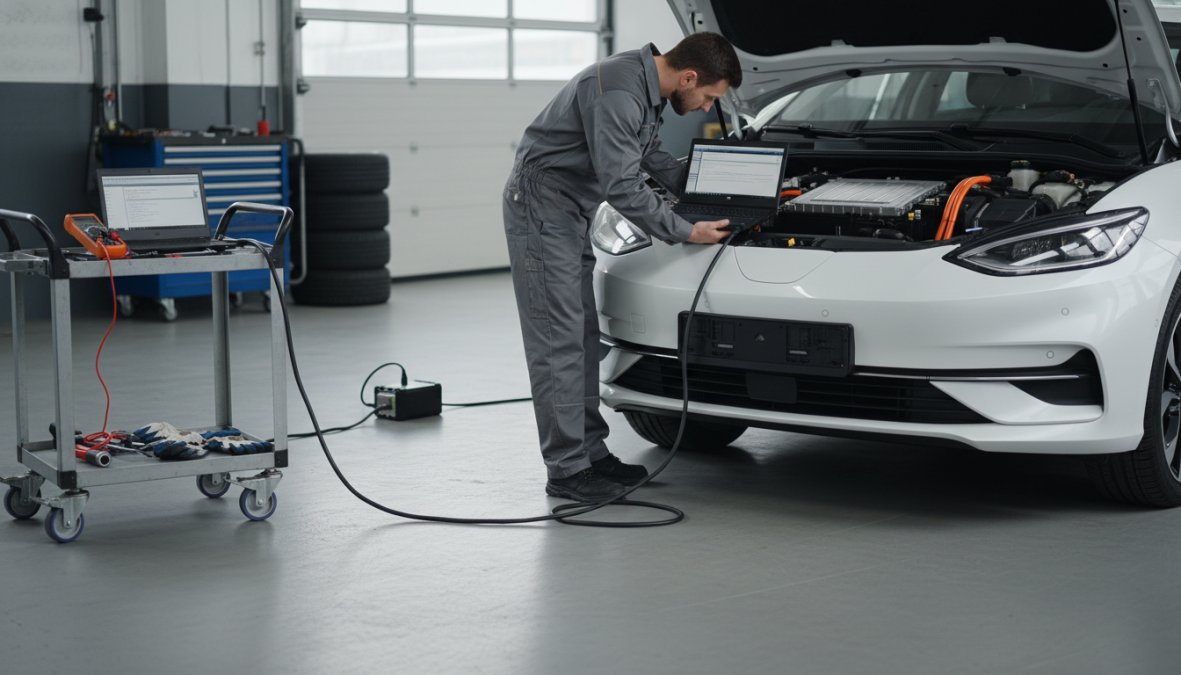
Understanding what is an electric vehicle diagnostic is no longer just a concern for workshop technicians. As EVs become mainstream across the UK, KMC Electric has worked with hundreds of Tesla and EV owners in Kettering and across Northamptonshire who arrive without a clear picture of what a diagnostic actually involves, what it costs, or whether they even need one. An EV diagnostic is a structured inspection process that reads fault codes, analyses battery health, tests high-voltage systems, and reviews software data to identify faults before they become expensive failures. Below, we'll show you exactly how the process works, what tools technicians use, and where the line sits between what you can safely do yourself and what demands specialist equipment.
The gap between EV diagnostics and traditional ICE vehicle diagnostics is wider than most owners realise. According to the Society of Automotive Engineers' technical documentation on EV service procedures, electric vehicles contain high-voltage systems operating at 400V or higher, which requires fundamentally different safety protocols and tooling compared to petrol or diesel vehicles. That distinction shapes everything from the equipment a workshop needs to the qualifications a technician must hold.
What Is an Electric Vehicle Diagnostic?
An electric vehicle diagnostic is a systematic process of interrogating an EV's onboard systems, including its battery management system, electric motor controllers, charging system, and power electronics, to identify faults, performance deviations, and potential failures.
Unlike a simple OBDII scan on a petrol car, an EV diagnostic pulls data from multiple control modules simultaneously. The battery management system alone generates hundreds of data points: cell voltage balance, state of health (SOH), thermal management performance, charge cycle history, and insulation resistance readings. A thorough diagnostic also captures DTC (Diagnostic Trouble Codes) from the drive inverter, onboard charger, DC-DC converter, and auxiliary systems.
The output is a detailed picture of the vehicle's electrical and mechanical health. That picture tells a technician whether a fault is active or historical, whether battery degradation is within acceptable limits, and whether software updates are pending that could resolve an intermittent issue without any physical repair.
How EV Diagnostics Differ from ICE Vehicle Diagnostics
The most important difference is voltage. A standard ICE vehicle operates its electronics at 12V. An electric vehicle's traction battery operates at 400V to 800V depending on the platform, and that changes everything about how a technician approaches the vehicle.
ICE diagnostics centre on the engine control unit, fuel system, and emissions data. EV diagnostics centre on the battery pack, power electronics, regenerative braking calibration, and CAN bus communication between modules. The data volume is significantly higher. A Tesla, for example, logs thousands of parameters continuously, and reading that data requires either the manufacturer's proprietary diagnostic interface or a specialist third-party tool capable of decoding the vehicle's firmware.
A common mistake is assuming that a generic OBDII reader will give you a complete EV diagnostic. It will not. It may surface some basic fault codes, but it misses the battery-level data and high-voltage system readings that matter most.
Watch OutNever attempt to probe high-voltage EV components with standard automotive multimeters. High-voltage systems require Category III or Category IV rated meters. Using the wrong equipment risks electrocution and can permanently damage the vehicle's battery management system.
Why EV Diagnostics Matter More Than Most Owners Realise
Here is where most guides get it wrong: they treat EV diagnostics as a reactive tool, something you run after a warning light appears. The real value is preventative.
Battery degradation does not announce itself with a dashboard warning until it has already progressed significantly. A diagnostic run annually, or before a warranty expires, can reveal cell imbalance or thermal management issues early enough to address them under warranty rather than at your own cost. For anyone buying or selling a used EV, an independent battery health check is arguably the single most important piece of due diligence available.
The charging system is another area where diagnostics catch problems invisible to the driver. Onboard charger faults often present as slightly longer charge times rather than outright failures, and they can be identified through real-time data analysis long before the charger fails completely.
EV maintenance schedules are also less intuitive than ICE equivalents. Without oil changes and spark plugs to prompt regular workshop visits, many EV owners go years without any professional inspection. A diagnostic fills that gap, covering software updates, brake system calibration (particularly important given the reduced wear on friction brakes due to regenerative braking), and suspension or steering error codes that accumulate silently.
Key TakeawayAn EV diagnostic run before your warranty expires is the most cost-effective insurance policy available to an EV owner. Faults identified in warranty cost nothing to fix. The same faults identified six months later come entirely out of your pocket.
Electric Vehicle Diagnostic Tools: What Technicians Actually Use
The tooling landscape for EV diagnostics splits into two categories, and understanding the difference matters whether you're a technician or an owner trying to assess a workshop's capability.
Specialist high-voltage test equipment covers insulation resistance testers (often called meggers), Category III/IV rated multimeters, current clamps rated for high-voltage DC circuits, and thermal imaging cameras for identifying hot spots in battery packs and power electronics.
Diagnostic software and interfaces cover the scan tools and software platforms that communicate with the vehicle's control modules. The most capable tools in this category include:
Manufacturer proprietary systems (Tesla's own toolset, for example)
Autel MaxiSYS Ultra EV, which covers a broad range of EV platforms
LAUNCH X431 with EV-specific modules
Pico Technology oscilloscopes for CAN bus signal analysis
Battery-specific tools capable of reading individual cell data from the BMS
A basic OBDII scan tool will read generic fault codes from some EV systems, but it cannot access battery pack data, calibrate regenerative braking systems, or perform high-voltage insulation tests.
Manufacturer-Specific Diagnostic Systems vs. Universal Scan Tools
This is the part most independent workshops do not advertise clearly. Manufacturer-specific diagnostic systems access proprietary data channels that universal scan tools cannot reach. For Tesla vehicles, the manufacturer's toolset reads individual cell voltages, charge history, thermal event logs, and can push firmware updates. A universal tool reads a subset of that data.
The practical implication: a workshop using only a universal scan tool on a Tesla is giving you a partial picture. That is not necessarily dishonest, but it is a limitation worth understanding. A specialist workshop with access to manufacturer-level data, or deep expertise in interpreting Tesla's data architecture, delivers a materially more complete diagnostic.
Tool Type
Data Access
High-Voltage Testing
Firmware Updates
Best For
Generic OBDII
Basic DTCs only
No
No
Initial fault code check
Universal EV scan tool
Most modules
No
Limited
Multi-brand workshops
Manufacturer proprietary
Full system access
Varies
Yes
Brand-specific repairs
Specialist BMS reader
Battery cell data
No
No
Battery health assessment
Full specialist kit
Complete access
Yes
Yes
Independent EV specialists
How an Electric Vehicle Diagnostic Works: A Step-by-Step Workflow
A professional EV diagnostic follows a defined sequence. Skipping steps is how faults get missed.
Process diagram showing steps for what is an electric vehicle diagnostic
Step 1: Pre-inspection and vehicle history review. The technician reviews any stored fault history, previous repair records, and the owner's reported symptoms. This shapes which systems get prioritised.
Step 2: High-voltage system isolation check. Before connecting any diagnostic equipment, the technician confirms the high-voltage system is in a safe state. This includes verifying the service disconnect is accessible and checking for any active insulation faults.
Step 3: Full system DTC scan. The diagnostic interface connects to the vehicle's CAN bus and pulls DTCs from all modules: battery management system, drive inverter, onboard charger, DC-DC converter, body control modules, and ADAS systems where fitted.
Step 4: Battery health assessment. The BMS data is extracted and analysed. This covers state of health (SOH), state of charge accuracy, cell voltage balance, thermal management performance, and charge cycle count.
Step 5: Live data monitoring. The technician runs the vehicle through a controlled sequence, monitoring real-time data from the motor controller, regenerative braking system, and charging system to identify intermittent faults that do not store a DTC.
Step 6: High-voltage insulation test. An insulation resistance test checks for current leakage between the high-voltage circuit and the vehicle chassis. This is a safety-critical check that generic tools cannot perform.
Step 7: Report and recommendations. The technician produces a written report covering all findings, fault severity, and recommended actions with estimated costs.
High-Voltage System Testing and Insulation Checks
High-voltage system testing is the element that separates a genuine EV diagnostic from a basic scan tool session. Insulation testing applies a controlled DC voltage (typically 500V or 1000V) between the high-voltage circuit and the vehicle body to measure resistance. A healthy system shows very high resistance. A deteriorating insulation layer shows lower resistance, indicating a potential fault that could cause electrical shock or system shutdown.
Voltage monitoring across the battery pack also identifies cell groups that are out of balance. A pack where some cell groups sit at 3.9V while others sit at 3.6V under the same load conditions indicates internal degradation or a BMS calibration issue, both of which affect range and longevity.
Safety Protocols and PPE: What Responsible Technicians Follow
Safety protocols for EV diagnostics are non-negotiable. According to the Institute of the Motor Industry's EV safety guidance for technicians, technicians working on high-voltage EV systems must hold appropriate qualifications and follow defined isolation procedures before touching any orange-cabled component.
The standard PPE for high-voltage EV work includes:
Class 0 or Class 1 insulating gloves (rated to 1000V minimum)
Insulated safety footwear
Eye protection
High-visibility and arc-flash resistant clothing where required
Insulated tools rated for the voltage class being worked on
The vehicle must be isolated using the manufacturer's specified procedure, which typically involves removing the service disconnect plug or triggering the high-voltage interlock before any component is touched. Waiting the manufacturer-specified discharge time after isolation is mandatory, not optional.
EV Battery Health Check: The Core of Any EV Diagnostic
Battery health is the single most commercially significant output of any EV diagnostic. The battery pack represents the majority of an EV's value, and its condition directly determines range, resale price, and long-term reliability.
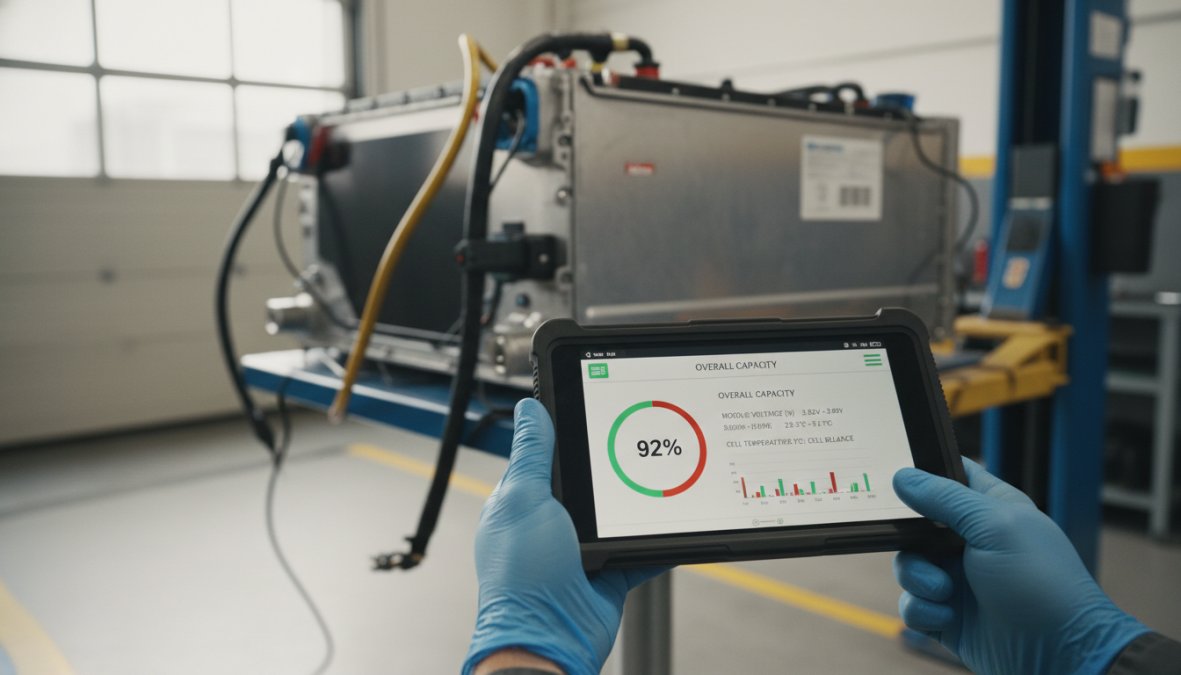
A battery health check extracts data from the BMS to calculate the state of health (SOH): the ratio of current usable capacity to the original factory capacity. A new EV battery starts at 100% SOH. Most manufacturers consider anything above 70-80% SOH to be within acceptable service limits, though the specific threshold varies by manufacturer and model.
Cell voltage balance across all cell groups
Minimum and maximum cell temperatures under load
Charge cycle count and depth of discharge history
Thermal management system performance (coolant flow, pump operation)
Any historical thermal events or overvoltage incidents logged by the BMS
Professional illustration showing what is an electric vehicle diagnostic
Understanding State of Health (SOH) and Battery Management System (BMS) Data
State of Health (SOH) is a calculated percentage representing how much usable capacity remains in a battery pack relative to its original specification. SOH is the key metric for any EV purchase decision or warranty claim involving battery performance.
Battery Management System (BMS) is the electronic control unit that monitors and manages every cell in the battery pack, balancing charge between cells, enforcing temperature limits, and protecting the pack from overcharge or over-discharge events.
The BMS data tells a more complete story than SOH alone. A pack at 88% SOH with good cell balance and consistent thermal management data is in better practical condition than a pack at 91% SOH with significant cell imbalance and logged thermal events. Reading BMS data correctly requires both the right tooling and the experience to interpret what the numbers mean in context.
For EV owners in Kettering and the surrounding area, KMC Electric provides independent battery health verification that goes beyond a simple SOH percentage, covering the full BMS dataset to give buyers and sellers a complete picture of battery condition.
Pro TipWhen buying a used EV, always request an independent battery health check before exchanging contracts. A basic test drive tells you nothing about cell balance, thermal history, or BMS fault logs. A full diagnostic can reveal issues that would cost thousands to address post-purchase.
DIY vs. Professional EV Diagnostics: What You Can and Cannot Do Safely
The honest answer here is that the DIY boundary for EV diagnostics is narrower than most enthusiasts want to hear, but it is wider than most professional guides admit, because those guides are written by workshops with a commercial interest in keeping you booked in. This section gives you an unbiased map of exactly where the line sits, what tools sit on each side of it, and what each tier actually costs.
What You Can Safely Do as an EV Owner
The entry point for DIY EV monitoring is a Bluetooth or Wi-Fi OBDII adapter paired with a compatible app. The adapter plugs into the standard OBDII port (usually located beneath the steering column) and communicates with the vehicle's publicly accessible CAN bus channels. This is low-voltage work, the OBDII port operates at 12V, and carries no meaningful electrical risk.
Useful adapters in this category include:
OBDLink MX+, A widely used Bluetooth adapter compatible with a broad range of third-party EV apps. Reads generic and some manufacturer-enhanced PIDs depending on the vehicle.
Veepeak OBDCheck BLE+, A lower-cost option that works reliably with iOS and Android apps for basic fault code reading and live data monitoring.
Carista OBD2 Adapter, Particularly useful for Volkswagen Group EVs (ID.3, ID.4, Audi e-tron) where it accesses some brand-specific modules beyond generic OBDII.
The standout exception in this list is Leaf Spy Pro, which, uniquely for a consumer app, surfaces individual cell group voltages and a calculated SOH figure for Nissan Leaf batteries. This gives Leaf owners a level of battery insight that approaches what a workshop tool provides, without any high-voltage risk. It is the closest the DIY tier gets to genuine battery diagnostics.
Beyond scan tools, EV owners can monitor battery health trends over time by logging consistent range data under comparable conditions (similar temperature, similar speed profile, similar starting SOC). A pattern of declining range that outpaces the expected degradation curve for that model and age is a meaningful signal worth investigating professionally, even if no fault codes are present.
Manufacturer apps (Tesla, Volkswagen, Renault, Kia) also surface some diagnostic-adjacent data: charge session history, energy consumption breakdowns, and in some cases software update status. These are worth reviewing regularly and cost nothing.
What you can safely do as an EV owner, summary:
Read and clear generic fault codes using an OBDII adapter and compatible app
Monitor state of charge accuracy and range consistency over time
Track battery degradation trends using apps like TeslaFi or Leaf Spy Pro
Check for pending software updates via the manufacturer app
Review energy consumption data through the vehicle's infotainment system
Perform basic visual inspection of charging cables, connectors, and coolant reservoir levels (where accessible without removing panels)
What Requires Professional Equipment and Qualifications
The boundary is defined by two factors: voltage class and data access depth.
Anything involving the high-voltage traction system, the orange-cabled components, is outside the DIY boundary without exception. This is not a matter of skill level. It is a matter of physics. A 400V to 800V DC circuit does not behave like AC mains voltage. DC at high voltage does not release a muscle contraction the way AC does; it causes sustained muscle lock, which prevents the person from releasing their grip. The energy stored in a traction battery pack is sufficient to cause fatal injury in a fraction of a second. No consumer-grade tool, no YouTube tutorial, and no level of mechanical confidence changes that risk profile.
Data access depth is the second boundary. Even setting safety aside, the BMS data channels that matter most, individual cell voltages, thermal event logs, insulation resistance readings, charge cycle depth history, are not accessible via the standard OBDII port. They sit on proprietary CAN bus channels that require either manufacturer-level tooling or specialist third-party interfaces (Autel MaxiSYS Ultra EV, LAUNCH X431 with EV modules, or battery-specific tools like the Midtronics MDX-P300 for certain platforms). These tools cost between £1,500 and £8,000+ and require trained interpretation.
What requires professional equipment and qualifications:
High-voltage insulation resistance testing (requires a calibrated insulation tester, Class 0 gloves, and isolation procedure compliance)
Full BMS data extraction including cell-level voltage balance and thermal event history
Calibration of regenerative braking systems after component replacement
Firmware updates to the battery management system or drive inverter
Diagnosis of charging system faults beyond what the OBDII port surfaces
Any physical inspection or repair involving orange-cabled components or the service disconnect
Oscilloscope-level CAN bus signal analysis for intermittent communication faults
The Risk of Misreading Partial Data
The most important thing to understand about DIY EV diagnostics is not the safety risk, it is the interpretation risk. A Bluetooth OBDII scan that returns zero fault codes does not mean the vehicle is healthy. It means no generic faults were found in the modules the tool could access via the standard OBDII gateway. That is a very different statement.
A battery pack with significant cell imbalance, a deteriorating insulation layer, or a thermal management pump running below specification will not necessarily generate a generic DTC. Those conditions show up in BMS data channels that the OBDII port does not expose. An owner who runs a DIY scan, sees no codes, and concludes the vehicle is fine has received a false negative, not a clean bill of health.
The practical recommendation: use DIY tools for ongoing monitoring and early warning, not for definitive health assessment. If a DIY scan surfaces a fault code, or if you notice range declining faster than expected for your vehicle's age and mileage, treat that as a trigger for a professional diagnostic, not a problem to clear and ignore.
Pro TipLeaf Spy Pro (for Nissan Leaf owners) and TeslaFi (for Tesla owners) are the two DIY tools that come closest to providing genuine battery health data rather than just fault codes. If you own either of those vehicles, these apps are worth the small cost as a baseline monitoring tool between professional diagnostics.
Watch OutClearing a fault code with a DIY OBDII tool does not fix the underlying fault. It removes the stored code from the module's memory, which can make subsequent professional diagnosis harder by erasing the freeze-frame data that shows the conditions under which the fault occurred. If a warning light appears, read and record the code, do not clear it before a technician has seen it.
EV Diagnostic Cost: What to Expect and Is It Worth It?
EV diagnostic pricing in the UK in 2026 is poorly standardised, which creates a genuine problem for owners trying to compare quotes. A workshop quoting £50 for an "EV diagnostic" and a specialist quoting £250 may be describing processes so different they share almost nothing in common. Understanding what drives the cost difference, and what you actually get at each tier, is the only way to make a rational buying decision.
The Four Tiers of EV Diagnostic Service
Tier 1: Generic OBDII Fault Code Scan, £30 to £60
This is what most general garages offer when they advertise an EV diagnostic at the lower end of the market. A generic scan tool connects to the OBDII port, reads whatever fault codes are accessible via the standard gateway, and produces a printout. The process takes 15 to 30 minutes.
What you get: a list of any stored DTCs from the modules accessible via the OBDII gateway, which typically includes some body control functions and basic powertrain codes.
What you do not get: battery cell data, insulation resistance readings, BMS thermal history, inverter live data, or any module that sits behind the manufacturer's proprietary CAN bus gateway.
When it is appropriate: as a first-pass check when a warning light has appeared and you want to know whether it is a generic fault before committing to a deeper investigation. Not appropriate as a standalone health check for a vehicle purchase or warranty claim.
Tier 2: Mid-Level EV Diagnostic, £80 to £150
A mid-level diagnostic uses a universal EV scan tool (Autel MaxiSYS series, LAUNCH X431 with EV modules, or equivalent) to access most of the vehicle's control modules, including the battery management system, onboard charger, DC-DC converter, and drive inverter. A state of health percentage is typically extracted from the BMS and reported.
What you get: DTC scan across most modules, a headline SOH figure, live data from the main EV-specific modules, and a basic written summary.
What you do not get: individual cell voltage data (most universal tools report aggregate pack data rather than cell-group level), insulation resistance testing, thermal event log history, or manufacturer-level firmware access.
When it is appropriate: for routine annual health checks on out-of-warranty vehicles, or as a follow-up to a Tier 1 scan that surfaced a fault requiring deeper investigation. Adequate for most common fault investigations on mainstream EV platforms.
Tier 3: Full Specialist EV Diagnostic, £150 to £300
A full specialist diagnostic combines a capable universal or manufacturer-adjacent scan tool with dedicated high-voltage test equipment and, where available, access to deeper data channels. This tier includes insulation resistance testing, cell-group level BMS data analysis, live data monitoring under load, and a detailed written report covering fault severity, trajectory, and recommended action.
What you get: the complete picture available from the vehicle's accessible data channels, high-voltage system safety verification, and a report that is usable for warranty claims, purchase negotiations, or insurance purposes.
What you do not get (unless the workshop has manufacturer-level access): the deepest proprietary data channels, such as Tesla's full charge history logs or certain manufacturer-specific calibration functions.
When it is appropriate: pre-purchase battery health checks, warranty expiry inspections, fault investigations involving intermittent or complex faults, and any situation where the diagnostic output needs to be defensible to a third party.
Tier 4: Manufacturer-Level Diagnostic, Main Dealer Pricing, Typically £150 to £400+
Manufacturer main dealers use proprietary diagnostic systems that access data channels unavailable to any third-party tool. For Tesla, this means individual cell voltages across the full pack, complete charge cycle history, thermal event logs with timestamps, and the ability to push firmware updates directly to the BMS or drive inverter. Other manufacturers operate equivalent proprietary systems.
What you get: the most complete data picture available for that specific vehicle, plus the ability to perform manufacturer-authorised calibrations and updates.
What you do not always get: better interpretation. Proprietary data access does not automatically mean better diagnostic reasoning. An independent specialist with deep experience on a specific platform may interpret the data more usefully than a main dealer technician following a diagnostic flowchart.
When it is appropriate: in-warranty vehicles where manufacturer authorisation matters, complex faults that have not been resolved at Tier 3, and situations where firmware updates are required as part of the repair.
Unbiased Cost-Benefit Analysis: When Each Tier Earns Its Fee
Scenario
Recommended Tier
Reasoning
Warning light appeared, no symptoms
Tier 1 or 2
Identify the fault before committing to repair costs
Annual health check, out of warranty
Tier 2 or 3
SOH trend data and module health worth the extra cost
Pre-purchase inspection
Tier 3 minimum
Cell balance and thermal history can reveal hidden degradation
Warranty expiry inspection
Tier 3
Report needs to be defensible; insulation test adds value
Intermittent charging fault
Tier 2 or 3
Live data monitoring under load is required to catch intermittent faults
The Hidden Cost Variable: Technician Qualification
Pricing alone does not tell you what you are buying. Two workshops quoting £150 for a full EV diagnostic may be operating with entirely different equipment and qualification levels. The IMI (Institute of the Motor Industry) EV qualification framework runs from Level 2 (awareness level, covering basic EV safety) through to Level 4 (Master Technician, covering full high-voltage system diagnosis and repair). A Level 4 technician interpreting BMS data is not doing the same job as a Level 2 technician running the same scan tool.
When comparing quotes, it is reasonable to ask:
What scan tool platform do you use, and does it access BMS cell-level data for my vehicle?
Does the diagnostic include an insulation resistance test?
What IMI EV qualification level does the technician hold?
Will I receive a written report I can use for a purchase negotiation or warranty claim?
A workshop that cannot answer those questions clearly is likely operating at Tier 1 or Tier 2 regardless of what they call the service.
Is It Worth It? The Return on Diagnostic Spend
The cost-benefit calculation is most straightforward in two scenarios.
For a pre-purchase inspection, a Tier 3 diagnostic at £150 to £250 on a used EV priced at £20,000 to £40,000 is an obvious investment. A battery pack showing significant cell imbalance or thermal event history is a negotiating lever worth multiples of the diagnostic cost, or a reason to walk away from a vehicle that would require expensive remediation within a short ownership period.
For a warranty expiry inspection, the calculation is equally clear. Faults identified while the vehicle is still under manufacturer warranty cost nothing to repair. The same faults identified six months after warranty expiry are the owner's financial responsibility. A diagnostic timed to run four to six weeks before warranty expiry, allowing time to raise a claim if faults are found, is one of the highest-return maintenance decisions an EV owner can make.
For routine annual health checks on out-of-warranty vehicles, the value depends on the vehicle's age, mileage, and the owner's risk tolerance. A Tier 2 diagnostic at £80 to £150 annually is a reasonable cost for early identification of battery cooling system faults, charging system degradation, or software issues that are cheaper to address before they cause secondary damage.
According to Which? consumer guidance on electric vehicle maintenance costs, independent EV specialists typically offer diagnostic services at significantly lower cost than main dealer networks while providing comparable or superior technical depth for out-of-warranty vehicles.
Watch OutAvoid workshops that quote a single flat rate for an "EV diagnostic" without specifying what systems they actually test. A £50 diagnostic that only reads generic OBDII codes is not an EV diagnostic in any meaningful sense. Ask specifically whether the quote includes BMS data extraction and insulation resistance testing before booking.
Key TakeawayThe most cost-effective diagnostic spend for most EV owners is a Tier 3 full specialist diagnostic timed four to six weeks before manufacturer warranty expiry. It is the one scenario where the diagnostic cost is most likely to return its value many times over, either through warranty-covered repairs or through the confidence of a clean bill of health going into the out-of-warranty period.
The skills required for EV diagnostics are also worth understanding from an owner's perspective. A Level 4 Master Technician qualification in electric vehicles, the standard held by specialists like the team at KMC Electric in Kettering, covers high-voltage safety, BMS interpretation, motor and inverter diagnostics, and charging system troubleshooting. That qualification level is not universal across the automotive trade, and it is worth verifying before booking a diagnostic on a vehicle worth tens of thousands of pounds.
Frequently Asked Questions
Do electric cars need diagnostic tests like petrol or diesel cars?
Yes, but the nature of an electric vehicle diagnostic is quite different. While traditional ICE vehicles rely heavily on OBDII scan tools to read engine-related error codes, EVs require specialist diagnostics covering the battery management system, high-voltage system, electric motor, charging system, and regenerative braking. EVs actually generate more complex data streams, making regular diagnostics equally — if not more — important than on a conventional vehicle.
What are common problems found during an EV battery health check?
An EV battery health check commonly reveals reduced state of health (SOH), cell imbalance within the battery pack, thermal management faults, and BMS calibration errors. Charging system faults and insulation degradation are also frequently identified. Catching these issues early through a proper electric vehicle diagnostic can prevent costly repairs and help owners make informed decisions, particularly when buying or selling a used EV.
Can I perform an electric vehicle diagnostic myself at home?
Basic checks — such as reading simple DTCs (Diagnostic Trouble Codes) via a compatible OBDII adapter — are possible for some EVs. However, high-voltage system testing, insulation testing, BMS data analysis, and anything involving the battery pack should only be carried out by a qualified technician with the correct PPE and specialist tools. High-voltage systems in EVs can be lethal, and DIY attempts beyond basic software-level checks carry serious safety risks.
How much does an EV diagnostic cost, and how long does it take?
EV diagnostic costs in the UK typically range from around £50 to £200 or more depending on the depth of the assessment and the vehicle make. A basic fault code scan may take under an hour, while a full electric vehicle diagnostic including a battery health check, high-voltage system inspection, and data analysis can take two to four hours. Independent EV specialists often offer more competitive pricing than main dealer networks, without compromising on technical depth.
What is the difference between an EV diagnostic and a standard vehicle service?
A standard service focuses on routine maintenance items such as tyres, brakes, and fluids. An electric vehicle diagnostic goes much deeper — it interrogates the CAN bus for stored and live DTCs, assesses battery state of health, checks the charging system, inspects power electronics, and tests the high-voltage system for insulation faults. A diagnostic identifies hidden faults and performance issues that a routine service would not uncover, making it an essential tool for EV maintenance and pre-purchase checks.