Is it worth replacing an old electric car battery? At KMC Electric, we've spent years helping vehicle owners understand whether battery replacement makes financial sense. The answer depends entirely on your specific circumstances. This guide covers the real costs, warranty coverage, and decision-making framework you need.
Replacing an EV battery pack costs between £8,000 and £15,000 depending on your vehicle model and battery capacity. For some owners, that investment extends the car's life by another 5-10 years. For others, it's cheaper to buy a used replacement vehicle. Below, we'll walk you through the financial analysis, technical factors, and practical alternatives that matter.
Is It Worth Replacing an Old EV Battery? The Financial Case
Determining whether it's worth replacing an old electric car battery requires comparing the replacement cost against your vehicle's remaining value and expected lifespan. If your car is worth £6,000 and a new battery costs £12,000, the maths don't work unless you plan to keep the vehicle for another decade. However, if your car is worth £15,000 and you'd otherwise need to replace it entirely, a £10,000 battery replacement suddenly looks reasonable.
The total cost of ownership (TCO) approach reveals what most guides miss. You're comparing battery cost to the cost of buying a replacement vehicle, insurance, registration, and the hassle of selling your current car. Many owners discover that keeping their existing vehicle with a new battery costs less over five years than trading up.
Pro TipCalculate your break-even point: if your car's current market value plus five years of ownership costs (insurance, servicing, fuel savings) exceeds the battery replacement cost, replacement makes financial sense. Use independent valuations from Glass's Guide.
When replacement makes financial sense
Battery replacement justifies itself when you own a mechanically sound vehicle worth £10,000 or more. A Tesla Model 3 worth £12,000 with 150,000 miles, if it drives well mechanically, becomes a viable candidate for a £10,000 battery replacement that extends its life another seven years. Replacement also makes sense if you plan to keep your vehicle long-term. Some owners have driven their EVs for 200,000 miles after battery replacement, making the per-year cost negligible.
Location matters too. If you're in Kettering or elsewhere in Northamptonshire where specialist EV services are limited, replacing your battery with an independent specialist like KMC Electric often costs 15-20% less than main dealer rates whilst offering the same technical expertise.
When it doesn't justify the investment
Don't replace the battery if your vehicle is worth less than the replacement cost. A £6,000 car with a £10,000 battery replacement becomes a £16,000 asset, but the used market won't pay that. If your vehicle has other significant mechanical issues, transmission problems, structural damage, or major corrosion, battery replacement won't fix those. A comprehensive pre-purchase inspection from KMC Electric reveals whether you're looking at a straightforward battery issue or a money pit disguised as an easy fix.
Electric Car Battery Lifespan UK: What to Expect
Modern lithium-ion EV batteries degrade gradually, not catastrophically. Most manufacturers guarantee 70-80% capacity retention after 8-10 years or 160,000 km, whichever comes first. In real-world UK driving, this translates to losing roughly 2-3% of capacity per year in the first decade.
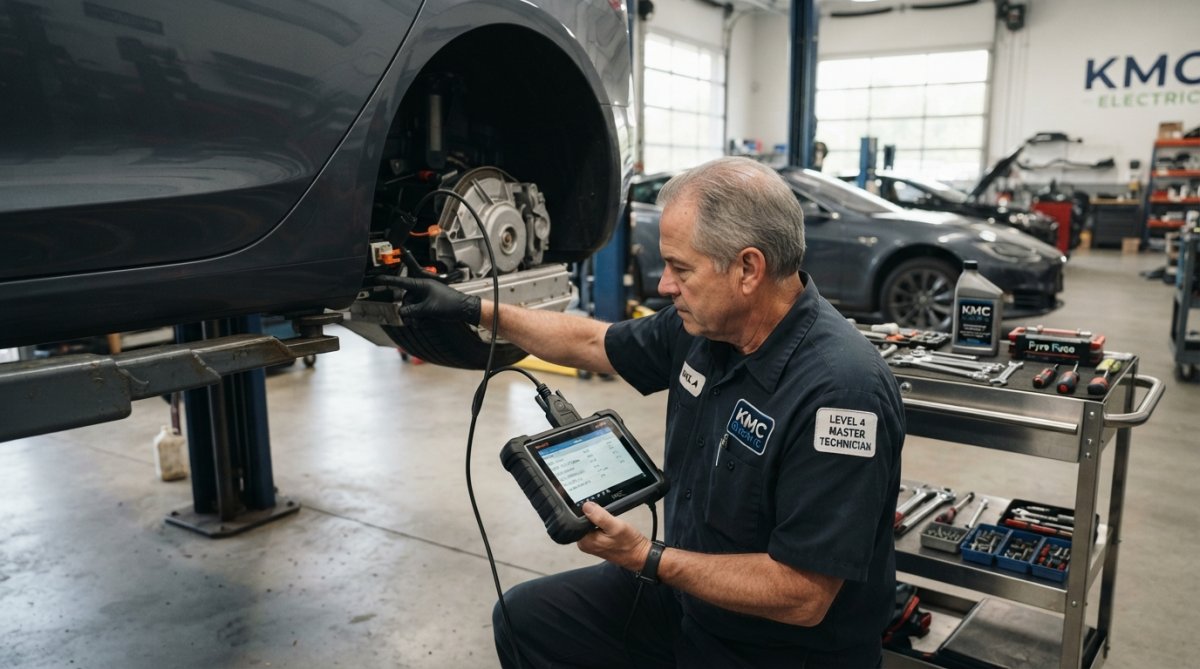
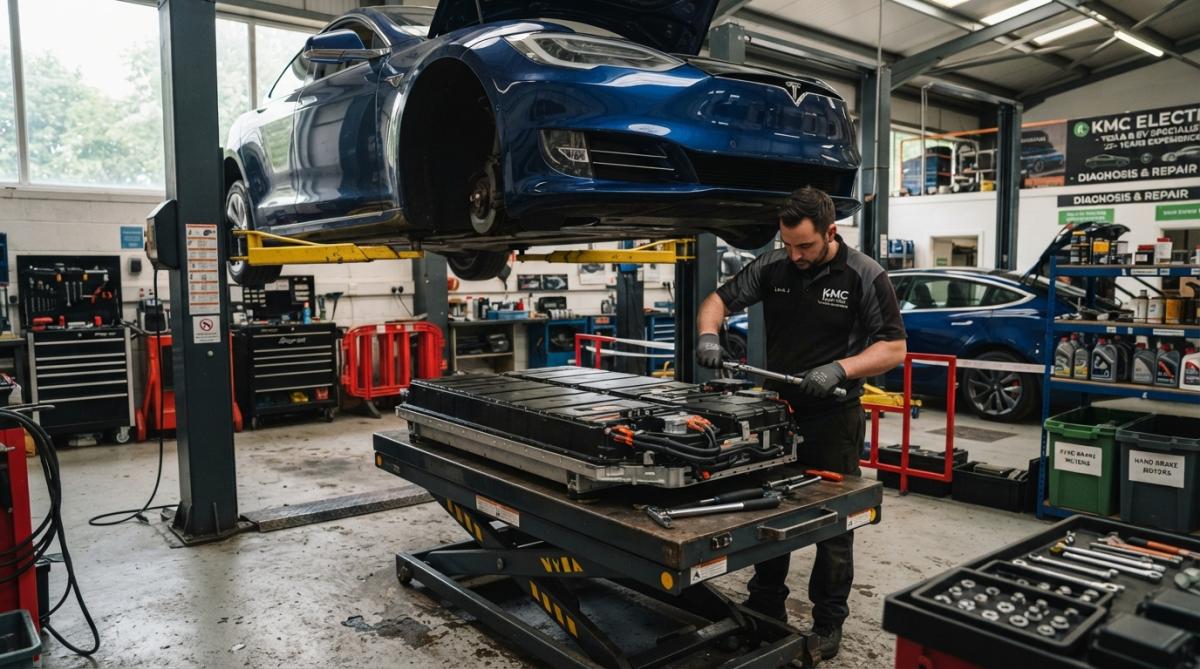
Technician using diagnostic equipment on an electric vehicle battery pack in a professional workshop with overhead lighting, checking State of Health readings on a specialist diagnostic device
However, degradation isn't linear. The first three years see minimal loss, often just 1-2%. The curve steepens between years 3-8, then plateaus. Individual variation is significant, with some vehicles retaining 85% capacity at 150,000 miles whilst others show 75% capacity loss at the same mileage.
Typical degradation patterns
Battery management systems actively protect your pack through thermal management and cell balancing. Real-world data from UK EV owners shows that highway driving in warm weather accelerates degradation slightly compared to city driving. Fast charging also accelerates wear compared to home charging, though modern thermal management minimises this impact.
The State of Health (SOH) metric tells the true story. An 85% SOH battery still delivers excellent range for most daily driving. At 70% SOH, you're approaching the point where range anxiety returns. Below 60% SOH, replacement becomes genuinely necessary.
Factors affecting battery longevity
Temperature is the primary enemy. UK winters are relatively mild, which helps. Consistent exposure to 35°C+ heat accelerates degradation significantly. Cold weather doesn't damage the battery, it just reduces temporary range until the pack warms up.
Charging habits matter more than most owners realise. Consistently charging to 100% and discharging to near-zero accelerates wear. Keeping your battery between 20-80% state of charge extends lifespan by years. Deep discharge events cause measurable stress. Owners who charge frequently and avoid emergency deep discharges see significantly better degradation curves.
Electric Car Battery Replacement Cost UK: Real Figures
Battery replacement costs vary dramatically by vehicle and capacity. A Tesla Model 3 Standard Range battery costs roughly £8,000-£10,000 for OEM replacement. A Model S Long Range reaches £14,000-£16,000. Nissan Leaf batteries fall in the £5,000-£7,000 range. These figures include labour and diagnostics from main dealers.
Independent specialists offer significant savings. At KMC Electric, we've helped owners in Northamptonshire reduce battery replacement costs by 20-30% compared to main dealer pricing, whilst maintaining the same technical standards and warranty coverage.
OEM replacement versus independent specialists
Main dealers offer battery replacement with full OEM warranty, typically 5 years or 100,000 km on the replacement pack. You're paying for brand assurance and the guarantee that parts are genuine. Independent specialists like KMC Electric offer competitive pricing without sacrificing quality. Many use OEM batteries sourced through authorised channels, paired with professional installation and diagnostics.
Watch OutAvoid ultra-cheap battery replacements from unknown suppliers. A £3,000 battery pack from an unverified source might fail within 12 months. The savings aren't worth the risk of a defective pack.
Module replacement as a cost-saving alternative
Not every battery failure means you need a complete pack replacement. Modern EV batteries use modular architecture. If one module fails, replacing just that module costs 30-50% less than a full pack replacement.
This approach works only if the failure is isolated to a single module. If diagnostics show multiple modules degrading simultaneously, full pack replacement is necessary. KMC Electric uses advanced battery diagnostics to identify exactly which modules are failing, which often reveals that module replacement is sufficient.
Electric Car Battery Warranty UK: Coverage and Limits
UK manufacturers typically offer 8-year/160,000 km battery warranties as standard. Tesla's warranty is 8 years and unlimited mileage for Model 3/Y, but only 8 years/160,000 km for Model S/X. Nissan Leaf warranties cover 8 years/100,000 miles. These warranties protect you against manufacturing defects and excessive degradation.
However, warranty coverage has strict limits. Most warranties guarantee 70-75% capacity retention, not 100%. If your battery degrades to 74% capacity, you're within warranty. At 69%, you're outside coverage and replacement is your responsibility.
Standard manufacturer warranty periods
Manufacturer warranties cover defects in materials and workmanship, plus premature degradation caused by manufacturing faults. They do NOT cover degradation from normal use, even if it exceeds the stated retention guarantee.
Warranty coverage also terminates if you've tampered with the battery, used non-approved charging equipment, or failed to follow manufacturer maintenance schedules. Geographic coverage varies. A Tesla purchased in the UK is covered under UK warranty law.
What warranty actually covers
Battery warranty covers sudden failures, not gradual degradation. If your battery pack fails completely due to a manufacturing defect, warranty replacement is free. If your pack gradually loses 5% capacity per year, which is normal, warranty doesn't cover replacement.
Some manufacturers offer "degradation warranties" that cover replacement if capacity drops below a stated threshold (typically 70%) before the warranty expires. Warranty claims require documentation. You'll need service records, charging history, and diagnostic reports showing the battery's State of Health. This is why independent diagnostics from specialists like KMC Electric matter, we provide the technical evidence needed to support warranty claims.
Refurbished EV Batteries UK: A Viable Alternative
Second-life batteries, refurbished packs from accident-damaged or end-of-life vehicles, offer significant cost savings. A refurbished Tesla Model 3 battery might cost £5,000-£7,000 versus £10,000 for OEM. The catch: refurbished batteries carry shorter warranties (typically 2-3 years) and unknown history.
However, refurbished batteries aren't inherently inferior. A pack removed from a 3-year-old vehicle written off due to minor accident damage is mechanically sound. It might have 90% capacity remaining and 5+ years of useful life ahead.
Second-life battery options and longevity
Refurbished batteries come from several sources: vehicles written off after accidents (battery intact), leased vehicles returned after 3 years, or vehicles upgraded to larger batteries. Quality varies significantly by supplier. Reputable suppliers test every battery before resale, providing State of Health reports and warranty coverage.
Longevity depends on the battery's history and your usage. A well-maintained refurbished pack with 85% SOH might deliver 5-7 more years of service. This is why independent diagnostics before purchase are essential.
How to verify refurbished battery quality
Before buying a refurbished battery, demand a State of Health report from an independent specialist. KMC Electric offers pre-purchase battery diagnostics that reveal the pack's actual condition, cycle history, and expected remaining lifespan.
Ask the supplier for documentation of the battery's source. Request a warranty period in writing. Reputable suppliers offer 2-3 year warranties. If a supplier offers "lifetime warranty" on a refurbished battery, that's a red flag.
Signs Your EV Battery Needs Replacement or Repair
Range loss is the primary indicator. If your vehicle's rated range was 300 miles and you now achieve 210 miles after a full charge, you've lost 30% capacity. This is significant degradation warranting investigation. However, range loss can also indicate charging system issues, so diagnostics are essential before assuming battery failure.
Warning lights on your dashboard, particularly battery or powertrain warning lights, signal potential issues. Unusual charging behaviour is another sign. If your vehicle takes significantly longer to charge, charges to a lower maximum capacity, or refuses to fast-charge, battery issues are likely.
Recognising early warning signs
Inconsistent range is often overlooked. If your vehicle delivers 250 miles on one day and 200 miles the next under identical driving conditions, thermal management or cell balancing issues are developing. Battery temperature warnings are significant. If your vehicle displays overheating warnings during normal driving or refuses to charge in warm weather, the thermal management system is struggling.
Unusual noises from the battery pack, clicking, buzzing, or grinding sounds, indicate internal problems. Modern batteries are silent under normal operation. Any noise suggests internal mechanical failure or BMS malfunction.
Battery health diagnostics and State of Health testing
State of Health (SOH) testing provides the definitive answer. SOH measures the battery's actual capacity relative to its original specification. A battery at 85% SOH is healthy. At 70% SOH, replacement is approaching. Below 60% SOH, replacement is necessary.
Professional diagnostics also reveal cell balancing issues, thermal management problems, and BMS faults. KMC Electric uses advanced diagnostic equipment that connects directly to your vehicle's battery management system, pulling detailed data on individual cell voltages, temperature distribution, and charge/discharge cycles. This reveals whether you need full replacement, module replacement, or targeted repair.
Replacing an Old EV Battery vs. Buying a New Car
The decision between battery replacement and buying a replacement vehicle hinges on total cost of ownership over your expected ownership period.
Option A: Replace the battery in your current vehicle. Expected additional service life: 5-7 years. Insurance and maintenance costs: unchanged.
Option B: Sell your current vehicle and buy a used replacement EV. Expected additional service life: 5-7 years. Insurance costs: potentially higher (newer models cost more to insure).
For many owners, Option A costs less over seven years. You avoid the hassle of selling your current vehicle, the risk of inheriting mechanical problems with a replacement, and the insurance premium increase that comes with a newer model.
Total Cost of Ownership comparison
TCO includes purchase/replacement cost, insurance, servicing, parts, tyres, and fuel (electricity). For an EV with a new battery, annual running costs are roughly £800-£1,200 (electricity, servicing, insurance). Over seven years, that's £5,600-£8,400 plus the initial replacement cost.
For a replacement used EV, you're looking at purchase cost plus running costs. The difference narrows when you factor in the hassle of selling your current vehicle. However, if you're in Kettering or Northamptonshire and have access to independent specialists like KMC Electric, battery replacement costs drop by 15-20%, making battery replacement significantly more attractive financially.
Residual value and used EV market implications
A vehicle with a new battery commands a premium in the used market. Buyers are willing to pay 10-15% more for a car with a documented new battery and warranty. This partially offsets your replacement cost.
Conversely, a vehicle with a degraded battery (60-70% SOH) sells for 20-30% less than one with healthy capacity. If you're considering selling, battery replacement before sale often increases your net proceeds despite the upfront cost. A comprehensive battery report from KMC Electric significantly improves your vehicle's marketability.
Independent Battery Diagnostics: Know Before You Decide
Professional battery diagnostics reveal the true condition of your pack, guiding your replacement decision. Without diagnostics, you're making a five-figure decision based on guesswork.
Comprehensive diagnostics include State of Health testing, cell voltage analysis, thermal imaging, charge/discharge curve analysis, and BMS fault code reading. This takes 2-3 hours and costs £150-£300 depending on vehicle complexity.
What a professional battery health check reveals
A professional check identifies whether you need full pack replacement, module replacement, or targeted repair. This distinction can save you £3,000-£5,000. Many owners discover their battery is healthier than they feared, or conversely, that failure is imminent and replacement is urgent.
Diagnostics also reveal whether battery degradation is normal age-related wear or caused by external factors (overcharging, thermal stress, deep discharge events). This information guides your future charging habits to extend the remaining battery life.
How independent specialists support buying and selling decisions
When buying a used EV, arrange a pre-purchase inspection including battery diagnostics. KMC Electric's diagnostic report provides documented evidence of the battery's condition, supporting your negotiation and protecting your investment.
When selling, a battery health report increases buyer confidence and justifies your asking price. For out-of-warranty vehicles, independent diagnostics often reveal that warranty claims are still possible if degradation exceeds manufacturer guarantees. We've helped owners recover significant amounts through successful warranty claims based on our diagnostic evidence.
Decision Point
Battery Replacement
New Vehicle Purchase
Installation Time
1-2 days
Immediate
Warranty Coverage
3-5 years (replacement/refurbished)
Manufacturer warranty
Expected Service Life
5-7 additional years
5-7 years
Insurance Impact
Minimal
Potential increase
Selling Process
Keep current vehicle
Sell current, buy new
Best For
Vehicles worth £10,000+
Vehicles worth <£6,000
Whether it's worth replacing an old electric car battery depends on your vehicle's value, remaining lifespan expectations, and personal circumstances. For most owners with vehicles worth £10,000 or more, battery replacement extends service life cost-effectively. If you're uncertain about your battery's condition, professional diagnostics from KMC Electric reveal the true state of your pack, guiding your decision with technical evidence rather than guesswork. Contact us for a comprehensive battery health assessment and transparent cost analysis tailored to your specific vehicle and situation.
Frequently Asked Questions
How much does it cost to replace an electric car battery in the UK?
EV battery replacement costs vary significantly depending on vehicle model and battery capacity. Costs typically range from £5,000 to £15,000+ for a full pack replacement from main dealers. Independent specialists like KMC Electric often provide more cost-effective solutions through targeted diagnostics and module replacement options rather than full pack replacement. A professional battery health check before committing to replacement can identify whether you actually need a full replacement or if targeted repairs will extend your vehicle's service life.
How long do electric car batteries typically last in the UK?
Modern lithium-ion EV batteries are designed to last 10-15 years or 150,000-200,000 miles, with most manufacturers offering 8-10 year warranties. In the UK, most owners see minimal degradation in the first 5-7 years. Capacity loss typically stabilises at 70-80% of original range after 10 years. Real-world longevity depends heavily on charging habits, thermal management, and driving patterns. Fast charging and deep discharge cycles accelerate degradation, whilst moderate charging and regular use tend to preserve State of Health better.
Are electric car battery replacements covered by warranty in the UK?
Most EV manufacturers offer 8-10 year battery warranties covering defects and significant capacity loss (typically below 70% State of Health). However, warranty coverage varies by brand and model. Gradual degradation from normal use is usually not covered. Damage from misuse, accidents, or extreme conditions may void coverage. If your vehicle is approaching or past its warranty period, independent battery diagnostics from specialists like KMC Electric can verify whether faults are manufacturing defects (potentially claimable) or age-related degradation requiring replacement.
Can old electric car batteries be repaired or refurbished instead of replaced?
Yes, several options exist before full replacement. Module replacement addresses faults in specific battery sections, often costing 30-50% less than pack replacement. Refurbished second-life batteries offer another alternative at reduced cost, though with shorter remaining lifespan. In some cases, Battery Management System recalibration or cell balancing can restore usable capacity. A professional battery health diagnostic is essential to determine whether repair, module replacement, or full replacement is appropriate for your vehicle's condition and remaining service life.
Is replacing an EV battery worth it financially compared to buying a new car?
This depends on your vehicle's current market value, remaining range needs, and total cost of ownership. If your EV still has good mechanical condition and replacement cost is less than 30-40% of its current value, replacement often makes financial sense. However, if the vehicle is significantly depreciated or replacement approaches 50%+ of value, purchasing a newer used EV may be more economical. Independent battery health verification helps establish whether you're facing a £5,000 targeted repair or a £15,000+ full replacement, which dramatically changes the financial equation.