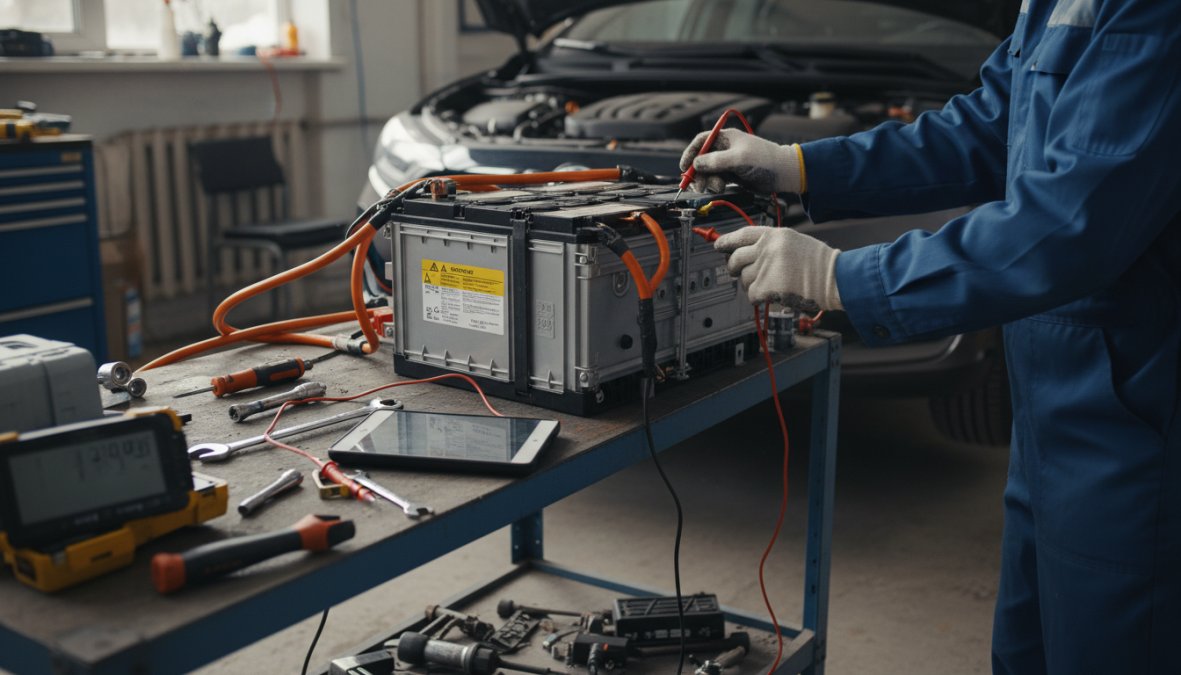
How to Check Hybrid Battery Health: What You Need to Know First
Knowing how to check hybrid battery health is one of the most practical skills any hybrid owner can develop, and this guide from KMC Electric covers every method from basic dashboard observation to professional-grade diagnostics. Capacity degradation often creeps in gradually, showing up as reduced fuel efficiency, sluggish acceleration, or a change in how frequently the internal combustion engine (ICE) kicks in. You do not need to wait for a breakdown to find out where your battery stands.
Below, we cover every reliable method for checking your hybrid battery's condition, from free DIY approaches to professional load testing and voltage balancing checks, plus a used car inspection checklist, warranty nuances, and specific tool recommendations.
The Difference Between Your High-Voltage Hybrid Battery and the 12V Auxiliary Battery
A hybrid vehicle contains two entirely separate battery systems, and confusing them is one of the most common mistakes owners make.
The high-voltage hybrid battery is the large pack (typically NiMH or lithium-ion) that powers the electric motor alongside the ICE, operating at 100V to over 300V. It determines your fuel economy, electric-only range, and long-term running costs.
The auxiliary battery is a conventional 12V lead-acid unit that powers electronics and starts the hybrid system. A dead 12V battery can prevent the hybrid system from initialising, which is sometimes misdiagnosed as high-voltage pack failure. Always check the 12V battery first.
Warning Signs of Hybrid Battery Failure You Should Never Ignore
The signs of hybrid battery failure accumulate over months, and owners rationalise each one away. Do not do that.
The clearest indicators include:
A noticeable drop in fuel economy without a change in driving habits
The ICE running more frequently than usual, even at low speeds
Reduced acceleration or lag when pulling away from a standstill
The battery charge gauge fluctuating erratically or hovering at extremes
The battery cooling fan running continuously or making grinding noises
The car taking longer to warm up its hybrid system in cold weather
The cooling fan behaviour is one that many guides overlook. If that fan is running constantly, it often signals the battery is working harder than it should to maintain a stable state of charge (SOC), pointing to cell failure or voltage delta issues within the pack.
Watch OutIgnoring a cooling fan running constantly is a costly mistake. Sustained heat exposure accelerates capacity degradation across all battery modules, turning a repairable situation into a [full pack replacement](/page/toyota-hybrid-high-voltage-battery-repair).
Dashboard Warning Lights and Diagnostic Trouble Codes (DTCs) to Watch For
The dashboard triangle warning light is the most recognised hybrid system alert, but it tells you very little on its own. The real information sits in the diagnostic trouble codes (DTCs) stored by the hybrid ECU, codes flagging individual module voltage deviations, thermal sensor faults, and SOC calibration errors. Without reading these with an appropriate OBD-II scanner, you are guessing.
Also watch for the charge indicator behaving erratically, EV mode disengaging sooner than expected, and any "Check Hybrid System" message. On some vehicles, a battery health score is accessible through the infotainment system, though this is a simplified metric and not a definitive assessment.
Choosing the Right Hybrid Battery Diagnostic Tool
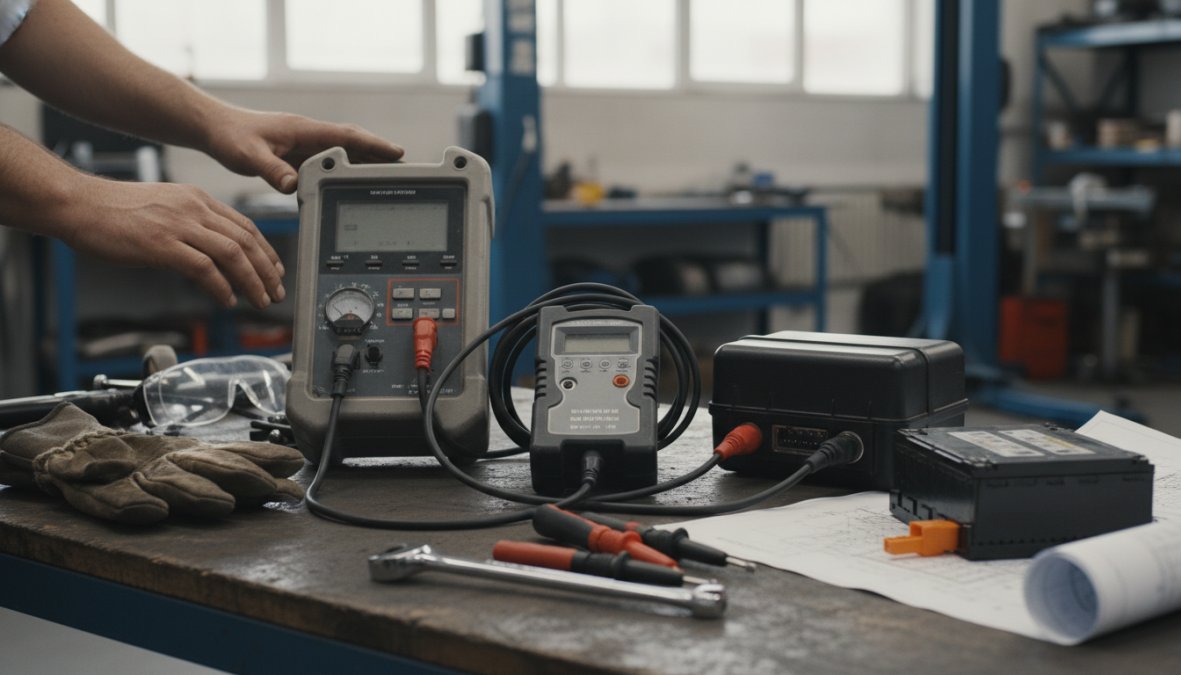
Not all OBD-II scanners read hybrid-specific data. A basic code reader pulls generic engine fault codes but misses battery module voltages, individual cell temperatures, and SOC readings that reveal what is actually happening inside the high-voltage pack. You need a scanner that supports manufacturer-specific protocols, not just the generic OBD-II standard.
Professional illustration showing Close, OBD for how to check hybrid battery health
Using an OBD-II Scanner: Step-by-Step
Total Time: 15-30 minutes Difficulty: Beginner to intermediate
What You'll Need:
A hybrid-compatible OBD-II scanner (see tool recommendations below)
A smartphone or laptop if using a Bluetooth/Wi-Fi adapter
The vehicle's ignition in "Ready" mode (engine not necessarily running)
Locate the OBD-II port. On most vehicles, this sits beneath the dashboard on the driver's side, near the steering column. [Time: 1 minute]
Connect the scanner. Plug in a wired scanner directly, or pair a Bluetooth adapter to your phone. [Time: 2 minutes]
Select the correct vehicle profile. Choose your make, model, and year. Select the hybrid ECU or battery management system (BMS) module, not the generic engine module. [Time: 2 minutes]
Read live data. Navigate to live data or data stream. Look for: battery pack voltage, individual module voltages, SOC percentage, battery temperature readings, and cooling fan status. [Time: 5-10 minutes]
Check for stored DTCs. Run a full system scan across all modules, not just the engine. Record all codes before clearing anything. [Time: 5 minutes]
Note the voltage delta. The difference between the highest and lowest individual module voltage. A healthy pack shows a very small delta; a large delta indicates cell imbalance or a failing module. [Time: 2 minutes]
Expected Result: A list of stored DTCs, a snapshot of module voltages, and a clear SOC reading. Any module deviating significantly from the others warrants further investigation.
Pro TipOn Toyota Prius and many other NiMH hybrid packs, a voltage delta above 0.3V between the highest and lowest module is a reliable indicator that the pack needs professional attention, even if no warning lights are present.
Mobile App Recommendations for Hybrid Battery Diagnostics
Several apps transform a cheap Bluetooth OBD-II adapter into a capable hybrid diagnostic tool:
Hybrid Assistant (Android): Purpose-built for Toyota and Lexus hybrids. Displays individual battery block voltages, SOC, and thermal data in real time with voltage balancing data in an interpretable format.
Dr. Prius / Dr. Hybrid (iOS and Android): Specifically designed for Toyota/Lexus NiMH battery diagnostics. Provides a battery health score, individual block voltage readings, and a capacity test.
Torque Pro (Android): Broader OBD-II app useful for live data monitoring and DTC reading across a wider range of makes.
OBD Fusion (iOS and Android): Strong manufacturer-specific support, works well with vehicles outside the Toyota ecosystem.
The adapter matters as much as the app. The Vgate vLinker series and OBDLink MX+ are consistently reliable choices that handle hybrid-specific protocols without dropping connections.
How to Check Hybrid Battery Health Yourself vs. Using a Professional
DIY diagnostics using OBD-II tools and mobile apps are genuinely useful for ongoing monitoring and catching early warning signs. The limitation is that consumer-grade tools cannot perform a full load test or accurately measure true remaining capacity under real-world discharge conditions.
A professional hybrid battery check goes further in three specific ways.
What a Professional Load Test and Voltage Balancing Check Reveals
A professional load test subjects the battery pack to a controlled discharge while monitoring each module's voltage response under load, revealing weaknesses that do not appear at rest. A module might read a normal voltage when idle but drop sharply under load, indicating degraded chemistry and reduced capacity.
Voltage balancing analysis maps the SOC across all modules simultaneously. Imbalanced modules force the battery management system to work harder, accelerating degradation in weaker cells and increasing self-discharge rate across the pack.
At KMC Electric in Kettering, Northamptonshire, professional hybrid battery diagnostics include a full health assessment covering both the high-voltage pack and the 12V auxiliary battery. With Level 4 Master Technician status in EVs and over 25 years of automotive experience, the team provides independent battery health verification that is particularly valuable for out-of-warranty vehicles.
How Long Do Hybrid Batteries Last and What Affects Their Lifespan?
Hybrid batteries generally last between 8 and 15 years or 100,000 to 150,000 miles under typical conditions, varying by model, chemistry, and usage. NiMH packs are more tolerant of charging abuse than lithium-ion packs, which offer higher energy density but are more sensitive to thermal stress.
The odometer reading alone is a poor indicator. A vehicle with 80,000 motorway miles may have a healthier pack than one with 40,000 city miles, because short stop-start trips prevent the battery reaching optimal operating temperature and place more stress on charge cycles.
Heat, Thermal Management, and Charging Habits: The Key Factors
Heat is the primary enemy of battery longevity. Sustained high temperatures accelerate chemical degradation inside battery modules, permanently reducing capacity. A blocked cabin air intake or a failing cooling fan can cause the pack to run hotter than designed, shortening service life significantly. On many Toyota hybrids, the cabin air intake feeding cool air to the battery is a common maintenance oversight.
Charging habits matter on plug-in hybrid models. Consistently charging to 100% and depleting to near zero stresses lithium-ion chemistry more than keeping the SOC between 20% and 80%. Many plug-in hybrid vehicles now include charge limit settings for this reason.
Key TakeawayThe single biggest factor in hybrid battery longevity is thermal management. Keeping the battery cooling system clean and functional extends service life more reliably than any other maintenance step.
How to Extend Hybrid Battery Life: Practical Steps That Actually Work
Practical steps that make a measurable difference:
Keep the battery cooling intake clear. On Toyota Prius models, the cabin air intake for the battery cooling fan sits in the rear passenger footwell or boot area. A blocked filter raises battery temperature.
Avoid prolonged full-charge and full-discharge cycles on plug-in hybrids. Partial cycles are gentler on lithium-ion chemistry.
Service the 12V auxiliary battery on schedule. A failing 12V battery places additional load on the high-voltage pack.
Use regenerative braking actively. Smooth, anticipatory driving reduces the number of deep charge cycles the battery undergoes.
Monitor fuel efficiency trends. A gradual mpg decline over several months without a change in driving conditions is one of the earliest signs of capacity degradation.
Avoid extreme temperatures where possible. Park in shade during summer and allow the vehicle to warm up briefly before demanding high-torque acceleration in cold weather.
Professional illustration showing car and person and casual concepts for how to check hybrid battery health
Cooling system maintenance is far more impactful than driving style changes. A clean intake and a functioning fan are worth more than a thousand miles of gentle acceleration.
Used Car Inspection Checklist: Checking Hybrid Battery Health Before You Buy
Buying a used hybrid without checking the battery health is one of the costlier mistakes a car buyer can make. The high-voltage pack is the most expensive component on the vehicle, and its condition is rarely reflected in the asking price.
Used hybrid battery inspection checklist:
Connect an OBD-II scanner and read hybrid system DTCs before starting the engine
Check individual module voltages using a hybrid-specific app (Dr. Prius or Hybrid Assistant)
Note the voltage delta across all modules (flag anything above 0.3V on NiMH packs)
Start the vehicle and monitor the battery cooling fan for unusual noise or continuous running
Drive the vehicle and observe how frequently the ICE engages at low speeds
Check the fuel efficiency display against the manufacturer's claimed figures
Inspect the 12V auxiliary battery condition and age
Ask for any service history relating to the hybrid battery or hybrid system
Check the odometer reading against battery age, not just vehicle age
Request an independent battery health assessment from a qualified EV specialist
(/page/pre-purchase-inspection): Checking Hybrid Battery Health Before You Buy]
For buyers in Kettering or the wider Northamptonshire area, an independent pre-purchase inspection from a specialist like KMC Electric provides battery health verification that neither the seller nor a general mechanic can match.
Warranty Coverage Nuances: What Is and Is Not Included
Hybrid battery warranty coverage varies significantly between manufacturers and is more nuanced than most buyers realise. Most manufacturers offer a separate, longer warranty on the hybrid battery pack, but this typically covers defects in materials and workmanship, not capacity degradation unless it falls below a defined minimum (commonly 70-80% of original capacity).
Key points to understand:
Capacity degradation is often excluded unless it falls below the manufacturer's specified threshold
Third-party servicing may affect warranty validity if the provider lacks recognised high-voltage qualifications
Warranty transfer to subsequent owners is not automatic in all cases
Extended warranty products sold at point of sale vary enormously in hybrid-specific coverage
Hybrid Battery Replacement Costs and Whether Reconditioning Is Worth It
Hybrid battery replacement costs vary by make, model, and whether you opt for a new, remanufactured, or reconditioned pack. New OEM packs from main dealers are the most expensive route. Remanufactured packs offer a middle ground. Reconditioned packs involve replacing failed modules and rebalancing the remaining cells.
Reconditioning is worth investigating when only a small number of modules have failed and the rest of the pack retains reasonable capacity. The honest caveat: a poorly reconditioned pack using mismatched cells with different self-discharge rates will develop voltage imbalance quickly and fail sooner than expected. Choosing a qualified specialist matters.
Option
Cost Range (Approx.)
Warranty
Best For
OEM new pack (main dealer)
High
Full manufacturer warranty
New or near-new vehicles
Remanufactured pack (specialist)
Medium
Varies by supplier
Mid-age vehicles
Reconditioned pack (module replacement)
Lower
Depends on specialist
Older vehicles, partial failure
Individual module replacement
Lowest
Workshop guarantee
Single module failure
For hybrid owners in Kettering and the surrounding Northamptonshire region, an independent assessment of whether reconditioning is viable before committing to a full replacement can save a significant sum. A specialist with genuine EV diagnostic capability can identify exactly how many modules have failed and whether the remaining cells are worth building around.
The challenge most hybrid owners face is not a lack of information; it is the absence of a trusted specialist who can translate raw diagnostic data into a clear recommendation. KMC Electric, based in Kettering, offers independent battery health verification, professional hybrid diagnostics, and practical repair options backed by Level 4 Master Technician EV qualifications and over 25 years of hands-on automotive experience. Whether you are monitoring an existing vehicle, preparing for a service decision, or inspecting a used car before purchase, get a professional assessment from KMC Electric and know exactly where your hybrid battery stands.
Frequently Asked Questions
How do I know if my hybrid battery is dying?
The most common signs of hybrid battery failure include a noticeable drop in fuel efficiency, the hybrid system warning light or dashboard triangle light illuminating, reduced power and torque during acceleration, and the internal combustion engine running more frequently than usual. You may also notice erratic state of charge (SOC) readings on your dashboard. If you spot any of these symptoms, running an OBD-II scanner to retrieve diagnostic trouble codes (DTCs) is a sensible first step before seeking a professional assessment.
Can you test a hybrid battery with a multimeter?
A standard multimeter can check your 12V auxiliary battery voltage but is not suitable for testing the high-voltage hybrid battery pack safely. The high-voltage battery requires specialist equipment, including an OBD-II scanner capable of reading hybrid-specific data such as voltage delta between battery modules, state of charge, and individual cell failure codes. Attempting to probe a high-voltage hybrid battery pack without proper training and equipment poses a serious safety risk and is strongly discouraged.
What hybrid battery diagnostic tool should I use at home?
For DIY hybrid battery diagnostics, a Bluetooth OBD-II scanner paired with a compatible mobile app is the most accessible option. Apps such as Torque Pro (Android) and OBD Fusion (iOS and Android) can display live data including state of charge, battery module voltages, and diagnostic trouble codes. For Toyota and Lexus hybrids, the Dr. Prius app is particularly well-regarded for reading hybrid battery health scores and individual cell data. Always verify your scanner supports enhanced hybrid protocols before purchasing.
How often should you check hybrid battery health?
As a general guideline, it is worth checking your hybrid battery health at least once a year or every 12,000 miles — whichever comes first. If your vehicle is approaching or beyond its manufacturer warranty period, more frequent checks are advisable. A pre-purchase inspection is also essential when buying a used hybrid. Regular monitoring of fuel efficiency trends and dashboard warning lights between formal checks can help you catch early signs of capacity degradation before they become costly problems.
Is it worth replacing a hybrid battery, or should I recondition it?
Whether to replace or recondition a hybrid battery pack depends on the extent of cell failure and capacity degradation. Reconditioning — which involves deep cycling individual battery modules to restore voltage balancing — can extend service life at a lower cost than full replacement, but it is only effective when individual modules are still viable. A full replacement is typically necessary when multiple modules have failed or overall capacity has dropped significantly. An independent specialist can assess which option offers better long-term value for your specific vehicle.
How long do hybrid car batteries typically last?
Hybrid battery packs — whether nickel-metal hydride (NiMH) or lithium-ion — are generally designed to last between 8 and 15 years or 100,000 to 150,000 miles under normal driving conditions. Actual service life varies depending on factors such as climate, thermal management system condition, driving habits, and how well the cooling fan and battery chemistry have been maintained. Many hybrids exceed these estimates with proper care, while others may show capacity degradation earlier if driven in extreme heat or with a neglected cooling system.