Can You Repair an EV Battery Pack? A 2026 UK Guide
Last Updated: July 27, 2026
Can you repair an electric vehicle battery pack? The short answer is yes, but not always in the way you might expect. At KMC Electric, we work with EV owners and dealerships across the UK who face battery issues, and the reality is far more nuanced than "replace or repair." Some components within a battery pack can be fixed. Others cannot. Understanding the difference is critical before you commit to any service.
This guide covers what can and cannot be repaired in an EV battery pack, the real costs involved, safety considerations, and how to find qualified technicians in Kettering and across Northamptonshire who can actually help.
Can You Repair an EV Battery Pack? The Short Answer
Yes, specific components within an electric vehicle battery pack can be repaired, but the battery pack itself cannot be repaired in the traditional sense. When technicians talk about "repairing an EV battery pack," they're usually referring to replacing individual failed modules, rebalancing cells to restore capacity, or repairing the battery management system (BMS). These interventions can extend pack life without the cost of complete replacement. However, if cells have suffered physical damage, thermal events, or irreversible chemical degradation, replacement is the only option.
The distinction hinges on what's actually failed. A faulty connector, malfunctioning BMS, or degraded module can be fixed. Widespread cell failure cannot. This is why professional diagnostics matter before any decision.
What Parts of an EV Battery Pack Can Actually Be Repaired
An electric vehicle battery pack is not monolithic. It's a system of interconnected components, and some are repairable whilst others are not.
Battery Management System (BMS) Repairs
The battery management system is the electronic brain of your pack. It monitors cell voltage, temperature, and charge state across the entire assembly. When the BMS fails, the vehicle often reports phantom warnings, refuses to charge, or shows inaccurate state of health readings, even though the cells themselves are fine.
BMS repairs are among the most cost-effective interventions available. A faulty BMS can often be reprogrammed, recalibrated, or replaced without touching a single battery cell. At KMC Electric, we've diagnosed countless cases where owners were quoted replacement costs only to discover the actual issue was a BMS fault requiring a fraction of that investment. Restoring BMS function can recover 10-15% of lost capacity in some cases.
Module Replacement and Cell Balancing
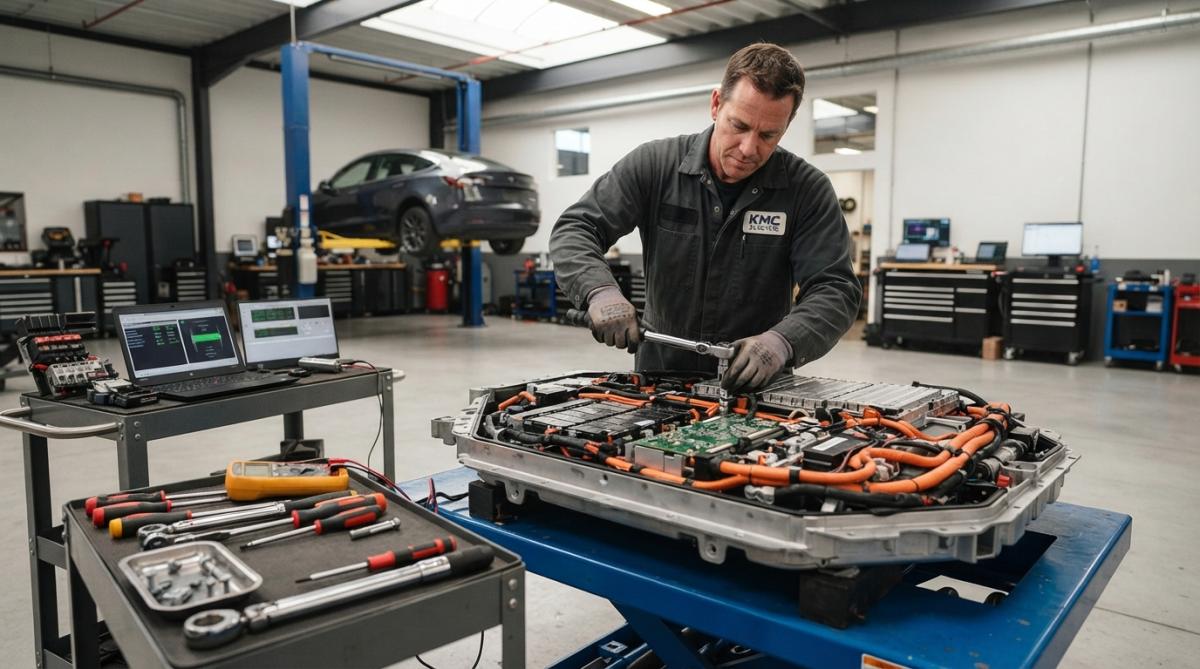
A modern EV battery pack contains dozens of individual modules, each containing multiple cells. If one module fails due to manufacturing defect, thermal damage, or age-related degradation, that module can often be replaced without replacing the entire pack. Module replacement requires specialist equipment to safely disconnect high-voltage components, extract the failed module, and integrate a replacement. Remanufactured modules offer a cost-effective alternative to new ones.
Cell balancing, the electronic equalisation of voltage across cells, can be performed on a functioning pack to restore capacity and extend lifespan. If your pack has drifted out of balance due to age or storage, professional rebalancing can recover lost capacity without physical repairs.
High-Voltage Connector and Safety System Repairs
Battery packs connect to the vehicle's high-voltage system through connectors and contactors. These components can fail, corrode, or develop poor connections. A corroded connector can cause voltage drop, reduced power delivery, and false error codes. These are repairable.
Safety systems, including thermal fuses, pyrotechnic disconnects, and pressure relief valves, can also be serviced or replaced. The Pyro Fuse component from KMC Electric is one such critical safety component that can be replaced if it fails. Connector and safety system repairs are typically straightforward and significantly cheaper than cell or module replacement.
Repair vs. Replacement: Understanding Your Options
The choice between repair and replacement hinges on three factors: the nature of the failure, the age and remaining lifespan of the pack, and the economics of each option.
Repair makes sense when:
The failure is isolated to the BMS, a single module, or connectors
The remaining cells are in good health and can deliver years of service
The cost of repair is less than 40-50% of replacement cost
The vehicle has resale value and longevity ahead of it
Replacement makes sense when:
Multiple modules have failed or show signs of imminent failure
The pack has suffered thermal damage or physical puncture
The state of health has degraded below 70% and continues declining rapidly
The repair cost approaches or exceeds replacement cost
Many owners assume any battery problem requires complete replacement. This assumption costs thousands of pounds unnecessarily. A professional diagnosis identifies exactly what's failed and what repair options are available before any decision is made.
EV Battery Warranty UK: What Repair Means for Your Coverage
Most EV manufacturers in the UK market offer 8-year, 100,000-mile battery warranties as standard. These warranties cover defects in materials and workmanship but typically do NOT cover degradation due to normal use.
UK consumer law, under the Consumer Rights Act 2015, grants you the right to repair your vehicle at any competent service provider without automatically voiding your warranty. The manufacturer cannot void your entire warranty because you used an independent technician; they can only deny claims directly related to that repair if they can prove the independent repair caused additional damage.
For in-warranty vehicles considering repair rather than replacement, contact the manufacturer with diagnostic findings and request they cover the repair under warranty if the failure is a defect. If they refuse, you have the right to repair independently without losing coverage on other components. For out-of-warranty vehicles, you can repair with any qualified technician without warranty implications.
Electric Car Battery Lifespan UK and Degradation Signs
Modern EV batteries are engineered to last the life of the vehicle. Most manufacturers guarantee that the pack will retain 70-80% of its original capacity after 8 years or 100,000 miles. In practice, many packs exceed these targets significantly. Degradation is not linear; a battery might lose 5% of capacity in the first year, then stabilise at 0.5% per year for the next seven years.
Recognising Battery Health Decline
The most obvious sign of degradation is reduced range. If your vehicle's advertised range was 300 miles when new and now delivers 240 miles at full charge, you've experienced a 20% capacity loss.
Charging speed can also decline. A pack with degraded cells may charge more slowly, especially at high power levels. Uneven power delivery during acceleration can indicate cell imbalance rather than overall capacity loss, which is often repairable through rebalancing or BMS repair.
Battery management warnings are the clearest signal. If your vehicle displays battery health warnings, reduced power mode, or charging restrictions, the BMS has detected a problem. Only diagnostics can determine whether it's a BMS fault, thermal issue, or degraded module.
State of Health (SOH) Testing and Diagnostics
State of health (SOH) is a technical measure of your battery's remaining capacity relative to its original specifications. A battery with 85% SOH still has 85% of its original capacity.
SOH testing requires specialist equipment and software. A proper diagnostic can take 2-4 hours and involves charging and discharging cycles under controlled conditions, thermal imaging, voltage monitoring, and BMS data analysis. SOH determines whether repair or replacement makes sense. A pack at 75% SOH with a single failed module is worth repairing. A pack at 50% SOH with the same failure is not. At KMC Electric, we provide independent battery health verification for buyers and sellers, giving you a clear picture before any decisions are made.
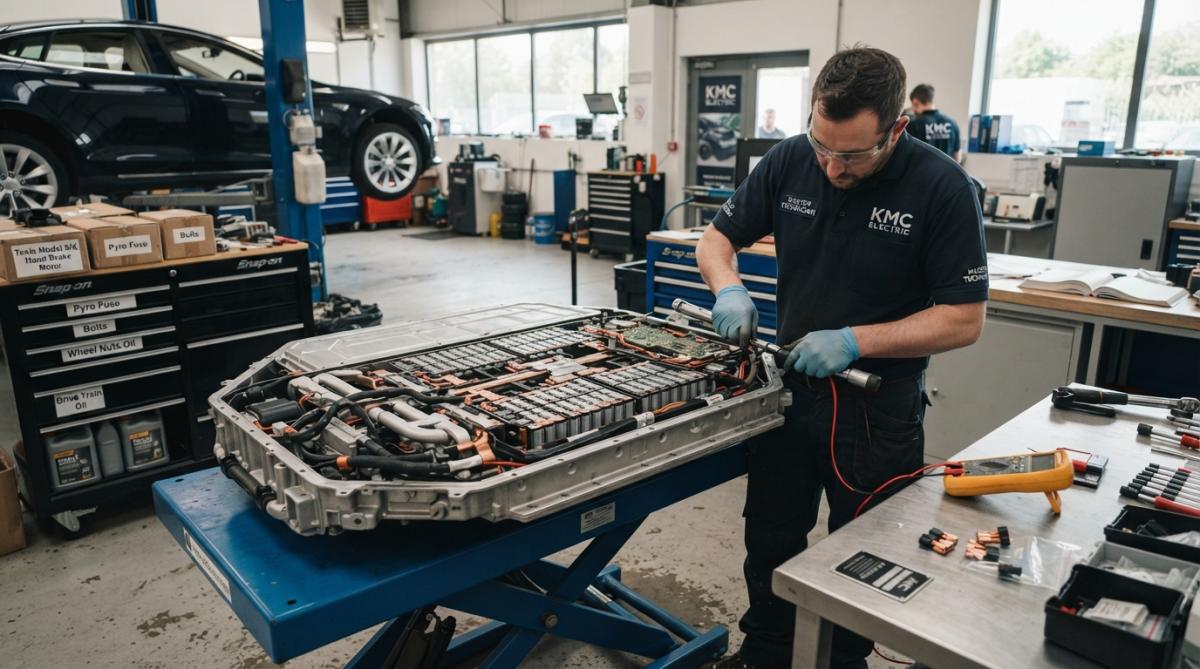
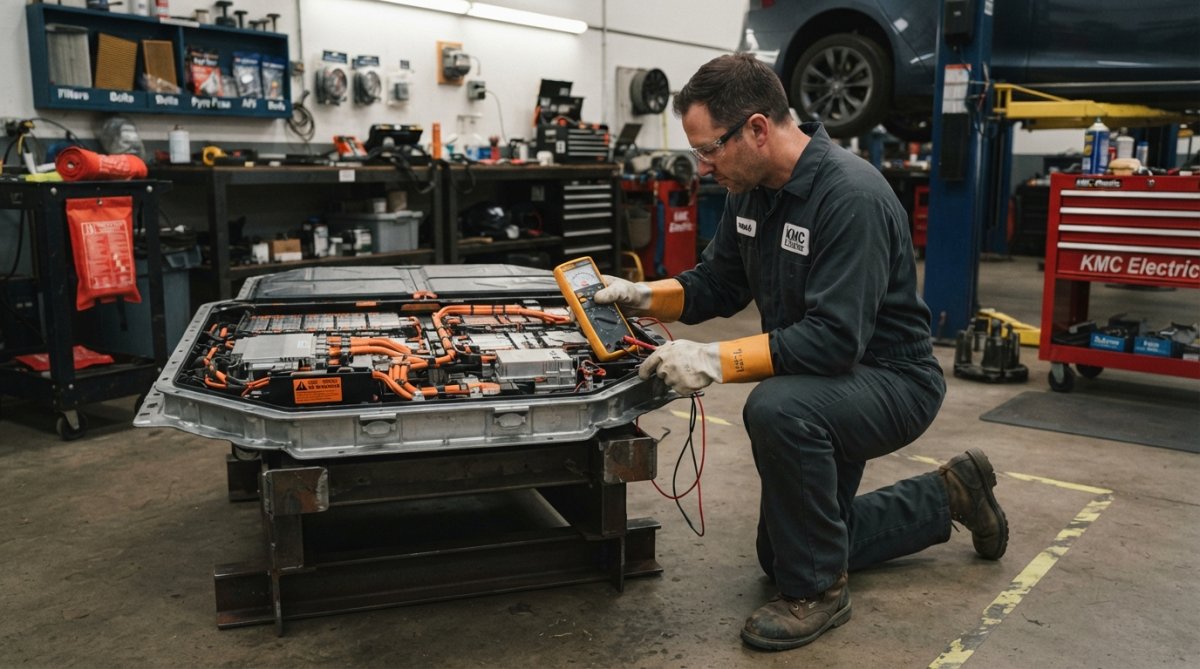
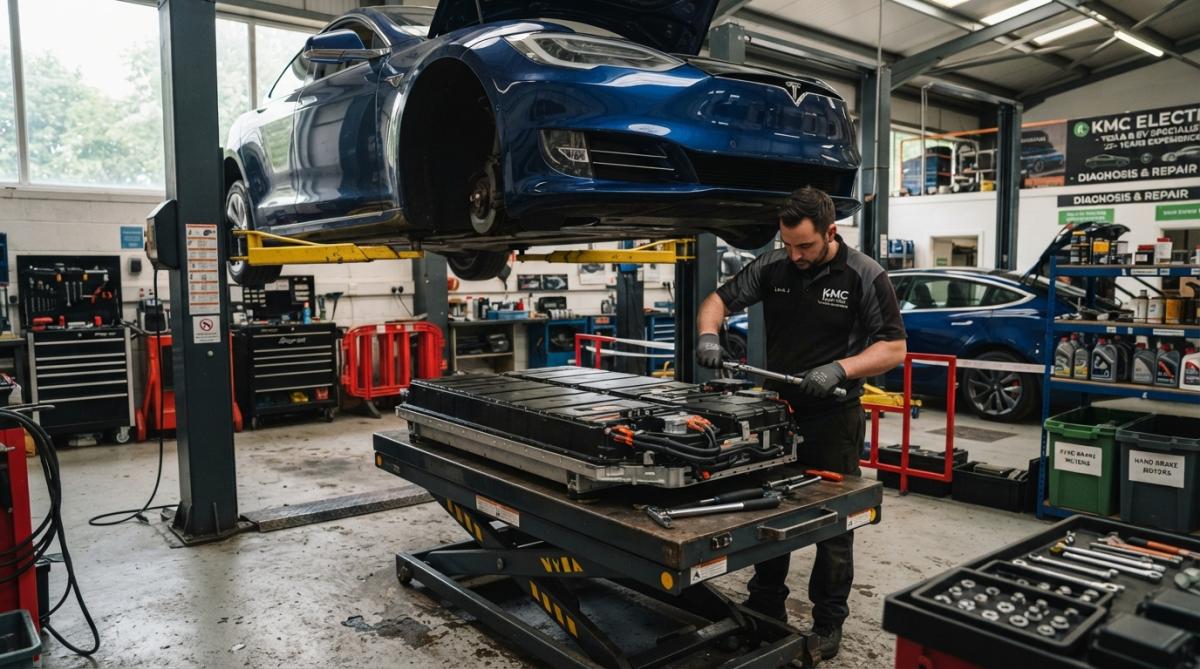
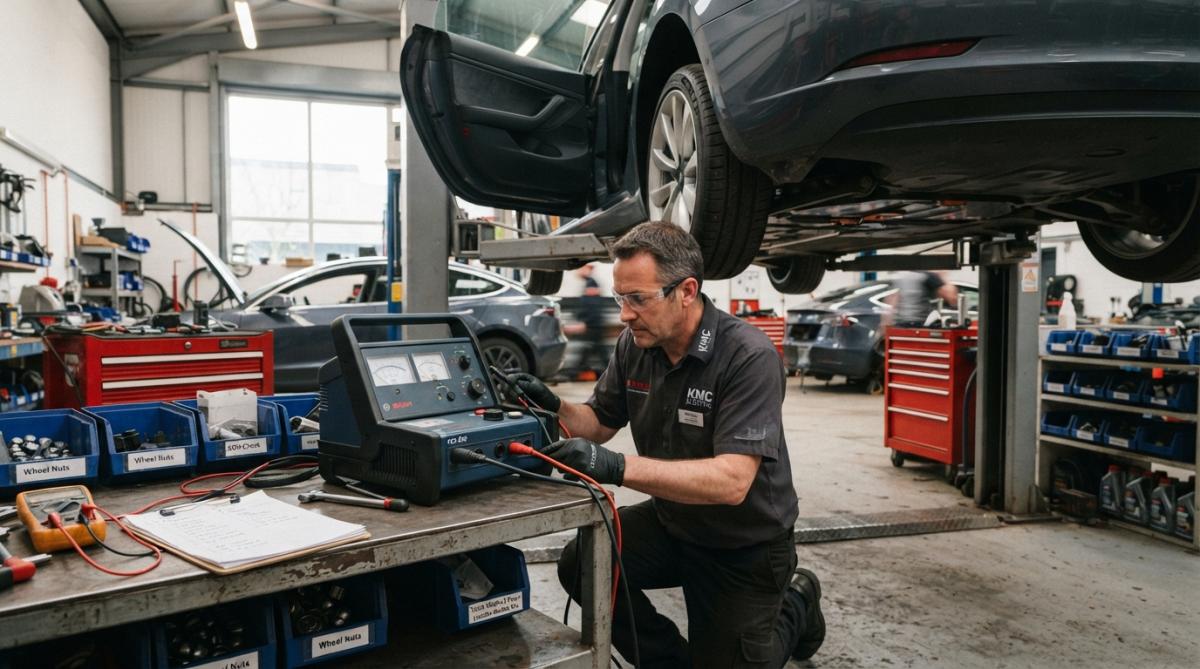
Qualified EV technician in safety equipment performing battery diagnostics on an electric vehicle in a professional workshop setting, with high-voltage testing equipment visible
Safety Risks: Thermal Events and Pack Integrity
Battery repair is not a DIY activity. High-voltage systems in EV packs operate at 400-800 volts, enough to cause fatal electrocution. Thermal runaway, a chain reaction where cells overheat uncontrollably, can occur if a pack is damaged or improperly handled during repair. A cell that enters thermal runaway can reach temperatures exceeding 500°C, igniting the electrolyte and potentially spreading to adjacent cells.
Battery repair must only be performed by technicians trained in high-voltage safety, thermal management, and emergency protocols. Pack integrity refers to the physical and electrical soundness of the entire assembly. A pack that has been dropped, punctured, or exposed to extreme cold can develop internal shorts that are invisible from the outside.
Professional repair facilities maintain thermal imaging equipment, insulated tools, fire suppression systems, and trained personnel. They follow strict protocols to isolate the pack, discharge residual voltage safely, and test every component before reassembly. If you've experienced significant impact, extreme thermal exposure, or water damage, have the pack inspected by a specialist before attempting any repair.
Finding Specialist EV Battery Repair UK Technicians
The market for EV battery repair in the UK is fragmented. Main dealers offer repairs at premium prices. Independent specialists vary wildly in competence and equipment. Finding a qualified technician requires checking credentials, understanding their diagnostic process, and verifying their experience with your vehicle's specific pack architecture.
Qualifications and Certifications to Look For
In the UK, there is no single mandatory certification for EV battery repair, though the industry is establishing standards. Legitimate specialists have:
Level 4 Master Technician status in electric vehicles (the highest independent certification available)
High-voltage safety training from an accredited provider (usually 40+ hours of formal training)
Manufacturer-specific training for the vehicles they service
Diagnostic equipment that can interface with the vehicle's BMS and read live data
Insurance and liability coverage for high-voltage work
Verifiable track record with customer references
KMC Electric holds Level 4 Master Technician status in electric vehicles and has maintained EV qualifications since 2016. Ask any technician you're considering: What formal high-voltage training have you completed? How many EV battery repairs have you performed? What diagnostic equipment do you use? Are you insured for high-voltage work? Can you provide customer references? A technician who answers these questions confidently and specifically is worth considering.
DIY vs. Professional Repair: Why Professional Matters
The temptation to save money by attempting DIY battery repair is understandable. It's also dangerous and, in most cases, impossible. EV battery packs are sealed systems requiring proper isolation and discharge procedures; skip these, and you risk electrocution or fire. Cell replacement requires matching chemistry, voltage, and capacity specifications; using mismatched cells creates imbalances that accelerate failure.
DIY repair voids your warranty entirely and voids your insurance if the vehicle is involved in an accident. Professional repair is worth the cost because it's safe, warrantied, and done right the first time.
EV Battery Replacement Cost UK and Repair Economics
Battery replacement is expensive. A new battery pack for a Tesla Model 3 can cost between £10,000 and £15,000 fitted. For larger vehicles like the Model S or X, costs approach £20,000 or more.
Repair costs are substantially lower. A BMS replacement might cost £1,500-£3,000. A single module replacement could be £3,000-£6,000. Cell rebalancing might cost £500-£1,500.
The economics of repair vs. replacement depend on the vehicle's remaining lifespan and resale value. Repairing a 10-year-old vehicle with significant other wear might not make sense if the repair cost exceeds the vehicle's value. Repairing a 3-year-old vehicle with low mileage makes excellent sense. A 2020 Tesla Model 3 with 60,000 miles experiencing BMS failure has 6 years remaining on its manufacturer warranty. A BMS replacement costs £2,000. The repair extends the pack's life by 5-7 years. The economics are clear: repair is the right choice.
By contrast, a 2015 Tesla Model S with 120,000 miles and a degraded pack (65% SOH) needing a new module faces a £5,000 repair cost. The vehicle's current market value is £8,000-£10,000. The owner might decide the repair isn't justified because the vehicle will likely be retired within that timeframe.
The key is getting accurate diagnostics before making the decision. A professional SOH test reveals the pack's remaining life. A BMS diagnostic reveals whether repair or replacement is necessary.
Decision Factor
Favours Repair
Favours Replacement
Vehicle age
Under 5 years
Over 8 years
Current SOH
Above 75%
Below 60%
Failure type
Single module, BMS
Widespread cell degradation
Repair cost vs. vehicle value
Under 30%
Over 50%
Remaining warranty
In warranty
Expired 2+ years ago
Vehicle's market value
£10,000+
Under £5,000
Deciding whether to repair an EV battery pack depends entirely on what's actually failed and what your vehicle's future looks like. Most battery issues are repairable at a fraction of replacement cost, but only if you get a proper diagnosis first. KMC Electric provides independent battery health verification and repair diagnostics across Kettering and Northamptonshire, identifying exactly what's failed and what options are available before any commitment is made. With over 25 years of automotive experience and Level 4 Master Technician status in electric vehicles, we offer a transparent alternative to main dealer pricing and the expertise to extend your vehicle's service life cost-effectively.
Frequently Asked Questions
Can you repair an EV battery pack, or do you always need full replacement?
Many EV battery pack issues can be repaired without replacing the entire unit. Common repairs include fixing the battery management system (BMS), replacing individual modules, rebalancing cells, and addressing high-voltage connector problems. However, severe internal cell damage, thermal events, or extensive capacity degradation typically require full pack replacement. A qualified technician can diagnose which approach is appropriate for your vehicle through battery health checks and diagnostics.
How much does EV battery repair cost in the UK compared to replacement?
EV battery repair costs vary widely depending on the fault. BMS repairs or module replacement typically cost significantly less than a full pack replacement, which can exceed £10,000-£15,000 for many models. Diagnostic testing costs between £200-£500 and reveals whether repair is viable. Getting an independent battery health report before committing to repairs helps you understand true costs and avoid unnecessary work. Specialist independent technicians often provide more cost-effective solutions than main dealers.
Will repairing my EV battery pack void my warranty?
This depends on your vehicle's warranty terms and where the repair is performed. Main dealer repairs typically maintain warranty coverage, but third-party repairs may affect it. Some manufacturers allow repairs at independent specialists without voiding warranty if the technician is properly qualified and the work meets safety standards. Always check your warranty documentation and ask your technician how their work affects your coverage. Independent specialists like KMC Electric can advise on warranty implications before work begins.
How long do electric car batteries last in the UK, and what are the warning signs?
Most modern EV batteries are designed to last 8-10 years or 100,000-200,000 miles, though many retain 80%+ capacity well beyond this. Warning signs include reduced range, slower charging, battery warning lights, or unusual thermal events. State of health (SOH) testing reveals actual degradation levels. Regular diagnostics catch problems early, often before they become expensive repairs. Checking battery health before buying a used EV or when your car reaches high mileage helps identify issues before critical failure.