Is Tesla Battery Repair Possible? The Short Answer
Yes, many Tesla battery issues are repairable, but whether repair makes financial sense depends on what's wrong. At KMC Electric, we've diagnosed hundreds of Tesla battery issues across all models. Some problems are straightforward to fix; others require full pack replacement costing more than many used cars.
Battery Management System (BMS) faults, cell balancing problems, and thermal management issues often respond to recalibration or targeted repairs. However, catastrophic pack degradation, internal short circuits, or physical damage typically demand complete replacement. Independent specialists can often diagnose and repair these issues far more cost-effectively than Tesla Service Centres.
Below, we'll walk you through which battery problems are fixable, which require replacement, what your warranty covers, and how to navigate repair options without financial devastation.
Understanding Tesla Battery Structure and Common Failures
Your Tesla's high-voltage battery pack contains thousands of individual lithium-ion cells organised into modules, all managed by a sophisticated Battery Management System that monitors voltage, temperature, and charge flow in real time.
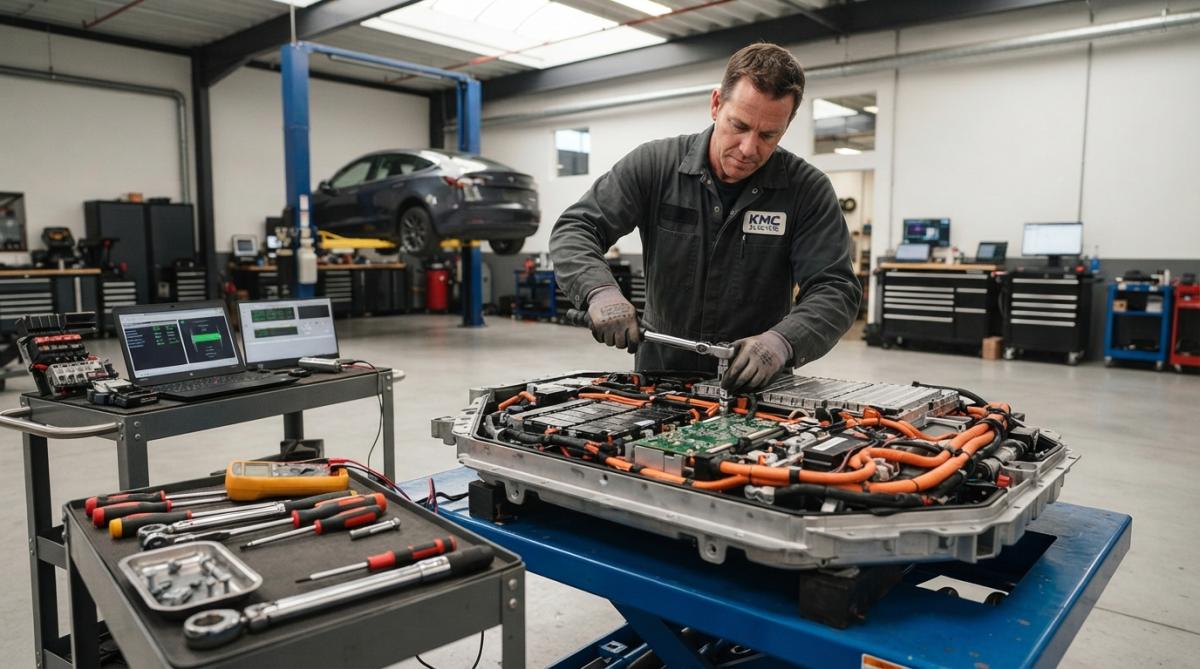
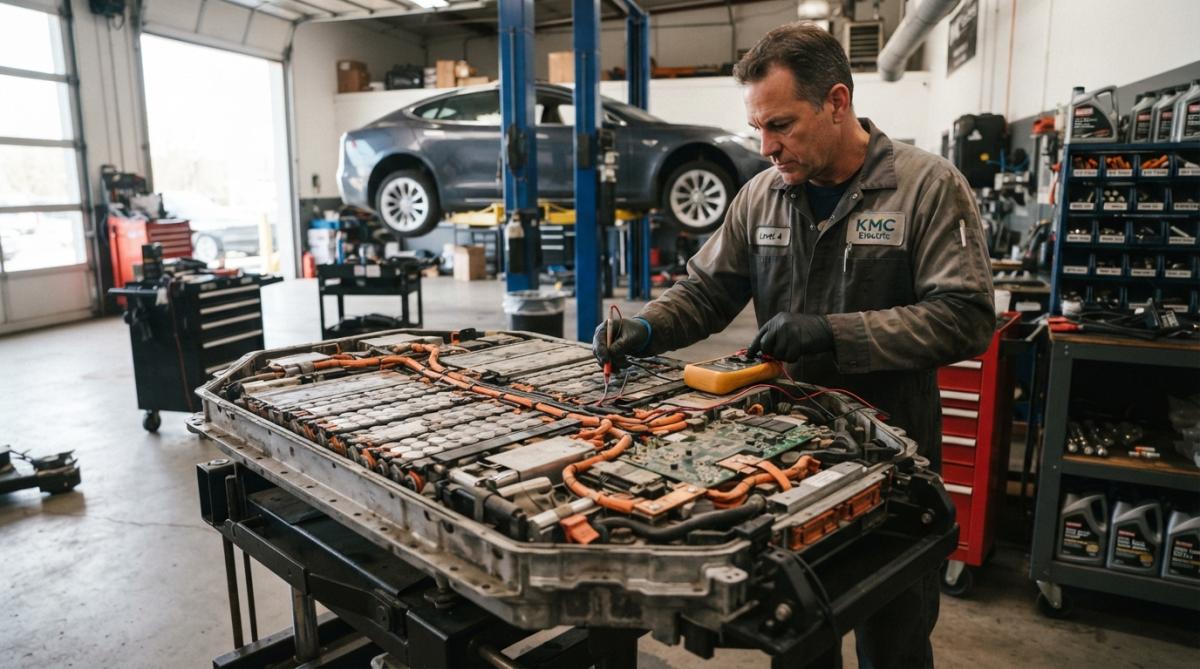
Close-up of a technician in safety equipment inspecting a Tesla battery pack module under bright workshop lighting, with diagnostic equipment visible on the workbench
Common failures fall into distinct categories. Capacity loss, where your car won't hold a full charge, is often gradual and linked to normal degradation. Voltage drop across modules can trigger warning lights and reduced performance. Thermal management failures prevent proper cooling during fast charging or hot weather, accelerating degradation. BMS faults are software or sensor issues causing the system to misread the battery's actual state, sometimes triggering warnings when the pack itself is fine.
A BMS recalibration might cost a few hundred pounds and take an afternoon. A module replacement could run into thousands. A full pack replacement means five figures.
Pro TipRequest a detailed diagnostic report from any specialist before committing to repairs. A proper diagnosis identifies whether the issue is reversible (BMS, thermal, cell balancing) or terminal (internal short, catastrophic degradation). This single step saves most owners thousands of pounds.
Repairable vs Non-Repairable Battery Issues Explained
Repairable issues typically involve the BMS, thermal system, or cell balancing. If your car shows "Battery Service Required" but holds charge reasonably well, the problem is often a sensor fault or recalibration issue. Cell balancing problems can sometimes be corrected by controlled charging cycles or by replacing a single faulty module rather than the entire pack. Thermal management faults may be fixable by flushing the thermal loop or replacing a failed pump.
Non-repairable issues involve compromised cell integrity. Internal short circuits cannot be repaired; affected cells are permanently damaged. Severe degradation (40%+ capacity loss) is typically non-repairable because the underlying cause is irreversible at the cell level. Physical damage from accidents or water ingress that has corroded internal connections also demands replacement.
A pack showing 20-30% capacity loss might be repairable if concentrated in a few modules (module replacement) or driven by BMS calibration error (recalibration). Diagnostic codes reveal whether the pack itself is failing or whether control systems are mismanaging a healthy pack.
Watch OutNever rely on Tesla's diagnostic message alone. "Battery Service Required" can mean anything from a sensor error (fixable in hours) to pack failure (requiring replacement). Independent diagnostics using specialised EV diagnostic tools reveal actual state of health.
Tesla Battery Warranty Coverage in the UK
Tesla's standard battery warranty in the UK covers the high-voltage battery pack for eight years or 160,000 miles, whichever comes first. If the battery degrades below 70% of original capacity before warranty expiry, Tesla will repair or replace it at no cost.
The warranty excludes damage from accidents, water ingress, or owner modifications. It doesn't cover BMS recalibration as preventative maintenance, only if system failure has already triggered a fault code.
Tesla's degradation calculation differs from independent testers. Many owners report 70-75% capacity on third-party diagnostics while Tesla reports 80%+. This discrepancy exists because Tesla uses a more forgiving algorithm.
Extended Service Agreement (ESA) Options
Tesla offers an Extended Service Agreement covering the battery for an additional four years or 80,000 miles beyond the standard warranty. This is only available at purchase or within a narrow window after delivery. For used Teslas, transferability depends on purchase date and current policy.
The ESA is worth considering if you plan to keep the car well beyond 160,000 miles and live in extreme temperature regions. For most UK owners replacing cars every 5-7 years, the standard warranty is sufficient.
Key TakeawayThe standard eight-year, 160,000-mile warranty is solid for most UK owners. The ESA is only worth the cost if you plan significantly longer ownership. For used purchases, [verify remaining warranty](/blog/tesla-warranty-expiry-check-service-guide) before committing.
Tesla Battery Replacement Cost in the UK
A full Tesla battery pack replacement typically costs between £12,000 and £18,000 depending on the model. A Model 3 Standard Range pack is on the lower end; a Model S or X Long Range pack is on the higher end. Independent specialists like KMC Electric often quote 15-25% less due to lower overhead.
The cost includes labour (8-12 hours of skilled work), diagnostics confirming pack failure, removal and installation, and comprehensive testing. Out-of-warranty replacements represent 30-40% of the car's current market value, making battery health diagnostics critical when buying used Teslas.
Partial replacements (single module) cost significantly less, typically £2,500-£5,000. Proper diagnosis matters: one failed module might cost £3,000 to replace versus £15,000 for a full pack.
Tesla Battery Degradation: When Repair Becomes Necessary
All lithium-ion batteries degrade over time. Tesla batteries are among the strongest on the market, but degradation is inevitable.
Capacity Loss and Charging Efficiency
Normal degradation for a Tesla battery is roughly 2-3% per year in the UK climate. A Model 3 showing 95% capacity after two years is performing normally. One showing 85% suggests abnormal use patterns or a developing fault.
Sudden slow charging when previously normal suggests thermal management problems or BMS sensor drift, often repairable. Gradual charging slowdown is normal ageing.
Thermal Management and Voltage Drop Issues
Thermal management is where most repairable battery problems emerge. If your Tesla's battery isn't cooling properly during or after charging, cells age faster and the BMS may trigger warnings. Symptoms include refusal to fast charge in hot weather or poor cabin heating in winter. These issues often respond to thermal system flushes, pump replacement, or coolant line repairs.
Voltage drop across modules is another fixable red flag. If one module runs 0.5V lower than others, the BMS throttles performance to prevent over-discharge. Cell balancing or module replacement can restore balance and performance.
Pro TipMonitor your battery's real-time voltage and temperature using third-party apps like Tesla Toolbox or TeslaMate. Abnormal thermal behaviour or voltage drift are early warning signs of problems still repairable. Catching these issues early often avoids full pack replacement.
Repair Options: Tesla Service Centres vs Third-Party Specialists
Tesla Service Centres have access to proprietary diagnostic software and genuine parts. However, they're expensive, often booked weeks in advance, and tend toward full pack replacement rather than targeted repairs.
Independent specialists like KMC Electric offer detailed diagnostics, cost-effective repairs, and willingness to fix problems not requiring full replacement. An independent shop can identify that your issue is a failed BMS sensor, not a degraded pack. They're also more transparent about actual options.
For BMS recalibration, module replacement, thermal system work, and most common repairs, independent specialists are fully capable and significantly cheaper.
Battery Module Replacement and Cell Balancing
Module replacement is a middle path between recalibration and full pack replacement. If one module fails while others are healthy, replacing just that module costs a fraction of full replacement.
Independent specialists excel here. Tesla typically recommends full replacement when one module fails. An independent shop isolates the failing module, verifies the rest of the pack is sound, and replaces only what's necessary. The cost difference can be substantial.
Cell balancing addresses cells drifting out of electrical sync. If imbalance is due to sensor error or calibration drift, controlled charging cycles or BMS reset can restore balance. This requires proper diagnostics first.
BMS Recalibration and Diagnostic Codes
The Battery Management System can develop software glitches, sensor calibration errors, or logic failures not reflecting actual battery state. BMS recalibration resets baseline measurements and allows the system to re-learn battery characteristics through controlled charging cycles.
Diagnostic codes reveal what's actually happening. A code like "HV Battery Cell Imbalance" indicates cell-level voltage drift (often fixable). A code like "HV Battery Voltage Low" indicates pack degradation (usually not fixable). Independent specialists with proper diagnostic equipment can read and explain these codes accurately.
Tesla Approved Repair Centres in the UK and Independent Alternatives
Tesla doesn't have an official "approved independent repair" network in the UK. However, independent specialists with deep Tesla expertise can perform repairs comparable to Tesla Service Centres, often at lower cost.
Tesla Service Centres in the UK are located in major cities: London, Manchester, Birmingham, Bristol, and a handful of others. For residents in Kettering, Northamptonshire, the nearest Tesla Service Centre is likely 40+ miles away. Independent specialists become valuable for expert diagnostics and repairs locally.
What Independent EV Specialists Can Offer
A competent independent EV specialist can perform most battery repairs not requiring Tesla's proprietary software. This includes BMS diagnostics and recalibration, thermal system repairs, module replacement, cell balancing work, and voltage drop troubleshooting. They also provide independent battery health verification, crucial when buying or selling used Teslas.
KMC Electric, based in Kettering, offers specialist support with Level 4 Master Technician status in electric vehicles and over 25 years of automotive experience. The team diagnoses complex battery issues, identifies which problems are repairable, and executes repairs at a fraction of main dealer costs. They also work with dealerships and private buyers needing independent battery verification before purchase or sale.
Independent specialists offer better value and transparency. You'll get a detailed diagnostic report explaining exactly what's wrong and your actual options, not just the default recommendation to replace the entire pack.
Key TakeawayFor battery diagnostics, BMS work, thermal repairs, and module replacement, independent specialists offer better value and transparency than Tesla Service Centres. Reserve Tesla Service Centre visits for work requiring their proprietary software or warranty claims.
Common Battery Issues and Their Repairability
Issue
Likely Cause
Typical Fix
Estimated Cost
Battery Service Required light
BMS fault or sensor error
Diagnostics + recalibration
£200-£600
Slow charging in hot weather
Thermal system failure
Coolant flush or pump replacement
£400-£1,200
Voltage imbalance between modules
Cell drift or sensor error
Cell balancing or module replacement
£1,500-£5,000
Sudden 15%+ range loss
Internal short or cell failure
Full pack replacement
£12,000-£18,000
Gradual 2-3% annual capacity loss
Normal ageing
No repair needed
N/A
"Battery Service Required" warning light is often fixable, usually indicating BMS fault, sensor error, or cell imbalance rather than pack failure. Diagnostics and recalibration frequently resolve it.
Reduced charging speed is often fixable, usually a thermal management issue or BMS throttling due to voltage imbalance. Thermal system repair or cell balancing can restore normal charging.
Sudden range loss (10-20% in a week) is usually not fixable, suggesting internal short or rapid cell degradation. However, if accompanied by a fault code, it might be BMS calibration error, worth diagnosing first.
Uneven module temperatures during charging is often fixable, suggesting thermal circulation problem or failing heater element. Thermal system flushing or component replacement can correct it.
Voltage drift (one module consistently lower) is sometimes fixable. If due to sensor error, recalibration helps. If due to cell degradation, module replacement is the answer.
Gradual capacity loss (5% per year or less) is normal ageing, not a repair issue. Only becomes concerning if it accelerates beyond 5-10% per year.
Insurance Coverage for Battery Failure
Standard car insurance doesn't cover battery failure as mechanical breakdown; it only covers accident, theft, or vandalism damage. If your battery fails due to age or defect, insurance won't help.
If battery failure results from an accident (water ingress from flooding, collision damage), insurance may cover it under comprehensive or accidental damage sections. The insurer must confirm the battery failure was directly caused by the accident, not pre-existing degradation.
Extended warranty products sold by dealers sometimes include battery coverage, but read the fine print carefully. Many exclude degradation and only cover sudden failure from manufacturing defects.
For used Tesla buyers, battery coverage is often a deal-breaker. A five-year-old Model 3 might have only three years of warranty remaining. If the battery fails one month after purchase, you're out of pocket. Independent battery diagnostics before purchase are essential, revealing whether you're buying a healthy pack or one that might fail soon after warranty expiry.
Watch OutNever assume insurance will cover battery failure. Check your policy's mechanical breakdown section and ask your insurer directly about battery coverage. For used purchases, budget for potential battery replacement or ensure remaining warranty is substantial.
DIY Diagnostics and When to Seek Professional Help
You can perform basic battery health checks using free or low-cost tools. Tesla's built-in diagnostics show real-time voltage, temperature, and capacity estimates. Third-party apps like Tesla Toolbox, TeslaMate, or EVNotify provide more detailed data and historical trends.
DIY diagnostics reveal whether your battery holds charge normally, whether thermal management works (by watching temperature during charging), whether one module is consistently hotter or colder, and whether capacity loss is gradual (normal) or sudden (concerning).
You cannot reliably diagnose whether a fault code indicates a repairable problem or terminal one, whether voltage imbalance is due to sensor error or cell degradation, whether a thermal problem is a failed pump or clogged line, or whether capacity loss is normal ageing or a developing defect.
Professional diagnostics become essential here. A proper EV diagnostic scan using specialist equipment can reveal actual cell state, BMS health, thermal system integrity, and whether problems are fixable or terminal. For a used car purchase or out-of-warranty repair decision, this diagnostic can save thousands.
Key Takeaways: Is Tesla Battery Repair Possible?
Tesla battery repair is possible for many common issues. BMS faults, thermal problems, cell balancing, and module replacement are all viable repairs costing a fraction of full pack replacement. However, not every battery problem is fixable, and the difference between a £500 repair and a £15,000 replacement comes down to accurate diagnostics.
Get a proper diagnostic from an independent specialist before committing to any repair. Understand whether your issue is repairable (BMS, thermal, cell balancing) or terminal (internal short, catastrophic degradation). If repairable, explore independent specialists first; they're often cheaper and more transparent than Tesla Service Centres. If terminal, get multiple quotes for replacement and factor the cost into your decision.
For Kettering and Northamptonshire owners, KMC Electric offers specialist support: detailed diagnostics, honest repairability assessments, and cost-effective repairs extending your vehicle's life. Whether you're facing a battery warning light, considering a used Tesla purchase, or dealing with degradation, professional diagnostics are the first step toward a smart decision.
Battery issues don't have to mean the end of your Tesla's life or a catastrophic repair bill. The difference between a manageable fix and financial disaster often comes down to getting the right diagnosis early. KMC Electric provides independent battery health verification, detailed diagnostics using specialist EV equipment, and transparent repair options prioritising cost-effectiveness over unnecessary replacement. Contact KMC Electric in Kettering to arrange a battery diagnostic and get a clear picture of your actual repair options.
Frequently Asked Questions
Is Tesla battery repair possible, or do I always need full replacement?
Tesla battery repair is often possible, depending on the fault. Many issues, such as BMS (Battery Management System) recalibration, cell balancing, or individual module replacement, can be repaired without replacing the entire pack. However, if the high-voltage battery has suffered critical internal damage or multiple cell failures, full replacement may be necessary. A professional diagnostic assessment from an independent EV specialist like KMC Electric can determine whether repair or replacement is viable for your specific situation.
What does the Tesla battery warranty cover in the UK, and what happens after it expires?
Tesla's standard battery warranty in the UK typically covers 8 years or 160,000 miles (whichever comes first) against defects affecting capacity below 70%. After warranty expiry, repair or replacement costs become the owner's responsibility. Out-of-warranty battery work can be expensive, ranging from a few hundred pounds for BMS repairs to £10,000-£15,000+ for full pack replacement. An Extended Service Agreement (ESA) can provide additional coverage. Independent specialists can diagnose battery health and perform cost-effective repairs before major failures occur.
How much does Tesla battery repair or replacement cost in the UK?
Costs vary significantly. BMS recalibration or cell-balancing repairs typically cost £500-£2,000. Battery module replacement ranges from £2,000-£8,000 depending on the number of modules affected. Full high-voltage battery pack replacement can exceed £10,000-£15,000 for newer models. Independent EV specialists often provide more competitive pricing than Tesla Service Centres. Getting a detailed diagnostic assessment and cost estimate from a qualified technician is essential before committing to repair or replacement.
What are the signs my Tesla battery is failing and needs repair?
Common warning signs include reduced driving range, slower charging efficiency, voltage drop warnings on the dashboard, thermal management alerts, or diagnostic codes related to battery health. You may also notice the car struggles to maintain performance in cold weather or the battery management system reports capacity loss. If you're considering a used Tesla purchase, an independent battery health check from a specialist can reveal degradation before you buy. Early detection allows for preventative repairs rather than emergency replacement.