Tesla drive unit failure symptoms range from subtle audible cues to dramatic performance drops. At KMC Electric, we've diagnosed hundreds of Tesla vehicles experiencing drive unit issues, and early recognition of these warning signs is the difference between a straightforward repair and catastrophic breakdown. A Tesla drive unit is the electric motor and transmission system that converts electrical energy into mechanical motion. Understanding what these symptoms mean protects your investment and keeps you safe on the road.
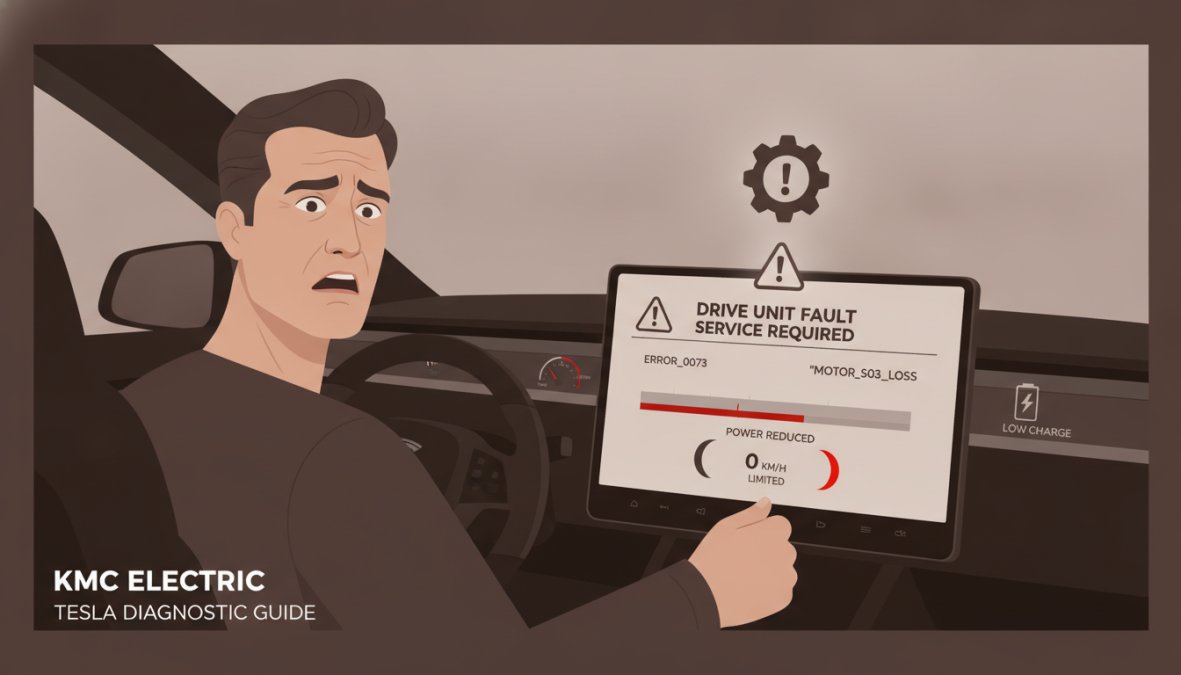
Close-up of Tesla dashboard displaying warning alerts and fault codes on the screen, with a driver's concerned expression visible in the rearview mirror
What is a Tesla Drive Unit and How It Works
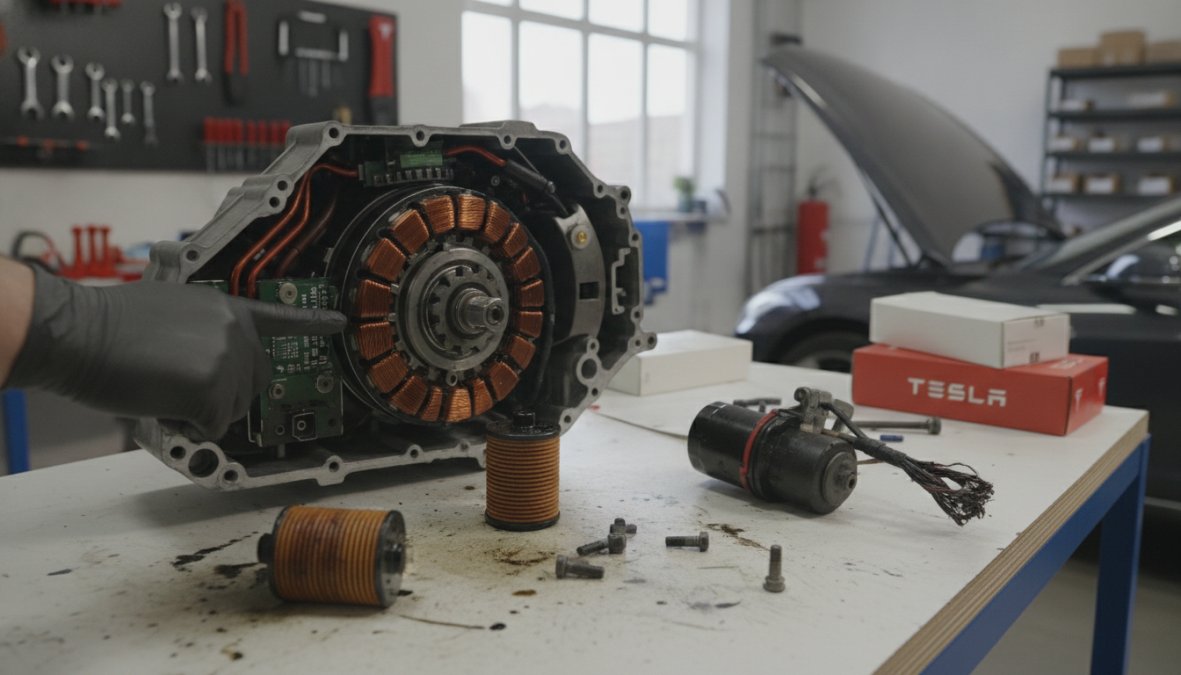
The Tesla drive unit houses an AC induction motor (in older Model S and Model X vehicles) or permanent magnet motor (in newer models), paired with a single-speed reduction gearbox. This assembly connects directly to the wheels through the differential and operates at speeds up to 18,000 RPM.
The drive unit is cooled by a dedicated thermal management system that circulates coolant through the motor windings and bearing assemblies. Without proper coolant flow, internal temperatures spike rapidly, degrading electrical insulation and accelerating bearing wear. The motor controller communicates with speed sensors, adjusting power output thousands of times per second. When seals fail or coolant intrudes, this electrical ecosystem breaks down, triggering protective measures that limit power to prevent further damage.
Why Early Detection Matters
Catching drive unit problems early can mean the difference between a £1,500 repair and a £4,000+ replacement. Once internal components begin to fail, the damage compounds exponentially. A small coolant leak that goes unnoticed for weeks can destroy electrical insulation, leading to inverter faults and complete drive unit failure.
Early intervention also protects your warranty claim. Tesla's drivetrain warranty covers manufacturing defects for 8 years or 160,000 miles. However, if you ignore warning signs and continue driving aggressively, Tesla may deny the claim, arguing that driver negligence contributed to the failure. Documenting symptoms and seeking diagnosis promptly creates a clear record of when the problem began.
Common Tesla Drive Unit Problems: Audible Warning Signs
The most reliable early indicators of drive unit failure are sounds. Your ears often detect problems before dashboard alerts appear.
Humming and Whining Noises
A high-pitched humming or whining noise during acceleration typically signals bearing wear. As bearings degrade, they no longer maintain perfect alignment, creating vibration that transmits through the motor casing as a high-frequency sound. Whining noises can also originate from the inverter, which converts DC power from the battery into three-phase AC current for the motor. Failing capacitors or transformer coils produce a distinct electrical whine that typically stays constant regardless of vehicle speed, changing only with throttle input.
Watch OutIf you hear humming or whining, avoid extended motorway driving. Bearing wear accelerates exponentially under sustained high-speed operation. Get a [professional diagnosis](/blog/book-tesla-diagnostic-check-kettering) within days, not weeks.
Grinding, Clunking, and Buzzing Sounds
Grinding noises indicate advanced bearing wear or rotor rub. When bearings fail completely, the rotor can contact the stator, creating a grinding sensation and sound. This is a critical warning requiring immediate attention.
Clunking sounds during acceleration or deceleration suggest differential problems or worn motor mounts. The differential distributes torque to both wheels; when internal gears wear or break, they produce distinct metallic clunks. Buzzing noises often come from the coolant manifold vibrating against the motor casing, indicating that fasteners may be loose.
Tesla Drive Unit Noise and Performance Indicators
Performance changes often precede audible symptoms. Your Tesla's acceleration and response characteristics are finely calibrated; deviations signal internal problems.
Vibration and Drivetrain Noise During Acceleration
Vibration felt through the steering wheel, floor, or seat during hard acceleration indicates drivetrain imbalance from bearing wear, differential problems, or motor mount failure. The vibration typically increases with throttle input and may disappear at steady speeds. A healthy Tesla drive unit produces almost no mechanical noise during normal driving.
Power Loss and Limp Mode Activation
Reduced acceleration or sudden power cuts indicate the vehicle's onboard diagnostics have detected a fault and activated protective limp mode. Limp mode activates when the vehicle detects isolation faults (electrical insulation breakdown), inverter faults, thermal overload, or speed sensor errors.
Pro TipIf you experience power loss, pull over safely and check your Tesla's diagnostic screen. Note the [exact fault codes displayed](/blog/tesla-fault-codes-explained-uk). These codes are essential for a technician to pinpoint the problem.
Dashboard Alerts and Fault Codes
Your Tesla's touchscreen displays specific fault messages when the onboard diagnostics detect drive unit problems. Common messages include "Drivetrain Fault," "Motor Fault," "Inverter Fault," and "Isolation Fault." Each fault code corresponds to a specific failure mode. Some faults are intermittent, appearing and disappearing unpredictably, but the fault history remains recorded in the vehicle's memory.
Root Causes of Drive Unit Failure
Most failures trace back to three primary causes.
Coolant Intrusion and Seal Leaks
The drive unit's cooling system circulates glycol-based coolant through passages in the motor windings and bearing assemblies, keeping internal temperatures below 90°C. The rotor seal can degrade, allowing coolant to seep into areas where it shouldn't be. Once coolant contacts the motor windings' insulation, it initiates electrical breakdown, allowing stray currents to flow and creating localized heating that accelerates degradation. Within weeks, the insulation fails completely, causing short circuits and catastrophic motor damage.
Seal leaks also occur at coolant manifold connections. Over time, thermal cycling causes rubber seals to harden and lose their sealing properties. Tesla's technical service bulletins recommend coolant system inspections every 50,000 miles to catch seal degradation early.
Bearing Wear and Rotor Seal Degradation
The drive unit's rotor bearings support the spinning rotor at extremely high speeds. When coolant intrusion occurs or manufacturing defects exist, these bearings degrade rapidly. As bearings wear, the rotor's position within the stator shifts, creating rubbing between rotor and stator surfaces that generates heat and noise.
The rotor seal prevents coolant and contaminants from entering the bearing cavity. Once this seal fails, coolant floods the bearing chamber, mixing with bearing grease and creating a corrosive slurry that accelerates wear. Bearing wear is particularly common in vehicles subjected to aggressive driving, such as Model 3 Performance and Model Y Performance variants.
Electrical Insulation Breakdown and Inverter Faults
The motor windings are insulated with a thin layer of enamel and polymer coating that must withstand thousands of volts and extreme thermal cycling. When coolant intrusion occurs or manufacturing defects create weak spots, breakdown becomes inevitable. Insulation breakdown typically progresses through stages, starting with slightly reduced resistance and small leakage currents that generate localized heating, eventually leading to complete short circuits.
The inverter can also fail independently. Manufacturing defects, thermal stress, or voltage spikes can damage capacitors, transistors, and transformer coils. Research indicates that inverter failures account for approximately 15-20% of drive unit-related warranty claims in Tesla vehicles, with most failures occurring in vehicles over 5 years old or 100,000 miles.
DIY Diagnostic Steps Before Professional Assessment
Before taking your vehicle to a service centre, you can perform several diagnostic checks to gather information.
Listening for Specific Noises and Patterns
Park your vehicle in a quiet location and conduct a systematic sound check. Accelerate gently from a standstill, noting any audible changes. Repeat this at different throttle levels. Test deceleration by releasing the accelerator and listening for noises as the motor regenerates energy. Finally, test steady-speed cruising at 30 mph, 50 mph, and 70 mph, listening for noises that persist regardless of throttle input. Document your findings for your technician.
Reading Fault Codes and Warning Messages
Access your Tesla's diagnostic menu by navigating to Controls > Service > Self-Test on the touchscreen. Write down every code that appears. For deeper diagnostics, use a third-party scanning tool like Scan My Tesla or a professional diagnostic scanner to access the vehicle's full fault memory.
Key TakeawayFault codes are your vehicle's diagnostic language. Collecting them before visiting a technician accelerates the diagnosis process and reduces labour costs.
Assessing Acceleration and Deceleration Response
Perform a controlled acceleration test in a safe location. Accelerate from a standstill to 30 mph, noting how the vehicle responds. A healthy drive unit delivers smooth, progressive acceleration with no hesitation or stuttering. Test deceleration by accelerating to 30 mph, then releasing the accelerator completely. If you feel vibration, hear grinding, or notice the vehicle doesn't decelerate smoothly, the drive unit is compromised.
Repair vs. Replacement: Understanding Your Options
Once a professional diagnosis confirms drive unit failure, you face a critical decision: repair or replace?
When Repair Is Viable
Repair is viable only when the failure is localised to a specific component: a failed seal, a worn bearing, or a faulty sensor. If the motor windings are intact, the inverter is functional, and the gearbox is undamaged, a repair technician can replace the failed component and return the drive unit to service. A failing rotor seal can be replaced without removing the entire drive unit, typically costing less than full replacement.
However, repair becomes impractical when multiple components have failed. If coolant intrusion has damaged the motor windings and the inverter, attempting to repair one component while the other fails will result in another breakdown weeks later. In these cases, replacement is more cost-effective.
OEM vs. Remanufactured Drive Units
When replacement is necessary, you have two options: an original equipment manufacturer (OEM) drive unit or a remanufactured unit. An OEM drive unit is brand-new, manufactured to Tesla's specifications, and comes with Tesla's full warranty coverage. However, OEM units are expensive and often have long lead times.
A remanufactured drive unit is a used unit that has been completely disassembled, inspected, cleaned, and rebuilt to OEM specifications. Failed components are replaced with new parts, and the entire unit is tested to ensure it meets performance standards. Remanufactured units cost significantly less than OEM units and are typically available immediately, though they come with shorter warranty coverage (typically 12 months or 12,000 miles).
Tesla Drive Unit Replacement Cost and Warranty Coverage
Typical Replacement Costs and Timelines
An OEM drive unit replacement through Tesla typically costs between £3,500 and £5,500, depending on the model and whether additional components require replacement. Labour typically adds another £800-£1,200 to the bill. If the drive unit is in stock, the repair may be completed within 3-5 days. If the unit must be ordered from the factory, you may wait 4-8 weeks.
A remanufactured drive unit replacement through an independent specialist typically costs £2,000-£3,500, including labour. Since remanufactured units are usually in stock, the repair can often be completed within 5-10 working days. Bearing replacement may cost £800-£1,500 including labour, and seal replacement costs £600-£1,000.
Tesla Drivetrain Warranty and Coverage Limits
Tesla's drivetrain warranty covers the drive unit, inverter, and associated electrical components for 8 years or 160,000 miles. However, if Tesla determines that driver negligence contributed to the failure, the warranty claim may be denied. For vehicles outside the warranty period, you're responsible for the full cost of repair or replacement. Independent specialists can diagnose and repair out-of-warranty drive unit failures at a fraction of Tesla's cost.
Warranty Type
Duration
Coverage
Cost of Replacement
Tesla OEM Warranty
8 years / 160,000 miles
Manufacturing defects
Covered (if approved)
Remanufactured Unit Warranty
12 months / 12,000 miles
Parts and labour
£2,000-£3,500
Out-of-Warranty Repair
N/A
Owner responsibility
£800-£5,500 depending on repair type
Impact of Driving Style and Maintenance on Drive Unit Longevity
How you drive and maintain your Tesla directly influences how long the drive unit lasts.
How Aggressive Acceleration and Deceleration Affect Lifespan
Every time you accelerate hard, you're stressing the drive unit's bearings, gearbox, and motor windings. Repeated hard acceleration accelerates bearing wear and increases thermal stress on the motor windings. Owners who regularly use Ludicrous Mode or frequently perform hard acceleration runs can expect bearing wear to accelerate by 30-50% compared to owners who drive conservatively. Smooth, progressive acceleration minimises stress on the drive unit.
Pro TipAdopt smooth driving habits to extend your drive unit's lifespan. Imagine you're carrying a full cup of coffee and trying not to spill it, that's the acceleration smoothness that maximises longevity. You'll also improve energy efficiency and reduce charging costs.
Maintenance Practices to Extend Drive Unit Life
Preventative maintenance is the single most effective way to extend drive unit longevity. The most critical maintenance item is the coolant system. Tesla recommends replacing the drive unit coolant every 50,000 miles. Old coolant loses its thermal conductivity and corrosion-inhibiting properties, allowing the drive unit to run hotter and providing less protection against seal degradation. Coolant system flushes typically cost £150-£250 and take 1-2 hours.
Monitor your vehicle's warning messages religiously. Any fault code warrants investigation. Additionally, avoid subjecting your drive unit to extreme conditions: driving through deep water risks water intrusion into the inverter, towing heavy loads stresses the drive unit beyond its design limits, and sustained high-speed driving generates continuous thermal stress. Keep detailed service records to increase the vehicle's resale value.
Diagnostic Procedures for Tesla Drive Units
Professional diagnostics go far beyond reading fault codes. A qualified technician begins with a visual inspection, examining the drive unit housing for signs of coolant leaks and checking all coolant hose connections for tightness. They review the vehicle's complete fault history, looking for patterns that suggest the root cause.
Next, they perform electrical testing using a multimeter to measure the insulation resistance of the motor windings. Healthy windings show resistance in the megohm range; compromised windings show dramatically lower resistance, indicating insulation breakdown. Thermal imaging can reveal hotspots within the drive unit, indicating areas of excessive friction or electrical resistance. Finally, they perform a road test under controlled conditions, monitoring the vehicle's behaviour and fault codes in real-time.
Summary: What You Should Know About Tesla Drive Unit Failure Symptoms
Tesla drive unit failure symptoms range from subtle audible cues to dramatic performance loss. Humming, whining, grinding, and clunking noises are early warning signs that internal components are degrading. Power loss, limp mode activation, and dashboard fault codes indicate the problem has progressed to where the vehicle's diagnostics have detected a fault.
Root causes, coolant intrusion, bearing wear, and electrical insulation breakdown, often develop gradually, giving observant owners time to seek diagnosis before catastrophic failure occurs. By listening carefully to your vehicle, monitoring dashboard messages, and maintaining the coolant system on schedule, you can catch problems early and minimise repair costs. When drive unit failure does occur, understanding your repair and replacement options helps you make an informed decision aligned with your budget and vehicle's warranty status.
Frequently Asked Questions
What are the most common Tesla drive unit failure symptoms?
Common symptoms include humming, whining, grinding, and clunking noises from the drivetrain, vibration during acceleration, reduced power output, and limp mode activation. Dashboard warning messages and inverter alerts are also key indicators. Many owners notice these audible signs before power loss occurs, making early detection crucial for preventing further damage to the drive unit.
How much does it cost to replace a Tesla drive unit?
Replacement costs vary significantly depending on your Tesla model, whether you choose an OEM or remanufactured unit, and labour charges. Out-of-warranty replacements typically range from £4,000 to £10,000 or more. Independent specialists like KMC Electric often provide more cost-effective alternatives to main dealer networks. Always obtain a detailed diagnostic assessment before committing to replacement, as some issues may be repairable.
Can Tesla drive unit failure be repaired instead of replaced?
Yes, many drive unit issues can be repaired. Coolant leaks, seal replacements, and bearing repairs are common fixes that extend the drive unit's lifespan without full replacement. However, severe electrical insulation breakdown or rotor seal degradation may require replacement. A professional diagnostic using specialist equipment is essential to determine whether repair or replacement is the right choice for your specific fault codes and symptoms.
How does driving style impact Tesla drive unit longevity?
Aggressive acceleration and hard deceleration place excessive stress on bearings, seals, and electrical components within the drive unit. Smooth, moderate driving patterns reduce wear and extend service life significantly. Additionally, maintaining proper coolant levels and following manufacturer maintenance schedules helps prevent seal leaks and thermal stress. Owners who adopt conservative driving habits typically experience fewer drive unit problems and longer intervals between major repairs or replacement.