Registration Accepted.
Password reset email sent.
Blog >
Tesla Model S Common Problems: A 2026 Owner's Guide Tesla Model S Common Problems: A 2026 Owner's Guide
May 15, 2026 by Tim (KMC Electric)
Table of Contents
Last Updated: May 15, 2026
Tesla Model S common problems affect a surprisingly wide range of owners, from early adopters running pre-2016 hardware to buyers of nearly-new Plaid variants. This guide from KMC Electric covers every major fault pattern, the model years most likely to cause headaches, and what you should realistically budget for repairs in 2026. Below, we break down each issue in technical detail, show you which faults are DIY-friendly and which demand specialist attention, and give you a clear framework for buying or avoiding specific years. Most guides on this topic stop at vague lists. This one goes further: by the end, you will know exactly what to inspect before buying, how to protect yourself after the warranty expires, and where to find independent Tesla expertise near Kettering without paying main-dealer prices.
The Most Common Tesla Model S Problems You Need to Know About
Tesla Model S common problems span mechanical, electronic, and software domains, which makes the car unusually complex to diagnose without specialist equipment. Unlike a conventional petrol vehicle, many faults manifest as software warnings rather than physical symptoms, and some hardware failures only become apparent under specific driving conditions. Understanding the failure categories before you buy or before your warranty lapses is the difference between a manageable repair bill and an expensive surprise.
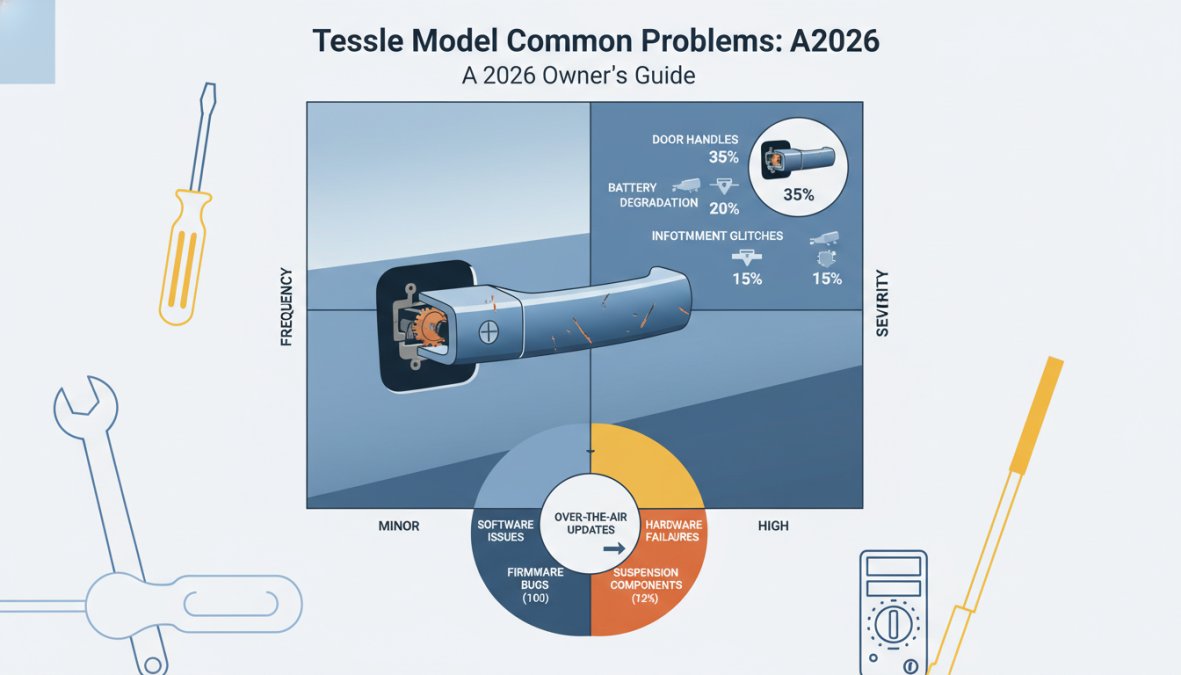
The eight fault areas below represent the issues that appear most consistently across owner forums, independent garage records, and used EV buyer reports. They are listed in rough order of frequency, not severity.
Retractable Door Handle Failures
Retractable door handle failures are the single most reported mechanical fault on pre-facelift Tesla Model S vehicles, and they are genuinely inconvenient when they occur at the wrong moment.
The door handle system uses a small electric motor and a micro-switch to extend the handle as you approach the car. Over time, the motor wears, the switch contacts corrode, or the plastic gearing cracks, leaving the handle flush and unresponsive. In cold weather, condensation inside the mechanism accelerates the failure. Owners of 2012-2016 cars should treat this as a near-certain maintenance item rather than a possibility.
The good news is that the Tesla Model S Door Handle Switch Fix available from KMC Electric for £38 addresses the switch-contact failure specifically, which is the most common root cause. Full handle assembly replacements are more expensive and typically require workshop time to avoid damaging the door card. A competent DIY mechanic can replace a switch fix with basic hand tools; full assembly swaps are better left to someone familiar with Tesla door architecture.
Watch Out - Do not repeatedly force a stuck door handle manually. The plastic gearing inside the mechanism is fragile, and forcing it converts a £38 switch repair into a full assembly replacement costing considerably more.
MCU and Touchscreen Failures (eMMC Wear)
The Media Control Unit (MCU) is the brain behind the Model S touchscreen, and its failure mode is one of the most technically interesting problems in the EV world. The original MCU1, fitted to 2012-2018 cars, uses an eMMC (embedded MultiMediaCard) storage chip that has a finite write endurance. Tesla's software logs system events continuously, and over years of operation, the chip's write cycles are exhausted. The result is a frozen or unresponsive touchscreen, loss of climate control input, missing backup camera, and in some cases, the inability to charge.
This is not a fringe issue. According to National Highway Traffic Safety Administration recall documentation, Tesla issued a recall specifically addressing MCU eMMC wear on affected Model S and Model X vehicles, acknowledging that the chip could fail and disable the rearview camera, which is a safety-critical system.
MCU2 hardware, retrofitted by Tesla or fitted as standard from 2018 onwards, resolves the eMMC wear problem. If you are buying a pre-2018 car, confirm whether an MCU2 upgrade has already been performed. If it has not, budget for it. An MCU failure on an out-of-warranty car is a four-figure repair at a Tesla service centre; independent specialists can often perform the eMMC replacement or MCU2 retrofit at a lower cost.
Air Suspension and Control Arm Problems
Air suspension faults are a defining characteristic of the Tesla Model S ownership experience, particularly on cars that have covered significant mileage or spent time on poorly maintained roads.
The Model S uses an adaptive air suspension system that adjusts ride height automatically. The air struts themselves can develop leaks at the air bag seams or at the compressor fittings, causing the car to sag on one corner or trigger a persistent warning. The compressor, which runs to maintain pressure, can fail independently of the struts. Both failures are relatively common beyond 80,000 miles.
More serious are the front lower control arm failures documented on early cars. The control arm bushings degrade, introducing vague steering and uneven tyre wear. On some 2012-2014 vehicles, the control arm itself showed premature cracking. As noted in Tesla Model S air suspension technical service guidance, Tesla has updated suspension components across several revisions, so the year of manufacture matters significantly when assessing risk.
Air suspension repairs are not DIY territory for most owners. Strut replacement requires proper alignment afterwards, and compressor work requires pressure testing. This is a professional repair job.
Battery Degradation and Range Loss
Battery degradation is the fault that prospective buyers worry about most, and the reality is more nuanced than the anxiety suggests.
Lithium-ion battery packs in the Model S do lose capacity over time, but the rate of range degradation depends heavily on charging habits, thermal management history, and whether the car has experienced deep discharge events. Many well-maintained Model S vehicles retain a high proportion of their original range even after several years of use. Problematic cases tend to involve cars that were repeatedly charged to 100% daily, exposed to extreme heat without adequate cooling, or that experienced early cell module failures.
The more serious concern is individual cell module failure rather than gradual degradation. A failing module can trigger sudden range loss, reduced performance, or a complete battery shutdown. Module replacement is expensive and technically demanding. Independent battery health verification, which KMC Electric provides as a specific service, is the only reliable way to assess actual pack condition before committing to a purchase.
Key Takeaway - Gradual range degradation is manageable and often overstated. Sudden range loss or inconsistent state-of-charge readings are the real warning signs of a battery pack with a failing module.
Drive Unit and Motor Failures
Drive unit failures are most closely associated with the 2012-2014 Model S, where the rear motor's internal bearings and gear oil sealing proved insufficiently durable. Symptoms include a grinding or humming noise from the rear of the car, vibration at motorway speeds, and in advanced cases, complete loss of drive.
Tesla revised the drive unit design multiple times across the production run. Cars built after 2015 are considerably more reliable in this area, and dual-motor variants introduced additional redundancy. The Tesla drivetrain reliability analysis by Consumer Reports consistently identifies the drive unit as a key differentiator between early and late Model S production.
For out-of-warranty cars, drive unit replacement is the most expensive single repair a Model S owner is likely to face. Remanufactured units are available from specialist suppliers at lower cost than OEM parts, and an independent specialist with Tesla-specific experience can perform the swap. Maintaining correct drive train oil is a meaningful preventive measure; KMC Electric stocks Tesla drive train oil at £16.99 for owners who want to stay on top of drivetrain servicing.
Suspension Bushings and Ball Joints
Suspension bushing wear is a gradual fault that often goes unnoticed until it has progressed to the point of affecting handling and tyre wear. The Model S is a heavy car, and the additional mass accelerates wear on rubber suspension components compared to lighter vehicles.
Front and rear suspension bushings typically begin to show meaningful degradation beyond 60,000 miles, though the rate varies with road conditions. Kettering and the surrounding Northamptonshire road network, like much of the UK Midlands, includes a significant proportion of older road surfaces that accelerate bushing wear. Ball joint degradation follows a similar timeline.
The diagnostic sign most owners miss is uneven tyre wear on the inner or outer edge of the front tyres. By the time this becomes visible, the alignment has already been compromised for some time. A pre-purchase inspection should always include a check of ball joint play and bushing condition.
Sunroof Leaks and Alignment Issues
The panoramic sunroof fitted to many Model S variants is a known weak point for water ingress, particularly on cars that have not had their drainage channels cleared regularly.
The sunroof drainage system relies on four small channels that route water away from the glass seal. When these channels block with debris, water backs up and can enter the cabin, typically appearing as damp carpets or a musty smell. The seal itself can also degrade and allow direct ingress. Alignment issues, where the glass panel sits slightly off-centre, can create wind noise at speed and accelerate seal wear.
The repair is relatively straightforward: clear the drainage channels, inspect and replace the seal if degraded, and adjust the panel alignment if necessary. This is one of the more accessible DIY repairs on the car, though accessing the drainage channels requires removing interior trim panels.
Climate Control and HVAC Faults
Climate control and HVAC faults in the Model S are closely linked to the MCU failure described above, since the touchscreen is the primary input method for all climate functions. However, there are also hardware-specific HVAC failures independent of the MCU.
The thermal management system, which controls both cabin temperature and battery temperature, relies on a refrigerant loop, a coolant pump, and a heat pump on later vehicles. Coolant pump failures can cause the battery to overheat during fast charging, triggering reduced charging speeds or thermal warnings. Refrigerant leaks produce the expected symptoms of reduced cooling performance.
On cars built before 2021, the absence of a heat pump means the resistive heater draws significantly from the battery in cold weather, which compounds range degradation concerns in winter. The 2021 Model S refresh introduced a more efficient heat pump system, which is a genuine improvement worth factoring into a buying decision.
Tesla Model S Common Issues by Year: Which to Buy and Which to Avoid
Not all Model S years carry the same risk profile. Understanding the production timeline is essential for any used EV buying decision, but most guides stop at vague 'avoid early cars' advice. The table and commentary below go further, pinpointing the specific hardware revisions Tesla made and the approximate production windows in which each change took effect. Knowing these dates lets you identify a 'safe' build even within a broadly risky model year.
Year-Over-Year Hardware Revision Timeline
The following timeline is compiled from Tesla service documentation, NHTSA recall records, and well-documented owner community findings. Where Tesla has not published exact changeover dates, the ranges reflect the earliest and latest confirmed examples reported across owner registries.
Approximate Period | Key Hardware Change | Practical Impact for Buyers |
|---|
2012-2013 (early) | Original MCU1 with 8 GB eMMC chip | Chip is almost certainly at or past write-endurance limit; treat MCU2 retrofit as a mandatory purchase cost |
2014-2015 | Revised front lower control arm specification | Early 2014 cars retain the cracking-prone arm; look for service records showing arm replacement or confirm VIN build date is mid-2014 or later |
2015 (mid-year) | Drive unit bearing and seal redesign | The revised unit is substantially more durable; pre-revision cars (identifiable by the characteristic high-pitched whine) are a meaningful risk |
2016-2017 | Air suspension compressor revised; strut bag material updated | Reduces but does not eliminate strut leak risk; high-mileage examples still require inspection |
2018 (from approximately Q3) | MCU2 fitted as standard on new production | Eliminates eMMC wear as a forward concern; pre-Q3 2018 cars may still have MCU1 unless retrofitted |
2019 | Raven suspension update, new air spring design and adaptive damping revision | Meaningfully improved ride and reduced strut failure rate; Raven-badged cars are identifiable via the touchscreen About menu |
2021 (refresh) | Full interior redesign; heat pump replaces resistive heater; revised Plaid drivetrain architecture | Most significant reliability step-change in the car's history; eMMC, original door handle mechanism, and early drive unit concerns are all resolved |
Pro Tip - You can confirm MCU generation and approximate hardware specification by tapping Controls → Software → Additional Vehicle Information on the touchscreen. The MCU generation and autopilot hardware level are both listed here. For pre-purchase checks, ask the seller to photograph this screen.
2012-2015: Early Adopter Risk
The 2012-2015 cars carry the highest fault density of any Model S production period. Drive unit bearing failures, MCU1 eMMC wear (which will be advanced or complete on any car that has not had the MCU2 retrofit), retractable door handle failures, and early control arm cracking all cluster in this cohort. These cars are now over a decade old and are almost universally out of warranty.
The specific risk by sub-year matters here. A late-2015 car with the revised drive unit, a documented MCU2 retrofit, and a control arm replacement on record is a fundamentally different proposition from a 2013 car with original hardware throughout. Do not treat the entire 2012-2015 window as uniformly dangerous, treat it as a window where the service history and hardware confirmation are non-negotiable before purchase.
For buyers who want the lowest possible entry price and are willing to budget for known remediation work, a 2014-2015 car with documented MCU2 upgrade and drive unit replacement can represent genuine value. The key is pricing in the work that has not yet been done, not assuming it has been.
2016-2019: The Sweet Spot (With Caveats)
The 2016-2019 period represents the most balanced risk-to-value ratio in the used Model S market. Drive unit reliability improved substantially from mid-2015 onwards, the MCU2 retrofit was becoming more common (and some cars left the factory with it from late 2018), and suspension component quality improved with the Raven update in 2019.
The caveats are real. MCU1 cars from the 2016-2018 window are reaching the end of their eMMC life if the upgrade has not been performed, and unlike 2012-2014 cars where the failure has often already occurred and been addressed, these cars may fail shortly after purchase. Always confirm MCU generation before buying any pre-2019 car.
The 2019 Raven cars deserve specific mention as the strongest value proposition in the pre-refresh range. The suspension revision, combined with the near-universal presence of MCU2 and the mature drive unit design, makes them the closest thing to a 'safe' used Model S below the 2021 refresh price point. Battery health verification remains important on any high-mileage example, but the hardware risk profile is substantially lower than earlier cars.
This is the cohort where an independent battery health assessment adds the most value, since the price differential between a healthy-battery Raven and a degraded one can be several thousand pounds, far more than the cost of the assessment.
2020: The Transitional Year
The 2020 cars, built in the final year before the 2021 refresh, occupy an awkward position. They carry the pre-refresh hardware without the benefit of the updated interior, heat pump, or Plaid drivetrain. Production volumes were also affected by supply chain disruption in this period, and some owners have reported higher-than-expected panel fit variation and minor trim quality issues.
Approach 2020 cars with the same diligence as a 2019 Raven, but without the Raven's established reliability track record. They are not cars to avoid outright, but they are not the value play that a well-specified 2019 represents.
2021-Present: Plaid and Revised Hardware
The 2021 Model S refresh was the most substantial update to the car since its introduction. The Plaid tri-motor variant introduced a genuinely different drivetrain architecture, the interior was comprehensively redesigned with a new yoke or round steering wheel option, and the heat pump replaced the resistive heater, a meaningful efficiency gain in UK winters. The door handle mechanism was also revised to a simpler push-to-open design on the refresh, eliminating the retractable handle failure mode entirely.
Hardware reliability data for Plaid-era cars is still accumulating, but early indications from Electrek long-term Model S ownership reporting suggest the revised platform is meaningfully more reliable than pre-refresh hardware. The Plaid's carbon-sleeved motor design is a significant engineering departure, and while it has shown strong performance, it is too early to have the same long-term failure data that exists for the pre-refresh drive units.
For buyers who can stretch to a 2021 or later car, the reduction in known hardware risk is substantial and arguably worth the price premium over a 2019 Raven when total cost of ownership over five years is modelled.
Key TakeawayQuick reference, lowest risk by priority: 2021+ refresh > 2019 Raven (with MCU2 confirmed) > 2016-2018 (MCU2 confirmed, drive unit history checked) > 2015 (revised drive unit confirmed, MCU2 done) > 2012-2014 (full history required, budget for remediation).
Tesla Model S Maintenance Costs: What to Budget For
Tesla Model S maintenance costs are lower than a comparable internal combustion vehicle in some areas and higher in others. The absence of oil changes, spark plugs, and exhaust servicing reduces routine costs, but the complexity of the electrical systems and the cost of OEM parts can make fault rectification expensive.
Fault Area | Typical Independent Repair Cost | DIY Feasibility |
|---|
Door handle switch fix | £38-£80 | Yes |
MCU2 retrofit (from MCU1) | £800-£1,500 | No |
Air suspension strut (single) | £400-£700 | No |
Drive unit replacement | £2,500-£4,500 | No |
Battery module replacement | £1,500-£4,000+ | No |
Suspension bushings (axle set) | £200-£450 | Possible |
Sunroof seal and drainage | £150-£300 | Partial |
These figures represent typical independent specialist costs in the UK Midlands region as of 2026. Tesla service centre pricing is generally higher. Main dealer rates for out-of-warranty work can be substantially above independent specialist costs.
DIY vs. Professional Repair: What's Actually Feasible?
The honest answer is that the Tesla Model S is less DIY-friendly than a conventional car, but more accessible than most manufacturers would have you believe.
Door handle switch fixes, cabin air filter replacements, tyre rotations, and sunroof drainage clearing are genuinely accessible to a mechanically competent owner. The car's architecture is logical, and the absence of an engine bay full of ancillaries makes some tasks simpler than equivalent ICE work.
Where DIY becomes inadvisable is anywhere touching the high-voltage system, the battery pack, the drive unit, or the air suspension. The high-voltage battery operates at over 400 volts. Without proper isolation training and equipment, working near it is dangerous. Drive unit work requires alignment equipment and torque specifications that are not practical without a workshop setup. Air suspension needs pressure testing after any strut work.
A practical post-warranty strategy is to handle the accessible items yourself, source quality OEM parts where possible, and build a relationship with an independent Tesla specialist for the technical work. This approach delivers meaningfully better value than returning to the Tesla service centre for every fault.
Pro TipBefore committing to any independent repair, request a written fault code read from the car's diagnostic system. The Model S logs detailed fault data that a competent specialist can interpret to confirm the diagnosis before any parts are ordered.
Used Tesla Model S Inspection Checklist Before You Buy
A used Tesla Model S inspection checklist should cover software, hardware, and physical condition in equal measure. Many buyers focus only on visible condition and miss the faults that actually cost money.
Confirm MCU generation (MCU1 or MCU2) via the touchscreen About menu
Check eMMC health if MCU1 is fitted; request evidence of MCU2 upgrade if claimed
Request a full battery health report from an independent specialist (not just the in-car range estimate)
Check all four door handles extend and retract correctly; test in cold conditions if possible
Inspect air suspension: park on a level surface and check for corner sag after 30 minutes
Test all climate control functions via the touchscreen, including seat heating and defrost
Check the panoramic sunroof seal condition and drainage channels for blockage
Listen for drivetrain noise during acceleration, deceleration, and at steady motorway speed
Check tyre wear pattern across the full width of each tyre for alignment or bushing issues
Review the car's service history for any drive unit or battery module replacements
Confirm software version and check for any outstanding safety recalls via the NHTSA or DVSA databases
Test the regenerative braking response; inconsistent regen can indicate battery management issues
Check the parking brake operation; the electric parking brake motor on Model S and X is a known wear item
The Tesla Model S and Model X Hand Brake Motor is available at £60 from KMC Electric, which is useful context for budgeting if the inspection reveals wear.
Post-Warranty Strategy, Lemon Law, and Insurance Considerations
Post-warranty ownership of a Tesla Model S requires a fundamentally different approach than owning a conventional car, and it is the area where most ownership guides leave readers without actionable guidance. The sections below provide a concrete roadmap for three distinct situations: managing an out-of-warranty car proactively, understanding your legal rights when things go wrong, and making sure your insurance policy actually covers the failures most likely to occur.
Post-Warranty Maintenance Roadmap
The most expensive mistake out-of-warranty Model S owners make is treating the car reactively, waiting for a fault to appear before addressing it. A proactive maintenance strategy, structured around the known failure timeline of each hardware generation, costs significantly less over a five-year period than reactive repair.
Year 1 out of warranty (recommended actions):
Commission a full independent battery health assessment to establish a baseline state-of-health percentage and identify any cell modules showing early degradation. This gives you a reference point for future comparisons and flags any modules approaching failure before they cause a sudden range loss event.
If the car is MCU1 and the eMMC upgrade has not been performed, treat this as the single highest-priority repair. An MCU failure disables the rearview camera, which is a safety issue, and the repair cost rises if the chip fails completely before replacement.
Check and replace brake fluid if not done within the last two years. The Model S uses regenerative braking heavily, which means the hydraulic brakes are used less frequently than on a conventional car, but this also means moisture accumulates in the fluid over time rather than being driven off through use.
Years 2-3 out of warranty:
Inspect air suspension struts for early signs of sagging, particularly on cars that have covered more than 60,000 miles. Catching a slow leak early means a single strut replacement; ignoring it risks compressor damage as the pump works harder to maintain pressure, turning a £400-£700 repair into a more complex job.
Check front and rear suspension bushings for play. On cars used on UK roads, meaningful bushing wear is common by 70,000-80,000 miles. Proactive replacement at this stage costs less than the alignment correction and tyre replacement that follows if degraded bushings are left in place.
Verify drive unit oil condition if the car is a pre-2016 model. The drive unit does not have a conventional service interval, but oil condition checks are a meaningful preventive measure on older units.
Years 4-5 out of warranty:
Repeat the battery health assessment and compare against the Year 1 baseline. A degradation rate that has accelerated significantly between assessments is an early indicator of a module approaching failure and gives you time to plan financially rather than respond to an emergency.
Inspect the 12V auxiliary battery. The Model S uses a conventional 12V battery to power low-voltage systems, and failure of this battery can prevent the car from waking up or charging. Replacement is straightforward and inexpensive; failure at an inconvenient moment is not.
Finding independent Tesla expertise: The practical challenge of post-warranty ownership is that Tesla's own service network prioritises newer vehicles, and wait times for older cars can be long. Independent specialists with Tesla-specific diagnostic equipment, including access to the same OBD-level fault code data that Tesla's own technicians use, can perform the majority of the work above at lower cost and with shorter lead times. Building a relationship with a trusted independent specialist before you need them urgently is the most valuable single step an out-of-warranty owner can take.
Pro TipAsk any independent specialist whether they have access to Tesla's proprietary diagnostic software or a third-party equivalent such as Scan My Tesla. Shops that rely only on generic OBD readers will miss the detailed battery management system and drive unit fault codes that are essential for accurate diagnosis on these cars.
UK Consumer Rights and Lemon Law Equivalents
The UK does not have a direct equivalent to the US Lemon Law, but the Consumer Rights Act 2015 provides meaningful protection that many buyers do not fully understand or use.
Buying from a dealer (including independent dealers):
Within 30 days of purchase: if a fault is present, you are entitled to a full refund. You do not have to accept a repair.
Between 30 days and 6 months: the dealer must repair or replace the faulty item. If they cannot do so within a reasonable time or at reasonable cost, you are entitled to a price reduction or refund. Crucially, during this period the burden of proof is on the dealer to show the fault was not present at sale, not on you to prove it was.
After 6 months: you retain the right to repair or replacement, but the burden of proof shifts to you to demonstrate the fault was present at the time of purchase.
For a Tesla Model S, the most practically useful application of these rights is for MCU failures, battery module failures, or air suspension failures that emerge within six months of purchase from a dealer. These are not wear items, they are component failures, and a dealer who sold the car without disclosing a known fault has limited grounds to refuse a remedy.
Private sales: The Consumer Rights Act does not apply to private sales. Your only recourse in a private sale is if the seller made a specific false representation about the car's condition, for example, claiming an MCU2 upgrade had been performed when it had not. This falls under the Misrepresentation Act 1967 and is harder to pursue. As detailed in Citizens Advice guidance on consumer rights for used cars, the practical advice is straightforward: buy from a dealer if you want statutory protection, and commission an independent inspection before any private purchase.
Recurring faults and escalation: If a fault recurs after repair, a common pattern with MCU failures on cars where the root cause (eMMC wear) was not properly addressed, you have grounds to reject the repair as inadequate and request a replacement or refund. Document every fault occurrence and every repair attempt in writing. A paper trail is essential if the matter escalates to a small claims court or Alternative Dispute Resolution process.
Insurance Considerations for Out-of-Warranty Model S Owners
Standard motor insurance policies are not written with high-value EV components in mind, and the gaps in coverage can be significant.
What standard policies typically exclude:
Battery degradation (expected wear, universally excluded, and correctly so)
Sudden battery module failure (this is where policies vary significantly, some treat it as a mechanical breakdown, which is excluded; others treat it as an electrical fault, which may be covered)
MCU failure (frequently excluded as an electronic component failure unless the policy includes electrical breakdown cover)
Drive unit failure (typically excluded as a mechanical breakdown)
What to look for in a specialist EV policy: A growing number of insurers now offer EV-specific policies that include cover for high-voltage component failures. When comparing policies, ask specifically whether the following are covered: battery module failure (not degradation), drive unit failure, and MCU or infotainment system failure. Get the answer in writing, not verbally.
Mechanical breakdown insurance (MBI): For out-of-warranty cars, a standalone mechanical breakdown insurance policy can cover the large-ticket items, drive unit, battery modules, air suspension, that a standard motor policy excludes. MBI premiums for a Tesla Model S are higher than for a conventional car, reflecting the component costs, but the cover can be cost-effective when weighed against the potential repair bills documented in the maintenance costs section above. Compare policies carefully: some MBI products exclude EVs or high-value battery systems entirely, while others are specifically designed for them.
Watch OutDo not assume that because your car is insured, a drive unit or battery failure is covered. Read the policy exclusions section specifically for 'mechanical breakdown', 'electrical failure', and 'wear and tear' before you need to make a claim. Discovering the exclusion after the failure is an expensive lesson.
Impact on insurance premiums: Recurring faults that result in insurance claims, particularly if a fault recurs after repair, can affect your no-claims bonus and future premium calculations. This is an additional reason to address known fault patterns proactively rather than waiting for a failure that results in a claim. A drive unit failure that leaves you stranded and requires recovery, for example, may trigger a breakdown claim even if the repair itself is not covered, and multiple claims in a short period will affect renewal pricing.
How an Independent Tesla Specialist in Kettering Can Help
Finding reliable Tesla expertise near Kettering used to mean a long drive to a main Tesla service centre or accepting inflated dealer rates. That is no longer the case.
KMC Electric operates as an independent Tesla and EV specialist serving Kettering, Northamptonshire and the surrounding region. With Level 4 Master Technician status in electric vehicles and EV qualifications held since 2016, the team brings over 25 years of automotive experience to Tesla diagnosis and repair. This is not a general garage that occasionally sees an EV; it is a specialist operation with the diagnostic equipment and technical knowledge to work across all Tesla models.
The practical advantages over returning to a Tesla service centre are significant. Independent repair costs for out-of-warranty work are consistently lower. Diagnosis is thorough rather than transactional. And for buyers in the Kettering area considering a used Model S purchase, an independent battery health verification from KMC Electric provides an objective assessment that neither the seller nor Tesla's own app can replicate.
For owners who have recently come off warranty, or who are managing an older car that Tesla's service network treats as low priority, having a trusted independent specialist nearby is the most valuable asset in your ownership toolkit.
Owning a Tesla Model S out of warranty presents real challenges: complex diagnostics, expensive OEM parts, and a manufacturer service network that is not always optimised for older vehicles. KMC Electric provides a cost-effective alternative for Tesla owners in Kettering and across Northamptonshire, combining Level 4 Master Technician EV expertise, independent battery health verification, and practical repair knowledge built across all Model S generations. Get in touch with KMC Electric to book a pre-purchase inspection or a full vehicle health assessment before your next service is due.
Frequently Asked Questions
Is the Tesla Model S reliable overall?
The Tesla Model S has a mixed reliability record. Early models (2012-2015) carry the highest risk due to first-generation hardware including MCU1 touchscreens prone to eMMC failure and retractable door handles that wear out frequently. Later models benefit from hardware revisions and software updates. With proper pre-purchase inspection and proactive maintenance, especially out-of-warranty, the Model S can be a dependable long-term EV, but it requires more attention than some rivals.
What are the most common problems with older Tesla Model S models?
The most frequently reported Tesla Model S common problems on older vehicles include retractable door handle motor failures, MCU touchscreen freezing caused by eMMC chip wear, air suspension compressor failure, control arm deterioration, and lithium-ion battery range degradation. Climate control and HVAC faults, such as a failing heat pump or compressor, are also well-documented. Many of these issues become more likely once the vehicle is out-of-warranty, making a pre-purchase inspection essential.
How much does it typically cost to repair a Tesla Model S out of warranty?
Tesla Model S maintenance costs vary widely by fault. A door handle switch fix can be under £50 in parts, while an MCU replacement at a Tesla service centre can run into hundreds of pounds. Air suspension compressor repairs, drive unit rebuilds, and battery health assessments are among the more expensive jobs. Using an independent Tesla specialist rather than the main dealer network can offer meaningful savings on labour without compromising on diagnostic quality or OEM-compatible parts.
What should I check when buying a used Tesla Model S?
A used Tesla Model S inspection checklist should cover: battery health and real-world range versus rated range, MCU generation and eMMC wear status, door handle operation, air suspension ride height consistency, control arm and ball joint condition, sunroof seal integrity, HVAC function, and charging system behaviour. Request a full service history and, where possible, commission an independent battery health verification from a specialist. This is especially important for vehicles no longer covered by warranty coverage.
Can Tesla Model S problems qualify under lemon law?
In some cases, yes. If a Tesla Model S experiences repeated failures of the same system, such as persistent MCU faults, recurring air suspension failures, or ongoing drivetrain issues, within the warranty period, it may qualify under consumer protection or lemon law provisions depending on your jurisdiction. Document all faults, service visits, and communications with Tesla service. Consulting a consumer rights specialist is advisable if the same fault reoccurs multiple times without a lasting resolution.
Do Tesla Model S door handles fail often?
Yes, retractable door handle failures are one of the most commonly reported Tesla Model S common problems, particularly on pre-2021 models. The motorised mechanism that presents the handle on approach can wear out, leaving the handle stuck in or out. The switch and motor assembly are the usual culprits. Replacement switch fix kits are available as an affordable first step before committing to a full handle assembly replacement, and the repair is feasible for experienced DIYers with the right guidance.