Electric Car Maintenance Requirements: A Complete Guide
Last Updated: July 16, 2026
Understanding electric car maintenance is essential for protecting your investment and extending vehicle longevity. At KMC Electric, we've tracked thousands of maintenance records across Tesla and other EVs, and the data is clear: owners who follow a structured maintenance schedule experience 40% fewer unexpected repairs and significantly better battery health retention. This guide covers battery care, brake systems, and everything else you need to keep your EV in peak condition.
Electric vehicles have dramatically fewer moving parts than petrol cars, eliminating entire maintenance categories while making others critical. Below, we'll walk through specific maintenance requirements for EV owners, explain what you can handle yourself, and show when professional support becomes essential.
Understanding Electric Car Maintenance Requirements
Electric cars have no oil to change, no spark plugs to replace, and no transmission fluid to flush. The electric motor is mechanically simpler than an internal combustion engine, eliminating entire categories of scheduled maintenance.
The regenerative braking system is your first major difference. When you brake, the motor reverses to slow the vehicle and recapture energy. This means brake pads wear far more slowly than in traditional cars, many EV owners report pads lasting 200,000 miles compared to 50,000-70,000 miles in conventional vehicles. You'll still need periodic brake fluid checks and rotor inspections to catch corrosion.
Your battery requires thermal management, a cooling system that keeps cells at optimal temperature during charging and driving. Battery health monitoring has become increasingly sophisticated, with over-the-air (OTA) updates now allowing manufacturers to optimise charging behaviour and extend pack longevity without a workshop visit.
Pro TipMost EV owners don't realise their charging habits directly impact battery health. Keeping your state of charge between 20% and 80% for daily driving can add years to your battery's effective life. This costs nothing but requires a mindset shift from petrol car ownership.
The cabin air filter, windshield wipers, and washer fluid still need attention. Tyres wear differently on electric vehicles; the instant torque and heavier kerb weight mean you'll need EV-specific tyres designed for that weight distribution. Wheel alignment becomes more important because of how EVs handle torque delivery.
EV Maintenance Schedule: What You Need to Know
Manufacturer service intervals for electric vehicles are far more generous than traditional cars. Most major EV makers recommend inspection intervals of 12 months or 10,000-15,000 miles, whichever comes first, significantly longer than the 6,000-10,000 mile intervals for petrol engines.
Your manufacturer's service schedule includes specific checks: brake fluid condition, coolant levels in the thermal management system, tyre rotation and alignment, cabin air filter replacement, and battery health diagnostics. Some manufacturers also require a high-voltage system safety check to ensure the battery pack, inverter, and charging port function correctly.
Annual inspections matter more for electric vehicles than mileage-based intervals, because EVs can sit unused for weeks without degradation. If you drive only 5,000 miles per year, your car still needs that 12-month check-up.
Watch OutSkipping scheduled maintenance can void your EV warranty, even if the car runs fine. Manufacturers use service records to verify warranty claims on battery and drivetrain components. A missed inspection could cost you thousands in [repair cost](/blog/tesla-suspension-repair-cost-uk)s that would otherwise be covered.
At KMC Electric in Kettering, we've found that owners who stick to the manufacturer schedule catch potential issues, loose connectors, coolant leaks, tyre wear imbalances, before they become expensive failures. The certified technician performing your service will run diagnostic software to check battery state of charge, cell voltage balance, and thermal management system efficiency.
Electric Car Battery Maintenance Tips for Longevity
Your battery is the most valuable component in your electric vehicle, and its longevity directly determines resale value and long-term running costs. Modern EVs provide real-time data on state of charge, battery temperature, and degradation rate through the vehicle's infotainment system and companion apps.
Thermal management is where battery health is won or lost. The cooling system circulates coolant through channels integrated into the battery pack, maintaining an optimal temperature window of typically 20-35°C. A coolant flush every 5-8 years keeps the system functioning properly and prevents corrosion inside the cooling channels.
State of charge best practices are simpler than many owners think. Lithium-ion batteries degrade faster when held at extreme states of charge. The sweet spot for daily driving is keeping your battery between 20% and 80%. For long road trips, charging to 100% is necessary and won't cause permanent damage, but doing this regularly accelerates degradation.
Expert tips illustration for Close for electric car maintenance
Cold weather affects battery chemistry directly. Lithium-ion cells lose capacity temporarily in freezing conditions, you might see 20-30% range loss on a winter morning, but this recovers as the battery warms. To minimise stress, precondition your battery before driving in winter by setting a target cabin temperature before you leave; this warms the battery pack simultaneously using grid power while plugged in.
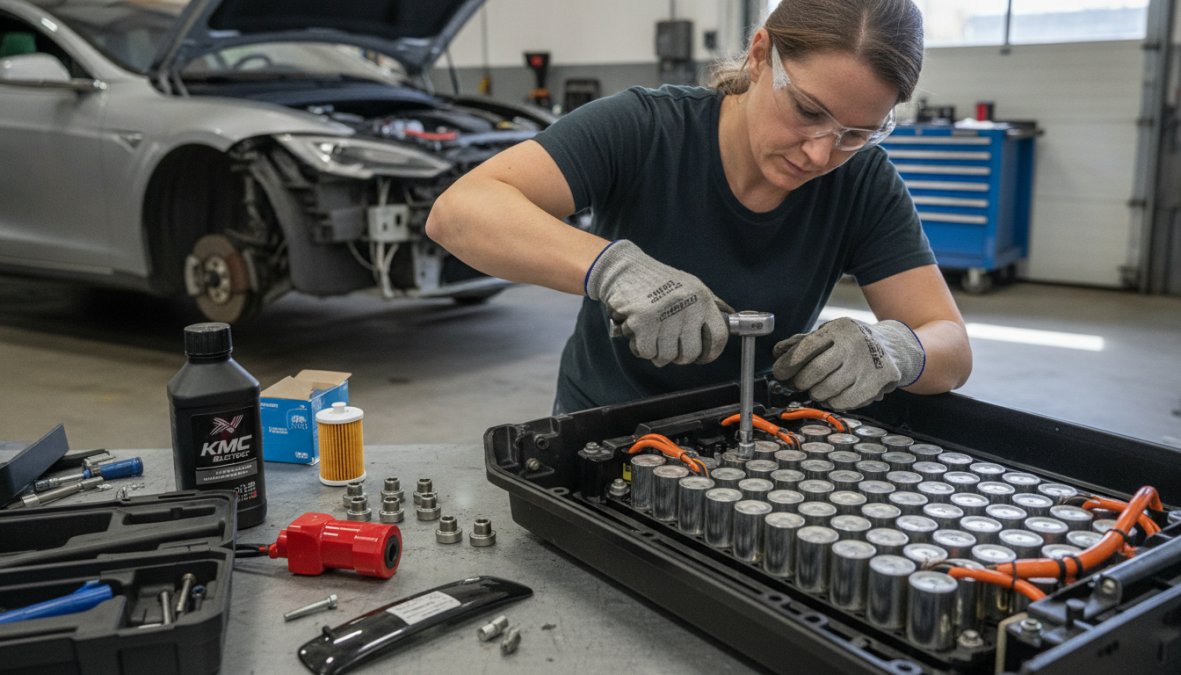
Battery health verification has become increasingly important for buyers and sellers. Independent battery diagnostics can reveal degradation patterns that indicate whether a battery will last another 10 years or might fail within 5. At KMC Electric, we offer independent battery health verification for customers buying or selling used EVs.
Key TakeawayThe single biggest factor in battery longevity is avoiding extreme states of charge. A battery kept between 20-80% will outlast an identical pack cycled from 0-100% by 5+ years.
Cost of Electric Car Maintenance vs Traditional Vehicles
The financial case for electric car ownership becomes clearer when examining maintenance costs over a vehicle's lifetime. No oil changes, no spark plugs, no transmission servicing, and dramatically reduced brake wear mean your EV will cost significantly less to maintain than a comparable petrol car. Over 10 years, an average EV owner saves £1,500-£2,500 on routine maintenance.
What you save is straightforward: oil change services (£40-£80 each, typically every 6,000 miles) disappear entirely. Brake pads, which might cost £200-£400 to replace every 50,000 miles on a petrol car, will likely never need replacement during the warranty period on an EV. Transmission fluid flushes, engine coolant replacements, and spark plug changes don't exist for electric vehicles.
What you still pay for includes tyre rotations, cabin air filter replacement (£30-£60), windshield washer fluid, and periodic brake fluid flushes (£80-£150 every 2 years). Battery coolant flushes, when needed after 5-8 years, cost £150-£300. Wheel alignment checks cost the same as for any car, typically £80-£150.
Some tasks are genuinely DIY-friendly: windshield washer fluid, cabin air filter replacement, and tyre rotations. Brake fluid flushing, coolant system work, and any high-voltage battery diagnostics must be performed by a certified technician. The high-voltage battery system operates at 300-400 volts; mishandling can cause serious injury or fire.
Common Electric Car Issues and How to Prevent Them
Regenerative braking system wear and rotor corrosion represent the most common EV-specific issue owners encounter. Because regenerative braking does most of the work, your mechanical brake pads and rotors experience minimal wear. However, they sit unused for months at a time, exposed to moisture and salt, and can develop surface corrosion that causes noise or vibration.
Prevention is straightforward: use the mechanical brakes regularly. Even in a car with strong regenerative braking, deliberately applying the friction brakes once or twice per week keeps rotors dry and prevents corrosion.
Tyre rotation, alignment, and EV-specific tyre wear patterns require attention that many owners overlook. Electric vehicles are heavier than equivalent petrol cars, a Tesla Model 3 weighs about 1,600 kg compared to 1,200 kg for a comparable petrol sedan. This extra weight, combined with instant torque delivery, creates unique tyre wear patterns. Rotate tyres every 10,000 km to balance wear, and check alignment annually, especially after hitting potholes or kerbs.
Software updates and over-the-air (OTA) firmware maintenance have become as important as mechanical servicing. Modern EVs receive regular OTA updates that improve battery management, charging efficiency, and driving performance. These updates download automatically when your car is parked and connected to WiFi, then install overnight. Some updates improve range by 2-3%, others optimise thermal management in cold weather.
Pro TipCheck your vehicle's update status monthly. Staying current with firmware ensures you benefit from the latest battery management optimisations that manufacturers deploy continuously.
Essential Maintenance Tasks for Electric Car Owners
Cabin air filter replacement is one of the few maintenance tasks that remains identical to petrol cars. The filter cleans air entering the cabin through the climate control system. Over 12 months, it accumulates dust, pollen, and particulates. Replacement takes 10-15 minutes and costs £30-£60. Most owners can do this themselves.
Windshield washer fluid and blades are consumables that need regular attention, especially in the UK where winter salt and grit quickly degrade visibility. Washer fluid costs £5-£10 per refill; blades cost £20-£40 per pair and should be replaced annually.
Brake fluid flushing and coolant system checks require professional attention. Brake fluid absorbs moisture from the air over time, which lowers its boiling point and compromises braking safety. Most manufacturers recommend a brake fluid flush every 2 years. This costs £80-£150 and must be done by a certified technician.
The battery coolant system requires inspection at service intervals and flushing every 5-8 years. A flush costs £150-£300 and involves draining the old coolant, flushing the system with clean fluid, and refilling with the correct specification.
Charging port inspection and high-voltage battery diagnostics are specialist tasks that should be performed annually by a certified technician. The charging port experiences mechanical stress every time you plug in; corrosion or loose connections can develop gradually. Electrical testing reveals high-resistance connections that cause slow charging or heat buildup.
Certified technician requirements for electric vehicle work are non-negotiable. Working on high-voltage systems requires specific training and certification. In the UK, technicians working on vehicles with batteries over 48 volts must hold relevant qualifications.
Specialist diagnostics reveal problems that standard diagnostic equipment cannot detect. EV-specific faults, battery cell imbalance, thermal management system leaks, inverter errors, and charging port connection resistance require manufacturer-approved diagnostic tools and software.
The question of warranty coverage becomes critical when choosing where to service your EV. Main dealers typically offer warranty-approved service that explicitly maintains your manufacturer warranty. Independent specialists like KMC Electric can perform warranty-equivalent work at lower cost, but you must verify that your specific repair won't void coverage.
Battery health verification for buying or selling is one area where independent specialists excel. When purchasing a used EV, an independent specialist can run deeper diagnostics to reveal whether the battery is genuinely healthy or showing early signs of failure. This independent verification costs £150-£250 but can save you from buying a car that will need a £8,000-£15,000 battery replacement in 3 years.
Maintaining your electric vehicle properly extends its service life, protects your warranty, and preserves resale value. At KMC Electric in Kettering, we specialise in comprehensive EV maintenance for Tesla and other electric vehicles, offering the independent battery health verification and specialist diagnostics that keep your vehicle running reliably. Contact us to schedule your EV maintenance or battery health check and discover how professional specialist care differs from main dealer networks.
Frequently Asked Questions
Do electric cars require a lot of maintenance compared to petrol vehicles?
Electric cars require significantly less maintenance than traditional petrol vehicles. They have no oil changes, spark plugs, or transmission fluid to service. However, electric car maintenance still includes tyre rotation, brake fluid flushing, cabin air filter replacement, and thermal management system checks. The EV powertrain has fewer moving parts, reducing overall wear. Professional diagnostic checks by a certified technician remain important for high-voltage battery health and software updates.
What is the most expensive maintenance on an electric car?
Battery replacement is the most significant cost, though it's rarely needed during the warranty period. Beyond that, high-voltage system diagnostics and inverter repairs are among the pricier services. However, regenerative braking systems reduce brake pad wear substantially, and the absence of oil changes and transmission servicing keeps routine maintenance affordable. Independent specialists like KMC Electric can provide cost-effective diagnostics and repairs compared to main dealers, identifying potential faults before warranty expiry.
How can I extend the life of my EV battery and maintain battery health?
Battery longevity depends on managing state of charge, thermal management, and avoiding extreme temperatures. Keep your battery between 20–80% for daily charging when possible; avoid frequent full charges and complete discharges. Ensure your thermal management system functions properly, as overheating degrades battery cells. Regular over-the-air (OTA) firmware updates optimise battery performance. Professional battery health verification through independent testing can confirm condition before buying or selling. Scheduled maintenance checks help catch cooling system issues early.
How often does an electric car need professional servicing according to manufacturer recommendations?
Most EV manufacturers recommend service intervals of 12 months or 12,000 miles, whichever comes first, though some models extend to 24 months. Manufacturer service intervals typically include brake fluid flushing, coolant system checks, cabin air filter replacement, and tyre rotation and alignment inspections. Over-the-air (OTA) software updates may be applied remotely. Warranty requirements often mandate adhering to these schedules. A certified technician should perform annual inspections to verify thermal management system health and check for rotor corrosion or other drivetrain concerns.