Registration Accepted.
Password reset email sent.
Blog >
Is Tesla Maintenance Really Necessary? What Owners Must Know Is Tesla Maintenance Really Necessary? What Owners Must Know
May 12, 2026 by ()
Table of Contents
Last Updated: May 12, 2026
Is tesla maintenance really necessary? That question comes up constantly among new and prospective EV owners, and the answer is more nuanced than Tesla's marketing suggests. This guide from KMC Electric breaks down exactly what you can skip, what you absolutely cannot, and where the real long-term costs hide. Below, we cover the full service picture across all major Tesla models, from the Model 3 and Model Y to the Model S and Model X, so you can make informed decisions about your car and your wallet.
Here is what most guides get wrong: they focus on what Tesla eliminates and gloss over the wear items and hidden costs that catch owners off guard at the 3-5 year mark. That is the part worth paying attention to.
Is Tesla Maintenance Really Necessary? The Honest Answer
Tesla maintenance is necessary, but not in the way most drivers expect from a traditional car. Tesla vehicles eliminate many of the mechanical parts that make gas cars expensive to run, yet they introduce a different set of service requirements that owners often underestimate.
The short answer: routine maintenance is simpler and cheaper than a petrol or diesel car. Non-routine repairs, however, can be significantly more expensive. Understanding that distinction is the key to managing cost of ownership intelligently.
What Tesla Eliminates Compared to Gas Cars
The list of things Tesla removes from the maintenance equation is genuinely impressive. No oil changes, no spark plugs, no transmission fluid, no fuel system servicing, no emission checks, and no coolant flush on most models under normal conditions. The absence of these items alone removes several of the most common service intervals that gas car owners budget for annually.
Regenerative braking also dramatically reduces brake wear. Because the motor handles most deceleration, brake pads and rotors last far longer than on a conventional vehicle. Many Tesla owners report going 100,000+ miles before needing brake work, though this varies significantly by driving style and terrain.
What Tesla Still Requires: The Non-Negotiables
Strip away the gas-car items and you are left with a focused but real list of maintenance needs:
Tyre rotation every 6,250 miles (more on this shortly)
Cabin air filter replacement every 2 years or as needed
Brake fluid test every 2 years, regardless of mileage
Air conditioning service every 2 years on Model S and Model X (every 4 years on Model 3 and Model Y)
Windshield washer fluid top-ups as needed
Tyre pressure checks monthly
Battery coolant replacement on older Model S and Model X vehicles at specified intervals
The brake fluid test is the one most owners skip and regret. Moisture contamination in brake fluid is a real safety issue, and Tesla's own guidance flags it as a time-based check, not a mileage-based one.
Watch Out - Skipping the brake fluid test because "EVs barely use their brakes" is a common mistake. Moisture still enters the system over time regardless of how rarely you brake hard. Contaminated fluid can cause brake fade in emergency situations.
Tesla Service Schedule: What to Do and When
Tesla's recommended service schedule is leaner than most manufacturers, but it is not zero. The schedule varies by model and year, so always verify against your specific vehicle's documentation.
Annual and Mileage-Based Checks
A practical Tesla service schedule for most owners looks like this:
Service Item - Frequency - Model 3 / Model Y - Model S / Model X
Tyre rotation - Every 6,250 miles - Yes - Yes
Cabin air filter - Every 2 years - Yes - Yes
HEPA filter (if fitted) - Every 3 years - N/A - Yes
Brake fluid test - Every 2 years - Yes - Yes
A/C desiccant bag - Every 4 years - Yes - Every 2 years
Battery coolant - Check at 50k miles - Rarely needed - Yes on older models
Tyre rotation stands out as the most frequent and most overlooked item. Tesla's instant torque delivery accelerates tyre wear, particularly on the rear axle of rear-wheel-drive variants. Missing rotations does not just cost you tyre life; it can affect handling and trigger alignment issues.
Software Updates and Remote Diagnostics via the Service App
One area where Tesla genuinely changes the game is remote diagnostics and over-the-air software updates. The Tesla service app lets owners schedule mobile service or service centre appointments directly, monitor real-time tyre pressure, and receive notifications for software updates and service completion.
Many faults that would require a dealer visit on a traditional car are resolved remotely on a Tesla. Software updates can adjust regenerative braking behaviour, improve range estimates, and even fix hardware-related bugs through calibration changes. According to Tesla's official support documentation, most software updates install automatically overnight when the car is connected to Wi-Fi.
This remote capability reduces out-of-pocket costs for minor issues, but it does not replace physical inspection. A software update cannot catch a worn control arm or a developing suspension issue.
Tesla Maintenance Cost Per Year: Tesla vs Gas Car Breakdown
The cost argument for EV ownership is real, but it deserves honest framing rather than best-case comparisons.
Routine Costs: Where Teslas Save You Money
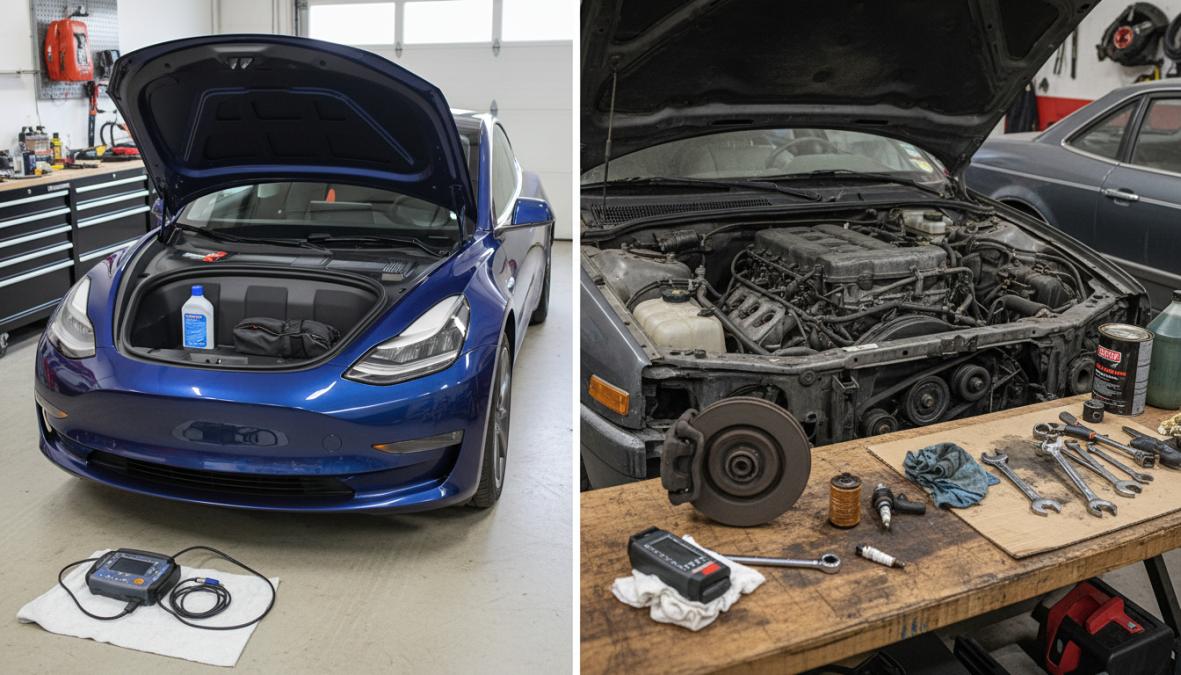
For routine items, Teslas are materially cheaper to maintain than comparable petrol cars. No oil changes alone removes a recurring cost that adds up to several hundred pounds or dollars per year depending on your service interval. Brake pads last longer due to regenerative braking. Spark plugs, transmission fluid, and fuel system servicing simply do not exist.
Many Tesla owners report annual routine maintenance costs that are a fraction of what they paid for a similarly priced petrol car. The biggest routine line items are tyre rotation and the biennial brake fluid test.
Hidden Costs Most Guides Don't Warn You About
Here is where the honest conversation starts. Several costs catch Tesla owners off guard:
Tyre wear: Tesla's weight and instant torque are hard on tyres. Replacing a set of performance tyres on a Model 3 or Model Y is a meaningful expense, and it happens more frequently than on a comparable petrol car.
Out-of-pocket repair costs post-warranty: High-voltage battery work, drive unit replacements, and body repairs are expensive. Out-of-warranty repairs at a Tesla service centre can run into thousands.
Alignment: Tesla's suspension geometry is sensitive. Kerb strikes or worn components can knock alignment out quickly, and misalignment accelerates tyre wear dramatically.
Suspension and control arms: These wear over time like any car. On higher-mileage Teslas, control arm bushings and ball joints are a known service item, particularly on Model S.
According to Consumer Reports' annual auto reliability data, electric vehicles generally have lower maintenance costs than petrol vehicles but can face higher repair bills for specific components when issues do arise.
Key TakeawayThe real cost advantage of Tesla ownership shows up in years 1-3. From year 4 onwards, suspension wear, tyre costs, and potential out-of-warranty repairs start to close the gap. Planning for these is smart ownership.
Tesla Tyre Rotation Frequency and Why It Matters More Than You Think
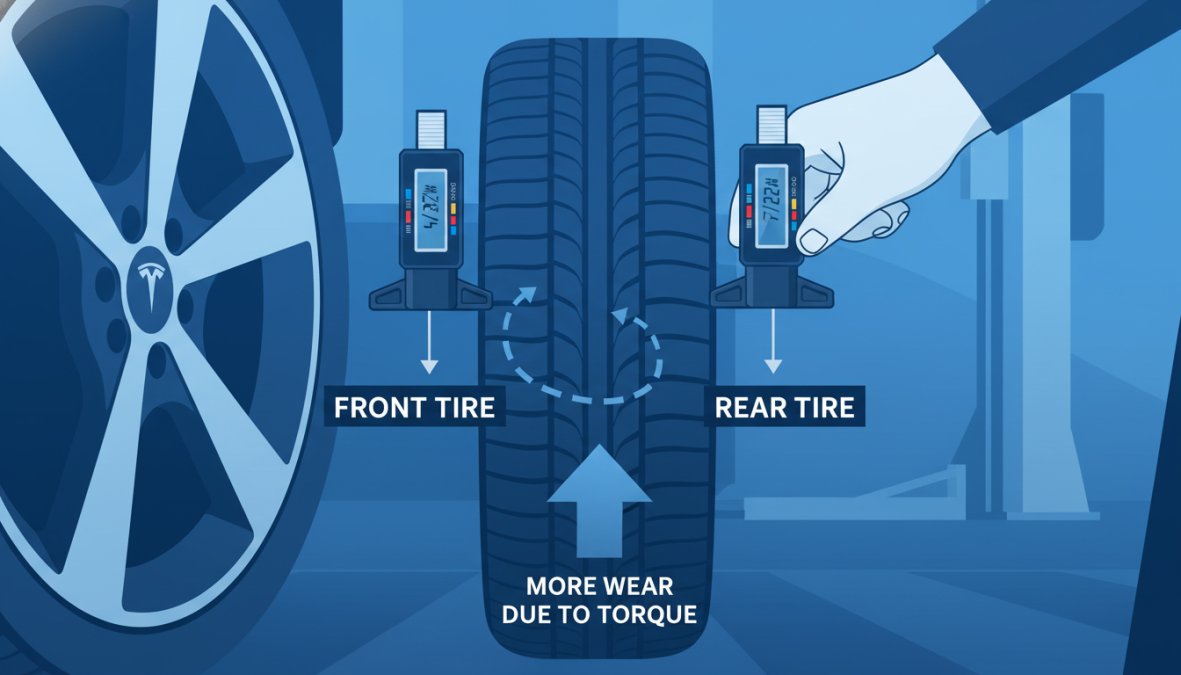
Tesla tyre rotation frequency should be every 6,250 miles, or every time you rotate if tread depth difference between axles exceeds 2/32 of an inch. This is more frequent than most petrol cars, and for good reason.
Tesla's performance profile puts unusual stress on tyres. Instant torque at low speeds accelerates rear tyre wear. The vehicles are also heavier than petrol equivalents of similar size, which increases wear across all four corners. Skipping rotations compounds this: uneven wear develops quickly, and once it sets in, no amount of rotation corrects it.
The practical consequence of poor rotation discipline is straightforward: you replace tyres far sooner than necessary, and you may experience handling imbalances that affect safety and ride quality.
Rotate every 6,250 miles without exception
Check tread depth at each rotation using a depth gauge
Inspect for uneven wear patterns that could indicate alignment or suspension issues
Check tyre pressure monthly; Tesla's weight makes it sensitive to pressure variation
If you are fitting aftermarket wheels or a dedicated winter tyre set, BLE TPMS sensors designed for Tesla (such as those from T Sportline) allow plug-and-play synchronisation with the vehicle's monitoring system, avoiding dashboard warnings and maintaining accurate pressure data.
PRO TIP - Rotate front to rear in a straight pattern on single-motor Teslas. On dual-motor all-wheel-drive variants, a cross-rotation pattern is generally preferred. If your tyres are directional, straight rotation only. Getting this wrong accelerates the very wear you are trying to prevent.
Is Tesla Maintenance Really Necessary for Long-Term Ownership? (5+ Years)
Past the five-year mark, the question of whether Tesla maintenance is really necessary shifts from routine upkeep to proactive care. This is where neglect starts to show up as real money.
Battery Health, Suspension, and Control Arms Over Time
Battery health is the most discussed long-term concern, and the data generally shows Tesla batteries degrade slowly under normal use. Avoiding frequent DC fast charging, keeping the battery between 20-80% state of charge for daily use, and not leaving the car at 100% for extended periods all contribute to long-term battery health.
Suspension wear is less discussed but equally important. Control arms, bushings, and ball joints on high-mileage Teslas are genuine service items. On the Model S in particular, front suspension components are a known wear area. Catching these early through regular inspection avoids the more expensive scenario of a failed component causing tyre damage or a safety incident.
An independent battery health verification from a specialist like KMC Electric gives long-term owners and prospective buyers an objective assessment of remaining capacity and cell balance. This is particularly valuable when buying or selling a used Tesla, where battery condition directly affects value.
Extreme Climates and What They Mean for Your Tesla
Cold climates reduce range and increase battery management system workload. Regular preconditioning before driving (using the Tesla app to warm the battery before departure) reduces strain and maintains efficiency. Tyre choice matters more in cold climates: summer tyres on a Tesla in sub-zero temperatures are a genuine safety risk, not just a range penalty.
Hot climates accelerate cabin air filter degradation and place additional load on the thermal management system. Parking in shade and pre-cooling the cabin before entry reduces HVAC workload and extends component life.
Independent Specialist vs Tesla Service Center: Which Should You Choose?
The honest answer depends on what your car needs and how old it is. For in-warranty work, Tesla's service centre network is the right choice. For out-of-warranty diagnosis, repair, and long-term maintenance, an independent specialist often offers better value and more transparent communication.
OEM vs Third-Party Parts: What You Need to Know
OEM parts from Tesla are engineered specifically for each model and carry the manufacturer's quality assurance. For safety-critical components (brakes, suspension, high-voltage system parts), OEM is the right choice.
Third-party parts vary considerably in quality. For consumables like cabin air filters, reputable aftermarket options (such as the EVANNEX HEPA filter) offer genuine performance benefits over OEM. For structural and safety components, the risk of substandard third-party parts outweighs the cost saving.
KMC Electric holds Level 4 Master Technician status in electric vehicles, with EV qualifications dating to 2016 and over 25 years of automotive industry experience. As an independent specialist, the team works across all Tesla models and provides detailed health assessments, fault identification before warranty expiry, and cost-effective repairs for out-of-warranty vehicles. This makes KMC Electric a credible alternative to the main dealer network for owners who want expert care without main dealer pricing.
As noted by the Society of Motor Manufacturers and Traders' EV guidance, independent specialists with recognised EV qualifications are increasingly important as the UK's EV fleet ages out of manufacturer warranty.
Service TypeTesla Service CentreIndependent Specialist (e.g., KMC Electric)In-warranty repairsRecommendedNot applicableOut-of-warranty diagnosisAvailableOften more cost-effectiveBattery health assessmentAvailableIndependent, unbiasedRoutine maintenanceAvailableCompetitive pricingPre-purchase inspectionLimitedSpecialist offering
Conclusion: Skip It or Schedule It?
The throughline of this entire guide is simple: Tesla maintenance is not the zero-effort proposition it is sometimes marketed as. The routine schedule is genuinely lighter than a petrol car, and the savings on oil changes, spark plugs, and transmission fluid are real. But tyres wear faster, suspension components age like any car, and out-of-warranty repair costs can be substantial.
Skip the maintenance, and you pay for it later, often at a point where the car is out of warranty and the costs fall entirely on you.
Long-term Tesla ownership rewards owners who stay ahead of wear items, particularly tyres, brake fluid, and suspension. KMC Electric provides independent diagnosis, battery health verification, and specialist maintenance for Tesla owners who want expert support outside the main dealer network. With Level 4 Master Technician status in EVs and over 25 years of automotive experience, the team identifies faults before they become expensive failures and offers practical, real-world fixes for out-of-warranty vehicles. Get in touch with KMC Electric to book a health assessment and protect the long-term value of your Tesla.
Frequently Asked Questions
What maintenance does a Tesla actually need?
Tesla maintenance really does exist, it just looks different from a petrol car. You can skip oil changes, spark plugs, and transmission fluid, but you still need regular tire rotation, cabin air filter replacement, brake fluid testing, windshield washer fluid top-ups, and periodic alignment checks. Battery health monitoring and suspension inspections become increasingly important as the vehicle ages, particularly for Model S and Model X owners beyond the warranty period.
How often should I rotate tyres on a Tesla?
Tesla's official guidance suggests rotating tyres every 10,000 to 12,000 miles, but many independent specialists recommend every 6,000 to 7,500 miles for Tesla models. This is because the instant torque delivery and heavier kerb weight, due to the battery pack, accelerates tyre wear significantly compared to equivalent petrol vehicles. Sticking to a stricter Tesla tire rotation frequency can meaningfully extend tyre life and reduce out-of-pocket costs over time.
Are Teslas expensive to maintain compared to gas cars?
For routine maintenance, Teslas are generally cheaper, no oil changes, no coolant flush cycles, no spark plugs or fuel system servicing. However, Tesla maintenance cost per year can spike unexpectedly due to high tyre wear rates, costly non-routine repairs outside warranty coverage, and limited regional service accessibility. Long-term ownership beyond five years often reveals higher-than-expected suspension and battery-related costs that official guides tend to understate.
What happens if I skip Tesla maintenance?
Skipping Tesla maintenance may seem harmless in the short term, but the consequences accumulate. Neglected tyre rotation leads to uneven wear and expensive early replacement. An unchecked cabin air filter degrades HVAC efficiency and air quality. Ignored brake fluid absorbs moisture over time, reducing braking performance. Most critically, skipping periodic battery health and suspension checks can allow faults to develop undetected, potentially voiding warranty coverage and resulting in significantly higher repair costs later.
Does Tesla offer mobile service, and is it worth using?
Tesla's mobile service sends a technician to your location for eligible repairs and maintenance tasks, bookable directly through the Tesla service app. It is genuinely convenient for minor work like cabin air filter changes or software-related issues. However, mobile service has limitations, it cannot perform tyre rotations, alignment, or suspension work on-site. For anything beyond basic tasks, visiting a service center or an independent EV specialist is necessary, and often more cost-effective for out-of-warranty vehicles.