Registration Accepted.
Password reset email sent.
Blog >
Tesla Model 3 Service: The Complete Owner's Guide Tesla Model 3 Service: The Complete Owner's Guide
May 11, 2026 by ()
Table of Contents
Last Updated: May 12, 2026
Tesla model 3 service is one of the most misunderstood topics in EV ownership. Many buyers assume an electric car means near-zero maintenance, then get caught off guard by brake caliper corrosion, degraded coolant, or a failed cabin air filter that's been ignored for three years. This guide from KMC Electric breaks down exactly what a Model 3 service involves, and where the real long-term costs hide. Below, we cover the full maintenance schedule, mobile service limitations, and the honest comparison between Tesla service centers and independent specialists.
The core argument running through this guide is simple: condition-based maintenance sounds convenient, but it puts the burden of judgment on the owner. Get that judgment wrong and you pay for it.
What a Tesla Model 3 Service Actually Involves
Tesla Model 3 service is a condition-based maintenance system rather than a fixed-interval schedule. Tesla does not mandate annual servicing the way traditional automakers do. Instead, the owner's manual specifies items to check "as needed" or at defined mileage and time thresholds. This design reduces unnecessary dealer visits, but it also means owners must actively track their vehicle's condition rather than relying on a service reminder sticker.
The Model 3 has no engine oil, no timing belt, no spark plugs, and no transmission fluid. Those omissions eliminate a significant chunk of traditional vehicle maintenance. What remains is a focused list: brake fluid, cabin air filter, HVAC filter, tyre rotation, wiper blades, coolant, suspension, and brake caliper condition. The touchscreen and software systems update over the air, which removes another category of workshop visits.
What most guides miss is that the simplicity of the list creates a false sense of security. Owners who never visit a service center can still accumulate serious deferred maintenance, particularly around brake health and coolant condition.
Condition-Based Maintenance vs. Fixed Intervals
Condition-based maintenance means Tesla's onboard diagnostics and the owner's own observations drive the service schedule, rather than a calendar or odometer trigger. The practical implication is that two Model 3s of identical age and mileage may have genuinely different service needs depending on climate, driving style, and charging habits.
This is a meaningful departure from conventional automotive thinking. Traditional vehicles use fixed intervals because manufacturers cannot predict how individual owners drive. Tesla's approach trusts the vehicle's systems and the owner to identify real needs. That works well for software updates and battery management. It works less well for physical components like brake fluid, which degrades chemically over time regardless of how often the brakes are applied.
Pro Tip - Check your brake fluid condition every two years regardless of mileage. Moisture absorption happens on a time basis, not a usage basis, and contaminated brake fluid raises the risk of brake fade under heavy braking loads.
What the Owner's Manual Says (and What It Leaves Out)
The Tesla Model 3 owner's manual provides a maintenance schedule table covering tyre rotation, brake fluid testing, air filter replacement, and wiper blade inspection. It specifies brake fluid testing every two years and cabin air filter replacement every two years or as needed.
What the manual does not address in detail: regional climate variations, the accelerated brake caliper corrosion common in salty climates, or the effect of low brake usage on caliper seizure. It also provides no guidance on when to seek independent battery health verification, which is particularly relevant for used Model 3 buyers. Owners in high-humidity or coastal environments should treat the manual's timelines as minimums, not targets.
Tesla Model 3 Maintenance Schedule: Year by Year
The Tesla Model 3 maintenance schedule organizes into time-based items, mileage-based items, and continuous monitoring tasks. The table below summarises the key service intervals based on official Tesla guidance.
Service Item Interval Notes
Tyre rotation - Every 6,250 miles or if tread depth difference exceeds 2/32 in - Critical for even wear on heavy EV
Brake fluid test - Every 2 years - Replace if contaminated
Cabin air filter - Every 2 years - More frequent in dusty/polluted areas
HEPA filter (if fitted) - Every 3 years - Model 3 with HEPA option
Air conditioning service - Every 2 years
Desiccant bag replacement
Wiper blades - As needed / annually - Check condition before winter
Brake caliper cleaning - Every 12 months in salty climates - Prevents seizure from low use
Coolant - Every 4 years (battery coolant) - Do not defer
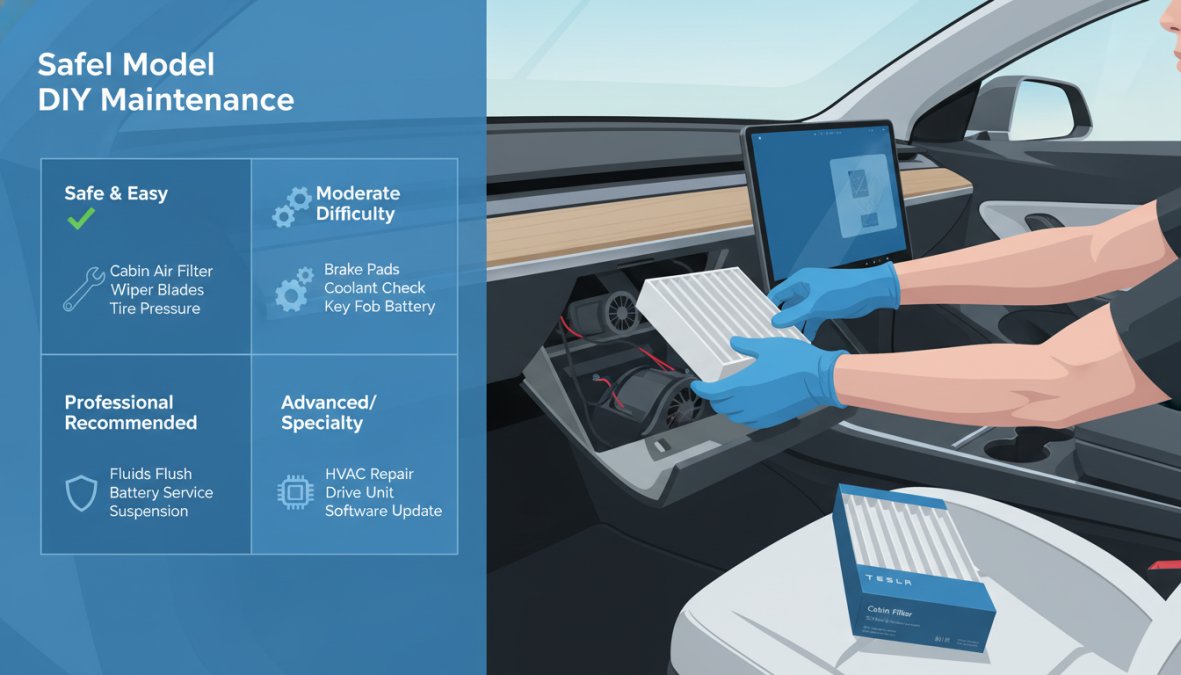
Year 1-2: Tyre rotation is the primary task. Wiper blade condition should be assessed. Brake fluid testing is due at the two-year mark. No major mechanical service is typically required.
Year 3-4: Cabin air filter replacement becomes due. Battery coolant condition should be assessed approaching year four. Brake caliper inspection is worthwhile, particularly if the vehicle is driven in a climate where roads are salted in winter.
Year 5+: Battery coolant replacement is due. A full brake system inspection, including caliper function and brake pad thickness, is advisable. Independent battery health verification becomes genuinely valuable at this stage, especially if the vehicle is being sold or purchased used.
As-Needed Service Items to Monitor Continuously
Several Model 3 service items operate outside any fixed schedule. These require owner awareness rather than calendar reminders:
Wiper blades: Replace when streaking appears or rubber shows cracking
Tyre pressure: Check monthly; Model 3 tyres carry higher loads than comparable ICE vehicles
Brake pad thickness: Inspect visually through the wheel spokes; regenerative braking reduces pad wear but does not eliminate it
Touchscreen responsiveness: Soft resets resolve most issues; persistent faults may indicate MCU hardware degradation
Charging behaviour: Unusual charging curves or reduced range can signal battery degradation worth investigating and repair if required
Tesla Model 3 Brake Fluid Check: What Owners Often Miss
Brake fluid is the most commonly neglected item in Tesla Model 3 maintenance, and the consequences are real. Brake fluid is hygroscopic, meaning it absorbs moisture from the atmosphere over time. As moisture content rises, the fluid's boiling point drops. Under hard braking, this increases the risk of brake fade.
The Tesla owner's manual recommends testing brake fluid every two years and replacing it if contaminated. Testing requires a refractometer or test strips; a visual inspection alone is not sufficient. Many owners skip this entirely because they rarely use friction braking, assuming regenerative braking means the brake system is fine. That logic is flawed. The fluid degrades on a time basis regardless of how often the brake pedal is pressed.
A common mistake is confusing low brake usage with low brake system wear. The brake caliper slides and pistons still require lubrication and freedom of movement. In vehicles that rely heavily on regenerative braking, the physical brakes go long periods without use, which accelerates caliper corrosion and seizure risk, particularly in salty climates.
Watch Out - Never defer brake fluid replacement beyond four years, even if test strips show borderline results. Contaminated brake fluid in an EV creates a compounding risk: if regenerative braking is reduced by a software fault or traction event, you are relying entirely on a degraded hydraulic system.
As documented in Tesla's official service documentation, brake fluid testing is a two-year interval item. Independent garages with EV specialist qualifications can perform this test and advise on replacement without the premium pricing of a main dealer.
Tesla Mobile Service: What It Can and Cannot Fix
Tesla mobile service is a technician dispatch programme that handles a defined set of repairs and maintenance tasks at the owner's location. For many routine items, it eliminates the need to book a service center appointment, which can involve significant wait times.
Mobile service handles tasks including wiper blade replacement, cabin air filter replacement, minor software diagnostics, key fob pairing, and some sensor calibrations. It is well-suited to owners who want routine maintenance completed without disrupting their schedule.
The limitations are meaningful. Mobile service cannot perform high-voltage battery work, major suspension repairs, body panel replacement, or brake caliper replacement. Any repair requiring a vehicle lift is typically outside mobile service scope. Owners who discover a brake caliper fault or coolant leak during a mobile visit will still need to attend a service center.
According to Tesla's mobile service overview, the programme is available in most major urban areas, but coverage varies significantly by region. Rural owners and those outside major cities often find mobile service unavailable or subject to long scheduling delays.
The practical takeaway: mobile service is excellent for what it covers, but it is not a substitute for periodic workshop-based inspection. Treating mobile service as your only maintenance channel means some items will go uninspected for years.
Tesla Service Center vs. Independent Specialist: Honest Comparison
What separates a Tesla service center visit from an independent specialist comes down to access, cost, and scope. Both have genuine advantages. Neither is always the right answer.
Tesla service centers use Tesla Toolbox 3, the official diagnostic software providing access to fault codes, live data streams, vehicle configuration tools, and Driver Assist System calibration. For warranty repairs and software-related faults, the service center is the correct choice. Tesla technicians are trained specifically on Tesla systems, and warranty work must be performed by an authorised center to preserve coverage.
The drawbacks are real: service center wait times are frequently long, pricing for out-of-warranty work is high, and the experience varies considerably by location. For owners whose vehicles are outside warranty, the cost differential versus an independent specialist can be substantial.
KMC Electric operates as an independent Tesla and EV specialist with Level 4 Master Technician status in electric vehicles and EV qualifications since 2016. With over 25 years of automotive industry experience, the team provides professional diagnosis, brake system servicing, battery health assessment, and long-term maintenance at a cost-effective alternative to main dealer pricing. For out-of-warranty Model 3 owners, this kind of specialist support offers genuine value without the overhead of a franchised network.
Factor - Tesla Service Center - Independent EV Specialist
Warranty work - Yes - No (voids warranty)
Diagnostic software - Tesla Toolbox 3 - Varies by specialist
Out-of-warranty cost - High - Typically lower
Wait times - Often 2-4 weeks - Generally shorter
Battery health verification - Limited - Available independently
Local availability - Urban areas only - Wider coverage
Warranty Implications of Using a Third-Party Garage
The warranty implications of using a third-party garage depend on what work is performed and when. Tesla's vehicle warranty covers manufacturing defects. Using an independent garage for maintenance items, such as cabin air filter replacement, wiper blades, or tyre rotation, does not void the vehicle warranty under UK consumer law.
However, if an independent garage performs work that causes a fault covered by the warranty, Tesla may dispute the claim. The practical rule: keep the vehicle under Tesla service for any work that touches high-voltage systems or software during the warranty period. Use independent specialists for maintenance tasks and post-warranty repairs.
The UK consumer rights guidance on vehicle warranties confirms that consumers are not required to use manufacturer-approved garages for routine maintenance to maintain their warranty, provided the work meets the required standard.
How Regional Climate Affects Your Service Needs
Regional climate is the variable the owner's manual consistently underweights. Owners in salty climates, coastal areas, or regions with heavy winter road treatment face accelerated brake caliper corrosion. Because the Model 3 uses regenerative braking for the majority of deceleration, the physical brake calipers can go weeks without meaningful use. Salt and moisture accumulate on the caliper slides and pistons, leading to seizure.
Annual brake caliper cleaning and lubrication is advisable for any Model 3 operated in these conditions. The EVANNEX Brake Service Cleaning Kit includes high-temperature brake lubricant and cleaning tools designed for this task, and addresses a specific Tesla maintenance need that generic brake service kits often miss.
Owners in hot, dry climates face different pressures: cabin air filter degradation accelerates in dusty environments, tyre wear is faster, and coolant systems work harder. Shorter cabin filter intervals (annually rather than every two years) are sensible in these conditions.
Long-Term Ownership Costs: Tesla Model 3 Service Over 5-10 Years
The long-term ownership cost picture for a Model 3 is genuinely favourable compared to equivalent internal combustion vehicles, but it is not zero. Owners who plan for the real service items avoid surprises; those who assume "electric means maintenance-free" tend to face concentrated costs later.
Over a five-year period, the main service costs for a typical Model 3 include: multiple tyre rotations and at least one full tyre replacement set, two rounds of brake fluid testing and likely one replacement, two cabin air filter replacements, one air conditioning desiccant service, and one battery coolant replacement. Brake caliper servicing adds cost for owners in corrosive climates.
At the ten-year mark, battery health becomes the dominant concern. Battery degradation is condition-based and varies significantly by charging habits, climate, and usage. Independent battery health verification, available from specialists like KMC Electric, provides an objective assessment of remaining capacity and identifies potential faults before they become expensive. This is particularly valuable when buying or selling a used Model 3, where the seller's claimed battery condition may not reflect the vehicle's actual state.
According to guidance on EV battery health and longevity, charging habits have a measurable effect on long-term battery capacity. Consistently charging to 100% and allowing the battery to sit at full charge accelerates degradation. The practical recommendation is to set the daily charge limit to 80-90% for routine use.
The real cost advantage of the Model 3 over a decade is not that it requires no maintenance. It is that the maintenance it does require is predictable, manageable, and significantly less expensive than equivalent ICE vehicle servicing when handled proactively.
Key Takeaway - The owners who get the best long-term value from a Model 3 are the ones who treat it as a low-maintenance vehicle, not a no-maintenance vehicle. Brake fluid, coolant, and battery health are the three areas where deferred attention creates the largest costs.
Keeping a Tesla Model 3 in good condition over the long term requires more active management than the "no maintenance needed" narrative suggests. Brake fluid, caliper condition, coolant, and battery health all need attention on a schedule the owner has to track. KMC Electric provides independent diagnosis, brake system servicing, and battery health verification for Model 3 owners who want expert support outside the main dealer network, backed by Level 4 Master Technician status and over 25 years of automotive experience. Get in touch with KMC Electric for a vehicle health assessment that gives you an honest picture of your Model 3's condition.
Frequently Asked Questions
Does a Tesla Model 3 need regular service?
Yes, but far less than a petrol or diesel car. The Tesla Model 3 uses condition-based maintenance rather than fixed annual service intervals. Key items include brake fluid checks every two years, cabin air filter replacement, tyre rotation, and wiper blade replacement as needed. There are no oil changes or spark plugs to worry about. Staying on top of these tasks helps extend the service life of the vehicle and can prevent larger faults developing over time.
How often should I rotate tyres on a Tesla Model 3?
Tesla's owner's manual recommends rotating tyres every 10,000-12,000 miles, or sooner if tread depth difference between axles exceeds 2mm. Because the Model 3 uses regenerative braking, rear tyres can wear unevenly compared to conventional vehicles. Regular tyre rotation is one of the most cost-effective Tesla Model 3 maintenance schedule tasks you can do, and it can be carried out by any competent tyre specialist, not just a Tesla service center.
Can I service my Tesla Model 3 at a local independent garage?
Yes, for most routine maintenance tasks. Independent EV specialists can legally carry out Tesla Model 3 service work including brake fluid changes, cabin air filter replacement, tyre rotation, and brake caliper cleaning. Under UK consumer rights law, using an independent garage does not automatically void your warranty, provided work is carried out to manufacturer standards. For advanced diagnostics requiring Tesla Toolbox 3 or HVAC and coolant system work, choose a garage with proven EV qualifications and experience.
How much does Tesla Model 3 service typically cost?
Costs vary significantly depending on where you go and what is needed. A brake fluid change typically costs £50-£100 at an independent specialist versus potentially more at a Tesla service center. Cabin air filter replacement is one of the cheapest DIY tasks, with filter kits available for under £30. Tyre rotation at a third-party tyre shop is often £20-£40. Over a 5-10 year ownership period, total service costs for a Model 3 are generally lower than a comparable combustion vehicle, making condition-based maintenance planning worthwhile.
What does Tesla mobile service cover?
Tesla mobile service can handle a range of tasks remotely or at your location, including wiper blade replacement, cabin air filter changes, minor software diagnostics via the touchscreen, and some brake-related work. However, it cannot carry out work requiring a vehicle lift, such as tyre rotation, brake caliper servicing, or coolant system checks. For anything requiring physical access underneath the vehicle, you will need a service center or an independent specialist garage with proper lifting equipment.
How do I check my Tesla Model 3 maintenance status?
The Tesla Model 3 touchscreen displays service reminders and alerts under the 'Service' menu in vehicle settings. You can also use third-party apps like Scan My Tesla to monitor battery health, motor torque data, and charging efficiency over time. For a more detailed long-term picture, TeslaMate is a free open-source data logger that tracks degradation trends and service history. For a professional assessment, an independent specialist can run a full vehicle health check and identify any faults before warranty expiry.