An electric vehicle battery health report is a detailed assessment of your EV's battery condition, expressed as a State of Health (SoH) percentage indicating how much capacity your battery retains compared to when new. Most EV batteries degrade at 2-3% per year under normal use, though this varies based on charging habits and climate. Understanding these metrics before purchasing a used vehicle can save thousands of pounds in unexpected repairs.
A battery health report captures detailed data about kilowatt-hour (kWh) capacity, charging cycles, thermal management performance, and voltage sag patterns that only professional diagnostic tools can reveal. The report includes readings from the Battery Management System (BMS), which monitors individual cell voltages, temperature data, and cell balancing performance, identifying specific fault codes before they trigger dashboard warning lights.
Pro TipMost owners assume 10-15% range loss means battery failure. In reality, recalibration or thermal management adjustments often restore 80% of that loss without cell replacement.
[Tesla battery(/page/tesla-battery-repair) degradation analysis by Geotab | geotab.com]
Why Battery Health Matters for Used EV Buyers
The battery represents 30-40% of your vehicle's total value, with replacement costs between £8,000 and £15,000 depending on model and capacity. A used Model 3 with 92% SoH versus 78% SoH differs by roughly £5,000 in residual value, a gap many buyers discover only after purchase.
Key TakeawayA battery health check costs £200-400. [Battery replacement](/blog/tesla-out-of-warranty-repair-costs) costs £10,000+. The maths is simple.
Used EV resale value depends almost entirely on battery condition. A 2020 Model Y with 95% SoH commands an 8-12% premium compared to an identical vehicle with 82% SoH. Independent verification through specialists provides peace of mind that dealer reports sometimes cannot match, as dealers have financial incentives to present battery condition optimistically.
Understanding EV Battery Degradation and State of Health
State of Health (SoH) is the percentage of your battery's original capacity that remains usable. A battery at 90% SoH can store 90% of its original kilowatt-hours. This metric derives from the Battery Management System's continuous monitoring of cell voltages, temperature, and charge cycles.
Battery degradation occurs through two mechanisms: calendar ageing (time-based) and cycle ageing (charge-based). Calendar ageing happens even when the vehicle sits unused, driven by chemical processes within lithium-ion cells. Cycle ageing accelerates with each charge-discharge cycle, particularly with DC fast charging, which generates higher heat and cell stress.
Most EV batteries are warrantied for 8 years or 160,000 km, guaranteeing SoH remains above 70-75%. However, warranty coverage excludes degradation caused by improper charging or extreme temperature exposure.
Watch OutLeaving your EV plugged into a DC fast charger after reaching 100% causes permanent capacity loss. Many owners don't realise their charging behaviour accelerates degradation by 15-20% compared to optimal practices.
How Charging Cycles and DC Fast Charging Impact SoH
A charging cycle is counted as a full discharge from 100% to 0%, though most EVs never complete full cycles. The Battery Management System counts fractional cycles; charging from 20% to 80% counts as 0.6 of a cycle.
DC fast charging delivers enormous current, generating heat that stresses individual cells. A 10-minute DC fast charge reaches 40-50°C internally, whilst a 7-hour home AC charge stays below 25°C. Repeated high-temperature exposure degrades the solid electrolyte interface, reducing cells' ability to accept and release charge efficiently.
Vehicles relying heavily on DC fast charging experience SoH loss rates 1.5-2x higher than vehicles charged primarily at home. The optimal charging pattern is: charge to 80% most days using AC power, use DC fast charging only for long trips, and avoid leaving the vehicle at 100% SoH for extended periods. This pattern extends battery lifespan by 2-3 years compared to aggressive charging.
How to Check EV Battery Health: Methods and Tools
Multiple methods exist for checking EV battery health, ranging from free dashboard metrics to professional diagnostic reports.
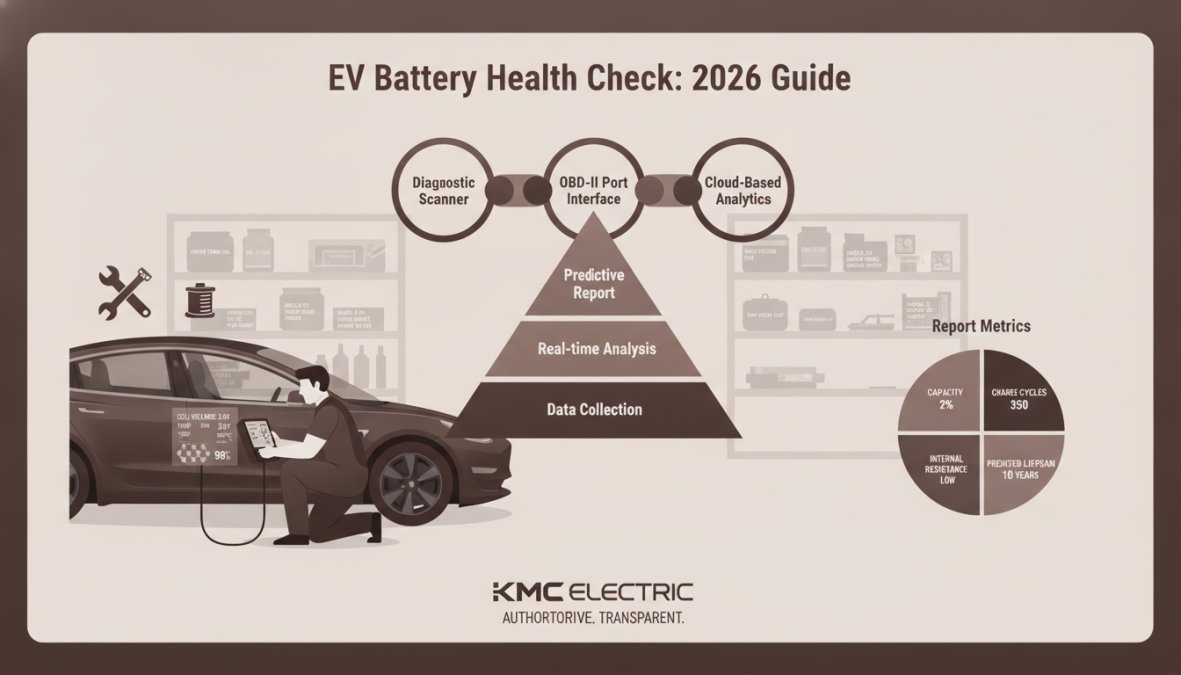
Technician using a diagnostic scanner on a Tesla Model 3, showing the OBD-II port and handheld device screen in a professional garage setting
Dashboard Metrics and Infotainment Diagnostics
Every modern EV displays battery health information through its infotainment system. Tesla vehicles show State of Charge (SoC), estimated range, and battery temperature through the touchscreen. However, these metrics are simplified and don't reveal detailed SoH percentage or cell-level diagnostics that professional reports provide.
Most EV dashboards show range estimates rather than actual capacity measurements, making it difficult for owners to track actual battery condition over time.
OBD-II Scanners and Third-Party Diagnostic Tools
OBD-II (On-Board Diagnostics) scanners connect to your vehicle's diagnostic port and retrieve fault codes and live data streams, including battery voltage, cell balancing status, and thermal management performance. Consumer-grade scanners cost £30-150 and reveal whether your vehicle has active battery-related fault codes.
However, consumer OBD-II scanners have significant limitations. Tesla restricts access to detailed battery metrics more than most manufacturers, meaning consumer scanners can read only basic information. Professional diagnostic tools cost £3,000-8,000 and access manufacturer-specific protocols, retrieving actual SoH percentage, individual cell voltages, charge cycle counts, and thermal history.
Third-party services like Recurrent Auto and Geotab offer cloud-based monitoring by connecting to vehicle telematics data, tracking degradation over months or years at subscription costs of £5-15 per month.
Pro TipIf considering a used EV purchase, request a professional battery report from an independent specialist before finalising. The £250-400 cost is trivial compared to the risk of inheriting a degrading battery.
Used EV Battery Assessment: What Professional Reports Reveal
A professional battery health report provides data that dashboard metrics and consumer scanners cannot access. These reports typically include comprehensive SoH percentage, individual cell voltage readings, thermal management performance, charge cycle history, and predictive lifespan estimates.
The report quantifies capacity loss in kilowatt-hours. If a vehicle originally had 75 kWh usable battery and testing shows 67 kWh remaining, the SoH is 89.3%. Professional reports also identify voltage sag patterns, indicating whether cell balancing works properly. Voltage sag above 200 mV indicates the BMS is working overtime to keep cells within safe ranges, a warning sign that the battery approaches end-of-life.
Reading Capacity Loss, Voltage Sag, and Battery Management System Data
Capacity loss shows how much original kilowatt-hour capacity has degraded. Most manufacturers warrant that capacity loss won't exceed 20-30% over the warranty period. If a report shows 35% capacity loss on a vehicle still under warranty, you have grounds to demand battery replacement.
Battery Management System data reveals thermal history. High maximum temperatures indicate aggressive charging or extreme environmental conditions. The report shows charge cycle count, which helps identify whether the owner used DC fast charging frequently (high cycles for age) or primarily home charging (low cycles for age).
Most EV manufacturers warrant the battery for 8 years or 160,000 km, guaranteeing it retains at least 70% of original capacity. If capacity loss exceeds this threshold during warranty, the manufacturer must replace the battery at no cost.
However, warranty coverage has significant exclusions. Damage caused by improper charging, extreme temperature exposure, or accidents is typically not covered. In the UK, consumer rights under the Consumer Rights Act 2015 provide additional protection beyond manufacturer warranties. If a vehicle develops a fault within 6 months of purchase, the seller must prove the fault was not present at sale.
What Happens After Warranty Expiry
Once warranty expires, battery replacement becomes the owner's responsibility. Replacement costs vary: Tesla Model 3 costs £8,500-10,500, Model Y costs £10,000-12,000, and Model S costs £12,000-15,000, including labour. Battery degradation after warranty expiry slows considerably with optimal charging practices, potentially extending usable vehicle life by 4-5 years.
Professional Battery Health Reports vs. DIY Diagnostics
The choice between professional reports and DIY diagnostics depends on technical expertise, decision stakes, and budget. For most used EV purchases, professional reports are worth the investment. For ongoing monitoring of owned vehicles, DIY tools offer reasonable value.
Assessment Method
Cost
Accuracy
Detail Level
Time Required
Dashboard metrics
Free
Low
Very limited
Instant
Consumer OBD-II scanner
£30-150
Medium
Basic fault codes
15 minutes
Professional diagnostic report
£250-400
Very high
Comprehensive SoH, cells, thermal history
1-2 hours
Cloud-based monitoring service
£60-180/year
High
Trends over time, degradation rate
Ongoing
Cost-Benefit Analysis and Manufacturer-Specific Limitations
A professional battery report costs £250-400 and takes 1-2 hours. For a used EV purchase worth £15,000-25,000, this represents 1-2% of purchase price and eliminates the largest variable cost risk.
Tesla restricts access to detailed battery metrics more than most manufacturers, though professional Tesla reports include SoH percentage and thermal data. Volkswagen and Hyundai make more detailed diagnostic data available through standard protocols, meaning professional reports on these vehicles often include more granular cell-level information.
Watch OutNever rely solely on a consumer OBD-II scanner to decide whether to purchase a used EV. Always commission a professional report for [pre-purchase assessment](/page/pre-purchase-inspection).
Interpreting Your EV Battery Health Report: Key Metrics Explained
A professional battery health report contains several key metrics determining whether a battery is in good condition or approaching end-of-life.
State of Health (SoH) is the headline metric. An SoH of 92% means the battery retains 92% of original capacity. SoH above 85% indicates good condition. SoH between 75-85% indicates moderate degradation but remains within manufacturer warranty coverage. SoH below 75% suggests significant stress and approaching warranty limits.
Kilowatt-hour (kWh) capacity is the actual usable energy the battery can store. A report showing 67 kWh remaining on a 75 kWh original battery translates to 89% SoH and directly affects range. State of Charge (SoC) differs from State of Health, SoC is current charge level, typically expressed as a percentage.
Charge cycles represent total charging events. Most EV batteries tolerate 1,000-2,000 full charge cycles before reaching 70% SoH. Battery lifespan predictions estimate how long the battery remains above 70% SoH based on current degradation trends.
EV battery health metrics and measurement protocols
Protecting EV Resale Value Through Battery Health Verification
Your EV's resale value is almost entirely determined by battery health. A 3-year-old Model 3 with 92% SoH might fetch £18,000, whilst an identical vehicle with 78% SoH might sell for £15,000.
Protecting resale value means adopting charging practices that minimise degradation. Charge to 80% for daily use, avoid leaving the vehicle at 100% SoH for extended periods, and use DC fast charging only when necessary. These practices preserve an additional £2,000-3,000 in resale value over the vehicle's life.
When selling your EV, commissioning an independent battery health report is increasingly expected by serious buyers. Sellers who provide transparent battery data command premiums of 5-8% compared to vehicles with unknown battery condition. The used EV market is maturing, and transparency around battery health is becoming a key competitive advantage.
Battery health is the foundation of EV ownership confidence. Whether buying a used vehicle or maintaining one you already own, understanding battery metrics and adopting practices that preserve capacity protects your investment. At KMC Electric, we specialise in independent battery health verification for Tesla and other electric vehicles across Kettering and Northamptonshire. Our Level 4 Master Technician team provides detailed diagnostic reports revealing actual battery condition, identifying potential faults before warranty expiry, and giving you the information needed to make confident purchasing decisions. Contact KMC Electric today to schedule a professional battery health assessment and protect your EV investment.
Frequently Asked Questions
What is an EV battery health report and why do I need one?
An EV battery health report measures your vehicle's State of Health (SoH), capacity loss, and charging cycle history. It's essential when buying a used EV to verify the battery hasn't degraded excessively, and helps identify potential faults before warranty expiry. Independent reports provide transparency that manufacturer diagnostics often cannot, revealing real degradation rates and whether thermal management issues exist.
How does EV battery degradation affect my vehicle's range and resale value?
Battery degradation reduces kilowatt-hour (kWh) capacity, directly shortening driving range. Most EV batteries lose 2-3% capacity annually under normal conditions, but aggressive DC fast charging or poor thermal management can accelerate this. A battery at 80% State of Health may lose 15-20% of original range. This impacts resale value significantly, buyers expect detailed battery health reports before purchase, and degraded batteries can reduce vehicle value by thousands of pounds.
What should I look for in a used EV battery assessment before purchase?
Focus on State of Health percentage (aim for 85% or higher), total charging cycles completed, and capacity loss trends. Check whether DC fast charging was overused, review thermal management system performance, and verify the Battery Management System (BMS) shows no balancing errors. Professional reports from independent specialists like KMC Electric provide manufacturer-specific diagnostic data that reveals issues main dealers might miss, protecting your investment and identifying costly repairs early.
How long does an EV battery typically last, and what does my warranty cover?
Most EV batteries are warrantied for 8 years or 100,000-160,000 miles, covering degradation below 70-80% State of Health. Real-world battery lifespan is often 10-20 years, but longevity depends on charging habits, climate, and usage patterns. After warranty expiry, battery replacement costs can exceed £15,000. Understanding your warranty terms and obtaining independent battery health verification before expiry ensures you're not left with unexpected repair bills.