Tesla Model S Battery Repair: Guide to Costs & Options
Last Updated: June 27, 2026
When your Tesla Model S battery shows signs of trouble, the stakes feel high. Battery issues can mean thousands of pounds in repair costs, extended downtime, or vehicle unreliability. At KMC Electric, we've spent over 25 years helping EV owners navigate tesla model s battery repair and prevent expensive mistakes.
Most owners don't understand their options. They assume they must go to Tesla Service Centre, don't know what their warranty covers, and haven't heard of module-level repairs that could save significant money. This guide breaks down everything you need to know: technical basics, warranty coverage, real cost breakdowns, and independent repair solutions changing the game for out-of-warranty Model S owners.
Understanding Tesla Model S Battery Repair Basics
The High-Voltage (HV) battery in your Model S isn't a single unit you swap out like a traditional car battery. It's a sophisticated system with hundreds of individual cells organized into modules, all managed by a Battery Management System (BMS) that monitors voltage, temperature, and cell health constantly.
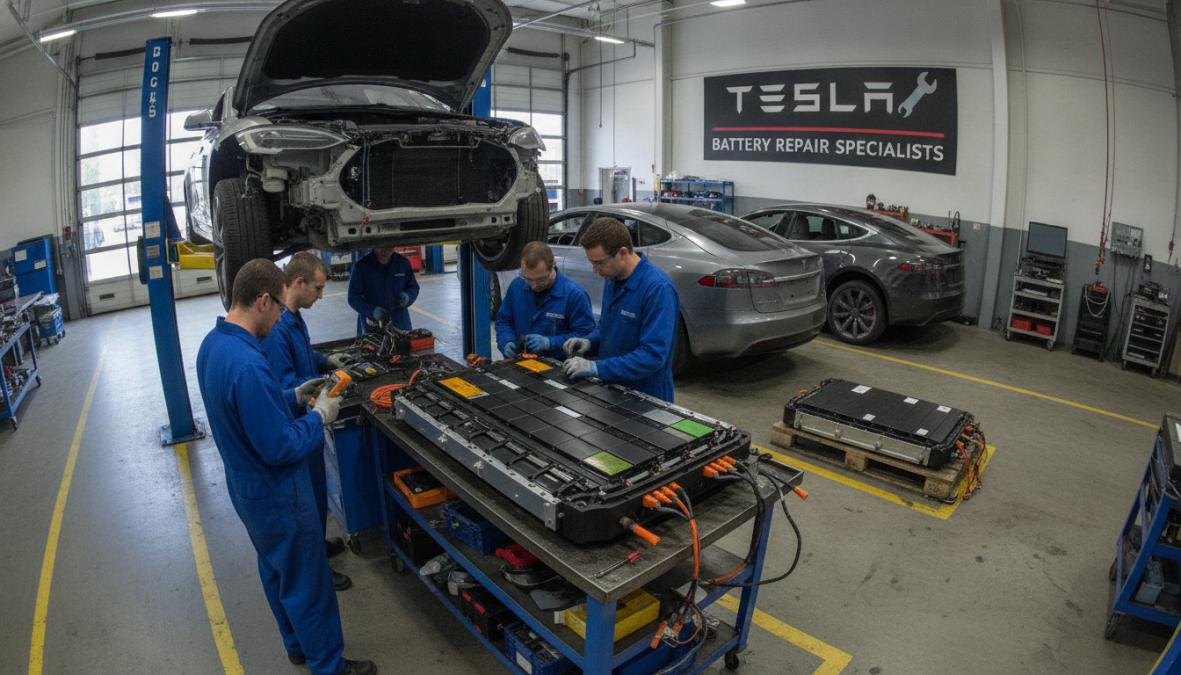
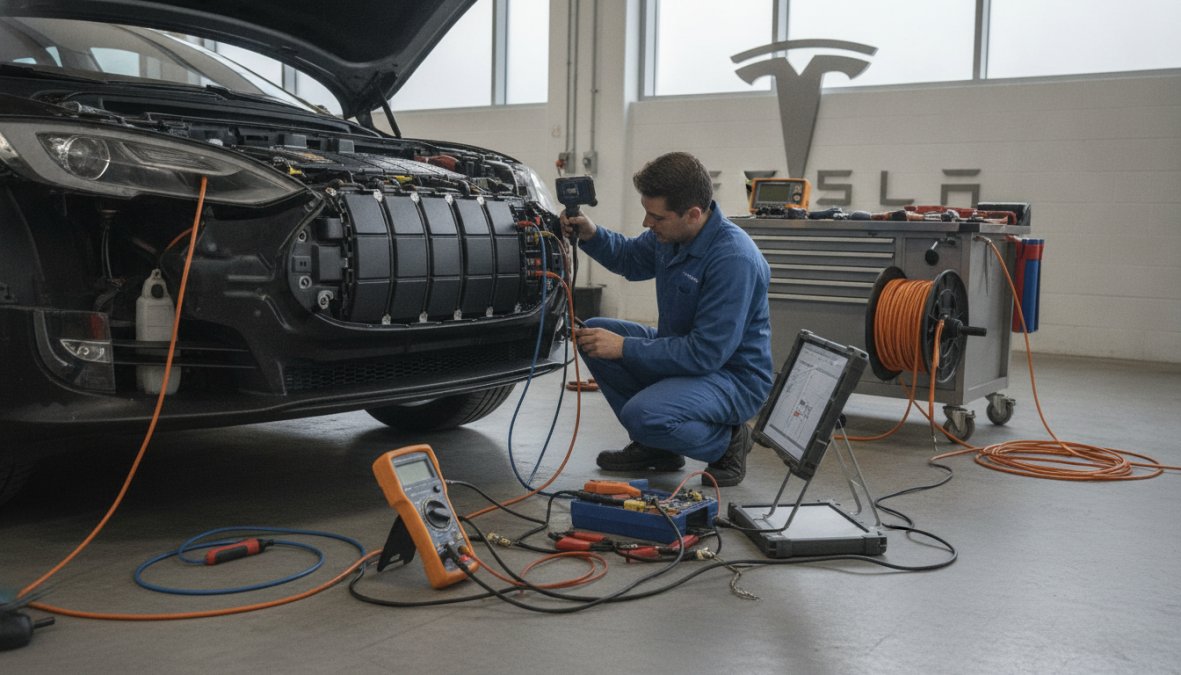
Technician in professional workshop inspecting Tesla battery pack modules with diagnostic equipment and safety protocols visible
How High-Voltage Battery Systems Work
Your Model S battery pack contains thousands of lithium-ion cells bundled into modules. Each module is self-contained with internal connections. The BMS continuously balances cells, prevents overcharging, and manages thermal conditions through a sophisticated coolant system. When one module fails, the entire pack's performance suffers, but the pack may still function.
This architecture means repair options exist beyond full replacement. A single failed module can sometimes be replaced without touching the rest of the pack. The BMS logs detailed diagnostics about State of Health (SoH), cell balancing, and potential failures, crucial data for deciding whether repair or replacement makes sense.
Pro TipRequest your vehicle's [battery diagnostics report](/blog/how-to-check-tesla-battery-health) before committing to any repair. The BMS logs cell voltage, temperature history, and degradation patterns, telling you exactly what's failing and whether it's a fixable module issue or a systemic pack problem.
Common Battery Failure Symptoms
Battery problems rarely announce themselves dramatically. You'll notice reduced range first, your Model S suddenly can't travel as far on a full charge, even in normal conditions. This happens when cells lose capacity or the BMS detects voltage inconsistencies and reduces available power.
Next comes the check battery light. You might also notice slower charging speeds or uneven thermal behavior where the battery pack feels hot or cold in specific areas. In severe cases, the vehicle limits power output, refuses to accelerate normally, or enters "limp mode."
The critical point: these symptoms don't mean your battery is dead. They mean something specific is wrong, often something repairable, and early diagnosis gives you more options.
Tesla Battery Warranty Coverage Explained
Understanding what your warranty actually covers is where most owners go wrong. Tesla's warranty structure is specific, and being out-of-warranty by even one month changes everything about repair costs and options.
What the Drivetrain Warranty Covers
Tesla covers the battery and drivetrain for 8 years or 160,000 miles from original purchase, whichever comes first. However, this coverage comes with critical conditions.
The warranty covers manufacturing defects and cell degradation below 70% capacity. If your battery degrades to 70% of original capacity within the warranty period, Tesla will repair or replace it at no cost. But you must be the original owner. Second owners get 8 years or 120,000 miles. Third owners and beyond get no battery coverage.
The warranty also doesn't cover accident damage, water damage, or degradation from extreme usage patterns.
Watch OutTesla's warranty coverage is non-transferable after the first owner. If you've bought a second-hand Model S, your battery warranty is already reduced. If you're the third owner, you have zero factory battery coverage. This dramatically changes your repair strategy.
Out-of-Warranty Repair Implications
Once your warranty expires, Tesla's responsibility ends. A full battery replacement becomes your financial burden entirely. Out-of-warranty status also opens the door to independent repair options that weren't available when warranty coverage was active. Third-party shops can perform module-level repairs, diagnostics, and refurbished battery installations at a fraction of Tesla's replacement cost.
If your battery is showing early signs of failure and you're approaching warranty expiration, you have a narrow window to get Tesla to cover repairs under warranty.
Tesla Battery Replacement Cost Breakdown
Real numbers matter. The cost of addressing a failing Tesla Model S battery varies dramatically based on which solution you choose.
Tesla Service Centre Pricing
A complete battery pack replacement through Tesla Service Centre represents the highest-cost option. For a Model S 85 or 90D, labour alone typically requires 8-12 hours of specialist technician time at Tesla rates. The replacement battery is factory-new with full warranty coverage.
However, Tesla doesn't publish standard pricing, quotes vary by location, model year, and demand. Getting an exact quote requires scheduling a service appointment.
Labour Costs and Diagnostic Fees
Before any repair happens, you'll need diagnostics. Tesla charges for diagnostic work, sometimes crediting the cost toward repair if you proceed with their service. Independent shops offer diagnostic services at lower rates than Tesla, providing the same technical information without the brand premium.
Labour costs for independent repairs are substantially lower than Tesla rates. A module-level repair might require 4-6 hours of labour, while full pack replacement needs 10-12 hours. The hourly rate difference can be 30-50%, making labour savings significant.
Key TakeawayThe real cost decision isn't about parts, it's about labour and certainty. Tesla offers certainty and warranty coverage. Independent shops offer lower costs and faster turnaround, but with less formal warranty protection.
Third-Party Tesla Battery Repair Solutions
The independent EV repair market has matured significantly. Specialists now offer viable alternatives to Tesla Service Centre repairs, with expertise to handle High-Voltage battery diagnostics and module-level work safely.
Module-Level Repair vs Full Pack Replacement
Not every battery failure requires replacing the entire pack. When a single module fails or degrades, replacing just that module can restore function at a fraction of the replacement cost. A module replacement involves disconnecting the pack, isolating the failed module, and installing a replacement or refurbished module. The BMS must be reprogrammed to recognize the new module and rebalance the pack.
Full pack replacement makes sense when multiple modules are failing, the BMS itself is faulty, or thermal management systems are compromised. It's also right if you're keeping the vehicle long-term and want maximum remaining battery life with warranty protection.
The decision hinges on your battery diagnostics. If the report shows a single module failure and the rest of the pack is healthy, module replacement is worth considering. If diagnostics show widespread degradation or multiple module issues, replacement becomes more reliable.
Battery Diagnostics and State of Health Testing
Before any repair decision, you need comprehensive diagnostics. Modern diagnostic equipment reads every data point the BMS logs: cell voltages, temperature patterns, charge/discharge cycles, and degradation trends. This data tells you exactly what's failing and whether it's repairable.
State of Health (SoH) testing measures how much capacity your battery retains compared to when new. A battery at 85% SoH is still quite usable. At 70% SoH, Tesla's warranty would cover replacement. Below 70%, you're managing a degraded asset losing range and performance.
The diagnostics process takes 2-4 hours and produces a detailed report showing whether your issue is a single module problem, widespread cell degradation, thermal management failure, or BMS malfunction. Independent shops now offer diagnostic services with the same technical capability as Tesla, but with faster turnaround and lower costs.
Repair vs Replacement: Making the Right Decision
The choice between repair and replacement isn't just financial. It's about your vehicle's remaining useful life, your risk tolerance, and your plans for the car.
Long-Term Reliability of Module-Level Repairs
A well-executed module replacement can restore your battery to reliable operation for years. The replaced module is typically a quality refurbished unit with its own warranty. The rest of your pack continues functioning as before.
If your pack is already showing degradation, replacing one module doesn't address the underlying aging process affecting other cells. You might get 2-3 years of reliable service before another module fails. This makes module repair most suitable for vehicles where the rest of the pack is healthy and the failure is clearly isolated.
Full replacement gives you 8+ years of reliable service with factory warranty. The certainty is worth the higher upfront cost if you're keeping the vehicle long-term. For vehicles you plan to sell within 2-3 years, module repair makes more financial sense.
The reliability question also depends on repair quality. Module replacement must be done correctly, improper reconnection, inadequate thermal management, or poor BMS reprogramming can cause premature failure. Choosing a qualified technician matters enormously.
Insurance Coverage for Battery Repair
Most standard vehicle insurance policies don't cover battery repair or replacement. Comprehensive or collision coverage might pay for accident damage, but degradation from age isn't covered. Some specialist EV insurance policies offer battery coverage, but this is still rare.
Before committing to expensive battery work, check your policy. If your battery failure was caused by an accident or external damage, you might have a claim. If it's degradation from normal use, you're paying out-of-pocket.
DIY vs Professional Battery Repair Safety
The High-Voltage battery in a Tesla Model S is genuinely dangerous. It stores enough electrical energy to cause severe injury or death if mishandled. The battery pack operates at 400+ volts, enough to cause cardiac arrest or severe burns.
Professional battery work requires specific training and equipment. Technicians must be certified in High-Voltage safety, understand how to safely disconnect and isolate the pack, and follow strict protocols for working with energized systems.
Watch OutDo not attempt any High-Voltage battery work yourself. The electrical hazard is severe, and improper work can cause permanent injury or death. Even simple-seeming tasks like disconnecting a module require professional-grade safety protocols and equipment.
The cost difference between DIY and professional work isn't worth the risk. Professional labour is expensive precisely because the work is dangerous and requires specialized training.
Finding reliable tesla model s battery repair support means understanding your options, getting proper diagnostics, and choosing a repair partner with expertise to handle your specific situation safely. Whether you're facing an out-of-warranty failure or planning ahead for potential battery issues, the decision should be based on clear technical information and realistic cost expectations.
If you're in Kettering or Northamptonshire and need expert battery diagnostics or repair guidance, KMC Electric brings 25+ years of automotive experience and Level 4 Master Technician status in electric vehicles since 2016. We provide independent battery health verification, transparent cost assessments, and practical solutions that extend your vehicle's service life without the Tesla Service Centre premium. Get started with a professional battery diagnostic today.
External Sources & Further Reading
According to Tesla's official battery warranty documentation, the 8-year, 160,000-mile battery coverage applies only to manufacturing defects and capacity degradation below 70%, with specific exclusions for accident damage and owner misuse.
Research from EV battery degradation studies by the International Energy Agency shows that lithium-ion battery capacity loss typically stabilizes between 70-80% of original capacity after 5-8 years of normal use, supporting the viability of module-level repairs for partially degraded packs.
Can a Tesla Model S battery be repaired instead of replaced?
Yes, Tesla Model S batteries can often be repaired at the module level rather than requiring full replacement. Independent specialists can diagnose specific cell failures and address them through targeted repairs. However, the feasibility depends on the extent of damage and battery pack integrity. A full State of Health diagnostic is essential to determine whether repair or replacement is more cost-effective and safe for your vehicle.
What are the signs of a failing Tesla Model S battery?
Common symptoms include reduced driving range, slower charging speeds, battery warning lights on the dashboard, and thermal management issues. You may also notice the Battery Management System (BMS) flagging errors or the vehicle entering reduced-power mode. Unexplained coolant leaks can indicate thermal system failure affecting battery performance. Professional battery diagnostics should be performed if you observe any of these warning signs.
Does Tesla battery warranty coverage include repairs after expiration?
Tesla's drivetrain warranty typically covers battery defects for 8 years or 160,000 km, whichever comes first. Once this warranty expires, out-of-warranty repairs become your responsibility. However, some battery issues may still be covered under extended warranty options or goodwill programmes. After warranty expiration, third-party specialists often provide more affordable diagnostic and repair solutions than Tesla Service Centres.
How much does third-party Tesla battery repair typically cost compared to Tesla Service?
Third-party battery repair costs vary significantly based on the specific issue and repair approach. Module-level repairs are generally more affordable than full pack replacement. Independent specialists can provide detailed diagnostic assessments and itemised quotes based on actual battery health data. Costs depend on labour rates, parts availability, and the extent of damage discovered during State of Health testing. Always obtain a comprehensive diagnostic report before committing to repairs.