What Is EV Battery Degradation and Is It Covered by Warranty?
Understanding whether electric vehicle battery degradation is covered by warranty is one of the most pressing questions for EV owners in the UK today. At KMC Electric, we've spent years helping Tesla and hybrid vehicle owners navigate battery warranty claims. Battery degradation is a natural electrochemical process that occurs every time you charge and discharge a lithium-ion battery pack. Most degradation within normal parameters is covered, but only up to a point and only if you haven't voided your warranty through charging habits or neglect.
The key distinction lies between natural wear and tear, which manufacturers accept as inevitable, and manufacturing defects or owner negligence, which they do not. This guide covers what's covered, what isn't, how to prove your battery has degraded beyond acceptable thresholds, and what to do when a dealer denies your claim.
Pro TipThe most common mistake EV owners make is assuming their battery warranty covers all degradation equally. Manufacturers set specific capacity retention thresholds, usually 70% or 80% of original capacity, and only cover claims that fall below those levels within the warranty period.
Understanding Lithium-Ion Battery Degradation
Every lithium-ion battery degrades from the moment it leaves the factory. The process accelerates with heat, fast charging, deep discharges, and age. After 100,000 charging cycles, roughly 8 to 10 years of typical driving, most EV batteries retain between 80% and 90% of their original capacity.
State of health (SoH) is the metric manufacturers use to measure degradation. A battery at 100% SoH holds a full charge; at 80% SoH, it holds 80% of what it did when new. The battery management system (BMS) constantly monitors voltage, temperature, and current flow to track this decline and protect the pack from damage.
Most manufacturers guarantee that their battery will retain at least 70% of its original capacity for 8 years or 100,000 miles, whichever comes first. Some, like Tesla, guarantee 80% retention on newer models. If your battery drops below that threshold before the warranty expires, you have grounds for a claim.
Natural wear and tear vs. manufacturing defect
A battery losing 5% capacity per year is normal. A battery losing 15% capacity in a single year suggests a manufacturing flaw or owner abuse.
Manufacturers investigate claims by examining the battery's diagnostic history. The BMS logs every charging session, temperature spike, and voltage anomaly. If data shows constant fast charging in hot climates without thermal management, the manufacturer will argue the degradation is your fault. If data shows normal usage patterns but the battery still failed to meet capacity thresholds, you have a legitimate defect claim.
Independent diagnostics from a specialist like KMC Electric can document the battery's current state of health and compare it against manufacturer specifications, giving you objective evidence for your claim.
Watch OutIf you've been using rapid charging stations multiple times per week in summer months without allowing the battery to cool, you've likely accelerated degradation beyond what the manufacturer will cover. The BMS records this data, and dealers will use it to deny your claim.
EV Battery Warranty Length in the UK: What Manufacturers Offer
Most EV manufacturers in the UK market offer battery warranties aligned with European regulations, though specifics vary by brand and model year.
Standard 8-year and 100,000-mile coverage explained
The industry standard in the UK is an 8-year or 100,000-mile battery warranty, whichever comes first. This aligns with EU Directive 2006/42/EC, which sets minimum durability requirements for EV powertrains. However, the capacity retention threshold varies significantly between manufacturers.
Tesla guarantees 70% capacity retention on Model 3 and Model Y vehicles for 8 years or 120,000 miles. BMW's i3 and i4 models guarantee 70% retention for 8 years or 100,000 miles. Nissan's Leaf warranty covers 70% retention for 8 years or 100,000 miles. Volkswagen's ID range guarantees 70% retention for 8 years or 160,000 miles.
The warranty period begins from the vehicle's first registration date, not from your purchase date if you're buying a used EV. A car registered three years ago has only five years of battery warranty remaining, regardless of actual mileage.
Mileage caps and capacity retention thresholds
The mileage cap is straightforward: once you exceed the manufacturer's mileage limit, the battery warranty expires, even if you're within the 8-year window. Most manufacturers set this at 100,000 miles, though some extend it to 160,000 miles. If you drive 15,000 miles per year, you'll hit the mileage cap before the 8-year term expires.
The capacity retention threshold means your battery must hold at least 70% of its original usable capacity to qualify for warranty coverage. If you have a 75 kWh battery and it degrades to 52.5 kWh (70% of 75), you're at the threshold. Drop to 52 kWh, and you've crossed below it.
Key TakeawayThe mileage cap, not the 8-year term, is often what expires first. If you drive 20,000 miles per year, you'll exhaust a 100,000-mile warranty in just five years. Check [your specific](/blog/tesla-warranty-expiry-check-service-guide) vehicle's warranty document to see which limit applies to your usage pattern.
What Voids EV Battery Warranty in the UK
Not all battery degradation is covered, and manufacturers have specific exclusions built into their warranty terms.
Charging habits and fast charging impact
The single biggest warranty void for EV owners is aggressive charging behaviour. Rapid DC charging heats the battery pack significantly. If you use rapid chargers multiple times per week without allowing adequate cool-down periods, you're accelerating degradation beyond what the manufacturer considers normal use.
Most manufacturers define "normal use" as a mix of AC home charging and occasional DC rapid charging. If your charging history shows rapid chargers used more than 2-3 times per week, or fast charging in ambient temperatures above 30°C without thermal management, the manufacturer may deny a degradation claim based on owner abuse.
The BMS records every charging session with timestamps, temperatures, and charge rates. When you submit a warranty claim, the dealer will pull this data. If it shows a pattern of rapid charging, high-temperature charging, or charging to 100% capacity repeatedly, you're vulnerable to claim denial.
Thermal management systems in modern EVs help mitigate this risk. Tesla's battery thermal management actively cools the pack during fast charging. If your vehicle has a thermal management system and you've used it consistently, you have stronger grounds for a warranty claim if degradation exceeds thresholds.
Thermal management and service interval neglect
Failing to maintain the vehicle's thermal management system can void your warranty. If the cooling system has a leak or malfunction and you don't address it promptly, the manufacturer may argue that your negligence caused excess battery degradation.
Regular servicing of the thermal management system, checking coolant levels, ensuring the radiator isn't blocked, and verifying pump operation is part of normal EV ownership. If you've ignored warning lights or skipped scheduled maintenance, the manufacturer has grounds to deny a warranty claim.
A proper battery health check from KMC Electric includes assessing the thermal management system's effectiveness. If the system is functioning correctly but the battery has still degraded beyond manufacturer thresholds, that's evidence of a manufacturing defect, not owner negligence.
Battery Repair vs. Replacement: Cost and Coverage Implications
When a battery fails warranty inspection, the manufacturer's response depends on the severity and location of the degradation.
When battery modules can be repaired
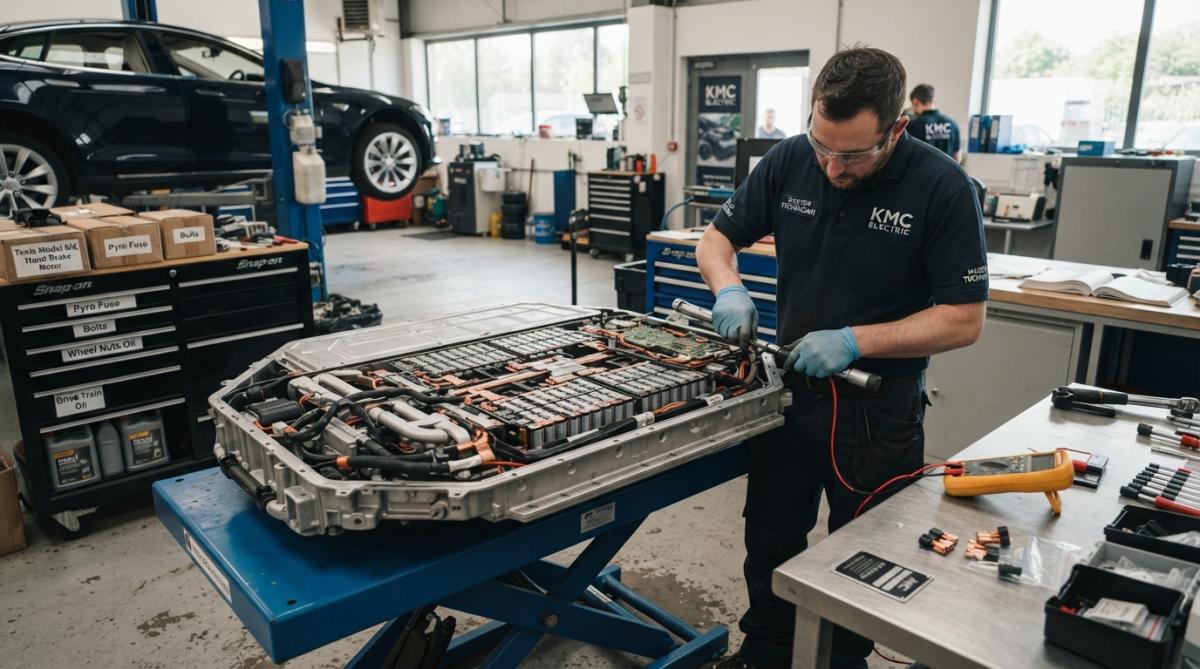
EV battery packs are composed of individual modules. If one or two modules fail while the rest remain healthy, a manufacturer or specialist workshop may repair the pack by replacing the faulty modules rather than the entire battery.
Module-level repair is significantly less expensive than full pack replacement. If the BMS diagnostic data shows localized failure rather than uniform degradation across the entire pack, repair is possible. Uniform degradation suggests a design flaw or manufacturing defect that typically requires full replacement.
Full battery pack replacement costs and warranty coverage
If your battery requires full replacement under warranty, the manufacturer covers the cost entirely. The replacement battery comes with a fresh warranty period, typically resetting the 8-year clock from the date of replacement.
Out-of-warranty battery replacement is where costs become prohibitive. This is why battery health verification before purchasing a used EV is essential. If you're considering a second-hand vehicle with 80,000 miles and the battery is already at 75% SoH, you're taking on significant risk. The remaining warranty may cover only 1-2 years of ownership before you're exposed to replacement costs.
KMC Electric offers independent battery health checks for used EV purchases. A diagnostic report provides objective evidence of the battery's condition and remaining warranty protection.
Pro TipIf a manufacturer denies your warranty claim, request the detailed BMS diagnostic report. This report shows charging history, thermal events, and capacity measurements. If the data doesn't support their denial, you have grounds to escalate the claim or pursue it through consumer rights channels.
How to Check EV Battery Health in the UK Before Warranty Expires
Knowing your battery's current state of health is the first step toward protecting your warranty claim.
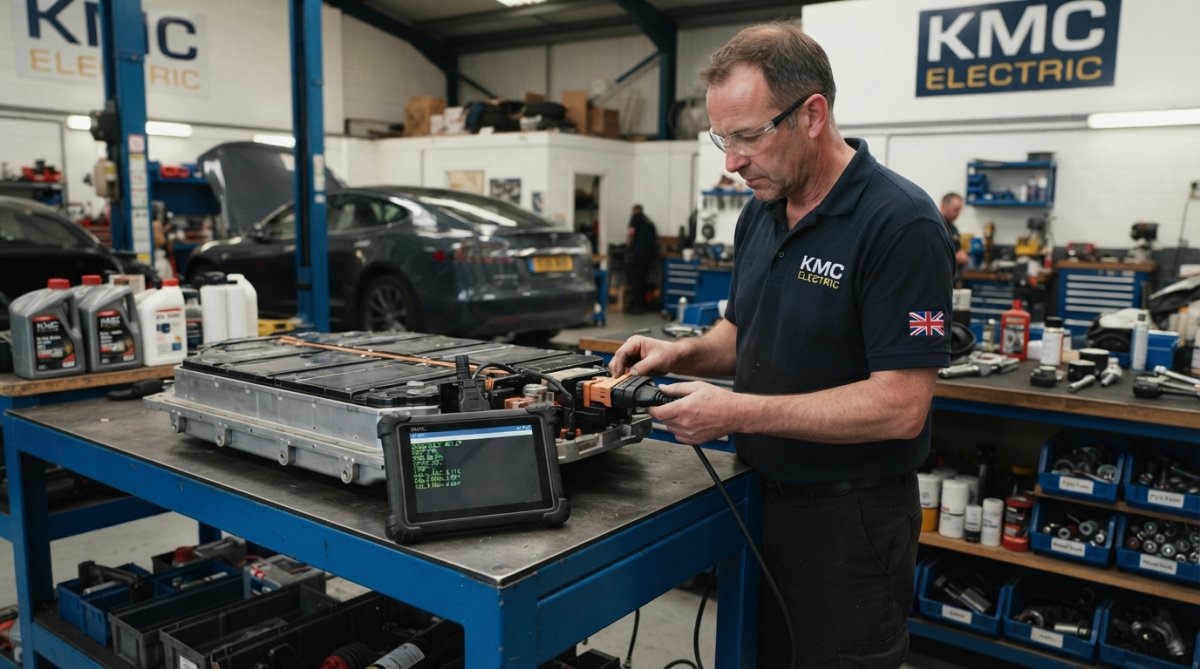
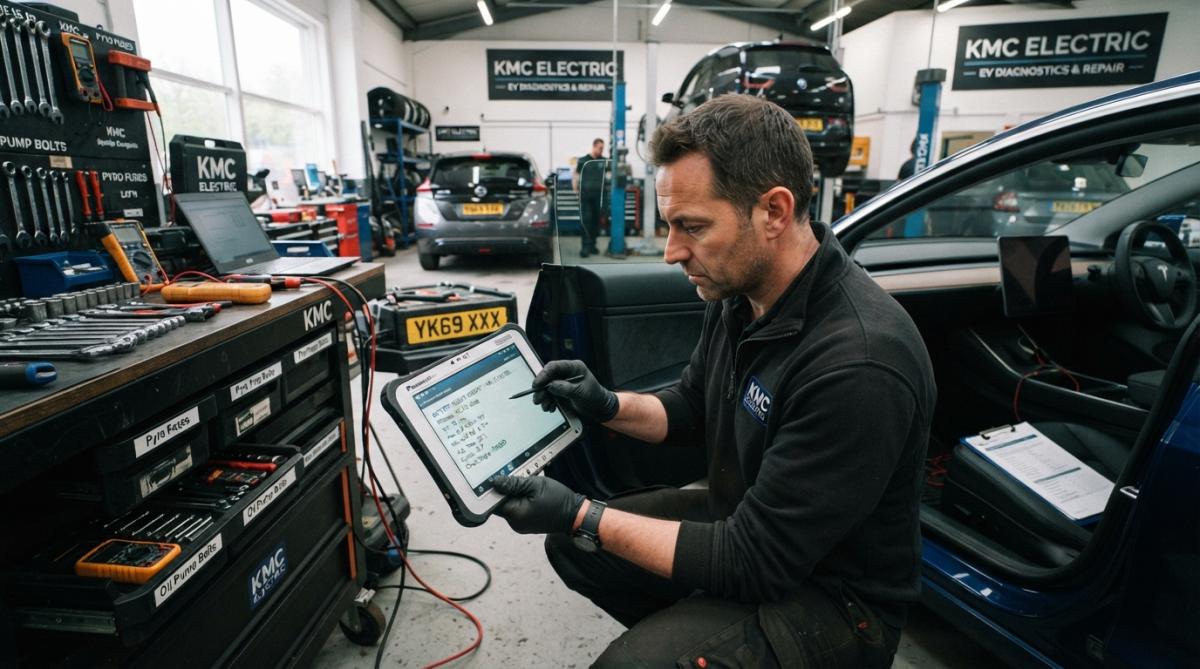
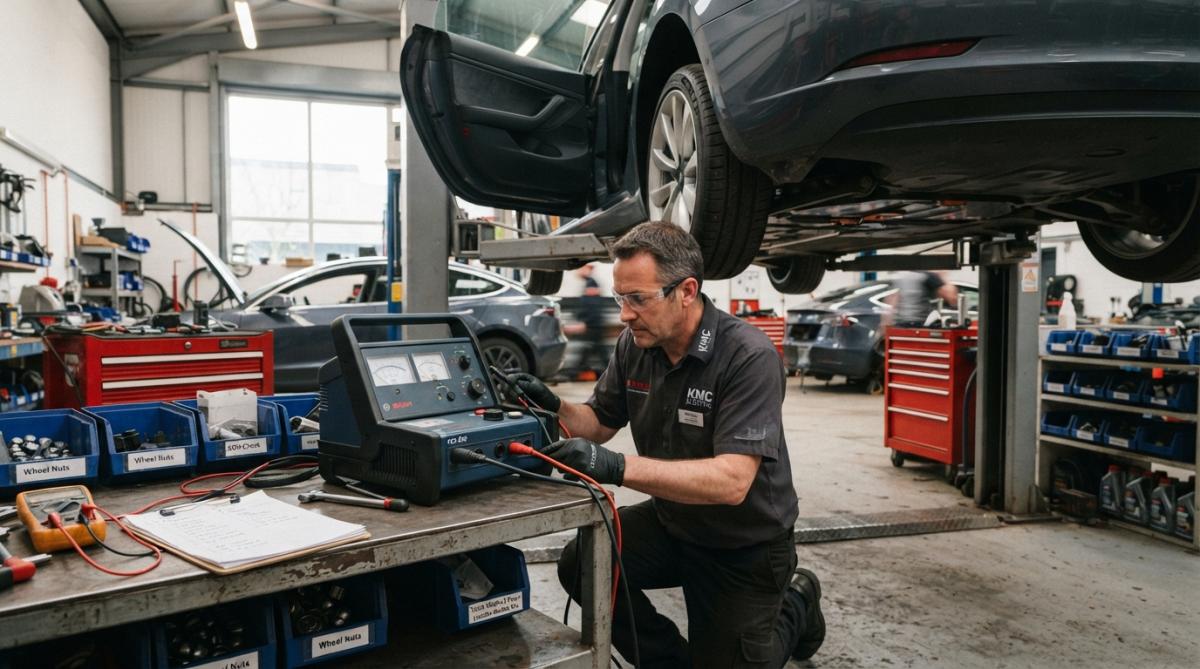
Technician using diagnostic scanner connected to electric vehicle battery management system in modern garage workshop, with technical readout visible on diagnostic screen
State of health (SoH) diagnostics and third-party tools
Most modern EVs display a basic capacity estimate in the infotainment system. However, this is a rough estimate, not a precise state of health measurement. The actual SoH requires deeper diagnostics.
Third-party diagnostic tools connect to the vehicle's OBD-II port or the battery management system directly and pull detailed capacity, voltage, and thermal data. A professional battery health check from a specialist workshop provides a detailed report showing current state of health percentage, capacity in kilowatt-hours, individual cell voltages and temperatures, charging and discharging efficiency, estimated remaining battery life, and comparison against manufacturer specifications.
This report is invaluable if you need to make a warranty claim. It provides objective, third-party evidence of your battery's condition and whether it meets manufacturer thresholds. Dealers are far more likely to approve claims when presented with professional diagnostics.
Independent battery verification for buying or selling
If you're purchasing a used EV, a pre-purchase battery health check is essential. A battery at 75% SoH is still functional, but significantly degraded. If you're planning to keep the vehicle for several years, that degradation trajectory matters.
Similarly, if you're selling an EV, a battery health report strengthens your asking price and builds buyer confidence. KMC Electric offers independent battery diagnostics for both purchase and sale scenarios, providing a realistic estimate of remaining useful life.
UK Consumer Rights for Faulty EV Batteries and Warranty Claims
Beyond the manufacturer's warranty, UK consumer law provides additional protections for faulty products, including EV batteries.
How to file a warranty claim and what to expect
The process begins with contacting the vehicle manufacturer or the dealership where you purchased the vehicle. You'll need to provide your vehicle registration number and VIN, mileage and registration date, and description of the issue.
The manufacturer will typically schedule a dealer inspection. The dealer will connect diagnostic equipment to the vehicle and pull the BMS data. This data shows your charging history, thermal events, and capacity measurements. The dealer compares these against the manufacturer's specifications and determines whether the battery qualifies for warranty coverage.
If the dealer approves the claim, the battery is replaced at no cost. If the dealer denies the claim, they'll provide a written explanation citing the reason, usually claiming evidence of owner abuse or fast charging.
Legal protections when a claim is denied
If a manufacturer denies your warranty claim unfairly, UK consumer law provides recourse. The Consumer Rights Act 2015 requires that goods (including vehicles) be of satisfactory quality and fit for purpose for up to six years from purchase (five years in Scotland).
A battery that fails to meet the manufacturer's own stated capacity thresholds within the warranty period could be argued as not of satisfactory quality, even if the manufacturer denies the claim. You can escalate a denied claim through manufacturer escalation, Trading Standards, Small Claims Court, or Alternative Dispute Resolution (ADR) schemes.
The key is documentation. Maintain records of all diagnostic reports, correspondence with the manufacturer, and evidence of normal usage patterns. If you can demonstrate that your charging habits were reasonable and the battery still degraded beyond manufacturer thresholds, you have a strong case.
Vehicle Warranty vs. Battery Warranty: Key Differences
Many EV owners assume their vehicle warranty covers the battery. In reality, the battery warranty is separate and operates under different terms.
The vehicle warranty (typically 3 years or 60,000 miles in the UK) covers the chassis, drivetrain, and electrical systems. The battery warranty is separate and typically extends to 8 years or 100,000 miles. This means your vehicle warranty may have expired while your battery warranty is still active.
Understanding your specific warranty terms is essential. Request a written copy of your battery warranty from the manufacturer or dealership. If you've lost the original documentation, contact the manufacturer directly with your vehicle VIN and registration details.
Factors Affecting Battery Health and Warranty Coverage
Multiple factors influence how quickly your battery degrades and whether degradation is covered by warranty.
Charging cycles, climate, and driving patterns
A charging cycle is a complete charge from empty to full. Most EV batteries are rated for 1,000 to 2,000 full charging cycles before reaching 80% SoH. Partial charges degrade the battery more slowly.
Climate has a dramatic effect on battery longevity. Batteries degrade faster in hot climates (above 25°C) and in cold climates (below 0°C). The UK's temperate climate is relatively forgiving for battery health. However, summer heatwaves and winter cold snaps do accelerate degradation. Parking in shade during summer and allowing the battery to warm before fast charging in winter helps mitigate this.
Driving patterns matter too. Aggressive acceleration and high-speed motorway driving generate more heat in the battery than gentle, steady driving. Repeated deep discharges degrade it faster than keeping the battery between 20% and 80% charged.
Battery management system (BMS) and preventative maintenance
The battery management system is the vehicle's computer that monitors and protects the battery. It balances cell voltages, manages thermal conditions, and logs all charging and discharging events. A properly functioning BMS extends battery life significantly.
Preventative maintenance includes keeping the thermal management system serviced and coolant topped up, avoiding prolonged exposure to extreme temperatures, not leaving the vehicle uncharged for extended periods, and following the manufacturer's charging recommendations in the owner's manual.
Neglecting these maintenance items can void your battery warranty. If the dealer's diagnostic data shows that a thermal management system failure contributed to battery degradation, they'll deny your claim based on owner negligence.
Factor
Impact on Degradation
Warranty Implication
Fast charging frequency
High acceleration of degradation
Voids warranty if excessive
Ambient temperature
Moderate in UK climate; accelerated in extremes
Covered if within normal usage
Charging to 100% regularly
Faster capacity loss than 20-80% charging
Covered if within manufacturer guidance
BMS maintenance neglect
Reduced thermal protection
Voids warranty if system fails
Deep discharges
Accelerated degradation
Covered if within normal driving
Thermal management failure
Rapid battery degradation
Voids warranty if owner-caused
The question of whether electric vehicle battery degradation is covered by warranty has a straightforward answer: it depends on your specific warranty terms, your usage patterns, and whether you can prove your degradation is within acceptable limits. Most UK EV owners have strong battery coverage for the first 8 years or 100,000 miles, but that coverage only extends to degradation that falls below manufacturer capacity thresholds. If you've been aggressive with fast charging or neglected thermal management, you're at risk of claim denial. If you maintain your vehicle properly and stay within normal usage parameters, your warranty provides genuine protection against catastrophic battery failure. The key is knowing your warranty terms, monitoring your battery health before it becomes critical, and documenting your usage patterns. When in doubt, a professional battery health check from KMC Electric provides the objective evidence you'll need to support a warranty claim or make an informed decision about purchasing or selling an EV.
Most manufacturers in the UK offer battery warranties of 8 years or 100,000 miles, whichever comes first. Some premium brands extend coverage to 10 years. However, warranty length varies by manufacturer and model, so always check your vehicle's specific OEM warranty documentation. The warranty typically covers defects in the battery pack and battery management system (BMS), but may exclude degradation caused by misuse or poor charging habits.
What voids an EV battery warranty in the UK?
Common warranty exclusions include: aggressive fast charging habits, exposure to extreme temperatures without proper thermal management, neglecting scheduled service intervals, modifications to the battery pack, and accidents or physical damage. Manufacturers may also void coverage if diagnostic reports show degradation within normal parameters (typically 70-80% capacity retention is acceptable). Always review your warranty terms, as some exclusions depend on charging behaviour and maintenance records.
Can I get an independent EV battery health check in the UK before buying a used car?
Yes. Independent specialists like KMC Electric offer professional battery diagnostics and state of health (SoH) verification for used electric vehicles. These third-party diagnostic reports provide objective evidence of battery condition, residual capacity, and any performance loss, essential information for buyers. An independent battery health check can identify potential faults before warranty expiry and help you negotiate fairly on price, particularly for vehicles nearing the end of manufacturer coverage.
What are my consumer rights if my EV battery degrades unfairly under warranty?
Under UK consumer protection law, you have the right to a refund, replacement, or repair if goods are faulty within a reasonable timeframe. For EV batteries, if degradation exceeds the manufacturer's stated threshold (e.g., below 70% capacity) and is not due to misuse, you can lodge a warranty claim with the dealer or manufacturer. If denied unfairly, you can escalate to the manufacturer's customer service, seek independent diagnostic evidence, or contact Citizens Advice for consumer dispute guidance.
Is battery repair cheaper than replacement, and does warranty cover both?
Battery module repair is sometimes possible for isolated faults and is less expensive than full pack replacement. However, most manufacturer warranties cover full battery pack replacement rather than repair. If your battery is degrading normally (within acceptable wear and tear), neither repair nor replacement may be covered. Out-of-warranty battery work can be costly; independent specialists can diagnose issues early to help extend vehicle service life and avoid expensive repairs.