Understanding tesla suspension repair cost uk is something every Tesla owner will face at some point, and the numbers can vary more than most people expect. This guide from KMC Electric covers everything UK owners need to know, from model-specific repair costs to the real difference between a Tesla Service Center and an independent specialist.
Suspension problems are not just a comfort issue. On an electric vehicle, a failing control arm or worn bushings can accelerate tyre wear, compromise stability, and trigger safety warnings that ground the car entirely. The stakes are higher than on a conventional vehicle, and the repair ecosystem is still catching up.
What Affects Tesla Suspension Repair Cost in the UK
Tesla suspension repair costs are shaped by three core variables: the specific component that has failed, whether the vehicle still has warranty coverage, and who carries out the work. Getting all three right is the difference between a manageable bill and an eye-watering one.
Chassis design varies significantly across Tesla's lineup. Model 3 and Model Y use conventional coil spring and shock absorber setups, while Model S and Model X offer air suspension involving compressors, bellows, and ride height sensors, all carrying higher parts costs. Diagnostic fees are another variable that catches owners off guard: Tesla Service Centers typically charge before issuing any quote, while independent specialists may fold this into the overall cost.
OEM Parts vs Aftermarket Parts: What UK Owners Should Know
OEM parts are manufactured to Tesla's original specification. Aftermarket parts are produced by third parties and may offer cost savings, but quality varies considerably. For air suspension components, stick with OEM or premium aftermarket equivalents. For bushings and minor hardware on coil-spring models, quality aftermarket parts from established suppliers are generally acceptable and reduce overall costs.
The key risk with cheaper aftermarket options is inconsistent metallurgy in ball joints, where premature wear creates a genuine safety hazard.
Pro TipAsk your specialist to show you the part number and brand before they fit anything. A reputable independent garage will not hesitate to share this information, and it protects you if the component fails prematurely.
Labour Costs: Tesla Service Center vs Independent Garage
Labour rates at official Tesla Service Centers sit at the higher end of the market. Independent EV specialists typically charge lower hourly rates, though the gap varies by region. The more important factor is familiarity with Tesla systems: a general garage may charge less per hour but take twice as long to diagnose a Model Y suspension issue, ultimately costing more. An EV specialist with Level 4 Master Technician status will work faster and catch related faults a generalist would miss.
Tesla Suspension Noise Symptoms You Should Never Ignore
Catching suspension failure early is the single most effective way to reduce your repair cost. A worn bushing caught at inspection costs a fraction of the bill once a control arm has failed completely.
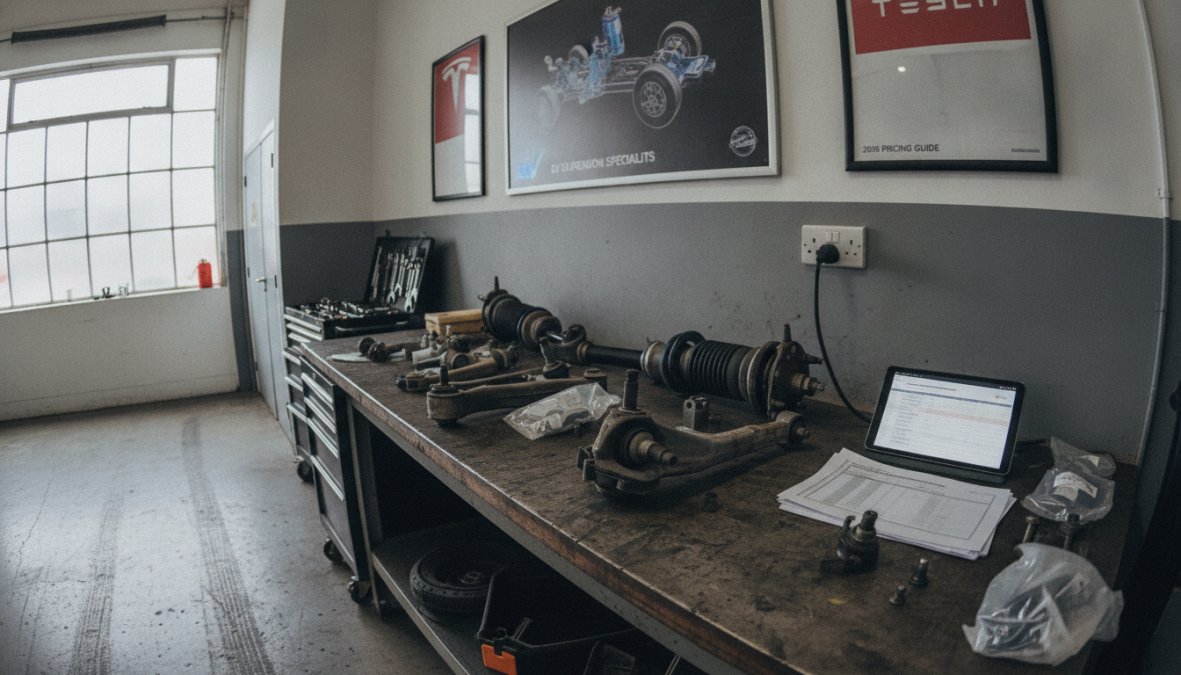
A mechanic in a workshop crouching beside the front wheel arch of a [Tesla Model](/blog/tesla-model-s-common-problems) 3, inspecting the suspension components with a torch in a well-lit independent garage
The most common tesla suspension noise symptoms UK owners report fall into four categories:
Clunking or knocking over speed bumps - usually points to worn control arm bushings or a failing ball joint
Squeaky noise at low speed - often a dry or cracked bushing, particularly common on older Model S vehicles
Vibration through the steering wheel - can indicate a worn shock absorber or alignment issue following suspension wear
Uneven or accelerated front tyre wear - a classic sign that suspension geometry is out of specification
Any of these symptoms warrants immediate inspection. On an air suspension car, a failed compressor or bellows can leave the vehicle sitting on bump stops, causing rapid chassis damage.
Tesla Control Arm Replacement Cost UK: Model-by-Model Breakdown
Control arm replacement is one of the most common suspension repairs across the Tesla range. The cost depends on which model is involved, whether it is a front or rear arm, and whether associated components need replacing at the same time.
Model 3 and Model Y Control Arm and Bushing Costs
The Model 3 and Model Y share a broadly similar suspension architecture, meaning parts availability is better and costs are more competitive than for older models. Bushings wear at a predictable rate on UK roads, and replacing them preventatively is considerably more cost-effective than waiting for full control arm failure.
Wheel alignment is always required after control arm or bushing replacement. Misaligned suspension will destroy a new set of front tyres within a few thousand miles.
Component
Model 3/Y
Notes
Front control arm (single)
Mid-range cost
OEM or quality aftermarket available
Rear control arm
Slightly lower
Less wear-prone than front
Bushing set (front)
Lower cost
Often replaced preventatively
Wheel alignment (post-repair)
Essential add-on
Always required after arm/bushing work
Model S and Model X Air Suspension: Compressor, Bellows, and Ride Height Repair
Air suspension on the Model S and Model X carries significantly higher repair costs. The main failure points are the air compressor, bellows, and ride height sensors. A failed compressor is the most common fault, the vehicle sits low on one or more corners and displays a ride height warning. Left unaddressed, the bellows take additional stress and can fail in sequence.
Many UK Tesla owners on out-of-warranty vehicles choose to convert to an aftermarket coilover kit at this point, eliminating the air system entirely and reducing long-term maintenance exposure. As documented in Tesla's owner documentation on air suspension maintenance, the air suspension system relies on all components functioning correctly to operate safely.
Tesla Suspension Repair Cost UK: Warranty, Out-of-Warranty, and Insurance
What Tesla's Warranty Actually Covers
Tesla's new vehicle warranty covers the vehicle for four years or a set mileage limit. Suspension components are generally covered, but damage caused by road hazards or potholes is typically classified as accidental damage rather than a manufacturing defect, and Tesla may decline a warranty claim on that basis. Wear items such as bushings may also be excluded if deemed end-of-life through normal use.
Pre-warranty-expiry inspections are genuinely valuable here. An independent specialist can identify components showing early signs of failure while the vehicle is still under warranty, giving you documentation to support a claim at a Tesla Service Center.
Watch OutDo not assume a suspension fault will automatically be covered under warranty. Tesla's service advisors assess each case individually, and damage attributed to road conditions is routinely rejected. Get an independent inspection before the warranty expires.
Can You Make an Insurance Claim for Suspension Damage?
Insurance claims for suspension damage are feasible in specific circumstances but more complicated than many owners expect. The practical obstacles are twofold: the excess on many UK policies makes small to mid-range repairs uneconomical to claim, and claiming typically affects your no-claims bonus. For many owners, the total cost of claiming exceeds the cost of paying directly.
Where a claim makes sense is for significant damage, a Model S air suspension system comprehensively damaged by a road incident, for example. Always get a written repair estimate before deciding whether to claim.
Why Wheel Alignment Matters After Every Suspension Repair
Wheel alignment is not optional after suspension work. Any time a control arm, ball joint, bushing, or shock absorber is replaced, the suspension geometry changes and alignment angles must be measured and corrected with a four-wheel alignment rig. On a Tesla, this is particularly important because the low rolling resistance tyres fitted as standard are sensitive to even minor misalignment, rapid uneven tyre wear is typically visible on the inner or outer edge within a few thousand miles.
A quality four-wheel alignment check should be included in the quote for any suspension repair. At KMC Electric, wheel alignment verification is built into every suspension repair process as standard.
DIY vs Professional Repair: Safety Risks UK Tesla Owners Must Consider
For most suspension work on a Tesla, DIY carries risks that go beyond mechanical complexity:
High-voltage proximity: Battery pack and high-voltage cabling run close to suspension mounting points on all Tesla models. Working here without proper EV training and insulated tooling is genuinely dangerous.
Torque specifications: Under-torqued components can work loose; over-torqued fasteners can strip threads in aluminium subframes, turning a straightforward repair into a major structural job.
Wheel alignment: Without a four-wheel alignment rig, any DIY suspension repair is incomplete.
Warranty implications: DIY repairs on a vehicle still under warranty can void coverage for related components.
For UK Tesla owners, professional repair by a qualified EV specialist is the right call for all but the most minor suspension maintenance tasks.
Choosing an Independent Tesla Specialist UK: What to Look For
The right independent specialist is not just cheaper than a Tesla Service Center, for out-of-warranty vehicles, a good independent is often the better technical choice. Experienced EV technicians with years of Tesla-specific work have seen failure patterns that a service center advisor rotating through different models may not recognise as quickly.
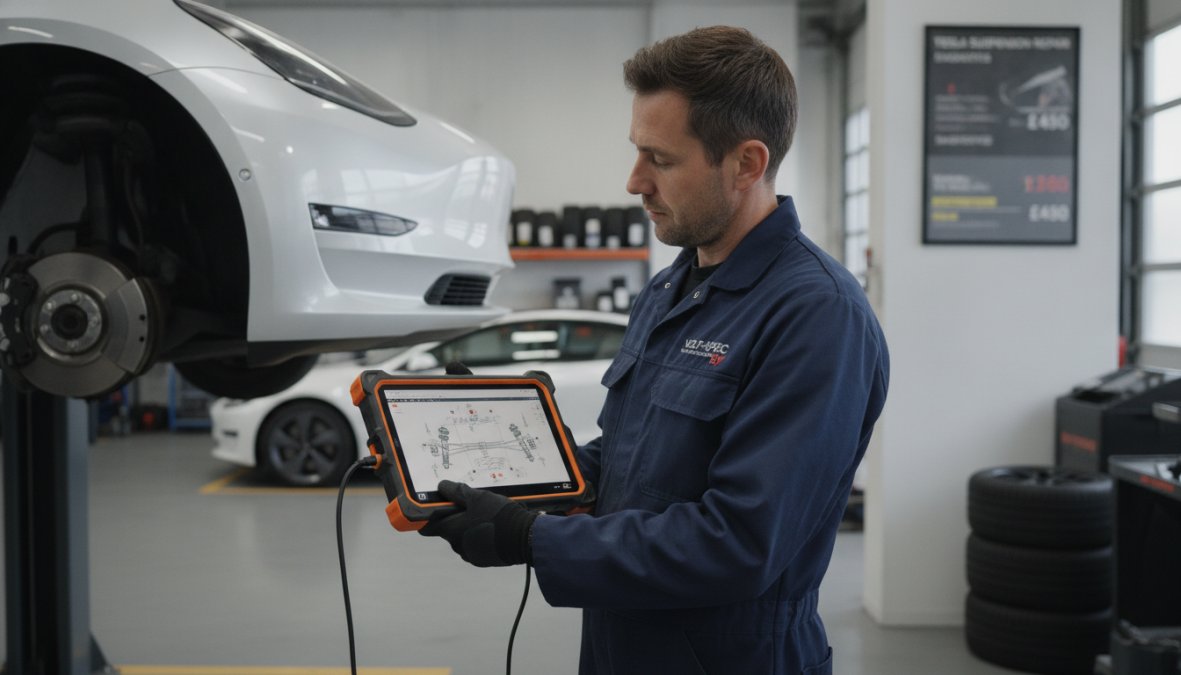
A qualified EV technician in branded workwear using a diagnostic tablet connected to a Tesla vehicle inside a clean, modern independent garage with bright overhead lighting
The credentials that actually matter:
Level 4 Master Technician status in electric vehicles - the highest UK qualification for EV work
Demonstrated Tesla model experience - ask specifically which models they work on regularly
Access to Tesla-compatible diagnostic equipment - not all OBD tools read Tesla data correctly
Transparent quoting - a written quote broken down by parts and labour before work begins
UK Regional Pricing Variations: Does Location Change the Bill?
Labour rates in London and the South East tend to run higher than in the Midlands or North of England. For owners in Northamptonshire and the surrounding East Midlands region, this is an advantage. Independent EV specialists in areas like Kettering typically offer more competitive labour rates than their London counterparts without any compromise in technical capability. Parts costs are broadly consistent across the UK since most specialists source from the same national distributors, the variation is almost entirely in labour rates and diagnostic fees.
Preventative Maintenance Checklist to Reduce Future Suspension Costs
Preventative maintenance is where the real savings are. A structured inspection programme catches wear before it becomes failure, and on a Tesla it also protects warranty coverage by creating a documented service history.
Tesla Suspension Preventative Maintenance Checklist:
Inspect control arm bushings for cracking or deformation every 12 months or 12,000 miles
Check ball joints for play and wear at each service interval
Inspect shock absorbers for leaks or reduced damping performance annually
Check air suspension compressor operation and listen for unusual cycling on Model S/X
Inspect bellows for cracking or abrasion damage on air suspension models
Verify ride height consistency across all four corners on air suspension vehicles
Carry out four-wheel alignment check annually and after any kerb or pothole impact
Inspect wheel bearings for play or noise at each suspension inspection
Check all suspension fastener torque values if the vehicle has had previous suspension work
Review tyre wear pattern at each tyre rotation for early signs of alignment or suspension issues
This checklist is particularly important for vehicles approaching the end of their factory warranty. Identifying a fault before expiry gives you the opportunity to pursue a warranty claim rather than paying out of pocket.
According to the RAC's guidance on EV maintenance schedules, electric vehicles still require regular mechanical inspections despite having fewer moving parts than combustion engine cars, and suspension components are among the most important items to monitor.
Key TakeawayThe most cost-effective approach to tesla suspension repair cost uk is prevention. Annual inspections by a qualified EV specialist cost a fraction of a control arm replacement and protect both your warranty and your tyres.
Suspension repairs on a Tesla are rarely cheap, but the final bill depends heavily on who does the work and how early the fault is caught. For UK Tesla owners, particularly those in Kettering and across Northamptonshire, KMC Electric offers a genuine alternative to main dealer pricing, backed by Level 4 Master Technician status in electric vehicles, over 25 years of automotive experience, and specialist knowledge of Tesla systems across all models. Get in touch with KMC Electric to book a suspension inspection or diagnostic assessment and protect your vehicle before a minor wear issue becomes a major repair.
Frequently Asked Questions
How much does Tesla suspension repair cost in the UK?
Tesla suspension repair cost in the UK varies widely depending on the model and component. A control arm replacement on a Model 3 or Model Y can range from roughly £300 to £700 including labour. Air suspension repairs on a Model S or Model X, such as replacing a compressor or bellows, can cost significantly more, often between £800 and £2,000 or higher. Using an independent Tesla specialist rather than a Tesla Service Center can reduce labour costs considerably.
What are the most common signs of Tesla suspension failure?
Common Tesla suspension noise symptoms include a squeaky noise or clunking sound when going over bumps, uneven or rapid front tyre wear, pulling to one side while driving, a noticeable drop in ride quality, and visible changes in ride height on air suspension models. On Model S and Model X, a warning about suspension fault or the car sitting lower than usual is a strong indicator that the air suspension compressor or bellows needs attention. Never ignore these signs, as they affect vehicle stability.
Does Tesla's warranty cover suspension repairs?
Tesla's New Vehicle Limited Warranty generally covers suspension components for four years or 50,000 miles, whichever comes first. However, wear items such as bushings and ball joints may be excluded. Damage caused by road hazards, kerb strikes, or potholes is typically not covered under a standard warranty claim. If you suspect a fault rather than accidental damage, it is worth raising a warranty claim with Tesla before paying for repairs out of pocket, particularly on newer vehicles.
Can an independent garage repair Tesla suspension, or must I use a Tesla Service Center?
An independent Tesla specialist UK can legally and competently repair Tesla suspension on out-of-warranty vehicles without voiding any remaining coverage, provided the work is carried out to the correct standard. Independent specialists often charge lower labour rates than Tesla Service Centers and may offer more flexible scheduling. For warranty claim work, repairs typically need to go through Tesla directly. When choosing an independent garage, look for Level 4 Master Technician qualifications and demonstrable EV-specific experience.
Is a wheel alignment always needed after Tesla suspension repair?
Yes. Any suspension repair that involves replacing control arms, ball joints, bushings, or shock absorbers on a Tesla will almost certainly disturb the geometry of the chassis. Skipping a wheel alignment after such work risks accelerated and uneven front tyre wear, reduced vehicle stability, and compromised ride quality. Wheel alignment should be treated as a mandatory final step, not an optional add-on. Factor the alignment cost, typically £60 to £120 at an independent garage, into your overall repair budget.
Is it safe to attempt a DIY Tesla suspension repair?
DIY suspension repair on a Tesla carries significant safety risks and is not recommended for most owners. Tesla's high-voltage battery system runs beneath the chassis, and improper jacking or component removal can cause serious injury. Beyond the electrical hazard, incorrect installation of control arms or ball joints can lead to suspension failure at speed. Unless you have professional automotive training and EV-specific knowledge, the risks far outweigh any cost saving. Always use a qualified specialist for suspension work on an electric vehicle.
 3, inspecting the suspension components with a torch in a well-lit independent garage](https://cdn.grandranker.com/articles/tesla-suspension-repair-cost-uk-2026-pricing-guide-content-1-1781141872.jpg)