Why Car Owners Seek Alternatives to Dealership Diagnostics
When your check engine light comes on, alternatives to dealership diagnostics have become increasingly popular as vehicle owners discover they're paying premium rates for services that independent specialists can deliver at a fraction of the cost. At KMC Electric, we've spent over 25 years helping EV and hybrid owners understand their options.
Dealerships aren't built to prioritise your wallet. They operate as profit centres for manufacturers, meaning diagnostic fees often subsidise other revenue streams. Independent specialists have no incentive to overcharge because their reputation depends entirely on transparency and accuracy.
A dealership diagnostic fee ranges from £80 to £150. The same scan at an independent shop typically costs £40 to £80. For EV and hybrid vehicles, the gap widens because specialists like KMC Electric hold Level 4 Master Technician certifications in electric vehicle systems, while dealer networks often employ technicians with generic training.
Pro TipThe first question to ask isn't "Where should I get my diagnostics?" but "What am I actually trying to find out?" A check engine light on a Tesla requires completely different knowledge than a [warning light on a petrol car](/blog/tesla-model-s-common-problems), and most main dealers lack that specialised knowledge.
Below, we'll walk you through genuine alternatives to dealership diagnostics and help you match the right solution to your specific vehicle and situation.
Dealership vs. Independent Repair Shops: Key Differences
The choice between a dealership and an independent shop comes down to three core differences: access to OEM-level equipment, warranty implications, and cost structure.
When to Choose a Dealership for Diagnostics
Dealerships make sense in specific situations. If your vehicle is under manufacturer warranty and you're experiencing a fault that might be covered, a dealership diagnostic is often the safest choice. Main dealers have direct access to technical service bulletins (TSBs) and factory scan tools that can identify recalls or known issues specific to your vehicle's production batch.
However, dealership diagnostics often come with a catch. Many main dealers charge a diagnostic fee upfront, then credit it toward repairs only if you proceed with their service department. If you decline their repair quote and take your vehicle elsewhere, you've paid for a diagnostic you won't use. Independent shops typically work differently: you pay for the diagnostic, you own the information, and you're free to take it anywhere.
Benefits of Independent Repair Shops
Independent repair shops, particularly specialists in electric and hybrid vehicles, offer three genuine advantages: transparency, expertise depth, and cost efficiency.
An independent shop has no incentive to recommend unnecessary repairs. Their revenue comes from the work they do, not from selling extended warranties or upselling service packages. Specialist independent shops focus exclusively on one vehicle type or technology. We've diagnosed thousands of Tesla systems since 2016, spotting patterns and solutions that generalist dealership technicians miss.
Independent shops have lower overhead than main dealers. Those savings flow directly to the customer. A diagnostic that costs £120 at a dealership might cost £50 at a specialist independent shop, and you'll get better analysis because the technician specialises in your vehicle type.
Key TakeawayIndependent shops excel when you need specialist knowledge and cost transparency. Dealerships excel when warranty coverage is at stake or you're dealing with a vehicle so new that no independent specialist has experience with it.
Is Dealership Diagnostic Fee Worth It?
In most cases, no. A dealership diagnostic fee is worth paying only when warranty coverage is at stake or when you're dealing with a vehicle so new that no independent specialist has experience with it.
A dealership charges £100 to £150 for a diagnostic. An independent specialist charges £40 to £80 for the identical scan. The difference isn't equipment quality; most modern OBD-II scanners are functionally equivalent. The difference is overhead and business model.
Where dealership diagnostics become problematic is the credit system. You pay £120 upfront. The dealership finds a fault and quotes £800 to repair it. If you decide that price is too high and take your vehicle to an independent shop instead, you've lost that £120. This creates a perverse incentive: the dealership is motivated to find problems that sound expensive, even if cheaper solutions exist elsewhere.
Independent shops operate differently. You pay for the diagnostic and get a detailed report explaining what was found, what it means, and your options. For electric vehicles, the case against dealership diagnostics is even stronger. EV specialists have access to battery health verification tools, thermal imaging systems, and software analysis capabilities that most main dealer service departments lack.
Watch OutNever pay a dealership diagnostic fee without understanding their credit policy. Some dealerships credit the full amount toward repairs; others credit only 50%. Always ask upfront: "Will this diagnostic fee be credited in full if I choose to repair elsewhere?"
Best OBD2 Scanner for Home Use: DIY Diagnostic Tools
For owners who want to diagnose problems themselves, OBD-II scanners offer a middle ground between dealership costs and professional expertise. These tools connect to your vehicle's onboard diagnostic port and read fault codes directly from the engine control unit.
Understanding OBD-II Scanner Capabilities
An OBD-II scanner reads Diagnostic Trouble Codes (DTCs) from your vehicle's computer. Every modern car has an onboard computer that monitors hundreds of sensors. When a sensor detects a problem, the computer logs a fault code. A check engine light simply tells you a code has been logged.
A basic OBD-II scanner retrieves these codes and displays them on a screen. A code like "P0300" means "Random/Multiple Cylinder Misfire Detected," but the code tells you something is wrong, not what caused it. That same code could mean a faulty spark plug, a fuel injector problem, a timing issue, or a vacuum leak. You need expertise to interpret the code correctly.
Higher-end OBD-II scanners offer additional features like live data streaming and bi-directional control. The BlueDriver Bluetooth Pro costs around £95 and connects to your phone via Bluetooth. The Autel MaxiCOM MK808S (approximately £340-£400) is a tablet-based system offering bi-directional testing and special service functions. For most DIY owners, a mid-range scanner like the TOPDON TopScan (around £65) or OBDeleven (£60-£85) strikes the right balance.
Scanner
Price
Key Features
Best For
FIXD OBD2 Scanner
~£50
Simple code reading, repair cost estimates
Non-technical owners
BlueDriver Bluetooth Pro
~£95
Live data, repair reports, no subscription
DIY enthusiasts
OBDeleven
~£60-£85
One-Click coding, multi-brand support
VW/Audi/BMW owners
TOPDON TopScan
~£65
Bi-directional tests, CAN-FD support
Budget-conscious DIYers
Autel MaxiCOM MK808S
~£340-£400
Full-system diagnostics, active tests
Serious DIYers, small shops
Warranty Implications of Using Third-Party Diagnostic Tools
Using a third-party OBD-II scanner to read fault codes does not void your vehicle's warranty. You're not modifying anything; you're simply reading data that the vehicle's computer is already logging.
However, if you use a diagnostic tool to reprogram your vehicle (called "coding" or "tuning"), you may have warranty issues. For electric vehicles, Tesla's warranty explicitly permits owner diagnostics using third-party tools like Carista or OBDeleven. What they don't permit is modification of the vehicle's software through third-party tools. A basic OBD-II scanner that reads codes and displays live data poses zero warranty risk.
Mobile Mechanic Diagnostic Services: Professional Convenience
Mobile mechanics bring professional diagnostics to your driveway. This model works well if your vehicle won't start or has a major fault that makes driving risky. However, mobile diagnostics have real limitations. A mobile technician typically works from a van with basic equipment and can run OBD-II scans and perform visual inspections, but they can't perform deep electrical testing, battery analysis, or software-level diagnostics that a workshop environment allows.
Pricing for mobile diagnostics typically ranges from £60 to £120 depending on your location and fault complexity. The real value emerges when combined with a specialist shop: a mobile technician performs initial diagnostics, identifies the fault type, and you then take that information to a specialist workshop for detailed analysis and repair.
Specialist vs. General Repair Shops for EV and Hybrid Diagnostics
This distinction has become critical as electric vehicles enter the mainstream. Not all repair shops are equipped to diagnose EV and hybrid faults accurately.
A general repair shop typically has basic OBD-II scanning capability. But electric and hybrid vehicles operate on fundamentally different principles. They have high-voltage battery systems, electric motors, regenerative braking, and complex thermal management systems. A technician trained only on petrol engines will struggle to interpret faults in these systems.
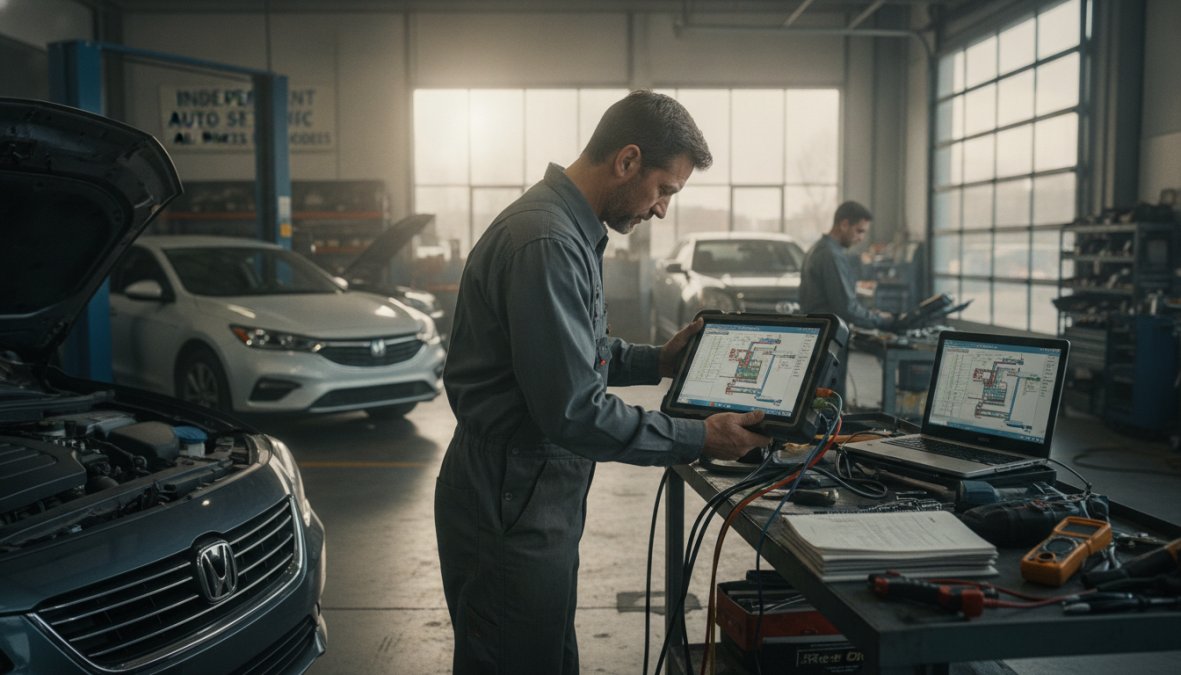
Experienced technician using advanced diagnostic equipment on an electric vehicle, with illuminated computer displays showing real-time data and fault codes in a professional workshop setting
A specialist EV shop has invested in the right equipment and training. They understand battery management systems, inverter diagnostics, and motor controller programming. For Tesla owners specifically, the difference is enormous. Tesla systems are proprietary, and a general mechanic cannot access Tesla's technical service bulletins or factory scan tools.
The Importance of ASE Certification and Technical Expertise
ASE (Automotive Service Excellence) certification is the gold standard for mechanic credentials. ASE now offers EV-specific certifications, and manufacturers like Tesla offer their own training programs. When selecting a shop for EV diagnostics, look for technicians with EV-specific credentials.
Level 4 Master Technician status in electric vehicles is the highest credential currently available. It requires thousands of hours of hands-on EV experience, factory training, and continuous education. The practical difference: a general ASE-certified mechanic might take six hours to diagnose an EV fault because they're working through unfamiliar territory. A Level 4 EV specialist completes the same diagnostic in 90 minutes because they understand EV systems intuitively.
How to Interpret Your Diagnostic Report and Avoid Overcharging
A professional diagnostic report should contain four elements: the fault codes identified, the sensor readings at the time the fault occurred, the probable causes, and the recommended repairs. A good report explains each element in plain language.
Fault codes tell you the computer detected a problem, but they don't prove the specific component is faulty. A code like "P0128" (Coolant Thermostat Not Opening) means a sensor detected unusual coolant temperature behaviour. The cause could be the thermostat, the sensor itself, a wiring issue, or a software glitch. A shop that simply lists the code and recommends replacing the thermostat is taking a shortcut.
When you receive a diagnostic report, ask these questions:
Is the fault code clearly explained? You should understand what the code means in plain English.
Are multiple possible causes listed? If the report suggests only one cause, they haven't done thorough diagnostics.
What sensor readings triggered the code? You should see actual data supporting the diagnosis.
What's the recommended repair? It should be specific, not vague.
What's the estimated cost? A good shop provides a repair estimate before starting work.
For electric vehicles, the report should include battery health status if the fault is battery-related.
Pro TipWhen comparing diagnostic reports from different shops, look at the depth of investigation. A report that lists multiple possible causes and explains why each was ruled out is worth more than a report that lists one cause and demands immediate repair. Thoroughness is a sign of competence.
Finding the Right Alternative to Dealership Diagnostics for Your Needs
If your vehicle is under manufacturer warranty and you suspect a defect: Go to the dealership. Their warranty database and direct manufacturer access are genuine advantages.
If your vehicle is out of warranty and you want cost-effective diagnostics: Use an independent specialist. For electric and hybrid vehicles, choose a shop with EV-specific credentials.
If you want to diagnose problems yourself: Buy an OBD-II scanner in the £50-£100 range. BlueDriver or OBDeleven are solid choices.
If you're immobilised and need immediate diagnostics: Call a mobile mechanic. The convenience premium is worth it when your vehicle won't move.
If you own an electric or hybrid vehicle: Prioritise specialist shops over general mechanics. The expertise gap is too large to ignore.
For EV and hybrid owners in Kettering, Northamptonshire, and the surrounding region, KMC Electric provides specialist diagnostics backed by Level 4 Master Technician credentials and 25 years of automotive experience. We offer independent battery health verification, Tesla system diagnostics, and transparent repair recommendations, all without the dealership markup.
Alternatives to dealership diagnostics exist because dealerships operate on a profit model that doesn't align with your interests. Independent specialists, mobile mechanics, and DIY tools all offer genuine alternatives. The right choice depends on your vehicle type, warranty status, and how much expertise you need. In almost every scenario, you have options that are cheaper, faster, or more transparent than the main dealer.
Frequently Asked Questions
Are independent mechanic diagnostics as accurate as dealership diagnostics?
Yes, when performed by ASE-certified technicians using OEM-level equipment. Independent shops often have the same diagnostic capabilities as dealerships, including access to technical service bulletins and fault code databases. The key difference lies in technician expertise and equipment quality, not dealership affiliation. Specialist independent shops, particularly those focused on electric vehicles, often provide more tailored diagnostics than generalist dealers.
Is dealership diagnostic fee worth it compared to alternatives?
Not always. Dealership diagnostics typically cost more due to higher labour rates and facility overhead. Independent repair shops and mobile mechanics often charge 30-50% less for the same diagnostic service. However, dealerships may be worth considering if your vehicle is under warranty, as their diagnostics are documented through OEM systems. For out-of-warranty vehicles, alternatives to dealership diagnostics usually offer better value without compromising accuracy.
Will using a DIY OBD2 scanner void my vehicle warranty?
No. Reading diagnostic trouble codes (DTCs) with a consumer-grade OBD2 scanner does not void your warranty. However, performing repairs based on those codes yourself may affect warranty coverage for that specific component. Dealerships cannot deny warranty claims simply because you've read fault codes. That said, always consult your warranty documentation and consider having a professional interpret complex diagnostic reports before proceeding with repairs.
What tools do independent mechanics use for diagnostics?
Professional independent mechanics use OBD-II scanners, factory scan tools, and proprietary diagnostic software similar to dealership equipment. Many use tablet-based systems that access technical service bulletins and vehicle-specific data. For electric vehicles and hybrids, specialists use advanced battery health verification tools and EV-specific diagnostic protocols. Quality independent shops invest in OEM-level equipment to provide accurate, transparent diagnostics comparable to dealership standards.
If you're unsure whether your vehicle needs diagnostics or you want expert guidance on what your diagnostic report actually means, KMC Electric can help. We provide transparent analysis of any vehicle's condition, identify faults before they become expensive problems, and help you understand your repair options. Contact us for a consultation, we'll give you the clarity you need to make the right decision about your vehicle's health.