Battery degradation is the gradual loss of a lithium-ion battery's capacity to hold and deliver energy over time. In a Tesla Model 3, this means your vehicle's maximum range decreases incrementally, and the battery's ability to charge to full capacity diminishes with each charging cycle.
This isn't a sudden failure. It's a slow, predictable process. A Tesla Model 3 battery typically retains 90% of its original capacity after 160,000 miles of driving under normal conditions (tesla.com). But "normal" is the key word. How you charge, where you drive, and what temperatures your vehicle experiences can accelerate or slow this natural decline significantly.
Understanding battery degradation matters because it affects resale value, running costs, and long-term ownership decisions. If you're buying a used Model 3 in the Midlands or planning to keep yours beyond the warranty period, knowing the early warning signs can save you thousands of pounds in unexpected repairs or poor purchasing decisions.
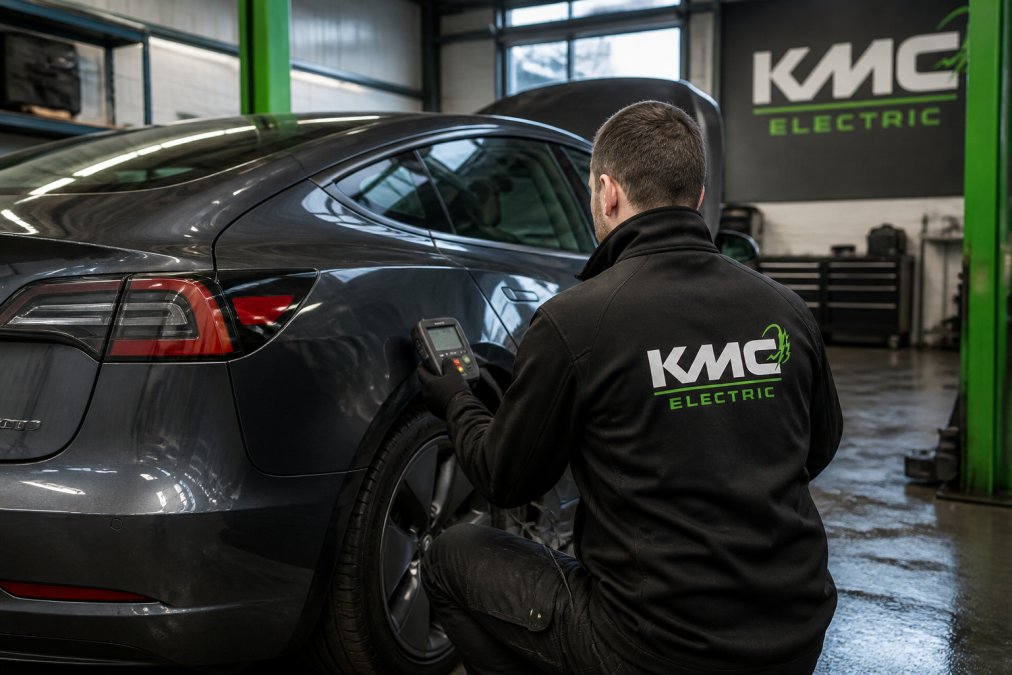
At KMC Electric in Kettering, we assess battery health for both private owners and dealerships. The patterns we observe are consistent: owners who monitor their battery's condition early catch problems before they become expensive failures. Those who ignore the signs often face steep replacement costs when degradation reaches critical levels.
Early Warning Signs of Battery Degradation
The first indication of battery degradation isn't always obvious. Your Model 3 won't display a warning light or send an alert saying "your battery is degrading." Instead, you'll notice subtle changes in how your vehicle behaves.
Reduced range on a full charge
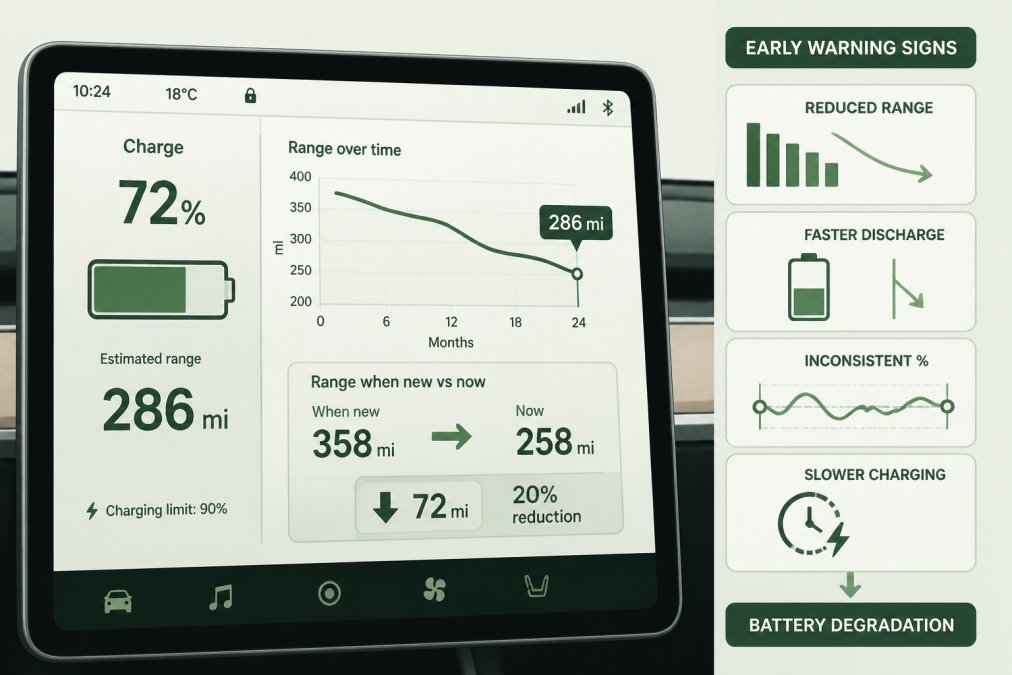
The most visible sign of battery degradation is a drop in maximum range. You'll notice this if you've owned the car for a while and can compare its current performance to earlier months.
Close-up of a Tesla Model 3 dashboard displaying battery range and charge percentage on the central touchscreen with visible degradation in range metrics
If your Model 3 originally showed 300 miles of range on a full charge and now shows 270 miles under identical conditions, that's a 10% loss. This is normal wear. But if the loss accelerates, dropping 15-20% within a few months, something is driving faster degradation than expected.
Pay attention to seasonal variation too. Cold weather naturally reduces range temporarily because the battery works less efficiently in low temperatures. But once spring arrives and temperatures stabilise, your range should return to previous winter levels. If it doesn't, degradation is likely the cause.
Slower charging speeds
A degrading battery charges more slowly than a healthy one. You might notice your Model 3 takes longer to reach 80% charge at a Supercharger than it used to, even when the charger itself is functioning normally.
This happens because the battery's internal resistance increases as cells age. Higher resistance means less current can flow into the pack safely, so the charging system automatically reduces the charging rate to protect the battery from damage.
If you're regularly charging at home, this slowdown might be less noticeable. But if you use public chargers or Superchargers frequently, you'll spot the difference. A Model 3 that once charged from 20% to 80% in 25 minutes might now take 35 minutes. That's a meaningful change worth investigating.
Inconsistent energy consumption
A healthy battery delivers power consistently. A degrading battery shows erratic behaviour. You might notice that driving the same route consumes different amounts of energy on different days, even when weather and driving style are similar.
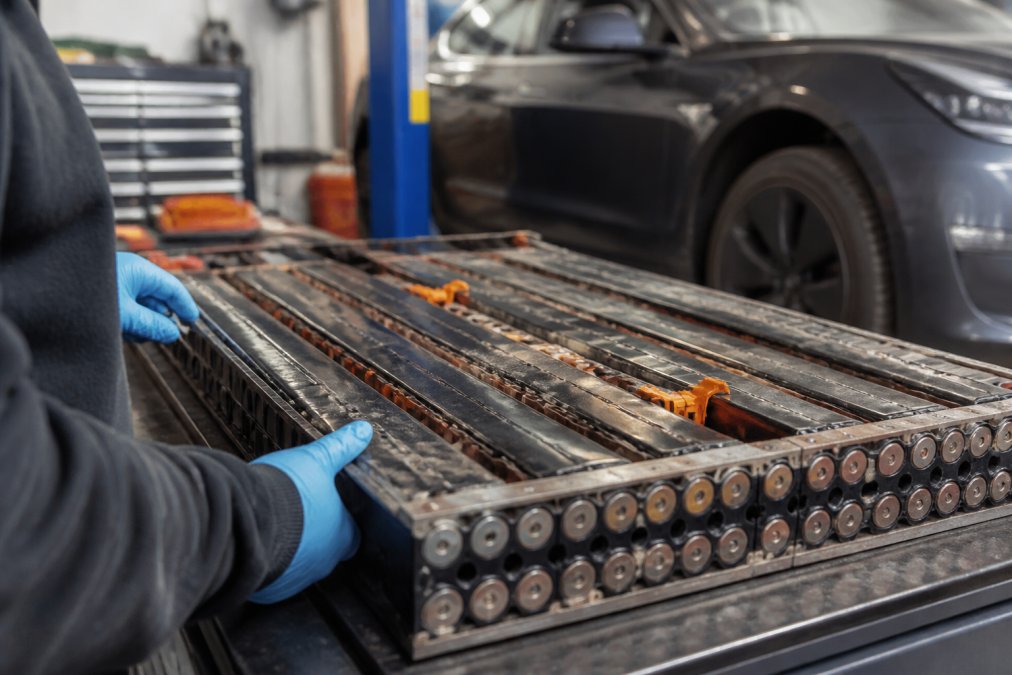
This inconsistency occurs because degraded cells lose their ability to deliver rated capacity reliably. Some cells in the pack degrade faster than others, creating imbalances. The battery management system has to work harder to balance these cells, which increases overall energy loss.
If your efficiency (measured in miles per kWh) fluctuates wildly week to week, or if the same 10-mile journey consumes 2.5 kWh one day and 3.2 kWh the next without obvious reason, battery degradation is a likely culprit.
How to Check Your Tesla Battery Health in the UK
Knowing the early signs is useful. But you need concrete data to confirm what's happening and decide whether to act.
Using the vehicle's onboard diagnostics
Your Tesla Model 3 contains built-in diagnostics that reveal battery health information. Access this data through the vehicle's touchscreen by navigating to Controls > Service > Battery.
This screen shows your battery's current state of health as a percentage. A new Model 3 displays 100%. As the battery ages, this number decreases. The rate of decrease tells you whether degradation is normal or accelerated.
Unfortunately, Tesla's onboard display doesn't show historical data or detailed degradation trends. You see the current number, but not how quickly it changed over the last six months. This limitation is why many owners turn to third-party tools.
Several apps and diagnostic tools can read deeper battery data from your Tesla's systems. Tools like TeslaFi or Tessie log your battery's state of health over time, creating a degradation curve you can monitor. If you see a sharp downward slope, that's a warning sign worth investigating professionally.
Professional battery health assessment
The most reliable way to assess your Model 3's battery is through professional diagnostics. This is especially important if you're buying a used vehicle or your vehicle is approaching the end of its warranty period.
A professional assessment goes beyond the onboard diagnostics. Specialists use dedicated diagnostic equipment to measure cell voltage, internal resistance, and capacity under load. This reveals whether all cells in the pack are degrading evenly or whether some cells have failed prematurely, a sign of a defective battery that may qualify for warranty replacement even if the overall capacity hasn't dropped dramatically.
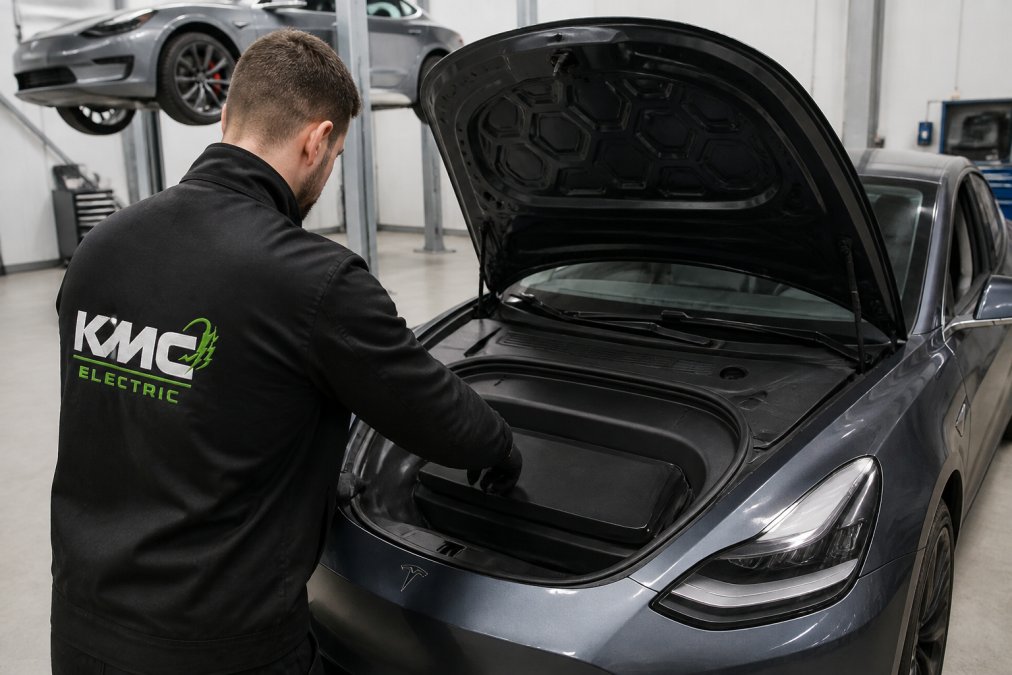
KMC Electric in Kettering provides independent battery health verification for used vehicle purchases and out-of-warranty diagnostics. We can identify degradation patterns that predict future problems. This assessment protects buyers from purchasing vehicles with hidden battery issues and helps owners understand whether their battery needs attention now or can safely operate for years longer.
Tesla Battery Warranty Coverage and UK Terms
Tesla's battery warranty in the UK covers defects in materials and workmanship for eight years or 160,000 miles, whichever comes first. During this period, if your battery's capacity falls below 70% of its original capacity due to manufacturing defects, Tesla will replace it at no cost.
This is important context: the warranty covers defects, not normal degradation. If your battery is degrading at a normal rate due to age and use, it's not covered. But if degradation is accelerated due to a manufacturing fault, you're protected.
Once your vehicle passes eight years or 160,000 miles, you're out of warranty. Any battery work becomes your responsibility. This is where independent specialists become valuable. If your battery is degrading rapidly after warranty expiry, you need to know whether the degradation is normal wear or a sign of a developing fault that could become catastrophic.
How to Improve Tesla Battery Life and Slow Degradation
You can't stop battery degradation entirely. But you can significantly slow it down with deliberate charging and driving habits.
Optimal charging practices
The single biggest factor affecting battery lifespan is how you charge. Lithium-ion batteries degrade faster when they're regularly charged to 100% or discharged to near 0%.
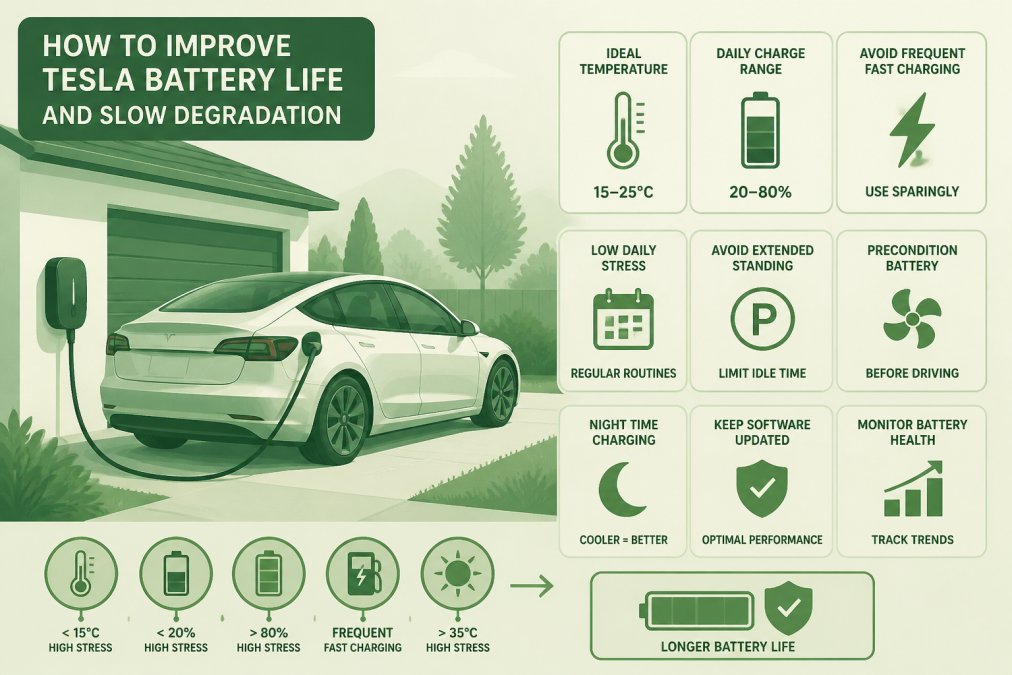
Tesla recommends keeping your battery charged between 20% and 80% for daily use (tesla.com). Charging to 100% should be reserved for long trips where you need maximum range. Discharging below 10% regularly accelerates degradation.
If you charge at home regularly, this is straightforward. Set your charging limit to 80% in your vehicle's settings and charge overnight. You'll wake up to a full daily charge without stressing the battery.
For commuters in Kettering and surrounding areas, home charging is ideal. You're not relying on public chargers, and you can maintain the optimal 20-80% charge window. Even if your commute requires 70 miles of range, an 80% charge on a Model 3 gives you more than enough.
When you do need a full charge for a long journey, charge to 100% only when necessary. Don't make it your default.
Tesla Model 3 plugged into a home charging station with the charging cable connected, showing the vehicle in a residential driveway with natural daylight
Temperature management
Cold and heat both accelerate battery degradation. A battery operating at 35°C degrades roughly twice as fast as one operating at 25°C (peer-reviewed research). Cold temperatures don't cause permanent damage, but they do reduce efficiency temporarily.
In the UK, extreme heat is less common than extreme cold. But during summer months, parking in direct sun with the windows closed can heat your battery significantly. Use the vehicle's climate preconditioning feature to cool the cabin before driving on hot days. This keeps the battery at a safer temperature.
In winter, precondition your cabin while plugged in. This uses energy from the charger, not the battery, to warm the car. When you unplug and drive, your battery is already at an optimal temperature for efficiency.
If you live in an area with consistent extreme temperatures, consider covered parking or a garage. Even partial shade makes a difference.
Driving habits that preserve battery capacity
Aggressive acceleration and high-speed driving generate heat and stress the battery. Smooth, gradual acceleration preserves charge and reduces thermal stress.
Regenerative braking, the system that captures energy when you lift off the accelerator, is your friend. Use it whenever possible. Anticipate stops and coast rather than brake hard. This maximises energy recovery and reduces the work the battery has to do.
Long-distance driving at motorway speeds heats the battery more than city driving. If you regularly drive motorway journeys, your battery will degrade faster than someone who commutes locally. This is unavoidable, but you can mitigate it by charging more conservatively (staying in the 20-80% window) and avoiding rapid charging whenever possible.
What Happens When Battery Degradation Becomes Serious
If your Model 3's battery capacity drops below 70% while still under warranty, Tesla will replace it. But what if you're out of warranty, or what if degradation has progressed beyond that point?
A seriously degraded battery, one that's lost 20-30% of its original capacity, becomes a practical problem. Your range is severely limited, charging takes much longer, and the vehicle's performance suffers. At this stage, you have three options: replace the battery, accept the reduced capability, or sell the vehicle for parts.
Battery replacement outside warranty is expensive. A new Model 3 battery pack costs several thousand pounds. But this is where early diagnosis matters. If you catch degradation early and understand the cause, you can sometimes address the root problem, a faulty charger, a software issue, or a defective cell, before the entire battery needs replacement.
This is also why independent battery assessment is crucial for used vehicle purchases. If you're considering a Model 3 with 80,000 miles and unknown charging history, you need to know whether the battery is healthy or degraded. A professional assessment reveals this before you commit to the purchase.
Conclusion
Battery degradation in a Tesla Model 3 is inevitable, but it's manageable. By monitoring the early warning signs, reduced range, slower charging, inconsistent energy consumption, you can catch problems early and make informed decisions about repair, maintenance, or purchase.
For owners in Kettering, Northamptonshire, and across the East Midlands, professional battery health assessment is the most reliable way to understand your vehicle's true condition. KMC Electric provides independent diagnostics and real-world guidance for out-of-warranty repairs, giving you the clarity you need to extend your vehicle's service life cost-effectively. Whether you're buying a used Model 3 or maintaining one you already own, understanding your battery's health protects your investment.
Frequently Asked Questions
Q: What is the expected battery degradation for a Tesla Model 3?
A: Tesla Model 3 batteries typically retain 90% of their original capacity after 8 years or 120,000 miles under normal use. Degradation is gradual, most owners experience 1-2% capacity loss per year. Battery degradation signs become noticeable when capacity drops below 85%, affecting real-world range. Professional battery health checks can confirm your vehicle's actual state of health and predict future degradation rates.
Q: How can I check my Tesla Model 3 battery health at home?
A: Use your Model 3's built-in battery management system: access Energy from the main menu to view current capacity and charging efficiency. Compare your maximum range when fully charged to the EPA-rated range, a significant gap suggests degradation. For precise battery health check UK results, independent specialists like KMC Electric provide diagnostic assessments that measure actual battery state-of-health, giving you confidence before purchasing a used vehicle or making repair decisions.
Q: Does frequent Supercharging cause battery degradation in the UK?
A: Frequent DC fast-charging accelerates battery degradation compared to slower AC charging, though modern Tesla batteries are engineered to handle it. Occasional Supercharging won't cause immediate damage, but regular daily Supercharging increases wear. To improve Tesla battery life, prioritise overnight home charging when possible and use Supercharging mainly for longer journeys. Balancing charging methods extends overall battery lifespan significantly.
Q: Does the Tesla battery warranty cover degradation?
A: Tesla's battery warranty in the UK covers defects but not normal degradation. The warranty typically guarantees 70% capacity retention over 8 years or 120,000 miles. Gradual capacity loss falls outside warranty coverage. However, if your Model 3 shows premature degradation, independent assessment through KMC Electric can determine whether the issue is manufacturing defect or normal wear, essential information if your vehicle is nearing warranty expiry.