Electric vehicles now account for a growing share of UK registrations, and the complexity of high-voltage systems, battery management technology, and over-the-air software means that expert ev technical support services have never been more critical to ownership. At KMC Electric, we work with Tesla and other EV owners across Kettering and Northamptonshire every week, and the pattern is consistent: the drivers who get the most from their vehicles are the ones who treat technical support as a proactive investment, not a reactive expense. Below, we cover everything from high-voltage inspection and BMS fault scanning to the real cost of independent versus main dealer support, and exactly where to draw the DIY line.
Most guides on this topic focus narrowly on charging infrastructure or manufacturer warranties. What they miss is the full picture: the interaction between battery health, software state, drivetrain condition, and regional compliance requirements that together determine whether your EV runs well or runs up bills.
What Expert EV Technical Support Services Actually Cover
Expert ev technical support services cover the full technical lifecycle of an electric vehicle, from initial fault diagnosis and high-voltage safety inspection through to long-term preventative maintenance, software management, and battery health verification. This is not the same as a routine service at a franchise dealer. A genuine EV specialist works across all vehicle systems simultaneously, using OEM-level diagnostic tools and technical documentation to identify faults that a generalist workshop would miss entirely.
The scope is broader than many owners realise. A comprehensive support engagement typically includes:
High-voltage system inspection and insulation resistance testing
Battery management system (BMS) fault scanning and capacity assessment
Drivetrain oil and filter condition checks (relevant to Tesla Model 3 and Model Y units)
Telematics and remote diagnostics review
Software and firmware version verification
Charging infrastructure compatibility testing
Warranty documentation and fault logging
For fleet management operators, the stakes are higher still. Unplanned downtime costs money directly and indirectly. Preventative maintenance and real-time monitoring through onboard IoT systems are what separate fleets that hit uptime targets from those that don't.
High-Voltage System Inspection and Safety Checks
High-voltage system inspection is the non-negotiable foundation of any credible EV technical support engagement. Electric vehicles operate at voltages that are immediately life-threatening if mishandled, and the safety checks required go well beyond what a standard automotive diagnostic technician is trained to perform.
A proper high-voltage inspection covers insulation resistance across the main battery pack, integrity of the orange high-voltage cabling, contactor function, and thermal management system performance. For Tesla vehicles specifically, this also means checking the pyrofuse and high-voltage interlock loop (HVIL) circuit. These are not checks you can approximate with a multimeter from a hardware shop.
The practical implication: always verify that any technician working on your EV's high-voltage systems holds a recognised qualification. In the UK, this means IMI Level 3 or Level 4 accreditation as a minimum. Level 4 Master Technician status, which KMC Electric holds, represents the highest tier of EV technical qualification currently available.
Watch OutNever allow unqualified personnel to open or inspect the high-voltage battery enclosure. A fault in the insulation resistance test that goes undetected is not just a repair cost risk; it is a fire and electrocution risk during subsequent charging cycles.
Remote Diagnostics, Telematics, and Real-Time Monitoring
Remote diagnostics and telematics have changed the economics of EV technical support significantly. Modern electric vehicles generate continuous data streams through onboard IoT systems, covering battery state of health, motor temperatures, charging behaviour, and fault codes. A skilled support provider can access this data without the vehicle being physically present.
For fleet operators in Northamptonshire and beyond, this means fault trends can be identified before they become roadside failures. Real-time monitoring flags anomalies in cell voltage deviation, regenerative braking efficiency, and thermal management performance. Connected apps allow drivers to see the same data their technician sees, which improves communication and reduces diagnostic time when the vehicle does come in.
The caveat worth stating plainly: remote diagnostics is a triage tool, not a replacement for physical inspection. High-voltage work always requires the vehicle on a ramp with a qualified technician present.
EV Battery Diagnostic Services: What to Expect
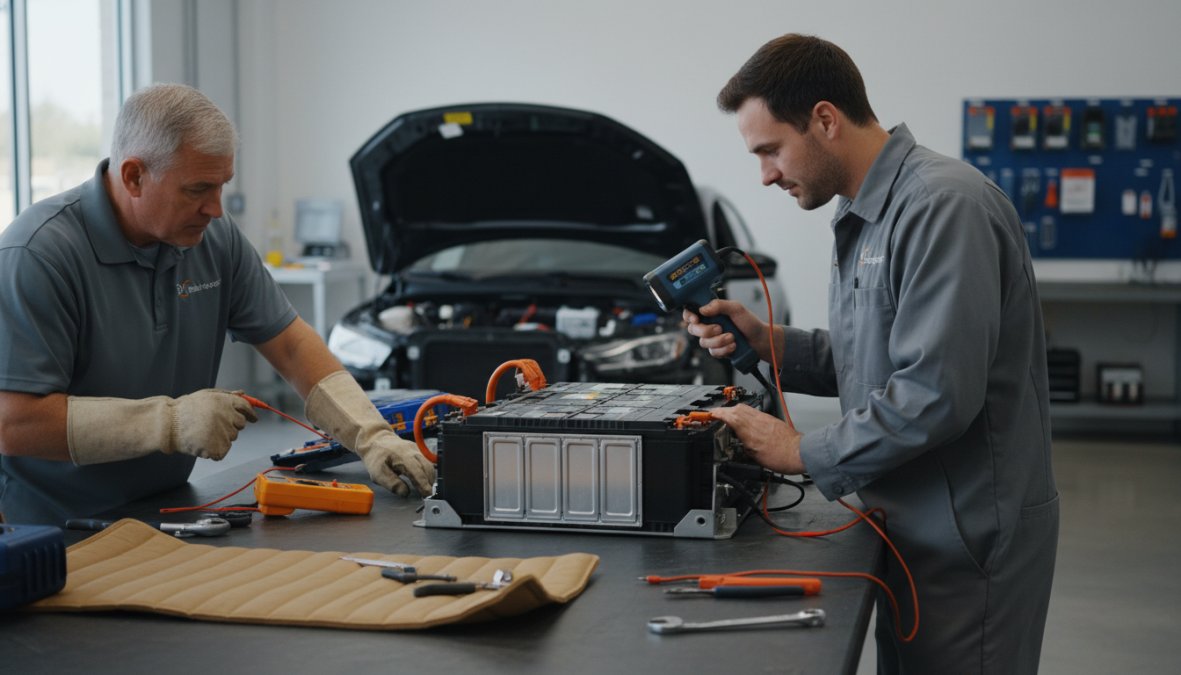
EV battery diagnostic services are specialist assessments that measure the real-world capacity, health, and fault status of an electric vehicle's battery pack, providing data that neither the vehicle's own dashboard nor a standard OBD scan tool can deliver accurately. A full battery diagnostic goes deeper than the state-of-charge reading on your instrument cluster.
Professional illustration showing A Level for expert ev technical support services
What you should expect from a professional battery diagnostic:
BMS data extraction: Full read of the battery management system, including individual cell group voltages, temperature distribution, and historical fault codes
Capacity test: Measured usable capacity compared against the OEM specification for that battery variant
Degradation rate assessment: How the pack is ageing relative to expected curves for mileage and charge cycle count
Thermal management check: Coolant condition and pump function for liquid-cooled packs
Written report: A documented health assessment you can use for warranty claims, private sale, or insurance purposes
The written report is the part most owners undervalue. According to the Society of Motor Manufacturers and Traders (SMMT) EV guidance, used EV values are increasingly tied to documented battery health evidence. A verified report from a qualified specialist protects both buyer and seller.
Battery Management System (BMS) Fault Scanning
The battery management system is the electronic brain of an EV's power pack, monitoring cell voltages, temperatures, and current flow to protect the battery from damage and optimise performance. BMS fault scanning reads the stored and active diagnostic trouble codes within this system, identifying issues that range from minor cell imbalance to serious thermal events.
Common BMS faults include cell voltage deviation outside tolerance, temperature sensor failures, and communication errors between the BMS and the vehicle's main control unit. Many of these faults are intermittent, which means they clear themselves temporarily and do not show as active warnings on the dashboard. A full BMS scan captures the full fault history, not just current active codes.
This is particularly relevant for out-of-warranty vehicles. A fault that was logged once and cleared may indicate a degrading cell group that will fail progressively. Catching it early is the difference between a cell balancing correction and a full pack replacement.
Independent Battery Health Verification for Buying or Selling
Buying or selling a used electric vehicle without an independent battery health check is, frankly, a significant financial risk. The seller's stated range and the dashboard's battery percentage tell you almost nothing about actual pack condition.
An independent verification from a qualified specialist provides a measured capacity figure, a degradation assessment against OEM data, and a fault history review. For buyers, this is negotiating use and protection against expensive post-purchase surprises. For sellers, a clean health report is a credible signal that supports the asking price.
KMC Electric provides independent battery health verification for Tesla and other EV models, with documented reports suitable for private sales, part-exchange negotiations, and pre-warranty-expiry fault identification.
Common Electric Vehicle Technical Problems and How Experts Fix Them
The most common electric vehicle technical problems that bring owners to a specialist garage fall into four categories: charging faults, drivetrain issues, software errors, and battery degradation symptoms. What separates expert diagnosis from guesswork is understanding the mechanism behind each fault, not just what it is, but why it happens, how it presents, and what the correct fix actually involves versus the common misdiagnosis.
Charging Faults: The Most Frequent and Most Misdiagnosed Category
Charging faults account for a significant proportion of EV workshop visits, and they are also the category most likely to be misdiagnosed, because the fault can originate in the vehicle, the charging cable, the charging unit, or the interaction between all three.
Onboard charger (OBC) module failure prevents AC charging entirely or causes the vehicle to accept charge at a reduced rate. The correct diagnostic sequence is to first rule out the charging cable and the supply unit before condemning the OBC. A common and expensive mistake is replacing the OBC module, a repair costing upwards of £1,200, when the actual fault is a corroded charge port latch sensor that is preventing the charge port from signalling a secure connection. The BMS fault code points toward the OBC; only a technician who understands the full charge initiation sequence knows to check the latch sensor first.
DC fast-charge communication errors are increasingly common as public charging infrastructure ages. The Combined Charging System (CCS) protocol requires a handshake between the vehicle's charge management system and the charger's power electronics. When this handshake fails, the vehicle may display a generic charging error that looks identical whether the fault is in the vehicle or the charger. Correct diagnosis requires testing the vehicle on a known-good DC charger before any vehicle-side investigation begins. Skipping this step wastes diagnostic time and can result in unnecessary parts replacement.
Charge port damage, bent pins, moisture ingress, or heat damage from repeated fast charging, is a physical fault that no software diagnostic will identify. It requires visual inspection with appropriate lighting and, in some cases, a pin continuity check. Replacement charge port assemblies for Tesla vehicles are model-year specific; using the wrong variant causes fitment and communication issues.
Watch OutNever attempt to clear a recurring DC fast-charge fault by repeatedly attempting to initiate a charge session. Repeated failed handshake attempts can log additional fault codes that complicate subsequent diagnosis and, in rare cases, can cause thermal stress on charge port components that are already marginal.
Drivetrain Problems: Noise, Efficiency Loss, and the Oil Change Most Owners Miss
Drivetrain problems in Tesla vehicles, and increasingly in other EV platforms, often present as noise, vibration, or efficiency loss rather than outright failure. The challenge is that efficiency loss is easy to attribute to battery degradation, cold weather, or driving style, which means drivetrain issues can go unaddressed for extended periods.
Drive unit noise typically presents as a whine or hum that varies with vehicle speed rather than motor RPM. The distinction matters: a noise that tracks vehicle speed points toward the gearset or bearings; a noise that tracks motor RPM points toward the motor itself. Correctly characterising the noise during a road test is the first diagnostic step, and it requires a technician who has driven enough Tesla drive units to know what normal sounds like.
Drivetrain oil condition is the preventative maintenance item most EV owners are unaware of. Tesla Model 3 and Model Y drive units contain a gearset that runs in a specific lubricant. This oil degrades over time and mileage, and running a drive unit on degraded oil accelerates bearing and gear wear. The oil change procedure requires the correct fluid specification, Tesla specifies a particular viscosity and additive package, and the correct torque on the drain and fill plugs. An incorrect fluid grade or an overtorqued plug can cause damage that costs multiples of the service itself. KMC Electric stocks the correct Tesla drivetrain oil and filters for Model 3 servicing and carries out this work to OEM specification.
Efficiency loss without a fault code is a diagnostic challenge that requires a structured approach. The correct sequence is: rule out tyre pressure and condition, check brake drag (seized callipers create measurable rolling resistance), assess battery state of health against mileage-adjusted OEM curves, and then investigate drivetrain condition. Jumping to battery diagnosis without ruling out mechanical drag is a common and costly shortcut.
Software Errors: When an OTA Update Creates the Problem
Software errors are increasingly common as over-the-air update complexity grows, and they represent a category of fault that did not exist in the ICE era. A failed or corrupted firmware update can cause anything from touchscreen lockouts and incorrect range estimates to charging behaviour changes and, in documented cases, alterations to regenerative braking calibration that affect the driving experience noticeably.
The diagnostic challenge with software faults is that they often present identically to hardware faults. A touchscreen that has locked up after a failed OTA update produces the same symptom as a touchscreen with a failing eMMC storage chip. The correct diagnostic sequence matters: a forced software reinstall via OEM diagnostic access should be attempted before any hardware replacement is authorised.
Firmware version tracking is something an experienced specialist does across the vehicles they service. A firmware version that improves range estimation on one Model 3 variant may introduce a charging communication error on a different battery configuration. A technician who services multiple Tesla vehicles regularly will have encountered these version-specific issues and can advise whether to accept or defer a pending update, advice that the Tesla app itself does not provide.
The 'phantom drain' fault, where a vehicle loses significantly more charge overnight than expected, is frequently software-related. The most common cause is a background process that prevents the vehicle from entering its low-power sleep state correctly. This can be triggered by a third-party app maintaining a persistent API connection, a recent firmware change to the vehicle's sentry mode parameters, or a BMS calibration issue. Correct diagnosis requires reviewing the vehicle's sleep behaviour data, which is accessible through OEM diagnostic tools but not through the standard owner app.
Battery Degradation Symptoms: What Is Normal and What Is Actionable
Battery degradation symptoms, reduced range, slower DC fast-charging acceptance, increased energy consumption at motorway speeds, are not always faults in the traditional sense, but they are diagnostically significant and often actionable before they worsen.
The key distinction an expert makes is between expected degradation and accelerated degradation. All lithium-ion battery packs lose capacity over time and charge cycles. The question is whether the rate of loss is consistent with the vehicle's age, mileage, and charging history, or whether it indicates an underlying issue.
Expected degradation follows a curve that is well-characterised for most EV platforms: relatively rapid initial capacity loss in the first year or two, followed by a slower, more linear decline. A vehicle showing capacity loss consistent with this curve, adjusted for its charge cycle count and fast-charge usage, is behaving normally.
Accelerated degradation, capacity loss that is materially faster than the expected curve for that vehicle's usage profile, points toward specific causes: a cell group with elevated internal resistance, a thermal management system that has been running suboptimally (often due to coolant degradation or a failing pump), or a charging behaviour pattern that has stressed the pack (frequent charging to 100% combined with regular DC fast charging, for example).
The actionable insight is that accelerated degradation caught early can sometimes be partially addressed. A cell balancing correction via BMS recalibration can recover usable capacity that the BMS has incorrectly written off. A thermal management service, coolant replacement and pump inspection, can prevent further thermally-driven degradation. Neither intervention is possible once the pack has degraded past a certain threshold, which is why early diagnosis matters.
Pro TipBefore booking a diagnostic appointment for any of these fault categories, note the exact conditions under which the problem occurs: ambient temperature, state of charge at the time, charger type used (AC home, AC public, DC fast), recent software update history, and any dashboard warning text. This information cuts diagnostic time significantly and reduces the cost of your appointment. A technician who arrives at a charging fault with this context can often identify the fault category before connecting a diagnostic tool.
Electric Vehicle Maintenance Best Practices to Maximise EV Longevity
The single most effective thing an EV owner can do to maximise EV longevity is follow a structured preventative maintenance schedule rather than waiting for warning lights. Electric vehicles have fewer mechanical wear components than combustion engines, but the components they do have, including brake systems, thermal management, tyres, and drivetrain units, still degrade and require attention.
Preventative Maintenance Intervals and EV Service Schedules
Preventative maintenance intervals for electric vehicles differ meaningfully from traditional ICE service schedules. There is no engine oil to change, no timing belt, no exhaust system. But the following items require regular professional attention:
Service Item
Recommended Interval
Notes
Brake fluid replacement
Every 2 years
Hygroscopic degradation regardless of use
Tyre rotation and inspection
Every 10,000-12,000 miles
EVs are heavier; tyre wear is accelerated
Cabin air filter
Annually
Affects HVAC efficiency and battery cooling
Drivetrain oil (Tesla)
Per OEM guidance
Critical for drive unit longevity
Battery coolant
Every 4 years or per OEM
Often overlooked; affects thermal management
High-voltage system check
Every 2-3 years
Insulation resistance can degrade over time
The brake system deserves specific mention. Regenerative braking reduces brake pad wear significantly, which sounds like good news. The problem is that reduced use allows brake callipers to seize and brake fluid to absorb moisture without the thermal cycling that would normally flag the issue. EV owners frequently arrive with seized rear callipers that have gone unnoticed for years.
For Tesla Model 3 and Model Y owners, the hand brake electric motor is a component that can fail silently. Replacement is straightforward when caught early; ignoring it risks caliper damage that multiplies the repair cost.
Software Updates, Firmware Management, and Connected Apps
Software updates are not optional maintenance items for modern electric vehicles. Firmware manages everything from charging behaviour and regenerative braking curves to thermal management parameters and safety systems. Running outdated firmware is not just a feature issue; it can affect vehicle safety and warranty validity.
The practical challenge is that OTA updates occasionally introduce new faults. A firmware version that improves range estimation on one vehicle variant may cause charging communication errors on another. An experienced EV specialist tracks these issues across the fleet of vehicles they service and can advise whether to accept or defer a pending update.
Connected apps provide useful real-time data for owners, but they are not a substitute for professional fault scanning. An app that shows "battery health: good" is reporting the BMS's own self-assessment, which is not the same as an independent capacity measurement.
DIY vs. Professional Expert EV Technical Support: Where to Draw the Line
This is the part most guides avoid saying clearly: some EV maintenance tasks are genuinely appropriate for informed owners, and others are not, and the line between them is not arbitrary.
DIY is appropriate for:
Cabin air filter replacement
Tyre pressure monitoring and rotation scheduling
Wiper blade replacement
Checking and topping up washer fluid
Monitoring charge behaviour through connected apps
Professional support is required for:
Any work involving the high-voltage system or battery enclosure
Brake fluid replacement and calliper inspection
Drivetrain oil and filter changes (requires specific tooling and fluid specification)
BMS fault scanning and software diagnostics
Charging fault diagnosis beyond a basic cable swap
The threshold is essentially this: if the task involves high-voltage components, specialist diagnostic software, or OEM-specific technical documentation, it requires a qualified technician. According to the Institute of the Motor Industry's EV safety guidance, working on live high-voltage systems without Level 3 IMI accreditation is both dangerous and, in a commercial context, a liability issue.
The grey area is drivetrain oil. It looks like a simple fluid change, and the components involved are mechanical rather than electrical. But the access procedure, torque specifications, and fluid grade are Tesla-specific, and an error here causes expensive drive unit damage. This is a professional job.
Key TakeawayThe DIY threshold for EVs is lower than for traditional vehicles, not higher. The high-voltage architecture means that mistakes which would be inconvenient on a petrol car can be catastrophic on an EV. When in doubt, the cost of a professional appointment is trivially small compared to the cost of getting it wrong.
Electric Vehicle Repair Costs in the UK: What You Should Budget
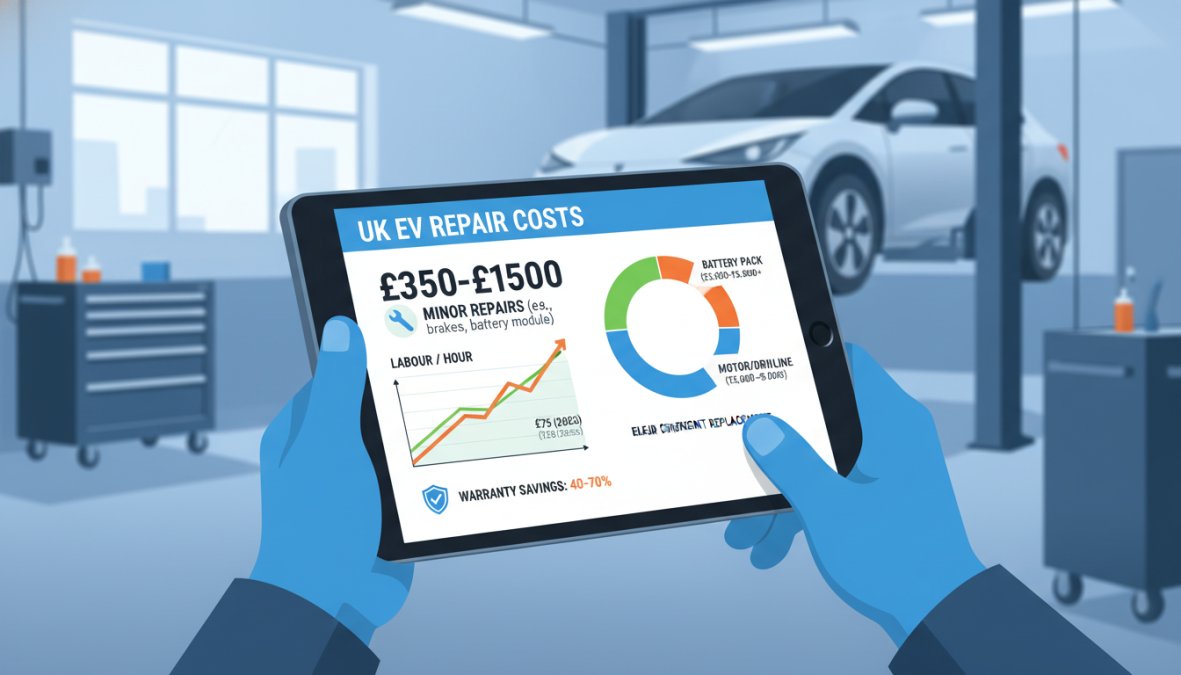
Electric vehicle repair costs in the UK vary considerably depending on the fault, the vehicle model, and whether you use a main dealer or an independent specialist. Understanding the structure of these costs helps owners make informed decisions rather than expensive ones, but for fleet operators and high-mileage private owners, the more useful question is not just what does a repair cost but what does a support contract cost versus not having one.
Common repair cost ranges for UK EV owners in 2026:
Hand brake electric motor (Tesla Model 3/Y): Parts from £60, labour typically 1-2 hours
Battery coolant service: £150-£300 depending on vehicle
BMS diagnostic and report: £100-£250 depending on depth
These are indicative ranges. The actual figure depends on parts availability, labour rate, and whether the fault requires further investigation.
Professional illustration showing expert ev technical support services
Cost-Benefit Analysis: Independent Specialist vs. Main Dealer
The honest answer is that independent specialists are almost always more cost-effective for out-of-warranty vehicles, and the quality gap that once justified main dealer premiums has largely closed for well-qualified independents.
Main dealer advantages are real but narrow: they have direct OEM system access for vehicles under active warranty, and they can process warranty claims directly. For a vehicle within the manufacturer's warranty period, this matters.
Outside warranty, the calculation changes. An independent specialist with Level 4 Master Technician status and OEM diagnostic tooling delivers the same technical capability at a materially lower labour rate. The absence of franchise overhead is the primary driver. For a complex repair like a drive unit replacement, the saving at an independent specialist versus a main dealer can be substantial.
The risk with independents is variability. Not all independent garages have the qualifications, tooling, or Tesla-specific knowledge to work safely and effectively on high-voltage systems. Vetting the technician's credentials before booking is not optional; it is the core of the cost-benefit calculation.
The Real ROI of Proactive Support Contracts vs. Reactive Repair: A Framework for Fleet Operators
This is the section most guides skip entirely, and it is the one fleet managers most need. The question is not whether expert EV technical support costs money, it does. The question is whether structured, proactive support costs less than the alternative.
Consider the two models side by side:
Model A, Reactive repair only (no support contract): The fleet runs vehicles until a fault presents. Diagnosis and repair happen on demand. Labour rates are standard. Downtime is unplanned.
Model B, Proactive support engagement (scheduled diagnostics + priority access): Vehicles are assessed at defined intervals. Fault trends are identified before roadside failure. Priority booking reduces vehicle-off-road time. Documentation supports warranty claims and resale.
The cost difference between these models is not primarily in the service fees, it is in the downstream costs that proactive support prevents. Three cost categories drive the ROI calculation for fleet operators:
1. Unplanned downtime cost. A commercial EV off the road unexpectedly has a direct cost in lost productivity or hire vehicle expense, and an indirect cost in scheduling disruption. For a sole trader or small fleet, even one unplanned day of downtime per quarter can dwarf the annual cost of a preventative maintenance schedule.
2. Fault escalation cost. Many expensive EV repairs are escalated versions of cheaper ones. A BMS fault caught at the cell-imbalance stage costs a fraction of what it costs once a cell group has degraded to the point of requiring pack intervention. A seized brake calliper caught at annual inspection costs far less than one that has damaged the disc and required emergency roadside recovery. The pattern is consistent: early detection is cheaper than late detection, and late detection is cheaper than failure.
3. Resale and residual value. Documented maintenance history from a qualified specialist is increasingly a tangible asset at disposal. A fleet vehicle with a complete service record from an IMI Level 4 technician, including battery health reports, commands a stronger part-exchange or auction value than an identical vehicle with no documentation. For fleets cycling vehicles every three to four years, this difference compounds across the whole fleet.
Key TakeawayFor fleet operators evaluating whether to bring EV maintenance in-house or outsource to a specialist, the break-even point depends on fleet size, vehicle model mix, and internal technician qualification level. A common pattern is that fleets below roughly ten to fifteen vehicles find outsourced specialist support more cost-effective than maintaining in-house Level 3 or Level 4 EV capability, because the qualification investment, tooling cost, and ongoing training burden do not distribute across enough vehicles to justify the overhead. Above that threshold, a hybrid model, in-house for routine items, specialist for high-voltage and BMS work, often delivers the best balance.
What to ask a support provider before committing:
What is the callout or priority booking arrangement for unplanned faults?
Does the engagement include written reports for every visit, suitable for warranty and resale use?
What is the technician's IMI qualification level, and can it be verified independently?
Are software diagnostic tools OEM-compatible for your specific vehicle models?
What is the parts sourcing policy, OEM, OEM-equivalent, or aftermarket, and how does that affect warranty position?
The answers to these questions separate a genuine support partner from a garage that has added 'EV' to its signage.
How to Choose the Right EV Technical Support Provider in Kettering and Northamptonshire
Choosing the right expert ev technical support services provider near you comes down to five verifiable criteria, not marketing claims.
1. Technician qualification level. Ask specifically for IMI EV qualification level. Level 3 is the minimum for high-voltage work; Level 4 Master Technician status is the benchmark for complex diagnostics and repair.
2. Diagnostic tooling. A credible EV specialist has OEM-compatible diagnostic software, not just a generic OBD reader. For Tesla vehicles, this means access to the same fault data the manufacturer uses.
3. Model-specific experience. General EV experience is not the same as deep knowledge of a specific platform. Tesla systems differ significantly from Nissan Leaf or Hyundai Ioniq architecture. Ask which models the garage works on most frequently.
4. Documented service records. A professional provider issues written reports for every diagnostic and service visit. If a garage cannot provide this, their work cannot support warranty claims or resale value.
5. Transparency on parts and labour. Reputable independents will tell you what parts they are using, where they source them, and what the labour rate is. Vagueness here is a warning sign.
For EV owners in Kettering looking for a specialist near me, KMC Electric offers Level 4 Master Technician expertise with over 25 years of automotive industry experience and EV qualifications dating to 2016. The combination of deep Tesla system knowledge, independent battery health verification, and practical out-of-warranty repair capability makes it the most credible independent option in the region.
The IMI's EV technician register allows owners to verify technician qualifications independently before booking any high-voltage work.
Finding qualified, trustworthy EV technical support in Kettering and across Northamptonshire is harder than it should be. KMC Electric addresses this directly: with Level 4 Master Technician status, EV qualifications since 2016, and specialist knowledge across all Tesla models, the garage provides the diagnostic depth and practical repair capability that out-of-warranty EV owners need. Get started with KMC Electric and protect both your vehicle's longevity and your investment with expert support that main dealer pricing does not require.
Frequently Asked Questions
What does expert EV technical support actually cover?
Expert EV technical support services typically cover battery management system diagnostics, high-voltage system inspection, fault scanning, software and firmware updates, charging infrastructure maintenance, remote diagnostics via telematics, and preventative maintenance. For Tesla and other electric vehicles, specialist support can also include drivetrain assessments, brake system checks, and independent battery health verification — whether you are out of warranty or preparing to buy or sell a vehicle.
What are the most common technical problems with electric vehicles?
Common electric vehicle technical problems include battery degradation and range loss, BMS fault codes, charging port failures, software glitches affecting onboard systems, regenerative braking irregularities, and drivetrain oil leaks. High-voltage system faults are less frequent but require immediate attention from an ASE-certified or Level 4 Master Technician. Many of these issues can be identified early through regular EV battery diagnostic services and preventative maintenance checks.
Is professional EV technical support worth the cost in the UK?
For most UK electric vehicle owners, professional expert EV technical support services offer strong value — particularly when out of warranty. Independent specialists typically charge significantly less than main dealer networks while delivering equivalent or superior diagnostic depth. Catching a battery fault or high-voltage issue early can prevent far more expensive repairs later. For Tesla owners in Northamptonshire and across the East Midlands, an independent specialist with Level 4 Master Technician status can be a cost-effective long-term choice.
Can I perform any EV maintenance myself, or do I always need a specialist?
Some electric vehicle maintenance tasks are safe for owners, such as checking tyre pressures, topping up screenwash, and monitoring software update notifications via connected apps. However, anything involving high-voltage systems, battery management system diagnostics, drivetrain components, or charging infrastructure must be handled by a qualified technician. Attempting high-voltage work without proper training poses serious safety risks and may void your warranty or breach UK regulatory requirements.
How do I find reliable EV battery diagnostic services near me?
Look for an independent EV specialist with verifiable qualifications — ideally Level 4 Master Technician status and EV-specific experience dating back several years. In Kettering and across Northamptonshire, KMC Electric offers comprehensive EV battery diagnostic services including BMS fault scanning and independent battery health reports. Always confirm the provider has hands-on experience with your specific vehicle make, particularly if you own a Tesla, as model-specific knowledge matters significantly for accurate diagnosis.