DISCLAIMER: KMC Electric do not install EV chargers, we maintain and repair the vehicles, this is for informational purposes only.
Installing a home EV charger correctly isn't optional, it's the foundation of safe, reliable electric vehicle ownership. A poorly installed charger can damage your vehicle's battery, create electrical hazards, or fail to meet UK safety standards, leaving you stranded and facing costly repairs. This guide covers the 5 best home EV charger installation practices in 2026, drawing on UK regulations, electrical safety standards, and real-world installation experience from specialists like KMC Electric who work with EV owners across Kettering and the wider Midlands region.
Whether you're installing your first charger or upgrading an existing setup, understanding these practices will help you avoid common mistakes and ensure your installation is safe, compliant, and future-proof.
1. Comply with EV Charger Installation Regulations UK 2026
Your home EV charger installation must comply with UK building regulations and electrical safety standards. This isn't just bureaucracy, it protects your home, vehicle, and family.
The primary framework governing EV charger installations in the UK is BS 7909:2020, the standard for in-vehicle power supply, combined with BS 7671:2018 (the 18th Edition Wiring Regulations), which covers all electrical installations in buildings. Additionally, the IET Code of Practice for EV Charging Equipment Installation provides detailed guidance for installers.
For grid-connected chargers, your installation must also comply with G98 (for smaller installations under 3.68 kW) or G99 (for larger installations up to 16 A single-phase or 32 A three-phase), which govern how your charger connects to the distribution network. These approvals ensure your charger doesn't destabilise the local grid.
Most installers in Kettering and across the UK will handle these approvals on your behalf, but you should verify they're NICEIC-registered, ELECSA-certified, or hold equivalent competency credentials. These bodies audit installers to ensure they meet Building Regulations Part P and BS 7671 standards.
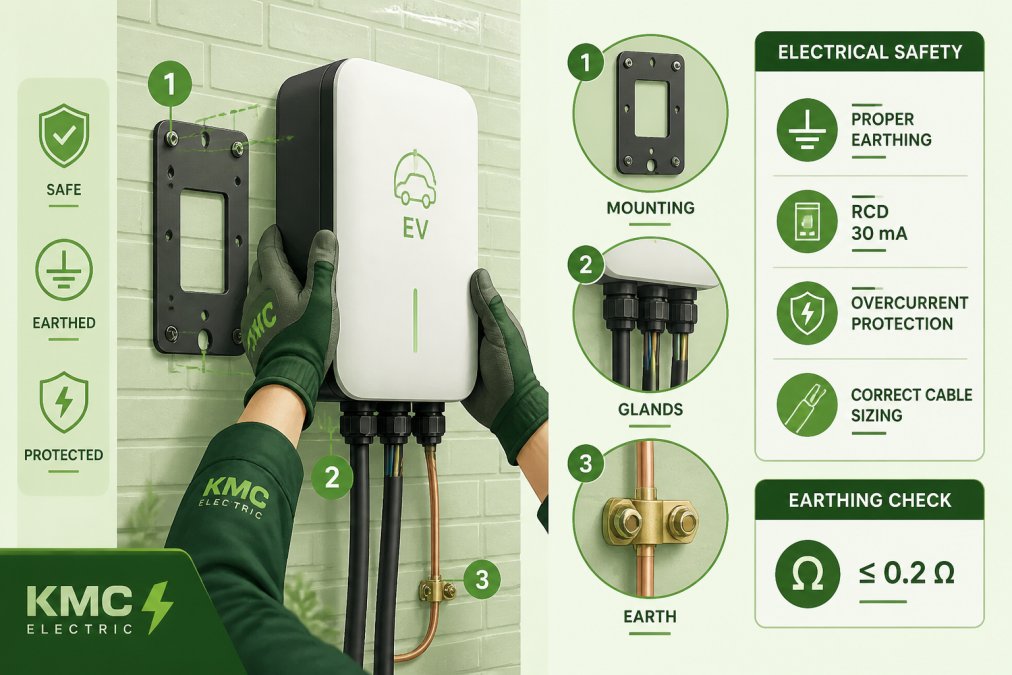
A key requirement: your installation must include an RCD (residual current device) rated at 30 mA or better, plus an MCB (miniature circuit breaker) or similar overcurrent protection. This combination stops electrical faults before they become dangerous.
2. Install Proper Earthing and Electrical Safety Systems
Earthing (grounding) is non-negotiable in EV charger installations. Without proper earthing, a fault in the charger or vehicle could allow dangerous voltages to remain on the metal chassis, risking electrocution.
Your installation must include a dedicated earth conductor running from your main consumer unit (fuse box) to the charger, sized according to BS 7671. For most domestic installations, a 6 mm² copper conductor is standard, but your installer should calculate the correct size based on the circuit length and current rating.
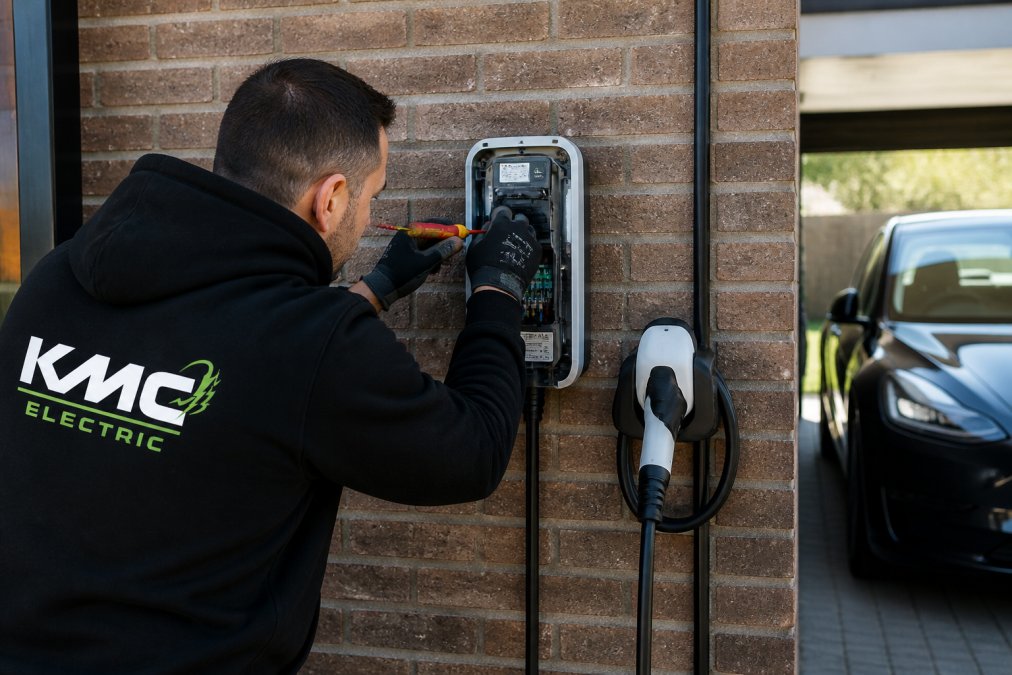
Professional illustration showing home EV charger installation
Beyond the main earth, your installation should include:
Type A RCD protection: Detects AC faults and some DC faults (older Type AC RCDs miss DC faults common in EV circuits)
Type B RCD (preferred): Detects both AC and DC faults, offering superior protection for EV chargers
Surge protection devices: Protect against voltage spikes from the grid or lightning
Isolation switch: Allows you to safely disconnect the charger from the mains for maintenance
Many installers now recommend installing a Type B RCD with integrated surge protection as a single unit. This simplifies the installation and meets current best practice in Kettering and across the UK.
Pro TipIf your home has an older earthing system (TT or IT earthing), you may need to upgrade to TN-S or TN-C-S before installing a charger. Ask your installer to verify your earthing type, it's printed on your consumer unit label.
Your consumer unit must have a dedicated circuit breaker for the charger, separate from other appliances. This ensures the charger's current draw doesn't trip circuits powering essential systems.
3. Implement Home EV Charger Load Management Systems
Load management prevents your charger from overwhelming your home's electrical supply. When your charger, heating system, and cooker all run simultaneously, the demand can exceed your supply, causing expensive damage to your main fuse or even triggering a grid failure.
Most UK homes receive a 100 A supply from the grid, shared across all appliances. A 7 kW charger draws roughly 30 A at full power, a significant portion. A load management system monitors your total household consumption and throttles the charger's power output if demand spikes elsewhere.
Modern smart chargers include built-in load management via IEC 61851-1 communication protocols. These chargers "talk" to your home's electrical system, reducing charging speed if the washing machine or oven kicks in. More advanced systems integrate with solar installations, prioritising EV charging when your panels generate excess power.
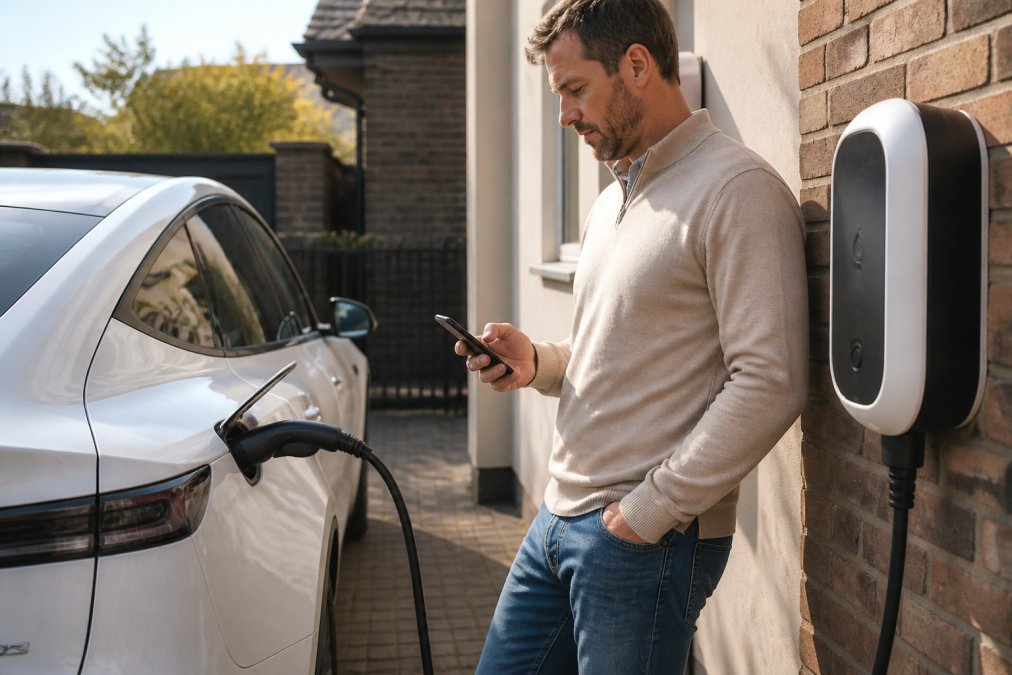
Professional illustration showing Homeowner for home EV charger installation
For installations in Kettering and across the Midlands, consider these load management approaches:
Smart charger with native load management: The charger itself monitors grid demand and adjusts output automatically
Separate load management unit: Installed between your consumer unit and charger, these devices provide more granular control
Whole-home energy management system: Integrates your charger, solar panels, battery storage, and appliances into a single system
If you're planning to install a second charger (for a second vehicle or future-proofing), load management becomes essential. Without it, two chargers running simultaneously would demand 14 kW or more, likely exceeding your supply.
Watch OutUndersizing load management is a common mistake. If your system can't handle your actual peak household demand, the charger will constantly reduce speed, adding hours to charge times. Specify your peak load (cooker, heating, charger) when discussing system sizing with your installer.
4. Choose the Right Charger Location and Infrastructure
Where you install your charger affects safety, convenience, charging speed, and long-term reliability. This isn't a purely technical decision, it's a practical one that shapes your EV ownership experience.
Location factors:
Driveway vs. garage: Garages offer weather protection but create heat buildup if poorly ventilated. Driveway chargers are exposed but simpler to install. For Kettering's climate, either works, but ensure adequate ventilation if you choose a garage
Distance from consumer unit: Longer cable runs require thicker conductors and cost more. Most installers recommend keeping the charger within 30 metres of your fuse box
Proximity to water sources: Chargers must be at least 2.4 metres away from baths, showers, and outdoor pools to prevent electrical hazards
Cable routing: Cables should run through conduit or trunking to protect against damage and UV degradation. Avoid routing cables across driveways where vehicles or foot traffic could damage them
For charging speed, consider your vehicle's maximum charge rate. A Tesla Model 3 can accept up to 11 kW from a home charger, whilst some older EVs max out at 7 kW. Matching your charger capacity to your vehicle's capability prevents wasted investment.
Key TakeawayA 7 kW charger (single-phase, 32 A) is the most practical choice for most UK homes. It's affordable, widely compatible, and charges a typical EV from empty to 80% overnight. Only choose 11 kW (three-phase) if your home has three-phase supply and you need faster charging.
Infrastructure considerations:
Three-phase supply: If available, three-phase supply allows 11 kW chargers. Check with your DNO (distribution network operator), upgrading from single-phase to three-phase costs £1,000-£3,000 but enables faster charging
Future-proofing: Install a larger cable duct or conduit than your immediate needs require, allowing for charger upgrades without excavation later
Aesthetic integration: Cable trunking, wall-mounted chargers, and recessed installation boxes improve appearance and reduce tripping hazards
5. Get Professional EV Diagnostic Services Before Installation
Before committing to an installation, a professional diagnostic check ensures your home's electrical infrastructure can safely support a charger. This step prevents costly mistakes and identifies upgrades needed beforehand.
A pre-installation diagnostic should cover:
Supply capacity assessment: Confirms your fuse rating, earthing type, and available capacity for a charger circuit
Fault loop impedance testing: Ensures your earthing and protective devices will respond fast enough if a fault occurs
Insulation resistance testing: Verifies your existing wiring is safe and not degraded
Harmonic analysis: For homes with solar panels or battery storage, checks whether the charger will cause grid disturbance
Load profiling: Maps your typical household consumption, informing load management system sizing
Specialists like KMC Electric offer pre-installation diagnostics specifically for EV owners, identifying potential issues before work begins. This is particularly valuable if you're buying a used EV and want to verify the previous owner's charger installation was done correctly, or if you're upgrading an older home's electrical system.
Many installers include basic diagnostic checks as part of their quotation process, but a dedicated diagnostic service provides more detail and gives you independent verification of what work is actually needed.
Why Professional Installation Matters
DIY EV charger installation is illegal in the UK under Building Regulations Part P. Only qualified electricians registered with NICEIC, ELECSA, or equivalent bodies can legally install chargers. This isn't about gatekeeping, it's because a poorly installed charger creates genuine risks: electrical fires, vehicle damage, grid instability, and personal injury.
Professional installers carry public liability insurance, understand local grid constraints, and know how to navigate DNO approval processes. They'll also provide certification proving your installation meets Building Regulations, which you'll need if you sell your home.
If you're an EV owner in Kettering or across Northamptonshire considering installation, or if you're a dealership service manager needing EV diagnostic expertise, KMC Electric provides pre-installation assessment and ongoing EV maintenance support. Their Level 4 Master Technician status in electric vehicles and 25+ years of automotive experience mean they understand both the technical requirements and the practical realities of EV ownership.
Installing a home EV charger correctly sets up years of reliable, safe charging. The five practices covered here, regulatory compliance, proper earthing, load management, location planning, and pre-installation diagnostics, address the most common failure points in domestic EV charger installations. If you're uncertain about any aspect of your installation, a professional diagnostic service removes guesswork and ensures your charger is built to last. For EV owners and dealerships in the Midlands seeking expert guidance on EV installation and maintenance, KMC Electric offers specialist diagnostic and maintenance support tailored to your vehicle and home infrastructure.
Frequently Asked Questions
What are the current UK regulations for home EV charger installation in 2026?
Home EV charger installation in the UK must comply with BS 7909 and Building Regulations Part P. All installations require sign-off by a qualified electrician registered with a competent person scheme such as NICEIC or ELECSA. The charger must have appropriate RCD protection, proper earthing, and cable routing that meets safety standards. Installation must be notified to your local authority building control, and the installer should provide certification upon completion. These requirements ensure your installation is safe and insurable.
Do I need an OZEV-approved installer for my home charger?
If you're applying for the OZEV grant scheme (now part of government EV charging support), you must use an approved installer from the official list. However, if you're installing without grant funding, you only need a competent person registered with an appropriate scheme like NICEIC or ELECSA. Both pathways ensure professional installation, but OZEV approval provides additional verification. Check the current scheme requirements on the government website, as eligibility and approved installer lists are updated regularly.
Why is load management important for home EV charger installation?
Load management systems prevent your home's electrical supply from being overwhelmed when your EV charger operates alongside other appliances. A typical home EV charger draws 7-22 kW, which can exceed your available capacity if you're running heating, cooking, or other high-power devices. Smart load management automatically adjusts charging speed or timing to stay within your supply limit, protecting your electrics and avoiding expensive upgrades to your main fuse board. This is especially important in older properties with limited capacity.
Can I get a battery health check before installing a home charger?
Yes, a professional EV diagnostic service can assess your battery state-of-health before you commit to home charging infrastructure. This is particularly valuable if you're buying a used EV or your vehicle is approaching warranty expiry. Understanding your battery's condition helps you plan long-term charging needs and avoid investing in a charger for a vehicle with degraded capacity. KMC Electric offers independent battery health verification to give you confidence in your EV's reliability before major expenditure.
What should I do if my property needs an electrical upgrade for EV charging?
If your home's electrical supply is insufficient, your installer will recommend an upgrade to your consumer unit or main fuse board. This is a straightforward process carried out by a qualified electrician, but it adds time and cost to your project. Plan ahead by getting a professional survey early. An electrician can assess your current capacity and advise whether you need an upgrade before you purchase your charger. This prevents delays and ensures your installation is safe from the start.