Why Charging Port Inspection Matters When Buying a Used EV
When considering a used electric vehicle, the charging port is one of the most critical components to evaluate, yet many buyers overlook it entirely. A faulty or degraded charging port can cost hundreds of pounds to repair and may indicate deeper electrical issues. At KMC Electric, we've assessed used EVs across Northamptonshire and the Midlands, and we've seen firsthand how port condition directly impacts real-world ownership costs.
The charging port handles high electrical loads every time you charge. Unlike traditional petrol caps, it's a complex electromechanical assembly with exposed pins, locking mechanisms, and safety systems that wear under regular use. A used EV with 80,000 miles may have charged 400+ times, creating microscopic wear on connector pins and thermal stress on the socket. Identifying these issues before purchase gives you negotiating power or helps you avoid a vehicle that will drain your budget within months.
Key TakeawayThe charging port is one of the most overlooked failure points in used EV purchases. A pre-purchase inspection can save you hundreds or thousands of pounds in unexpected repairs.
Visual Inspection of the Charging Port
Start your inspection with what you can see. A visual assessment takes 10 minutes and reveals the majority of common problems without specialist equipment.
Identifying physical damage and wear
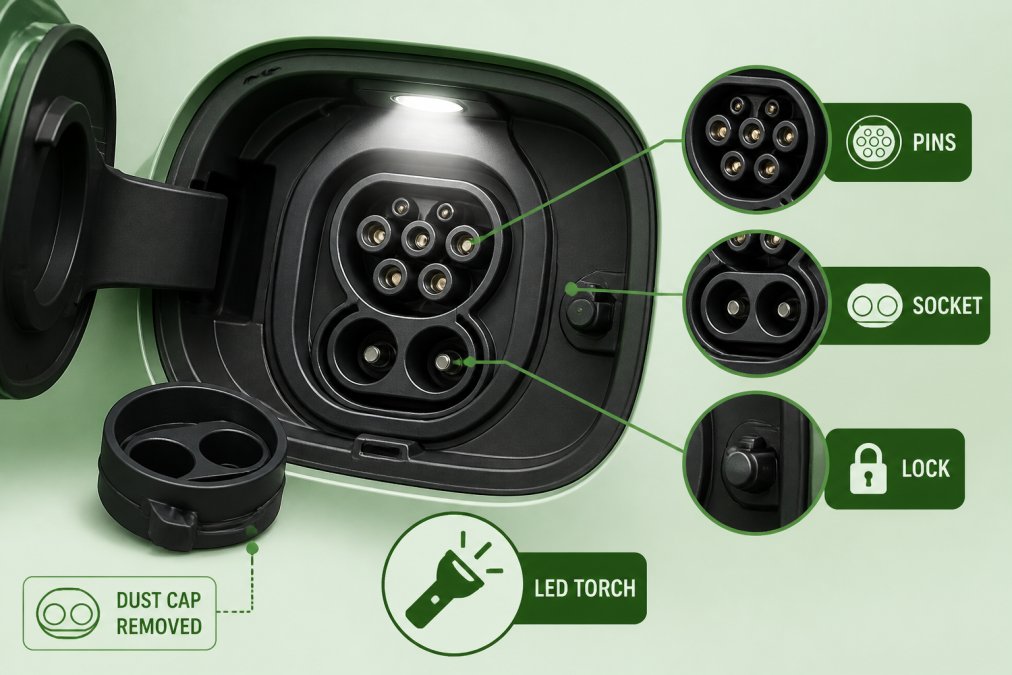
Remove the dust cap and examine the socket outlet and charging cable connector for obvious damage: cracks in the plastic housing, loose connectors, or signs the port has been forced or misaligned.
Check the locking mechanism by grasping the connector gently and trying to wiggle it side to side. If it moves more than a millimetre or two, the locking pins inside may be worn or damaged. A loose connection creates electrical resistance and heat buildup.
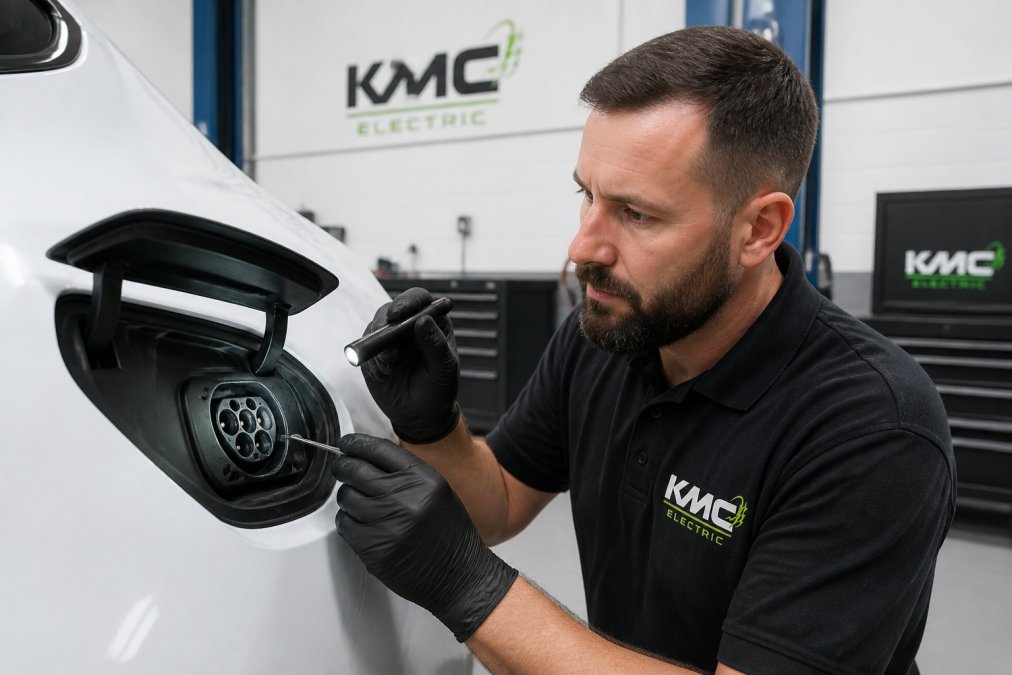
Inspect the metal pins inside the socket using a torch. They should be straight, evenly spaced, and free of visible debris. Any bent pins, missing pins, or visible corrosion indicates previous electrical faults or poor maintenance. In Kettering and across the East Midlands, we've seen corroded pins caused by moisture exposure, a common problem in vehicles parked outdoors without protective covers.
Professional illustration showing charging port inspection
Look at the cable entry point where the charging cable connects to the port housing. Cracks or separation here suggest thermal cycling damage.
Signs of cable and connector degradation
Examine the entire cable length for cuts, abrasions, or melting. The insulation should be intact and flexible, not brittle or discoloured. Discolouration, especially dark brown or black marks, suggests overheating.
Check where the cable exits the port. If the outer sheath is cracked or inner conductors are exposed, the vehicle is unsafe to charge and the cable must be replaced immediately.
Flex the cable gently near the connector. It should bend smoothly. If it's stiff or cracked, the insulation has degraded. Look for any white or blue powder residue on the connector, indicating corrosion of the metal contacts.
Watch OutIf you see exposed copper wires or melted plastic on the cable, do not attempt to charge the vehicle. This is a serious safety hazard. Have it inspected by a professional like KMC Electric before proceeding.
Common EV Charging Port Problems to Watch For
Understanding what typically fails helps you spot problems during your inspection.
Pin corrosion and contact wear
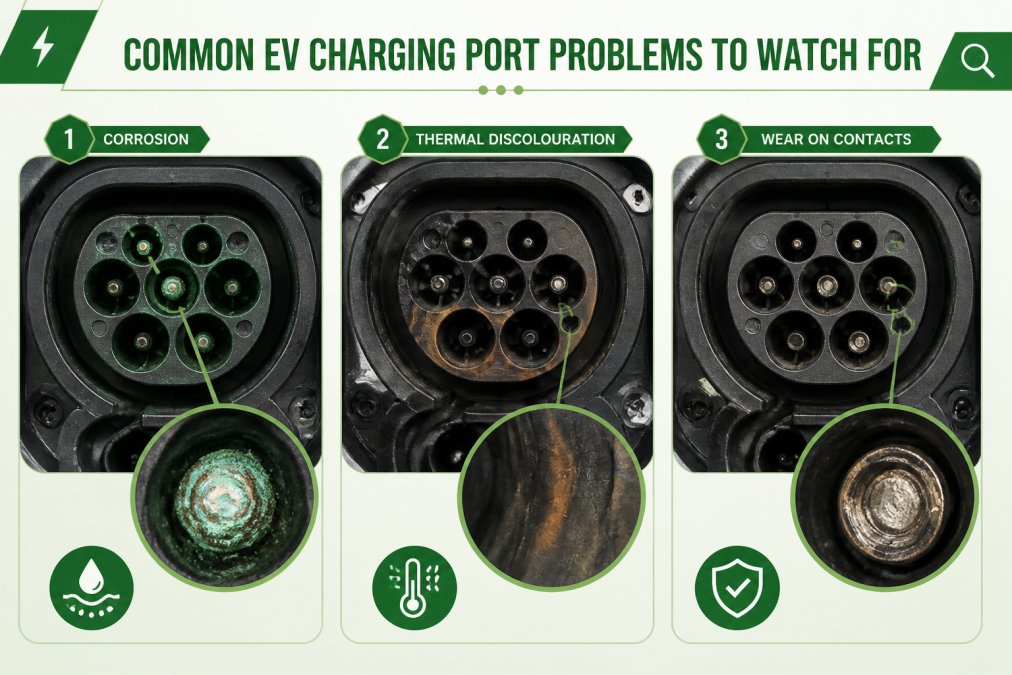
Corrosion is the enemy of electrical connections. When moisture enters the charging port through poor sealing, condensation, or water exposure, it oxidises the copper pins inside the socket. The oxidation creates a thin layer of copper oxide, which is a poor conductor of electricity.
Corroded pins increase electrical resistance at the connection point, generating heat that can melt the plastic housing or damage the cable connector. They also prevent proper electrical contact, meaning the vehicle may charge slowly or not at all. To check for corrosion, use your torch to examine each pin. Healthy pins are shiny copper or gold-plated. Corroded pins appear dull, green, white, or black.
Professional illustration showing charging port inspection
Used EV-specific port wear patterns
Rapid charging creates more thermal stress than home charging because it pushes higher currents through the port in shorter time. If a used EV has been charged frequently at rapid chargers, expect to see more discolouration and pin wear. The connector pins may show flattening or micro-scratches.
Home-charged vehicles often show less wear but may have moisture damage if parked outdoors without a protective cover. A vehicle with 100,000 miles but garaged since new may have a healthier port than one with 60,000 miles and outdoor parking.
Thermal damage and overheating signs
Heat damage is visible if you know what to look for. The plastic housing around the connector may be discoloured, darker on one side than the other, indicating uneven heat distribution. Severe overheating leaves black or brown scorch marks on the plastic.
Check the cable sheath near the connector. If it's melted, shiny, or warped, overheating has occurred. This is often caused by a loose connection or a faulty pin that forces current through a smaller contact area.
Testing the Charging System Functionality
Visual inspection reveals physical problems, but some faults only show up when you test the charging system under load.
Continuity and insulation resistance testing
Continuity testing checks whether electrical current can flow through the charging cable and connectors without interruption. You'll need a multimeter.
Set your multimeter to continuity mode. Touch one probe to a pin inside the charging port socket and the other probe to the corresponding terminal on the charging cable connector. A good connection produces a beep or shows near-zero resistance. If the multimeter shows high resistance or no beep, that pin is corroded or damaged.
Test every pin this way. A typical EV charging port has 5-7 pins, each serving a different function. All must show good continuity.
Insulation resistance testing checks whether the cable insulation is intact. Set your multimeter to resistance mode and test between the power pins and the cable sheath. A good cable shows very high resistance (typically above 10 megohms), indicating the insulation is not leaking current to ground. If resistance is low, moisture has penetrated the insulation and the cable must be replaced.
Diagnostic tool integration for fault detection
Modern EVs store diagnostic codes when charging faults occur. You can retrieve these using an OBD-II diagnostic scanner, which connects to the vehicle's onboard computer.
Plug the scanner into the OBD-II port (usually under the dashboard) and search for charging-related codes. Common codes include P0A00 series (battery or hybrid system faults), U0100 (loss of communication with the battery management system), and P06 codes (charging system faults). Fault codes don't always mean the port is damaged; they may indicate issues with the battery management system or charger control module. However, if you see charging-related codes and the vehicle has a visibly degraded port, you've identified the likely cause.
Safety Standards and Compliance (BS7671)
Electrical safety in the UK is governed by BS7671, the Building Regulations Technical Guidance, and the Electricity at Work Regulations 1989. For EV charging installations and vehicle ports, these standards establish minimum safety requirements.
Residual current device protection and grounding
A residual current device (RCD) is a safety switch that cuts power instantly if it detects a fault current. All EV charging installations in the UK must include RCD protection rated at 30 milliamps or less, according to BS7671 requirements.
The vehicle's charging port must be properly grounded (earthed) to allow fault currents to flow safely to ground rather than through a person. Check the ground pin inside the charging socket. It should be clean, undamaged, and make solid contact with the connector.
In-service inspection certification requirements
Used EVs should have documentation of in-service inspections, particularly if they've been used as fleet vehicles. An in-service inspection is a formal test of the electrical safety of the vehicle's charging system, performed by a qualified electrician.
For commercial vehicles and fleet EVs, BS7671 requires periodic in-service inspections, typically every 12 months for high-use vehicles. Ask the seller whether they have records of in-service inspections. If the vehicle was used commercially and has no inspection history, this is a red flag.
Used Electric Vehicle Pre-Purchase Inspection Checklist
Combine your visual assessment, functional testing, and safety knowledge into a structured inspection.
Step-by-step visual assessment
Examine the port housing - Look for cracks, discolouration, or loose components.
Inspect the connector pins - Use a torch to examine each pin for corrosion, bending, or missing pins.
Test the locking mechanism - Gently grasp the connector and try to move it side to side. It should be firmly seated with minimal play.
Check the charging cable - Inspect the entire length for cuts, abrasions, melting, or discolouration.
Look for moisture damage - Check inside the port for water stains, corrosion, or white residue.
Examine the cable entry point - Look where the cable exits the port housing for cracks or separation.
Inspection Point
What to Check
Pass Criteria
Action if Failed
Connector pins
Colour and alignment
Shiny, straight, no corrosion
Request professional inspection
Locking mechanism
Tightness and movement
Minimal play, connector seated firmly
Likely needs replacement
Cable insulation
Cuts, melting, discolouration
Intact, flexible, clean
Cable replacement required
Ground pin
Cleanliness and contact
Clean, undamaged, solid contact
Professional repair needed
Port housing
Cracks or damage
Intact plastic, no separation
May indicate deeper damage
Functional testing and load assessment
Test continuity - Use a multimeter to verify electrical continuity on each charging pin.
Check insulation resistance - Test between power pins and the cable sheath to confirm the insulation is intact.
Attempt a charging session - If possible, connect the vehicle to a charger and observe the charging process. The vehicle should recognise the charger and begin charging within 10 seconds.
Monitor charging rate - A typical home charger delivers 3-7 kW. A rapid charger delivers 50+ kW. If the vehicle charges significantly slower than expected, the port may be limiting power.
Run a diagnostic scan - Use an OBD-II scanner to check for charging-related fault codes.
Documentation and certification review
Request service history - Ask the seller for maintenance records. Look for notes about charging issues, port repairs, or cable replacements.
Check for in-service inspection records - If the vehicle was used commercially, ask whether it has formal in-service inspection documentation.
Verify warranty status - Confirm whether the vehicle is still under manufacturer warranty. If the charging system has a fault, warranty coverage may apply.
Ask about charging habits - Understand how the vehicle has been charged. Has it been charged exclusively at home, or frequently at public rapid chargers?
Professional vs DIY Inspection: When to Get Expert Help
A visual inspection and basic multimeter testing can be done by any owner. However, some situations require professional expertise.
Do it yourself if:
The vehicle shows no obvious damage
You have a multimeter and basic electrical knowledge
You're performing a preliminary assessment before deciding whether to pursue the purchase
The vehicle is relatively new (under 5 years old) with low mileage
Get professional help if:
You see corrosion, discolouration, or physical damage
Multimeter testing reveals poor continuity or insulation resistance
The vehicle has high mileage (over 100,000 miles) or unknown charging history
Diagnostic codes appear on the OBD-II scanner
You're purchasing a used commercial or fleet EV
You're considering a vehicle with a degraded port and want a repair estimate
KMC Electric provides independent battery health assessments and charging system diagnostics for used EVs across Kettering and Northamptonshire. A professional inspection includes detailed documentation of port condition, electrical safety testing, and a repair cost estimate.
Pro TipIf you're buying from a dealer, ask whether they've had the charging system professionally inspected. Reputable dealers will provide inspection documentation. If they haven't, that's a reason to be cautious.
Charging Port Compatibility and Repair Cost Considerations
Not all charging ports are the same, and compatibility issues can be expensive to resolve.
Connector type compatibility issues
The UK has standardised on the Type 2 connector for AC charging and the CCS (Combined Charging System) for DC rapid charging. Most EVs sold in the UK since 2015 use these connectors.
However, some older vehicles or imports use different standards: Tesla Supercharger connector (proprietary to Tesla; requires an adapter for other chargers), CHAdeMO (used by some Japanese EVs; largely phased out in the UK), or Type 1 (older standard; rare in modern UK vehicles).
If you're buying a used EV with a non-standard connector, verify that compatible chargers are available in your area. Connector type also affects repair costs. If the port needs replacement, a Type 2 port may cost less than a Tesla Supercharger connector because Type 2 components are more widely available.
Repair cost estimates and replacement options
A damaged charging port can be repaired or replaced depending on the severity of the fault. Minor repairs such as cleaning corroded pins or replacing a damaged cable connector can be done by a specialist garage. Port replacement is required if the socket outlet is cracked or the locking mechanism is broken, requiring access to the vehicle's electrical system. If the charging cable is damaged beyond repair, a replacement cable may be needed.
For used EVs with visible port damage, always ask for a repair estimate before committing to purchase. KMC Electric can provide detailed cost estimates after a professional inspection, giving you the information needed to negotiate with the seller or decide whether the vehicle is worth the investment.
A thorough used electric car charging port inspection is one of the most practical investments you can make before buying a used EV. The few hours you spend checking the port visually, testing it with a multimeter, and reviewing the vehicle's charging history can save you hundreds or thousands of pounds in unexpected repairs. If you're buying a used EV in Kettering, Northamptonshire, or the East Midlands and want professional guidance, KMC Electric offers independent battery health verification and charging system diagnostics. With over 25 years of automotive experience and Level 4 Master Technician status in electric vehicles since 2016, the team provides transparent, cost-effective assessments that identify potential faults before they become expensive problems. Contact KMC Electric for a pre-purchase inspection and get the confidence to buy the right used EV.
Frequently Asked Questions
What are the most common signs of damage in a used EV charging port?
Look for pin corrosion (green or white deposits on connector pins), exposed wires, discolouration from thermal damage, loose or cracked plastic housings, and wear marks inside the socket outlet. These indicate the charging system has experienced stress or improper use. A faulty connection here can degrade charging speed and damage the vehicle's battery over time, making early detection critical when buying used.
How does a used electric vehicle pre-purchase inspection checklist help protect my investment?
A thorough checklist identifies physical integrity issues, tests continuity and insulation resistance, verifies locking mechanism function, and confirms BS7671 safety compliance before you commit to purchase. This prevents buying a vehicle with hidden charging system faults that could cost hundreds to repair. Independent verification of port condition and battery health gives you negotiation leverage and peace of mind that the vehicle is safe to own.
Do I need professional diagnostic testing or can I inspect the charging port myself?
Visual inspection you can do: check for corrosion, damage, and wear. However, functional testing requires specialist equipment like insulation resistance testers and load testing tools. For used EVs, professional in-service inspection is strongly recommended because it certifies safety compliance and identifies faults diagnostic tools can catch before they become expensive battery-related repairs. KMC Electric offers independent charging system diagnostics for buyers in the East Midlands.
What should I do if I discover charging port problems during my pre-purchase inspection?
Document all findings with photographs and diagnostic reports. Minor wear (slight surface marks) may be acceptable; corrosion, exposed wires, or failed continuity tests are serious red flags. Use your inspection results to negotiate a price reduction, request the seller repair it before sale, or walk away if costs seem high. Repair estimates depend on whether the connector, cable, or internal port components need replacement—get a quote from an independent specialist before finalising your offer.