Installing a Tesla charging station at home transforms your EV ownership experience, offering overnight charging convenience without relying on public networks. The process requires planning, electrical assessment, and compliance with UK building standards. You're integrating a significant electrical load into your home's infrastructure, which means understanding your current capacity, assessing safety requirements, and navigating regulatory approvals.
The decision between Wall Connector, 240V outlet installation, or retrofit scenarios depends on your electrical panel capacity, usage patterns, and long-term needs.
Electrical Requirements and Safety for Tesla Wall Connector Installation
Your home's electrical infrastructure determines what charging solutions are feasible. Before selecting any charger, you need to understand three core concepts: your available amperage, circuit breaker requirements, and cable gauge specifications that ensure safe power delivery.
Circuit breaker and amperage considerations
A Tesla Wall Connector typically requires a dedicated 240V circuit with a 40-60 amp circuit breaker. The Wall Connector can deliver up to 11.5 kW on a 60-amp circuit, roughly 48 miles of range per hour for a Model 3. However, not every home's electrical panel has spare capacity for this load.
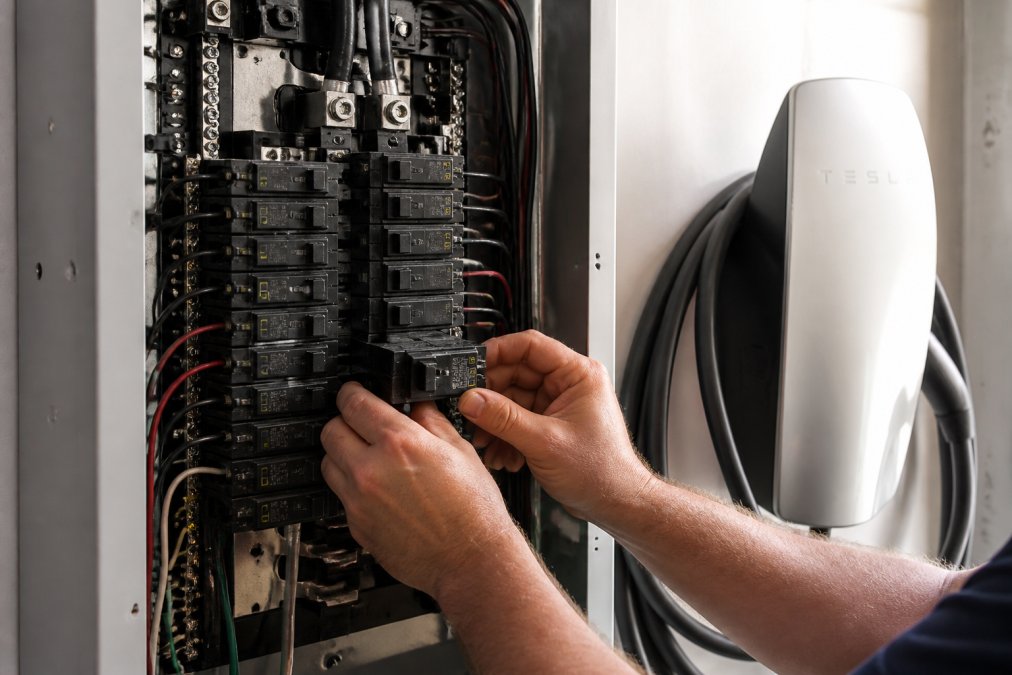
Your main electrical panel has a total amperage rating, typically 60, 100, or 200 amps for residential properties. If your home already draws significant power during peak usage, adding a 60-amp charger circuit may exceed safe limits. A load calculation is essential, an electrician assesses your peak demand across all circuits and determines whether your panel can safely accommodate the charging load or requires upgrading.
Common mistakes include assuming panel capacity without verification or choosing a lower amperage circuit to avoid upgrades. A 30-amp circuit delivers only 7 kW, charging much more slowly and often not justifying installation costs.
Professional illustration showing Professional, Tesla Wall Connector for Tesla charging station installation
Voltage drop and cable gauge specifications
Distance matters significantly. If your garage is 50 metres from your main electrical panel, voltage drop becomes a real concern. Voltage drop occurs when electrical resistance in long cable runs reduces the voltage reaching your charger, cutting charging efficiency and speed.
UK electrical code specifies that voltage drop should not exceed 3% for branch circuits. For a 240V supply, that's a 7.2V maximum loss. To maintain this standard over longer distances, you need thicker cable, typically 6 gauge or larger for Tesla installations beyond 30 metres. Professional assessment of your specific installation site ensures cable specifications match your actual installation distance and load requirements. KMC Electric recommends getting a site survey before purchasing equipment.
EV Charger Installation Regulations in the UK
The UK regulatory framework for EV charger installation involves building regulations, electrical code compliance, and in some cases, local planning approval.
Permits and planning permission requirements
Most residential EV charger installations in Kettering and Northamptonshire don't require formal planning permission. However, if your property is listed, in a conservation area, or if the charger installation significantly alters your building's appearance, consult your local planning authority beforehand.
More importantly, you need Building Regulations approval. The Building Regulations 2010 (as amended) require that any new electrical installation meets current safety standards. Your installation must be certified by a qualified electrician registered with a competent person scheme such as NICEIC, ELECSA, or NAPIT. These schemes ensure compliance with BS 7671 (the UK standard for electrical installations).
The certification process protects you and future buyers. When selling your home, buyers' surveyors and mortgage lenders will ask for Building Regulations sign-off or NICEIC certification. Without it, you may face difficulty selling or refinancing.
Building regulations and electrical code compliance
BS 7671 (Requirements for Electrical Installations) sets the standard for all electrical work in the UK. For EV charger installation, this means:
Your charger must have an RCD (Residual Current Device) protecting the circuit, cutting power instantly if a fault occurs
The installation must include proper grounding and bonding to protect against faults
Cable must be installed in conduit or trunking to prevent damage
The charger must be installed according to manufacturer specifications and local electrical code
These requirements exist because electrical faults can cause fires or fatal shocks. A properly installed Tesla Wall Connector with correct RCD protection, grounding, and cable management is safe for decades. KMC Electric emphasises that compliance is the foundation of safe charging infrastructure.
Choosing the Right Charging Equipment
Your charging equipment choice shapes your daily ownership experience. The main decision is between a Tesla Wall Connector (hardwired installation) and a 240V outlet-based solution.
Wall connector versus 240V outlet options
A Tesla Wall Connector is purpose-built for Tesla vehicles, delivering up to 11.5 kW on a 60-amp circuit and charging a Model 3 from empty to full in roughly 8-10 hours. It's weather-resistant and communicates directly with your vehicle to manage charging safely.
The alternative is installing a 32-amp three-phase outlet and using a portable Tesla charging adapter. This costs less upfront but limits charging speed and requires manual setup each time. For most owners, the Wall Connector is the better long-term choice, offering faster charging and integration with smart features.
Smart charging and load management features
Modern EV chargers can communicate with your home's electrical system and adjust charging speed based on available power. Smart charging allows your charger to reduce its draw during peak household usage, then resume full-speed charging during off-peak periods. Some chargers integrate with time-of-use electricity rates, automatically charging during cheaper hours, or communicate with solar inverters to prioritise charging when your home generates excess power.
Load management is especially valuable in older homes with limited electrical infrastructure. Rather than upgrading your entire panel, load management allows a smaller circuit to deliver adequate charging by spreading the load intelligently across your home's usage patterns.
OZEV Grant for EV Chargers: Funding Your Installation
The Office for Zero Emission Vehicles (OZEV) grant scheme closed to new applications in March 2022. However, some energy suppliers and local councils in Northamptonshire offer grants or subsidies for EV infrastructure. If you're installing solar panels alongside your charger, you may be eligible for the Smart Export Guarantee (SEG), which pays you for excess solar power exported to the grid, effectively reducing charging costs.
Check with your local authority and energy supplier for current schemes. The financial landscape changes regularly, so confirming current availability before proceeding with installation planning is essential.
Installation Process and Finding a Certified Electrician
The installation follows a logical sequence once you've confirmed electrical capacity and regulatory requirements.
Assessing your electrical panel capacity
A qualified electrician visits your home, evaluates your main electrical panel, reviews your current load, and calculates available capacity. They measure the distance from your panel to the proposed charger location, assess existing conduit or cable routing, and identify obstacles affecting installation complexity.
This assessment determines whether a straightforward installation is possible or whether panel upgrades are necessary. If your panel is at capacity, upgrading to higher amperage service is a significant undertaking involving your DNO (Distribution Network Operator), potentially adding weeks to your timeline.
Hardwired installation versus retrofit options
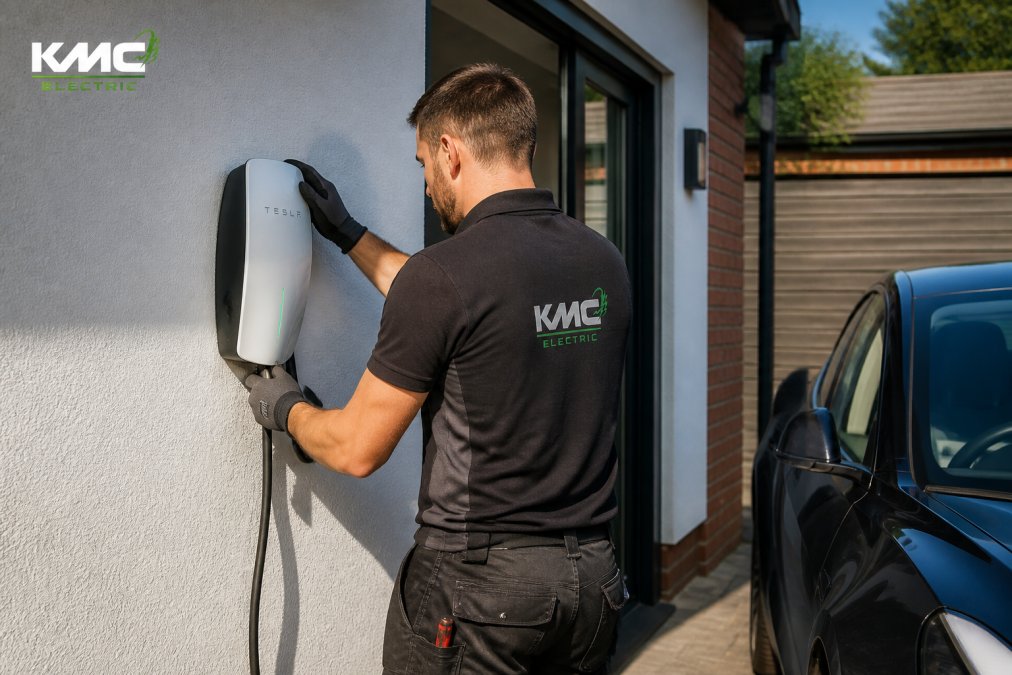
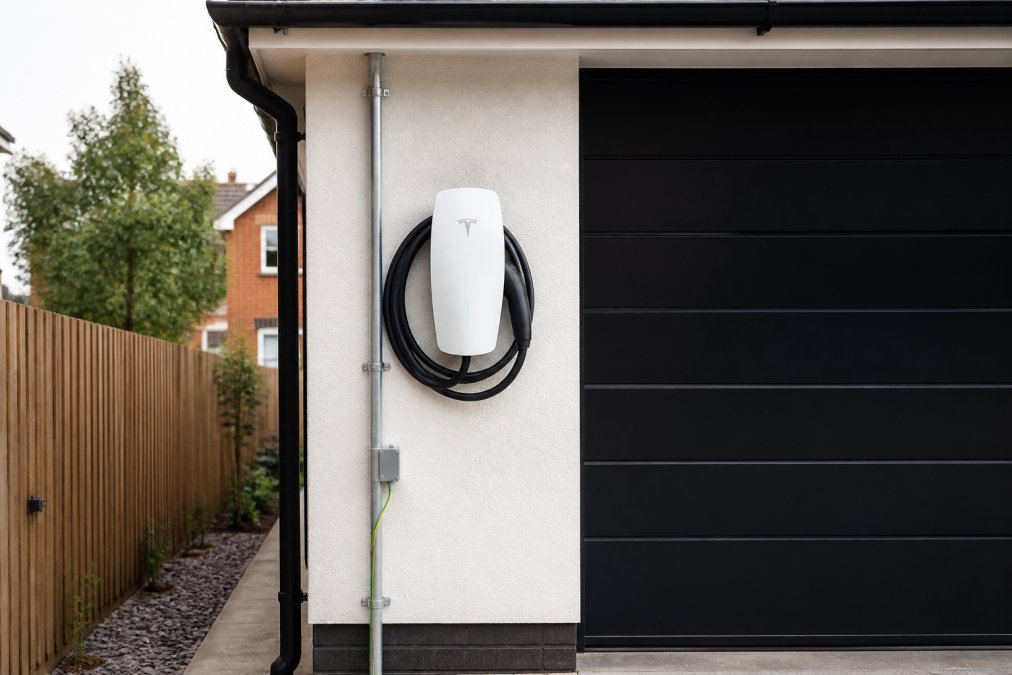
A hardwired installation means the charger is permanently connected to your electrical circuit, the preferred approach for most homes. The electrician runs cable from your panel through conduit to the charger location, installs a dedicated circuit breaker, and mounts the Wall Connector on your garage or external wall.
A retrofit installation applies to homes where running new conduit is impractical, perhaps due to listed building status or structural constraints. Retrofit solutions are more expensive and often less aesthetically clean, but sometimes necessary. KMC Electric has worked with Tesla owners across Kettering and Northamptonshire on both approaches, finding that early consultation prevents costly surprises.
Professional illustration showing Completed Tesla Wall Connector for Tesla charging station installation
What to expect during installation
A straightforward hardwired installation typically takes one to two days. The electrician installs the circuit breaker, runs cable through conduit, installs grounding and bonding connections, mounts the Wall Connector, tests the installation, and arranges Building Regulations sign-off or NICEIC certification.
During installation, expect disruption as your electrician accesses lofts, under-floor spaces, or external walls. Once complete, you'll receive a certificate of installation to keep for your records and provide to future buyers or mortgage lenders.
Finding the right certified electrician is crucial. Look for NICEIC, ELECSA, or NAPIT registration and ask for references from previous EV charger installations. KMC Electric can recommend qualified installers or discuss your specific installation requirements if you need technical guidance.
Charging Speeds, Performance, and Long-Term Maintenance
Once your charger is installed, understanding how it performs and maintaining it properly ensures years of reliable operation.
Understanding kilowatt hour delivery and charging efficiency
A Tesla Wall Connector on a 60-amp circuit delivers approximately 11.5 kW of power, translating to roughly 48 miles of range per hour for a Model 3, or about 300 miles overnight. Real-world charging speed varies based on battery temperature, ambient conditions, and charger efficiency.
A well-installed system with properly sized cable and quality charger typically achieves 90-95% efficiency. Monitoring your charging behaviour helps optimise efficiency. Charging during off-peak hours reduces grid strain and often costs less. Keeping your battery between 20% and 80% charge extends long-term battery health.
Safety testing and maintenance for residential infrastructure
Your charging installation requires annual visual inspection to ensure cables aren't damaged, connections remain tight, and the charger shows no signs of weathering or electrical stress. Every five years, a qualified electrician should perform a formal electrical safety test (an EICR, Electrical Installation Condition Report).
KMC Electric recommends keeping records of your installation certificate, maintenance performed, and safety test results. For Tesla owners in Northamptonshire considering diagnostics or battery health assessments, having a complete installation history helps technicians rule out electrical causes.
Installing a Tesla charging station transforms your EV ownership, but the process requires understanding electrical capacity, regulatory compliance, and equipment selection. For Tesla owners in Kettering and Northamptonshire seeking professional guidance on installation planning or post-installation diagnostics, KMC Electric offers independent technical expertise with over 25 years of automotive experience and Level 4 Master Technician status in electric vehicles since 2016. Whether you're planning a new installation, assessing an existing charger's performance, or diagnosing charging-related faults, our team provides practical, transparent advice tailored to your specific situation. Contact KMC Electric for a site assessment or technical consultation.
Frequently Asked Questions
What are the electrical requirements for a Tesla Wall Connector?
A Tesla Wall Connector typically requires a dedicated 240V circuit with appropriate amperage (usually 40-60 amps depending on your model). You'll need 6 gauge wire or larger, a compatible circuit breaker, and proper grounding. A certified electrician must assess your electrical panel to ensure it has sufficient capacity for the additional load. Voltage drop calculations are essential for installations more than 30 metres from your panel to maintain charging efficiency and safety.
Do I need planning permission for a home EV charger in the UK?
Most residential EV charger installations don't require planning permission under permitted development rights, provided they're installed on your property and don't exceed certain size limits. However, you will need Building Regulations approval and must comply with electrical code standards. If your property is listed or in a conservation area, check with your local council. Installation must also meet EV charger installation regulations UK that govern safety and electrical compliance.
Can I claim the OZEV grant for EV chargers on my home installation?
The OZEV grant for EV chargers provides funding for eligible home charging installations. To qualify, your property must not already have a publicly available charger nearby, and the installation must be completed by an approved installer. Funding covers equipment and installation costs up to a set limit. Check the current OZEV scheme eligibility criteria and approved installer list on the government website, as terms and funding amounts can change. Your installer should be able to guide you through the application process.
How long does Tesla charging station installation take?
A typical Tesla Wall Connector installation takes 1-2 days, depending on your existing electrical infrastructure. If your electrical panel requires upgrades or the installation distance is significant, the project may take longer. Once the hardwired installation is complete, configuration and safety testing add a few hours. The total timeline also depends on permit approval times, which vary by local authority. A certified electrician can provide a more precise estimate after assessing your home's electrical setup.