Is My Tesla Battery Failing? Key Warning Signs to Know
Asking yourself "is my tesla battery failing" is more common than you might think. At KMC Electric, we work with Tesla owners across Kettering, Northamptonshire and beyond who arrive convinced their battery is dying, only to discover the issue is something far more specific and fixable. Distinguishing genuine failure from normal degradation or a calibration quirk requires a structured approach.
Battery degradation is the gradual, expected reduction in capacity over time and charge cycles. Battery failure is sudden, abnormal loss of function. Most owners conflate the two, leading to expensive decisions made on incomplete information.
Below, we cover every diagnostic step: reading warning signs and error codes, running your own checks with tools like Scan My Tesla, understanding your warranty, and what realistic replacement costs look like out of warranty.
Close-up of a Tesla touchscreen dashboard displaying a battery warning alert or reduced range notification, illuminated in a dimly lit car interior with the driver's hands visible on the steering wheel
Sudden Range Loss vs Gradual Degradation: What Is the Difference?
Gradual capacity loss is normal. Sudden range loss is not. If your estimated range drops significantly overnight, or battery percentage falls faster than usual during a single journey, that points to an acute issue rather than normal ageing. Common causes include:
A cell fault causing voltage imbalance
Moisture ingress affecting the battery management system
Thermal management issues preventing cells from operating in their optimal temperature window
A software miscalibration misreading the state of health (SOH)
The practical test: track your range reading at 100% charge over four to six weeks. A sharp drop in days is not normal. Gradual decline over months is.
Charging Performance Issues and Reduced Supercharging Speed
A healthy Tesla battery charges at or near its rated supercharging speed. When cells degrade unevenly, the battery management system throttles charging to protect weaker cells. Watch for:
Charging speed peaking lower than your model's rated maximum and dropping off earlier
The car refusing to charge above 80-90% without explanation
Noticeably longer sessions to reach the same state of charge as previously
Reduced regenerative braking is another overlooked signal. If the car is limiting regen, the BMS has detected a condition making it unsafe or inefficient. According to Tesla's official support documentation on charging and range, battery temperature, state of charge, and cell condition all influence regenerative braking availability.
Common Error Codes and What They Mean
Error codes are the battery management system's way of flagging a problem before it becomes a breakdown. Understanding them is the difference between a planned repair and an unexpected breakdown on the A14.
BMS_u029 and Other Battery Management System Alerts
BMS_u029 is the error code most commonly associated with Tesla battery concerns. The BMS monitors individual cell voltages, temperatures, and state of charge across the entire pack. BMS_u029 typically indicates a communication fault or out-of-range reading from one or more cell groups.
This does not automatically mean pack replacement is imminent. BMS_u029 can be triggered by:
A single underperforming cell group pulling overall voltage out of balance
A wiring or connector fault within the high-voltage battery assembly
A software glitch requiring a reset or update
Genuine cell degradation crossing a threshold the BMS flags as unsafe
A BMS fault code is a starting point for diagnosis, not a verdict. Many owners have been quoted for pack replacement based on this code alone when the actual fix was far less invasive.
Watch OutNever ignore a BMS_u029 alert and continue driving without investigation. In rare cases, unaddressed cell faults can escalate to thermal management failures. Have the code read by an EV repair specialist before assuming the worst.
Voltage Imbalance, Cell Faults, and Moisture Ingress Warnings
Voltage imbalance warnings appear when individual cell groups diverge too far from each other. A healthy pack maintains tight voltage consistency. When one group lags, the BMS restricts the entire pack's usable capacity to protect the weakest cells, which is why you can see significant range reduction even when most of the pack is healthy.
Cell faults are distinct from imbalance: they indicate one or more cells have failed outright rather than simply underperformed, requiring professional assessment to determine whether the affected module can be isolated or a full pack replacement is necessary.
Moisture ingress is a serious but less discussed failure mode. Water entering the battery enclosure causes corrosion of high-voltage connectors and accelerates cell degradation. Tesla packs are sealed, but physical damage, poorly executed previous repairs, or manufacturing defects can compromise that seal.
How to Check Tesla Battery Health
Checking Tesla battery health involves two approaches: tools you can use yourself and professional diagnostic testing that goes deeper into the pack's condition.
DIY Tools: OBD-II Adapters and Scan My Tesla
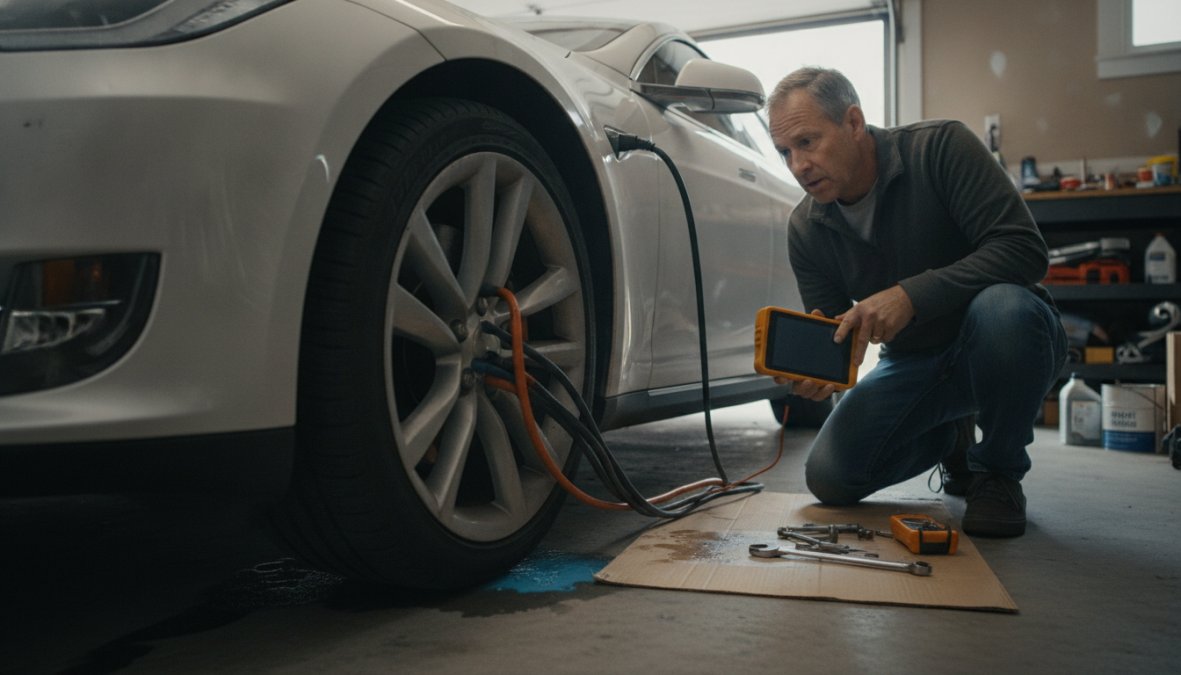
An OBD-II adapter plugs into the diagnostic port and communicates with the car's systems via Bluetooth or Wi-Fi. Scan My Tesla is the most widely used application, reading battery-specific parameters the Tesla app does not surface, including SOH, individual cell group voltages, charge cycle count, and BMS fault history.
To run a basic battery health check:
Purchase a compatible OBD-II adapter (ensure it supports Tesla's CAN bus protocol)
Plug the adapter into the OBD-II port beneath the dashboard
Connect to your phone via the Scan My Tesla app
Navigate to the battery section and allow the app to read live data
Note the SOH percentage and compare it against expected values for your model year and mileage
Check for any stored fault codes in the BMS section
A SOH reading above 85-90% for a car with moderate mileage is generally healthy. Readings below 80% on a relatively young vehicle warrant further investigation.
A technician in a clean automotive workshop connecting a diagnostic OBD-II adapter to a Tesla vehicle's port, with a laptop open on a nearby workbench showing EV diagnostic software and battery cell data on screen, workshop lighting overhead
Pro TipRun your Scan My Tesla check after a full charge and before driving. Cell voltages are most stable at rest, giving a more accurate SOH reading than immediately after a long motorway run.
Professional Diagnostic Testing: What an EV Repair Specialist Checks
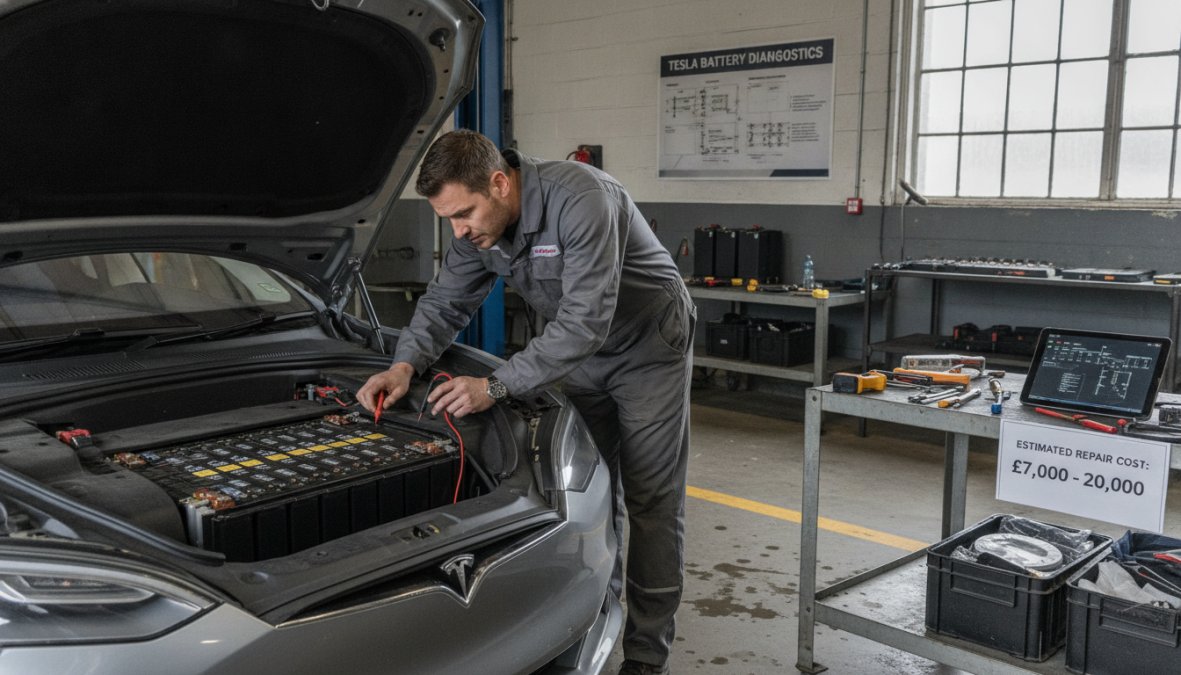
DIY tools give a useful snapshot, but professional testing goes considerably further. At KMC Electric, with Level 4 Master Technician status in electric vehicles and EV qualifications dating back to 2016, a professional battery health test covers:
Full cell group voltage mapping across the entire pack
Thermal management system performance under load
High-voltage insulation resistance testing
Physical inspection for moisture ingress or impact damage
Comparison of current SOH against production-year baseline values
This is particularly valuable before a warranty claim, before purchasing a used Tesla, or when a DIY tool has flagged an anomaly you cannot interpret confidently. According to the Society of Motor Manufacturers and Traders guidance on EV battery health, independent verification of battery condition is increasingly important as the used EV market grows.
Battery Health vs BMS Calibration: Are You Diagnosing the Right Problem?
A poor SOH reading does not always mean the battery is physically degraded. Sometimes the BMS has simply lost accurate calibration of the pack's true capacity, and the displayed range or SOH figure is pessimistic rather than accurate.
BMS calibration drift happens when a Tesla is regularly charged to partial levels without completing full charge cycles, or left in a low state of charge for extended periods. The fix is straightforward: charge to 100%, drive down below 10%, then charge back to 100% without interruption. Repeat two or three times. Many owners have seen their displayed range improve noticeably after this process, without any physical repair.
Genuine battery degradation does not improve with calibration cycles. If SOH remains low after recalibration, the capacity loss is real. This distinction matters enormously before committing to a pack replacement conversation.
Key TakeawayAlways attempt a BMS recalibration cycle before concluding that your Tesla has genuine capacity loss. A calibration issue costs nothing to fix. Misdiagnosing it as pack failure could cost thousands.
Tesla Battery Warranty Terms and What They Actually Cover
Tesla covers the battery pack against defects in materials and workmanship and against capacity loss below a defined threshold, for most models, around 70% of original capacity within the warranty period. The warranty does not cover gradual degradation above that threshold, meaning a battery that has lost 25% of its capacity but sits just above the 70% floor is not covered for replacement.
Warranty Limitations and What to Do Before It Expires
The 70% capacity threshold is the detail that catches most owners out. This is why independent battery health verification before the warranty expires is so valuable.
Key steps to take before your Tesla warranty runs out:
Commission an independent SOH test to establish a documented baseline
If the reading is close to the 70% threshold, request a formal assessment from a Tesla Service Centre while still in warranty
Keep records of any BMS fault codes, charging anomalies, or range reduction incidents as supporting evidence
Check the battery pack label for your specific model's warranty end date and mileage cap
As documented in Which? guidance on EV battery warranties and consumer rights, UK consumers retain rights under the Consumer Rights Act even after the manufacturer warranty expires in some circumstances, particularly where a fault was present but undetected during the warranty period.
Tesla Battery Replacement Cost: What to Expect Out of Warranty
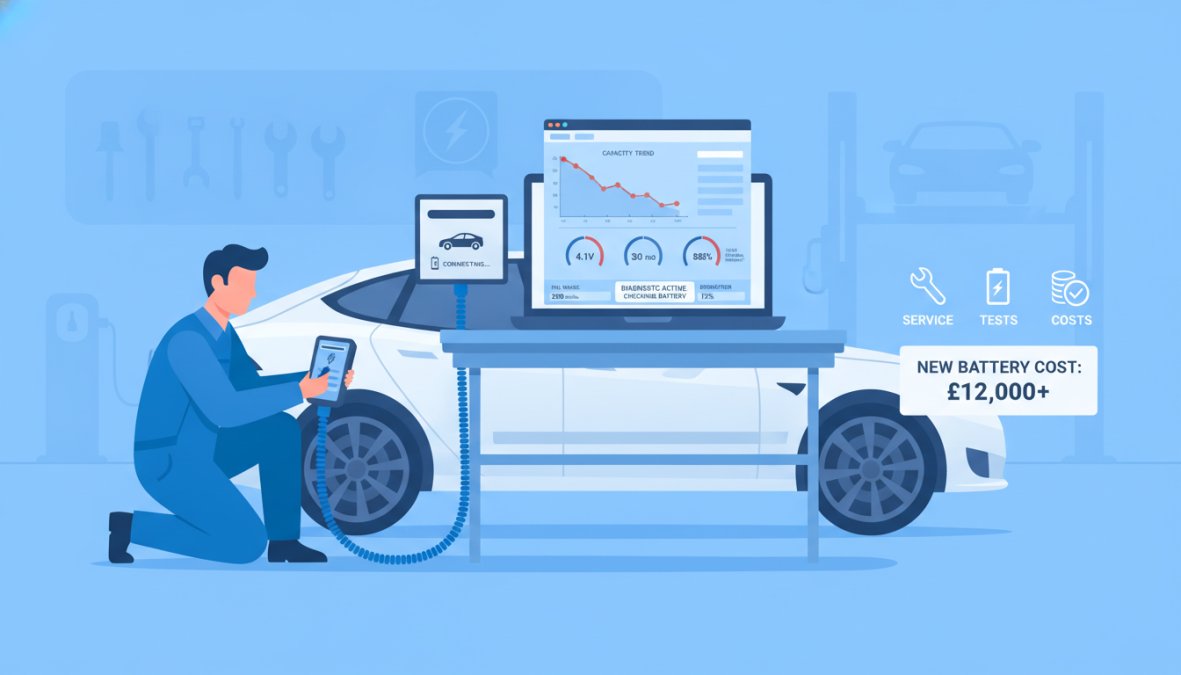
Out-of-warranty battery replacement is substantial. A full pack replacement through a Tesla Service Centre typically runs into several thousand pounds, depending on the model, year, and whether the pack is new or refurbished. The cost includes the replacement pack, significant labour for removal and installation, and ancillary components such as the pyro fuse.
The pyro fuse protects the high-voltage circuit in the event of a severe impact. Many specialists recommend replacing it whenever the battery pack is accessed. A replacement pyro fuse for Tesla models is available directly from KMC Electric at £39.99, a fraction of main dealer pricing.
Independent Specialist vs Tesla Service Centre: Cost Comparison
Independent specialists can offer meaningful cost savings on out-of-warranty battery work, but quality matters enormously. Not all independent garages have the tooling, training, or high-voltage safety certification to work safely on Tesla battery packs.
Factor
Tesla Service Centre
Independent EV Specialist
Pack replacement cost
Higher (OEM pricing)
Lower (refurb/third-party options)
Labour rate
Premium
Typically lower
Diagnostic depth
Standard Tesla tooling
Varies by specialist
Warranty on repair
Tesla-backed
Specialist-dependent
Turnaround time
Can be lengthy
Often faster
High-voltage certification
Yes
Verify before booking
The key question to ask any independent specialist is whether they hold Level 4 Master Technician status or equivalent high-voltage EV certification. According to the Institute of the Motor Industry's EV technician accreditation framework, Level 4 EV qualification is the benchmark for safe, competent work on high-voltage battery systems.
Is My Tesla Battery Failing or Just Ageing Normally?
Normal ageing looks like this: gradual reduction in maximum range over years of use, slightly slower supercharging at higher states of charge, and a SOH reading that declines incrementally. All lithium-ion batteries age this way.
Battery failure looks different: sudden sharp range loss, persistent BMS fault codes, charging that stops mid-session, thermal warnings during normal driving, or a SOH reading that has dropped dramatically over a short period.
A practical self-assessment checklist:
Has your range dropped suddenly rather than gradually?
Are you seeing persistent BMS error codes?
Has your Supercharging speed dropped significantly?
Is regenerative braking being limited unexpectedly?
Has your SOH reading fallen below 80% on a car under five years old?
Have you attempted a BMS recalibration cycle without improvement?
If you answered yes to three or more, professional diagnostic testing is the right next step. If only one or two, recalibration and monitoring are reasonable first moves before committing to a repair.
A Tesla battery is one of the most durable components in the vehicle when treated correctly. Consistent charging habits, sensible Supercharger use, and periodic health checks go a long way toward extending pack life well beyond the warranty period.
Uncertainty about your Tesla's battery condition is a reasonable concern, particularly as vehicles age past their warranty period. KMC Electric, based in Kettering, Northamptonshire, offers professional battery diagnostic testing, independent SOH verification, and out-of-warranty repair for Tesla owners who want a transparent, technically credible alternative to main dealer pricing. With over 25 years of automotive experience and Level 4 Master Technician status in electric vehicles since 2016, the team provides the depth of assessment needed to make confident decisions. Submit your vehicle details to KMC Electric and get a clear picture of your battery's true condition.
Frequently Asked Questions
What are the signs of a failing Tesla battery?
Key signs include a noticeable drop in real-world range, reduced regenerative braking performance, slower charging speeds at a Supercharger, unexpected shutdowns, and dashboard warnings such as BMS_u029. If your Tesla is losing range far faster than typical lithium-ion degradation would suggest, or if you are seeing repeated battery management system alerts, it is worth having a diagnostic test carried out by an EV repair specialist as soon as possible.
How do I check my Tesla battery health?
You can get a basic state of health (SOH) reading using a compatible OBD-II adapter paired with an app such as Scan My Tesla, which reads high-voltage battery data including cell voltages and capacity. For a more thorough battery health test, an independent EV specialist can carry out a full diagnostic, checking for cell faults, voltage imbalance, and thermal management issues that DIY tools may not surface. A professional assessment is especially important before a warranty claim or a vehicle purchase.
Does Tesla battery degradation mean it is failing?
Not necessarily. Some capacity loss is normal across all lithium-ion battery packs and does not mean the battery is failing. Gradual degradation of around 10-15% over many years and high mileage is considered typical. However, sudden range loss, repeated error codes, or a state of health figure significantly below expected levels for the vehicle's production year and mileage can indicate a genuine fault rather than normal wear. A diagnostic test helps distinguish between the two.
What is the warranty on a Tesla battery?
Tesla battery warranty terms vary by model and production year, but generally cover the high-voltage battery pack for eight years or a set mileage limit, whichever comes first. The warranty also guarantees a minimum battery retention level, typically around 70% of original capacity. Importantly, the warranty does not cover all forms of degradation, and some cell faults or moisture ingress issues may be disputed. Having an independent battery health verification carried out before your warranty period expires is strongly advisable.
Can a Tesla battery be repaired, or does it need full replacement?
In some cases, faults such as a BMS calibration issue, a faulty pyro fuse, or a minor cell imbalance can be resolved without a full pack replacement, which significantly reduces cost. However, widespread cell faults, severe moisture ingress, or critical thermal management failures are more likely to require a pack replacement. An independent EV specialist can advise on whether repair or replacement is the most cost-effective route for your specific vehicle and fault type.
How much does a Tesla battery replacement cost in the UK?
Tesla battery replacement cost in the UK varies depending on the model and whether the work is carried out at a Tesla Service Centre or an independent EV specialist. Out-of-warranty replacements can run into several thousand pounds for a full pack. Independent specialists typically offer more competitive pricing than main dealer networks while using equivalent parts and diagnostic procedures. Getting an independent assessment first can confirm whether a full replacement is truly necessary or whether a more targeted repair will resolve the fault.