The benefits of professional EV battery health checks extend far beyond a simple pass-or-fail verdict on your battery pack. At KMC Electric, we work with Tesla owners and other EV drivers across Kettering and the wider Northamptonshire area every week, and the gap between what a DIY check reveals and what a professional diagnostic uncovers is consistently striking. Below, we'll show you exactly how professional diagnostics protect your investment, what degradation factors actually matter, and why the used EV market in 2026 demands independent verification before any transaction.
Here's what most guides get wrong: they treat battery health as a binary question. It isn't. State of Health (SOH) is a spectrum, and the difference between an 88% SOH and a 76% SOH can represent thousands of pounds in resale value and years of usable range.
Why Professional EV Battery Health Checks Matter More Than You Think
Professional EV battery health checks are the most reliable method for establishing the true condition of a lithium-ion traction battery, going well beyond the basic range estimates your vehicle's dashboard provides. A professional diagnostic interrogates the battery management system (BMS) directly, pulling VIN-level data that reflects actual charge cycles, thermal events, and capacity loss over time.
Most EV owners assume their car's built-in battery indicator tells the full story. It doesn't. The onboard display shows estimated usable range based on recent driving patterns, not a calibrated measurement of the battery pack's remaining capacity against its original specification. That distinction matters enormously when you're buying, selling, or planning a long-distance journey.
The throughline here is trust. Professional diagnostics generate a written diagnostic report with specific SOH percentages, cell-level voltage data, and degradation rate trends. That report is something you can act on, negotiate with, and in some cases, use to support a warranty claim.
What Is State of Health (SOH) and Why It Defines Your EV's Value
State of Health (SOH) is a percentage measurement that expresses a battery pack's current energy capacity relative to its original rated capacity when new. An EV with a 100 kWh battery that now delivers 88 kWh of usable energy has an SOH of 88%.
SOH is the single most important number in any EV transaction. A battery with 85% SOH on a long-range Tesla Model 3 still delivers strong real-world range. Below 70%, range anxiety becomes a genuine daily concern, and battery replacement costs can outweigh the vehicle's remaining value. Professional diagnostics give you that number precisely, not approximately.
Key TakeawaySOH below 70% on most EV platforms represents a significant financial risk. Without a professional diagnostic report, neither buyer nor seller has a defensible figure to negotiate around.
DIY Checks vs. Professional Diagnostics: Where the Gap Really Lies
A DIY check using an OBDII scanner and a compatible app can surface some useful data. You'll see estimated SOH, basic voltage readings, and charge cycle counts. For a quick sanity check, that's fine.
The gap becomes critical in three areas. First, consumer-grade OBDII tools cannot access manufacturer-specific BMS protocols on many EVs, including most Tesla models, which use proprietary communication systems that require specialist diagnostic software. Second, DIY tools cannot flag subtle cell-level imbalances that precede accelerated degradation. Third, they produce no verifiable documentation. A screenshot from a phone app carries zero weight in a resale negotiation or a warranty dispute.
Professional diagnostics, by contrast, access high-voltage system data at the cell group level, log thermal management performance, and produce a timestamped, signed report. That's the difference between an opinion and evidence.
Key EV Battery Degradation Factors Every Owner Should Understand
Understanding EV battery degradation factors is essential for any owner who wants to extend their vehicle's service life and maintain resale value. Lithium-ion battery packs degrade through a combination of electrochemical ageing, thermal stress, and charge cycle accumulation, and not all of these factors are within the driver's control.
The most common mistake owners make is treating all degradation as inevitable and equal. It isn't. Degradation rate varies significantly depending on how the vehicle is charged, where it's stored, and how hard the battery is driven under load.
How Charging Habits and DC Fast Charging Accelerate Capacity Loss
DC fast charging is the most convenient way to top up on a long journey, but frequent reliance on high-power chargers accelerates lithium-ion battery degradation more than almost any other single factor. The high current throughput generates heat inside the battery pack, and heat is the primary enemy of lithium-ion cell longevity.
Charging habits compound this effect over time. Regularly charging to 100% and letting the battery sit fully charged for extended periods stresses the cell chemistry. The same applies to consistently depleting the battery below 10% before recharging. Most manufacturers recommend a daily charging window of 20-80% for routine use, reserving full charges for long trips.
Watch OutOwners who use DC fast charging as their primary charging method, rather than home AC charging, tend to see measurably faster capacity loss. If your vehicle's thermal management system is underperforming, this effect is amplified significantly.
Charging cycles accumulate. Every full charge-discharge cycle contributes to electrochemical wear. A professional battery health check quantifies this by comparing your actual cycle count against expected capacity loss curves for your specific battery chemistry.
Climate Impact and Thermal Management on Lithium-Ion Battery Packs
Climate impact on EV batteries is more pronounced than many owners realise. Extreme cold reduces immediate performance capacity by limiting ion mobility within the cells. Extreme heat causes permanent capacity loss by accelerating the degradation of cell chemistry.
Thermal management systems exist to mitigate both extremes, but they require energy to operate and can themselves develop faults. A battery pack with a compromised thermal management system may show normal SOH readings in temperate conditions but degrade rapidly during a UK summer or after sustained motorway driving.
Owners in the East Midlands, including those driving in and around Kettering, typically face moderate climate conditions, but summer heatwaves and cold winter mornings still put thermal management systems under periodic stress. A professional diagnostic will flag thermal management anomalies that a DIY check will miss entirely.
EV Battery Diagnostic Tools: What Professionals Use and Why It Matters
Professional EV battery diagnostic tools fall into two categories: manufacturer-proprietary systems and third-party specialist platforms. Understanding the difference explains why independent specialists often produce more complete diagnostic reports than main dealer networks.
Manufacturer diagnostic systems are designed to support warranty claims and recall processes. They are optimised for the manufacturer's workflow, not the customer's transparency. Third-party specialist tools, used by experienced independent technicians, can often access deeper BMS data and produce more granular battery health scores.
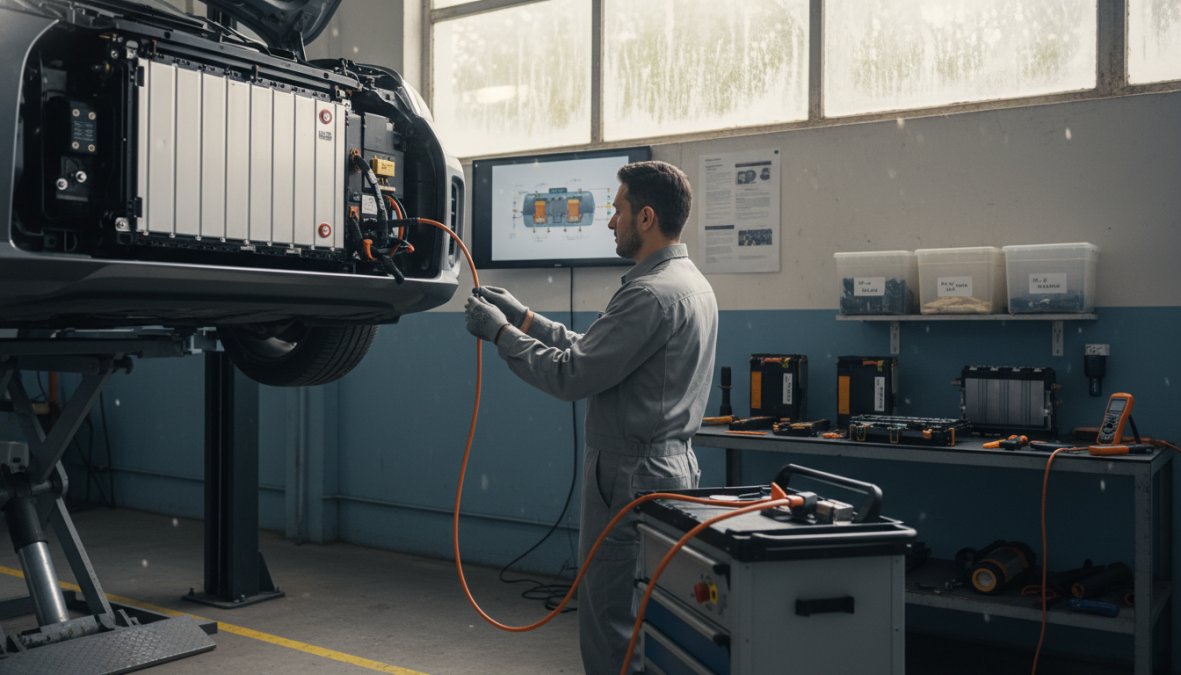
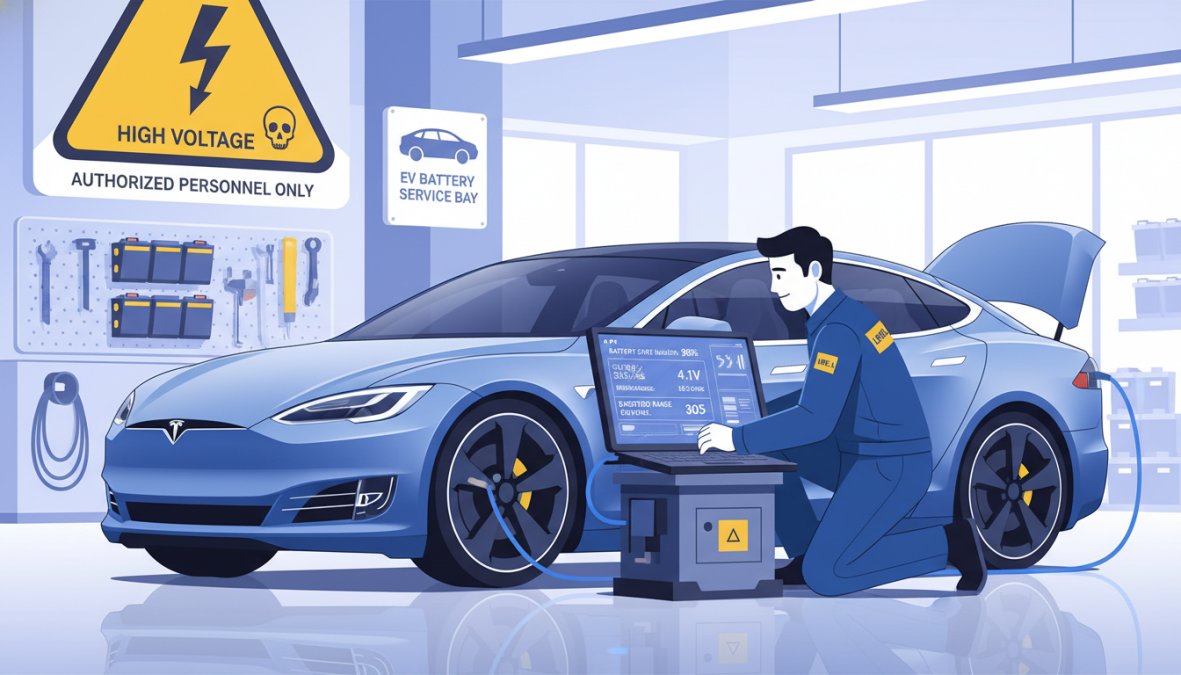
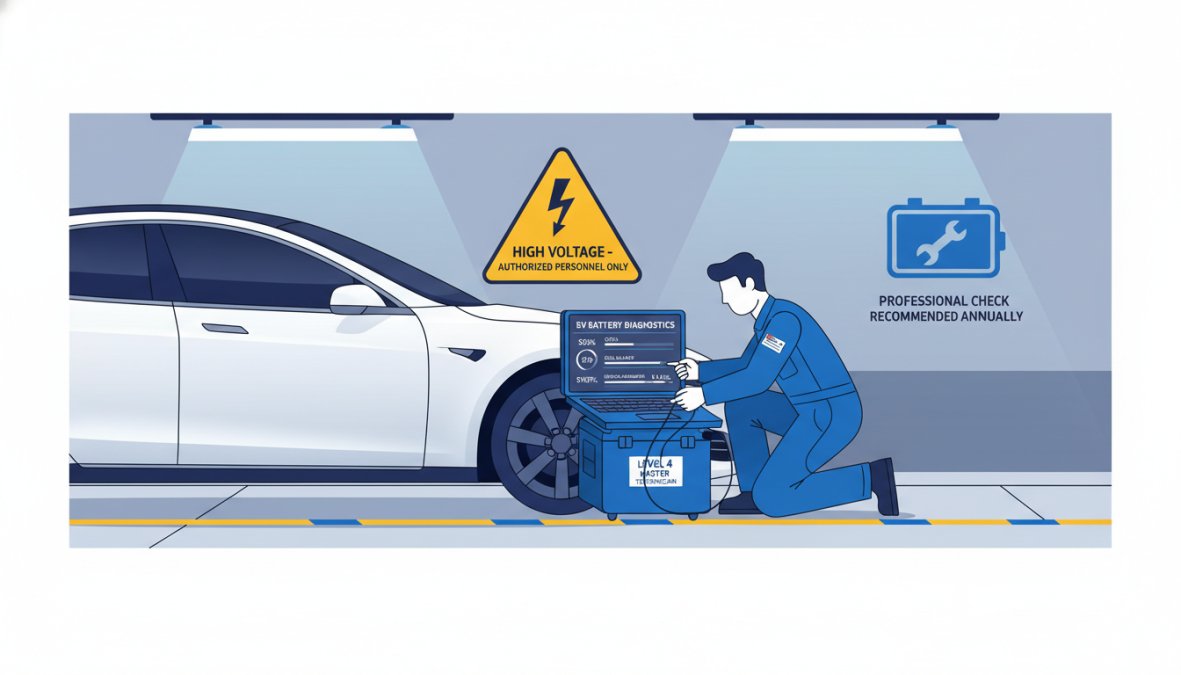
A Level 4 master technician in a professional workshop connecting a diagnostic laptop to a Tesla's OBD port, with high-voltage warning signage visible in the background, under bright workshop lighting
At KMC Electric, our Level 4 Master Technician qualification in electric vehicles, held since 2016, means we work with diagnostic platforms that access cell-level voltage data, charge history, and thermal event logs across Tesla models and other EV platforms. This is not data that a standard OBDII scanner retrieves.
Manufacturer-Specific Diagnostic Limitations You Need to Know
This is the part most EV guides skip entirely. Manufacturer-specific diagnostic tools have real limitations that affect what dealers can tell you about your battery.
Tesla's proprietary diagnostic system, for example, is primarily designed to identify faults that fall within warranty parameters. It is not designed to give you a granular, comparable battery health score that you can use in a private sale or insurance claim. According to EV battery transparency research from Transport & Environment, standardised battery health reporting remains inconsistent across manufacturers, leaving consumers without reliable like-for-like comparison data.
The practical implication: a dealer telling you "the battery is fine" based on their diagnostic system may be accurate within their warranty framework but miss degradation patterns that a specialist tool would flag. Independent diagnostics fill this gap. For Tesla owners specifically, the combination of proprietary architecture and limited third-party access makes specialist knowledge of Tesla systems a genuine differentiator, not a marketing claim.
The Real Benefits of Professional EV Battery Health Checks for Resale
The benefits of professional EV battery health checks are most financially tangible at the point of sale or purchase. A verified battery health score with a written diagnostic report changes the negotiating dynamic entirely.
Sellers with a clean, independently verified SOH report can justify a higher asking price and reduce buyer hesitation. Buyers armed with a professional diagnostic before purchase avoid inheriting hidden degradation problems that emerge months after the transaction. In the used EV market, where battery condition is the single largest variable in long-term ownership cost, this documentation is not optional. It's the equivalent of a full service history.
Battery Warranty, Consumer Rights, and What Your Report Should Cover
Battery warranty terms vary significantly by manufacturer and model year. Most manufacturers offer a separate battery warranty covering capacity below a specified SOH threshold, typically around 70%, for a defined period or mileage. Understanding your warranty position requires knowing your actual SOH, which requires a professional diagnostic.
Consumer rights in the UK provide additional protections for EV buyers. Under the Consumer Rights Act 2015, goods must be as described and of satisfactory quality. If a seller misrepresents battery condition and you have no independent verification, establishing a claim is difficult. A professional diagnostic report, obtained before purchase, creates a documented baseline.
Your diagnostic report should cover:
Confirmed SOH percentage with methodology
Cell-level voltage balance data
Charge cycle count and degradation rate
Thermal management system status
Any logged fault codes or historical battery events
Technician sign-off with credentials
As documented in UK consumer rights guidance on vehicle purchases, buyers have stronger grounds for redress when they can demonstrate the condition of a vehicle at the point of purchase. A battery diagnostic report is that evidence.
Cost-Benefit Analysis: Is a Professional Diagnostic Worth the Investment?
The cost of a professional EV battery diagnostic is modest relative to the financial decisions it informs. A professional health check typically costs a fraction of what a battery replacement or a mispriced vehicle purchase would set you back.
Consider the decision tree. If you're buying a used EV and the battery has undisclosed degradation, you face either reduced range for the life of the vehicle or a battery replacement cost that can run into several thousand pounds. If you're selling and cannot verify your battery's condition, you either leave money on the table by pricing conservatively or risk a post-sale dispute.
Scenario
Without Professional Diagnostic
With Professional Diagnostic
Buying used EV
Risk of hidden degradation
Verified SOH before purchase
Selling EV
Uncertain asking price
Justified premium pricing
Warranty claim
Weak supporting evidence
Documented baseline data
Pre-MOT / service
Unknown battery trajectory
Fault identification before failure
Peace of mind
Range anxiety persists
Confirmed performance capacity
The cost-benefit case is straightforward. Professional diagnostics pay for themselves in a single transaction where they prevent a poor decision or support a better negotiation. For vehicles still within the manufacturer's battery warranty period, identifying potential faults before warranty expiry is arguably the highest-value use of a professional diagnostic. This is exactly the kind of practical, real-world fix that independent specialists like KMC Electric in Kettering are structured to deliver.
Pro TipIf your EV is approaching the end of its battery warranty period, book a professional diagnostic 3-6 months before expiry. Identifying a qualifying fault while warranty coverage remains active can save thousands of pounds in replacement costs.
Your Used EV Inspection Checklist: What to Verify Before You Buy or Sell
A thorough used EV inspection covers more than battery health, but battery health is the non-negotiable starting point. The following checklist reflects what a professional pre-purchase or pre-sale inspection near Kettering should cover.
Battery and Electrical Systems:
Independent SOH measurement with written report
Cell voltage balance check across all cell groups
BMS fault code history reviewed and cleared or documented
Thermal management system function verified
High-voltage cable and connector inspection
Charge port condition and locking mechanism
Drivetrain and Performance:
Drive unit or motor diagnostics for noise, vibration, and error codes
Regenerative braking function and calibration
Voltage system integrity check
Charging Infrastructure Compatibility:
AC onboard charger function verified
DC fast charging capability confirmed
Charge rate consistency with manufacturer specification
Documentation:
Battery diagnostic report with technician credentials
Service history, including any battery-related work
VIN-level data check for recalls or open campaigns
Warranty status confirmed in writing
Close-up of a mechanic's hands holding a printed battery diagnostic report beside an electric vehicle in a clean, well-lit independent garage, with workshop tools visible on a pegboard in the background
For buyers and sellers near Kettering and across Northamptonshire, having this checklist completed by an independent specialist before any transaction removes the single biggest source of uncertainty in the used EV market. According to Autotrader UK's used EV buying guidance, battery condition is consistently cited as the primary concern among used EV buyers, yet independent verification remains underused.
The thing nobody tells you about used EV inspections is that the absence of fault codes is not the same as a healthy battery. A battery can be degrading steadily with no active faults logged. Only a calibrated SOH measurement reveals the true picture.
Protecting the value of an electric vehicle comes down to one question: do you actually know the condition of your battery, or are you working from an estimate? For EV owners and buyers across Kettering and Northamptonshire, KMC Electric provides independent battery health verification backed by Level 4 Master Technician status in electric vehicles and over 25 years of automotive experience. Whether you need a pre-purchase diagnostic, a pre-sale report to justify your asking price, or a fault check before your warranty expires, our specialist knowledge of Tesla systems and EV platforms delivers the evidence you need. Submit your enquiry today and get a verified battery health report you can act on.
Frequently Asked Questions
How often should you get an EV battery health check?
For most EV owners, a professional battery health check once a year is a sensible baseline, particularly before a warranty expires or when buying or selling. If you regularly use DC fast charging, drive in extreme climates, or notice a drop in real-world range, more frequent checks are advisable. An annual diagnostic gives you a reliable record of your battery's State of Health (SOH) over time, making it easier to spot unusual degradation early.
What does a professional EV battery health report include?
A professional diagnostic report typically covers State of Health (SOH) as a percentage, usable capacity versus original capacity, individual cell voltage data, battery management system (BMS) fault codes, and charging cycle history where accessible. Unlike a basic OBDII scan, a specialist report uses manufacturer-level or third-party professional tools to pull VIN-level data, giving you an accurate picture of real-world range potential and any early signs of traction battery degradation.
Can a battery health check increase the resale value of my EV?
Yes, having an independent battery health check with a verified diagnostic report can meaningfully improve buyer confidence in the used EV market. A documented battery health score from a credible specialist removes range anxiety for prospective buyers and can justify a stronger asking price. Sellers who provide transparent SOH data tend to achieve faster sales and face fewer last-minute price negotiations, making the cost of a professional EV battery health check a practical investment before listing.
Is it worth paying for a professional EV battery diagnostic test?
For most EV owners, the answer is yes. The cost of a professional diagnostic is modest compared to the expense of an unexpected battery pack replacement or the financial loss of selling an EV below its true value. Professional checks identify faults before warranty expiry, verify battery health for used EV purchases, and provide documented evidence of performance capacity, all of which carry real monetary value. The benefits of professional EV battery health checks typically far outweigh the upfront diagnostic fee.
What are the main EV battery degradation factors I should monitor?
The most significant EV battery degradation factors include frequent DC fast charging, consistently charging to 100% or depleting to near zero, exposure to extreme heat or cold without adequate thermal management, and high total charging cycles over the vehicle's life. Parking in high temperatures for extended periods also accelerates capacity loss in lithium-ion battery packs. A professional diagnostic can quantify how these habits have affected your specific battery and recommend a maintenance schedule to slow further degradation.