Why EV Suspension Wears Differently to Petrol Cars
Electric vehicles carry more weight and deliver instant torque, and both facts shorten the life of suspension components. A Tesla Model 3 weighs roughly the same as a large SUV, yet its springs and bushes are sized for a saloon. That mismatch is why common electric vehicle suspension issues to check show up earlier than most owners expect.
At KMC Electric in Kettering, we see this constantly on out-of-warranty Teslas across Northamptonshire. The battery pack adds mass low in the chassis, which is good for handling but hard on control arms, ball joints and shock absorbers. Add regenerative braking, which reduces pad wear but leaves the dampers doing all the work over speed bumps, and you get a suspension system that ages faster than the one under a petrol equivalent.
Common Electric Vehicle Suspension Issues to Check
The three faults we diagnose most often are worn control arm and ball joint play, leaking shock absorbers, and air suspension compressor or bag failures. Each has a distinct symptom, and each gets more expensive the longer it is left.
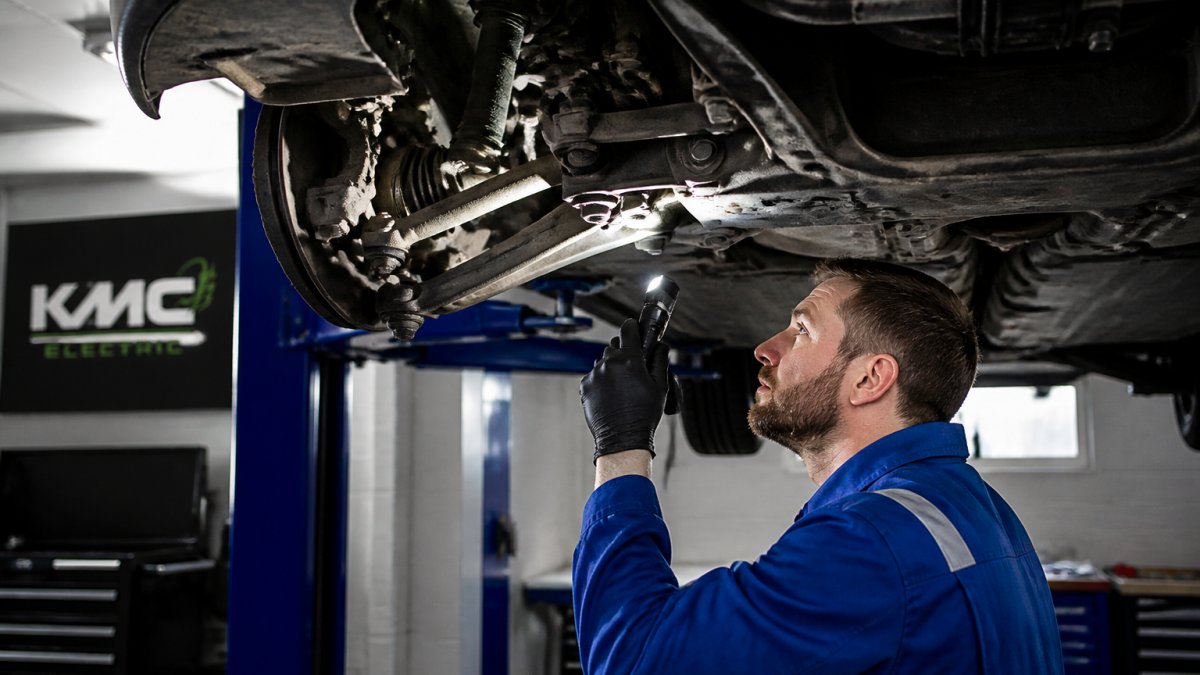
A technician in blue overalls using a torch to inspect the underside of an electric car raised on a two-post lift in a clean independent garage, with suspension arms and shock absorbers clearly visible
Worn Control Arm and Ball Joint Play
A clunk over rough tarmac at low speed is the classic sign. The control arm bushes compress under the extra kerb weight of an EV, and once they crack, the arm moves under load. You will feel vagueness through the steering and uneven wear on the front tyres.
We check this by rocking the wheel at the 12 and 6 o'clock positions with the car raised. Any movement beyond a millimetre or two means the joint is on its way out. It is a straightforward fix, but ignore it and the play accelerates wear on the tyre and the hub bearing.
Leaking or Failed Shock Absorbers
Shock absorbers on an EV work harder because the car is heavier and the motor delivers full torque instantly. A leaking damper shows as an oily film on the shock body and a bouncy, floaty ride over dips. You may also notice the car squatting under acceleration or diving harder than usual under braking.
Test it by pushing down firmly on each corner of the car and releasing. If it bounces more than once, the damper has lost its control. Worn shocks also extend braking distances and increase tyre wear, so this is a safety item, not a comfort one.
Air Suspension Compressor and Bag Faults
Air suspension appears on Model S and Model X, and it is the single most common fault we see on those cars. A sagging corner overnight points to a leaking air bag or a tired compressor. You may hear the compressor running far more often than it should, or find a warning on the dash.
One of our customers brought in a 2019 Model S with exactly this problem. We saw it at short notice, diagnosed the leak properly, and offered a cost-effective fix rather than a full system replacement. That is the difference between a proper diagnosis and a parts lottery.
EV Suspension Noise Over Bumps: What Each Sound Means
EV suspension noise over bumps is a diagnostic clue, and the pitch tells you where to look. A dull thud usually means worn control arm bushes or a failing top mount. A sharper metallic clunk points to a loose anti-roll bar link or a worn ball joint. A knocking that follows the road surface at low speed often traces back to a failing shock absorber.
Because EVs are so quiet, you hear suspension faults far earlier than you would in a petrol car. Use that to your advantage. The moment a new noise appears, note the speed and the type of bump that triggers it. That detail saves diagnostic time and money.
Pro TipRecord the noise on your phone while driving over a known rough stretch. We can often narrow down the fault from the audio alone before the car even arrives, which cuts the diagnostic time on your bill.
Electric Car Uneven Tyre Wear and What It Reveals
Electric car uneven tyre wear is usually a suspension problem wearing a disguise. If the inner or outer edge of a tyre is scrubbing while the rest looks fine, the alignment has moved, often because a worn control arm bush or ball joint has changed the geometry. EVs also run higher tyre pressures and heavier loads, so any misalignment punishes the rubber faster.
Check your tread depth across the full width of each tyre every month. A difference of more than a millimetre between the inner and outer edge means something in the suspension has moved. Do not just replace the tyre and hope. Get the geometry checked, or you will be buying another one within a year.
When to Replace EV Shock Absorbers
Replace EV shock absorbers when they leak, when the car bounces more than once on the push test, or when you notice increased dive under braking. As a rule of thumb, most dampers are past their best somewhere between 60,000 and 80,000 miles, though weight and road quality shorten that.
Do not wait for a failed MOT. A worn damper affects braking distance, tyre life and stability in crosswinds. We recommend replacing shocks in axle pairs, never singly, because mismatched damping makes the car unpredictable under load.
Symptom
Likely Fault
Urgency
Clunk at low speed over bumps
Worn control arm or ball joint
Book within weeks
Oily film on shock body
Leaking damper
Replace soon
One corner sagging overnight
Air bag or compressor leak
Diagnose immediately
Edge scrubbing on tyres
Alignment shifted from worn joint
Check geometry now
Car bounces more than once
Failed shock absorber
Safety item
EV Suspension Inspection Checklist
An EV suspension inspection checklist splits neatly into what you can do at home and what needs a ramp. Monthly checks catch the cheap problems. Annual checks catch the expensive ones before they become dangerous.
Monthly Owner Checks
Push down on each corner and count the bounces, one is fine, two or more is not
Look for oily residue on each shock absorber body
Check tread depth across the full width of every tyre
Note any new noise and the speed that triggers it
Check ride height at each corner, a sagging one points to air suspension
Look for fresh grease or splits around the ball joint boots
Annual Garage Inspection Points
Rock each wheel to test for ball joint and bearing play
Inspect control arm bushes for cracking or separation
Check anti-roll bar links and bushes for movement
Test the air suspension compressor cycle and check for leaks
Measure ride height against spec on all four corners
Check four-wheel alignment and adjust if geometry has moved
If you would rather not crawl under the car, bring it to us. We offer independent Tesla and EV diagnosis in Kettering, and we will tell you honestly what needs doing and what can wait. Owners searching for a Tesla specialist near me in Northamptonshire often find us because we explain the fault before we quote for it.
Watch OutNever ignore a sagging corner on an air-suspension car. A failing compressor that runs constantly will eventually burn out, and that turns a cheap air bag fix into a much larger repair bill.
Conclusion
Suspension faults on an EV rarely fix themselves, and the longer you leave a worn joint or a leaking damper, the more it costs you in tyres, braking performance and replacement parts. Catching them early is the whole game.
That is exactly what we do at KMC Electric. With over 25 years of automotive experience, Level 4 Master Technician status in electric vehicles since 2016, and specialist knowledge of Tesla systems across all models, we diagnose the real fault rather than guessing. We also carry genuine parts, including Tesla Model 3 and Model Y hand brake motors and Model S and Model X equivalents, alongside wheel nuts for everyday servicing.
If your Tesla is clunking, sagging or scrubbing its tyres, get it looked at before it becomes a bigger bill. Get started with KMC Electric and keep your EV riding the way it should.
Frequently Asked Questions
What are the most common suspension problems in electric cars?
The most frequent issues are worn control arm bushes and ball joints, leaking shock absorbers, broken coil springs, and air suspension faults on models that use it. Because EVs weigh more than comparable petrol cars, these components work harder and wear sooner. Knocking noises, uneven tyre wear, and a bouncy or vague ride are the usual warning signs. An independent specialist such as KMC Electric can diagnose these before they affect safety or spread damage to other parts.
Why does my electric car make a knocking noise over bumps?
A knocking or clunking sound over bumps usually points to worn anti-roll bar links, control arm bushes, or top mount bearings. On heavier EVs these parts degrade faster than on petrol equivalents because there is more weight pressing through the suspension. Ignoring it lets the wear accelerate and can affect steering precision. A suspension noise over bumps is one of the clearest signals to book an inspection rather than wait for the next service.
Is it safe to drive an electric car with a suspension fault?
It depends on the fault. A light rattle may be safe for a short trip to a garage, but a broken spring, failed shock absorber, or collapsed air suspension bag affects braking, steering, and stability. Driving with these faults risks uneven tyre wear, longer stopping distances, and, in the worst case, loss of control. If the car feels unstable, pulls to one side, or sits unevenly, stop driving and arrange recovery or a prompt inspection.
How can I tell if my EV suspension is worn?
Watch for a bouncy ride that continues after a speed bump, knocking or creaking over rough roads, uneven or scalloped tyre wear, and the car sitting lower on one side. Check tyre pressures monthly and look for oil mist on shock absorber bodies. An EV suspension inspection checklist should include a bounce test, a visual check for leaks and cracked bushes, and a tyre tread depth check across all four corners.
Can a suspension problem affect an EV's range or handling?
Yes. Misaligned or worn suspension increases rolling resistance, which raises energy consumption and shortens range. Poor alignment also causes uneven tyre wear, so tyres need replacing sooner. Handling suffers too: worn shock absorbers reduce tyre contact with the road, so the car feels floaty and takes longer to settle after bumps. Fixing suspension faults early protects both range and safety.