Tesla suspension issues rarely announce themselves with a dramatic failure. They start as a faint clunk over a speed hump, a slight pull to one side, or a tyre that wears unevenly no matter how often you check the pressures. Left alone, these small symptoms turn into worn control arms, damaged tyres, and repair bills that grow with every mile.
This guide from KMC Electric covers the faults we see most often on out-of-warranty Teslas across Northamptonshire and Leicestershire. Below, we explain what each noise or wear pattern means, what to check, and when to book a proper inspection before a cheap fix becomes an expensive one.
Tesla suspension issues fall into a handful of recognisable patterns, and most owners notice the same warning signs first. The good news is that catching them early usually means a straightforward repair rather than a full rebuild.
Here is what most guides get wrong: they treat every knock as "just a Tesla thing." It is not. A noise is information, and each one points to a specific component.
Tesla Suspension Clunking Noise: What It Means
A clunking noise from a Tesla suspension almost always points to worn bushes, a failing ball joint, or a loose control arm. The sound is metal meeting metal under load, and it gets worse over time.
Clunks Over Bumps and Speed Humps
If you hear a single heavy knock as the car settles over a bump, the usual culprit is play in a control arm bush or a worn anti-roll bar link. The suspension compresses, the worn part shifts, and you hear the result.
Watch for these signs:
A dull thud on the driver's side over speed humps
A knock that appears only when the car is loaded
A rattle that speeds up with rougher road surfaces
Squeaks and Groans When Turning
A groan when you turn at low speed is different. It often points to a dry or worn bush, or a top mount bearing that has started to break down. Squeaks tend to show up first in cold weather and ease once the car warms up.
Pro TipA clunk that only happens when the car is cold and quietens after ten minutes is usually a bush, not a ball joint. Mention the temperature and timing when you book, because it narrows the diagnosis fast.
Tesla Control Arm Symptoms You Should Not Ignore
Tesla control arm symptoms include vague steering, a knock over bumps, uneven tyre wear, and a car that wanders at motorway speed. The control arm holds the wheel in position, so any play here affects how the car tracks and steers.
The tricky part is that control arm wear is gradual. Owners adapt to it without realising. Steering that felt sharp when new starts to feel soft, and you blame the tyres or the road.
Look out for:
Steering that needs constant small corrections
A shimmy or vibration through the wheel
Clunks that appear when you brake or accelerate
We see this often on higher-mileage Model 3 and Model S cars. The arms themselves are strong, but the bushes and ball joints inside them are wear items, and they do not last forever.
Watch OutIgnoring a worn control arm does not just make noise. It accelerates tyre wear and can affect how the car handles in an emergency. A small repair now avoids a much larger bill later.
Tesla Uneven Tyre Wear: A Suspension Warning Sign
Uneven tyre wear is one of the clearest signs of a suspension problem on any Tesla. Tyres are expensive, and when one edge wears faster than the rest, the suspension geometry is usually to blame rather than the tyre itself.
Inner Edge Wear and Cupping
Inner edge wear points to too much negative camber or worn suspension components pulling the wheel out of alignment. Cupping, where the tyre develops dips or scalloped patches, usually points to worn dampers or bushes that let the wheel bounce instead of staying planted.
A bald inner edge while the outer tread looks fine
A scalloped or wavy tread surface you can feel by hand
A pull to one side that a wheel alignment does not fix
If alignment keeps drifting back out, the worn part is still there. Aligning a car with a worn bush is a temporary fix at best.
Why a Regular Tesla Suspension Inspection Matters
Regular Tesla suspension inspection catches worn parts before they damage tyres, affect handling, or turn into a bigger repair. Tesla's own guidance is light on routine maintenance, but that does not mean suspension components last forever.
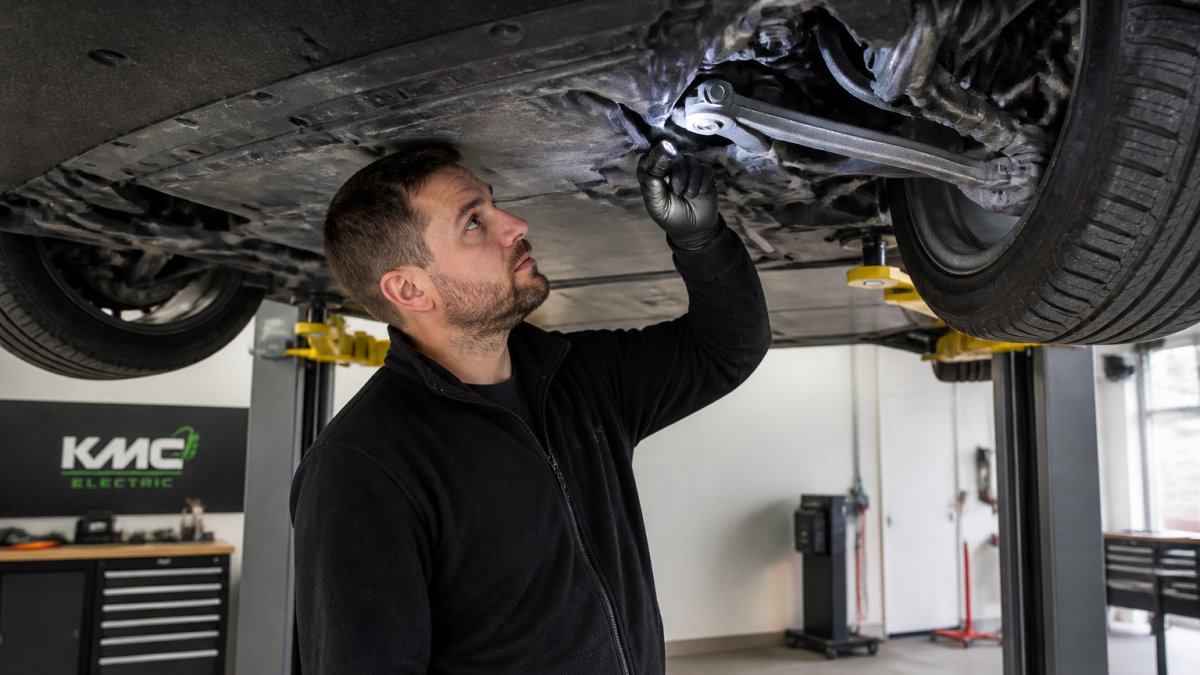
A technician in clean workwear using a torch to inspect the underside of an electric car raised on a two-post lift in a tidy independent workshop, with suspension arms and a wheel arch clearly visible
Suspension parts are wear items. Bushes perish, ball joints develop play, and dampers lose their damping over time. None of this shows up on a dashboard warning. You find it by looking.
A proper inspection covers:
Control arms and their bushes
Ball joints and anti-roll bar links
Dampers and top mounts
Tyre wear patterns and alignment
At KMC Electric, we check these on every Tesla that comes through our Kettering workshop. We have over 25 years of automotive experience and have held Level 4 Master Technician status in electric vehicles since 2016, so we know where these cars wear and what to look for.
Symptom
Likely Cause
What to Do
Clunk over bumps
Worn bush or anti-roll bar link
Book an inspection
Squeak when turning
Dry or worn bush, top mount
Check and lubricate or replace
Vague steering
Worn control arm or ball joint
Inspect before it worsens
Inner edge tyre wear
Camber or worn suspension
Realign after repair
Cupped tread
Worn dampers or bushes
Replace worn parts
When to Book an Independent Tesla Suspension Check
Book an independent Tesla suspension check as soon as you notice a new noise, uneven tyre wear, or vague steering. Early diagnosis is cheaper than waiting, and it protects your tyres and your safety.
We work with Tesla owners across Kettering and the wider Northamptonshire area, plus dealerships that need specialist support on complex fault codes. If your car is nearing the end of its warranty, an inspection now can identify faults before they become your cost.
A few things to bring to the booking:
When the noise happens and under what conditions
Any recent tyre or alignment work
Whether the car pulls or wanders
Key TakeawayThe cheapest suspension repair is the one you catch early. A noise today is a worn bush; the same noise in six months is often a worn bush plus two ruined tyres.
If you are looking for a Tesla suspension specialist near me, an independent check gives you a clear picture without the main dealer runaround.
Suspension faults on a Tesla rarely fix themselves, and the longer you wait, the more they cost you in tyres and handling. At KMC Electric, we offer independent Tesla and EV diagnosis, repair, and long-term maintenance, backed by over 25 years of experience and Level 4 Master Technician status in electric vehicles since 2016. Our team provides practical, real-world fixes, identifies faults before warranty expiry, and gives you transparent advice you can trust. Get started with KMC Electric and keep your Tesla handling the way it should.
Frequently Asked Questions
What are the most common suspension problems on a Tesla?
The most frequently reported Tesla suspension issues are clunking or knocking noises over bumps, worn control arms and bushes, squeaks when turning, and uneven tyre wear. Air suspension faults also appear on Model S and Model X. Because Tesla models are heavy and produce instant torque, suspension components can wear faster than owners expect. Catching these early with a proper Tesla suspension inspection usually means a simpler, cheaper fix.
Why does my Tesla make a clunking noise over bumps?
A Tesla suspension clunking noise over bumps usually points to worn control arm bushes, a failing ball joint, loose anti-roll bar links, or worn top mounts. On air suspension models, it can also indicate a tired air strut. A single clunk when pulling away or braking may be a loose component rather than a worn one. Because the cause varies, a proper diagnosis on a lift is the only reliable way to confirm what is actually moving.
Can suspension problems affect Tesla tyre wear?
Yes. Tesla uneven tyre wear is one of the clearest signs of a suspension fault. Worn control arm bushes or incorrect geometry often cause inner edge wear, while worn dampers can produce cupping or scalloped patches. Because Tesla models are heavy and quiet, tyre noise and wear can develop before drivers notice a handling change. If your tyres are wearing unevenly, get the suspension checked before simply replacing them.
How often should Tesla suspension components be inspected?
For most Tesla owners, an annual Tesla suspension inspection is sensible, and it becomes more important once the car is out of warranty or past 50,000 miles. If you drive on poor road surfaces, tow, or notice new noises, get it checked sooner. A thorough inspection covers control arms, bushes, ball joints, anti-roll bar links, dampers or air struts, top mounts and tyre wear patterns. KMC Electric can carry out this check and flag anything likely to fail before your warranty expires.