Why Northamptonshire Tesla Owners Look Beyond the Main Dealer Network
Tesla service centre alternatives in Northampton have become a genuine consideration for owners across Northamptonshire and Leicestershire, and the reason is simple: once the manufacturer warranty lapses, the main dealer network stops being the obvious default for anyone weighing up Tesla service centre alternatives in Northampton. This guide from KMC Electric covers what actually changes at that point, what to check before trusting any independent specialist, and how to avoid paying main dealer rates for work an independent can do properly.
Here is the uncomfortable truth. Tesla's own maintenance guidance has long suggested that electric cars need far less routine attention than combustion vehicles. That is broadly correct, and it is also why so many owners are surprised when something does go wrong and they are quoted a main dealer price for a job with no second opinion attached.
What Changes Once Your Tesla Leaves Warranty
The warranty expiry date is the moment the maths changes. While a Tesla is covered, the manufacturer has an interest in diagnosing and fixing faults at its own cost, so the incentive to look closely is built in. Once that cover ends, every diagnostic hour and every part is billed to you, and the dealer's commercial model no longer rewards caution.
Three things shift at once:
Diagnostic costs become yours. Fault-finding that was previously absorbed now appears on your invoice.
Repair-versus-replace decisions get expensive. A component that could be repaired may be quoted as a full replacement.
You gain the right to a second opinion. Nothing obliges you to accept the first diagnosis you are given.
That last point matters most. A diagnosis is an opinion, not a verdict, and independent specialists exist precisely because second opinions frequently change the outcome.
What to Look for in a Tesla Service Centre Alternative in Northampton
A credible Tesla service centre alternative in Northampton should meet four tests: verified EV qualifications, Tesla-specific diagnostic access, a transparent diagnostic process, and a willingness to explain the fault in plain terms before quoting. Miss any one of those and you are taking a risk with a high-voltage vehicle.
Qualifications, Equipment and Diagnostic Access
Ask directly what EV qualifications the technician holds and when they were gained. The automotive industry moved to formal high-voltage EV certification levels years ago, and a Level 4 Master Technician qualification is the recognised benchmark for working safely on live high-voltage systems.
Equipment matters just as much. Tesla vehicles communicate through proprietary diagnostic protocols, so a generic OBD reader will not read the fault codes that actually matter. A specialist needs Tesla-compatible diagnostic software, insulated tooling rated for high-voltage work, and a workshop set up for battery and drivetrain work.
Watch OutNever let an unqualified garage touch the high-voltage system. A technician without current EV certification should not be removing a battery pack or working on live orange cabling, and an error there is a serious injury risk, not just a costly one.
KMC Electric holds Level 4 Master Technician status in electric vehicles, with EV qualifications dating back to 2016 and more than 25 years in the automotive industry. That combination of long-standing mechanical experience and dedicated EV training is what separates a specialist from a general garage that has added an EV sign to the door.
Tesla MOT Testing Northampton: What the Test Actually Covers
Tesla MOT testing in Northampton follows the same DVSA standard as any other car, because an MOT is a roadworthiness inspection, not a manufacturer service. The test checks brakes, suspension, steering, tyres, lights, seatbelts, and structural condition. It does not assess battery health, motor condition, or software status.
That distinction catches owners out constantly. A car can pass its MOT with a degrading battery pack, because the MOT has no test for state of health. Passing the test tells you the vehicle is safe and legal to drive today. It tells you nothing about what the drivetrain will cost you next year.
For Tesla owners, the practical points are:
Brakes still matter. Regenerative braking means friction brakes get used less, and less-used brakes can seize or corrode. Testers check them properly.
Suspension and bushes wear. These are heavy cars, and worn components show up at MOT time.
Software faults are not covered. An error message on the screen will not fail an MOT, but it may signal a real problem.
Book the MOT as part of a broader inspection and you get roadworthiness and drivetrain condition checked in one visit. The DVSA guidance on MOT testing standards sets out exactly what testers examine, and it is worth reading before you assume a pass means a clean bill of health.
Tesla Out-of-Warranty Repairs Kettering: Common Faults and Realistic Fixes
Tesla out-of-warranty repairs in Kettering tend to cluster around a predictable set of faults, and most of them are repairable rather than replaceable. Air suspension failures, control arm and bush wear, drive unit noise, charging port faults, and coolant or heat pump issues account for a large share of the work we see.
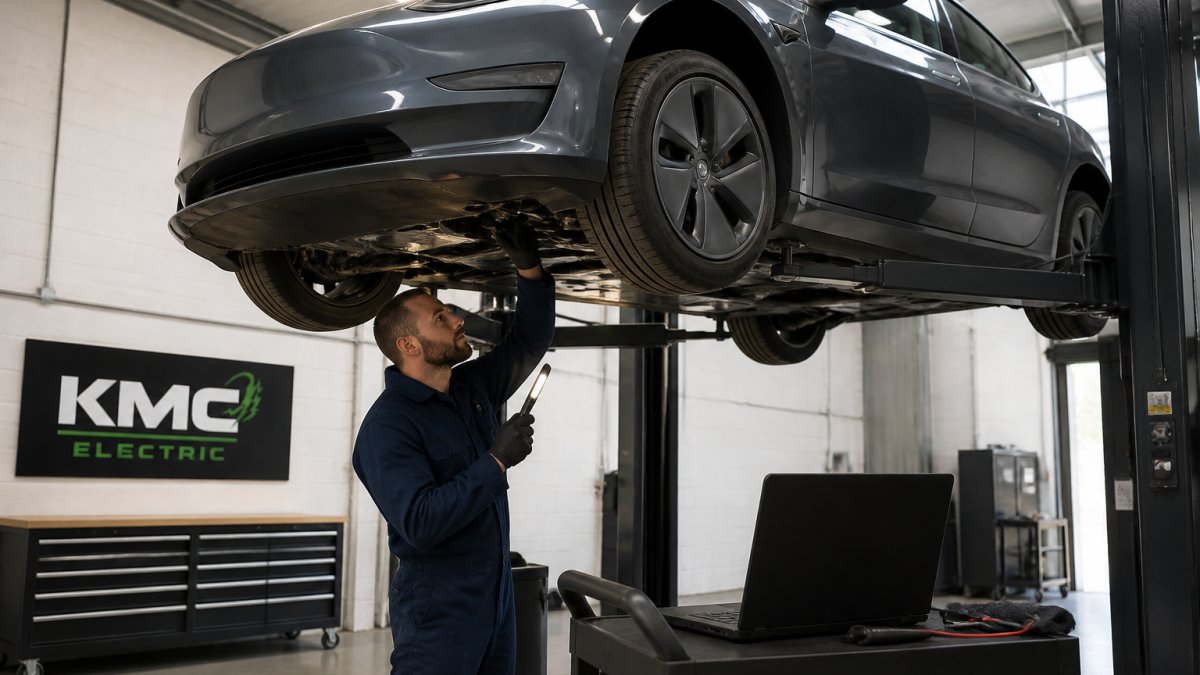
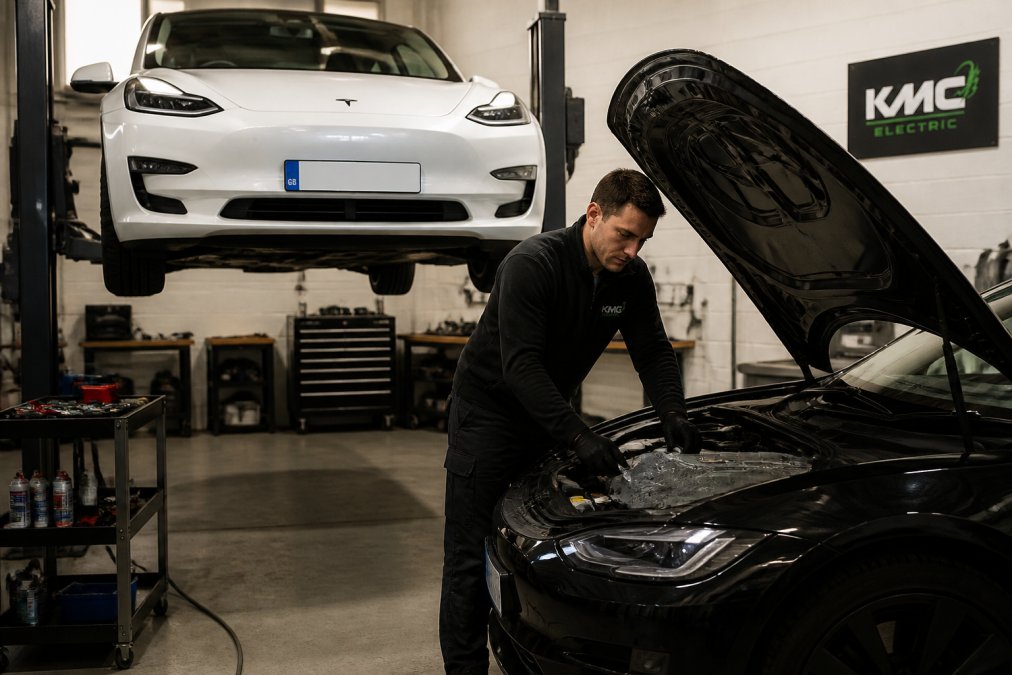
A clean, well-lit independent garage workshop with a Tesla Model 3 raised on a lift, a technician in navy overalls inspecting the underside suspension components, diagnostic laptop on a nearby trolley
Air suspension is the classic example. A main dealer approach often means replacing the whole assembly. An independent who understands the system can frequently identify whether the fault sits with the air strut, the compressor, or the height sensor, and repair only what has failed. One of our customers put it plainly after we diagnosed an air suspension issue on a 2019 Model S at short notice: the problem was thoroughly diagnosed and a cost-effective fix was offered.
The pattern across all five is the same: diagnose the specific failure before authorising a replacement. That single discipline is where most of the savings come from.
EV Battery Health Check Northampton: Catching Problems Before They Get Expensive
An EV battery health check in Northampton measures the actual state of health of the high-voltage pack, not just the range estimate on the dashboard. It reports usable capacity against original specification, cell balance across modules, and charging behaviour under load. That data is what tells you whether a pack is healthy, ageing normally, or heading for trouble.
This matters for two very different people. If you own the car, a health check catches degradation early, while there is still time to plan. If you are buying a used EV, it is the difference between a purchase you understand and one you are gambling on.
Pro TipIf you are buying a used Tesla privately, insist on an independent battery health check before money changes hands. Sellers rarely object to a check that confirms a healthy pack, and a refusal tells you something useful in itself.
We regularly carry out independent battery verification for buyers and sellers across the Midlands, including dealerships that need a defensible state-of-health figure before they retail a used EV. The Office for Zero Emission Vehicles guidance on electric vehicle ownership is a useful starting point for understanding what official support and standards apply to EV owners in the UK.
How KMC Electric Compares as an Independent Tesla Specialist
KMC Electric is an independent Tesla and EV specialist based in Kettering, and the difference comes down to three things: qualification depth, diagnostic transparency, and a repair-first approach. We hold Level 4 Master Technician status in electric vehicles, have held EV qualifications since 2016, and bring more than 25 years of automotive experience to every job.
What most guides miss is that the value of an independent is not just a lower hourly rate. It is the willingness to spend time finding the actual fault instead of defaulting to the most expensive plausible fix.
We work with private owners, used EV buyers, and franchised dealership service departments that need technical support on complex Tesla fault codes. A recent customer had their MOT completed before 9am and, because they were unable to collect the car due to injury, we arranged delivery. That is the standard we work to.
If you are searching for a Tesla specialist near me in the Kettering and Northamptonshire area, the sensible first step is a conversation about the fault before any work is authorised. We explain what we have found, what it will take to fix, and what the alternatives are.
Conclusion: Choosing the Right Alternative for Your Tesla
The real challenge is not finding someone willing to work on a Tesla. It is finding someone who will diagnose it honestly and repair what has actually failed. Plenty of garages will take the booking. Far fewer will tell you that the expensive part you were quoted for does not need replacing.
That is the standard KMC Electric works to: Level 4 Master Technician EV qualifications, Tesla-specific diagnostic capability, and independent battery health verification for owners and buyers across Northamptonshire and Leicestershire. Submit your details and we will tell you what the fault is, what it takes to fix, and what it should cost before you commit to anything.
Frequently Asked Questions
Can I use an independent garage for my Tesla service in Northampton?
Yes. Under UK block exemption rules you are free to have your Tesla serviced or repaired at an independent specialist without affecting your statutory rights as a consumer. The key is that the work is carried out to the manufacturer's schedule using appropriate parts, and that records are kept. For anything still covered by a Tesla warranty, an independent specialist can document faults so you have evidence before the cover expires.
Does using an independent Tesla specialist void my warranty in the UK?
It does not automatically void your warranty. UK consumer law protects your right to choose where servicing and repairs are done, provided correct procedures and parts are used. A Tesla service centre alternative in Northampton should give you a written record of every job, including diagnostic reports and parts fitted. That paperwork is what protects you if a warranty claim is ever questioned.
How often does a Tesla actually need servicing in the UK?
Tesla does not require annual servicing in the traditional sense, but UK driving conditions still wear components such as brake discs, suspension bushes, cabin filters and coolant. An independent check every 12 months, combined with an MOT when due, catches most issues early. For out-of-warranty vehicles, a yearly inspection of the high-voltage system and battery state of health is worth doing regardless of mileage.
Are independent Tesla specialists in Northamptonshire qualified to work on high-voltage systems?
The good ones are. Look for technicians holding recognised EV qualifications, such as Level 3 or Level 4 awards in electric and hybrid vehicle repair, and evidence of ongoing training. KMC Electric, for example, has held Level 4 Master Technician status in electric vehicles since 2016 and brings over 25 years of automotive experience to Tesla diagnostics and repair work.