Why Five Years Is the Point Where Electric Vehicle Faults Start Showing
Five years is the age at which the 7 common faults in electric vehicles after 5 years begin to surface, even on cars that have been serviced by the book. At KMC Electric, we see this pattern weekly: a 2019 or 2020 Tesla arrives running perfectly, then a suspension strut, a door handle or a 12V battery starts playing up within months of the other.
There is a simple reason. Most EV wear items are age-related rather than mileage-related. Rubber perishes, seals dry out, small motors seize through lack of use, and software ages out of step with newer hardware revisions. A low-mileage five-year-old car can therefore need more attention than a high-mileage three-year-old one.
Below, we break down each fault, what causes it, and what you can realistically do about it. If you are near Kettering and want a fault confirmed before it becomes a bill, our team in Northamptonshire can check the car while it is still under warranty.
1. Battery Degradation and Reduced Range
Battery degradation is the gradual loss of usable capacity and increased internal resistance in the high-voltage pack, which shows up as shorter range and slower charging. It is the fault owners worry about most, and usually the least dramatic in practice.
A healthy pack loses capacity slowly and predictably. What catches people out is imbalance between modules, where the weakest group of cells drags the whole pack down and the car reports a range figure that looks alarming.
What an EV Battery Health Check UK Owners Can Trust Actually Measures
A proper EV battery health check UK owners can rely on measures state of health as a percentage of original capacity, cell balance across modules, and charge acceptance under load. It is not the same as reading the range estimate on the dashboard, which varies with temperature, driving style and recent history.
For anyone buying used, this matters. An independent assessment before purchase tells you whether the pack is genuinely healthy or simply displaying a flattering estimate.
Pro TipAsk for a state-of-health figure taken at a steady ambient temperature, not straight after a fast charge. A reading taken on a cold pack or immediately post-charge can be several points out either way.
How to Slow Further Degradation
Keep the car between roughly 20% and 80% charge for daily use
Avoid leaving it at very low or fully charged states for long periods
Precondition the battery before fast charging in cold weather
Use AC charging for routine top-ups where you can
2. Electric Vehicle Suspension Wear and Air Suspension Faults
Electric vehicle suspension wear accelerates faster than most owners expect because EVs carry substantial weight low down. Air suspension on Model S and Model X adds another layer: struts, height sensors and the compressor all age, and a sagging corner is usually the first sign.
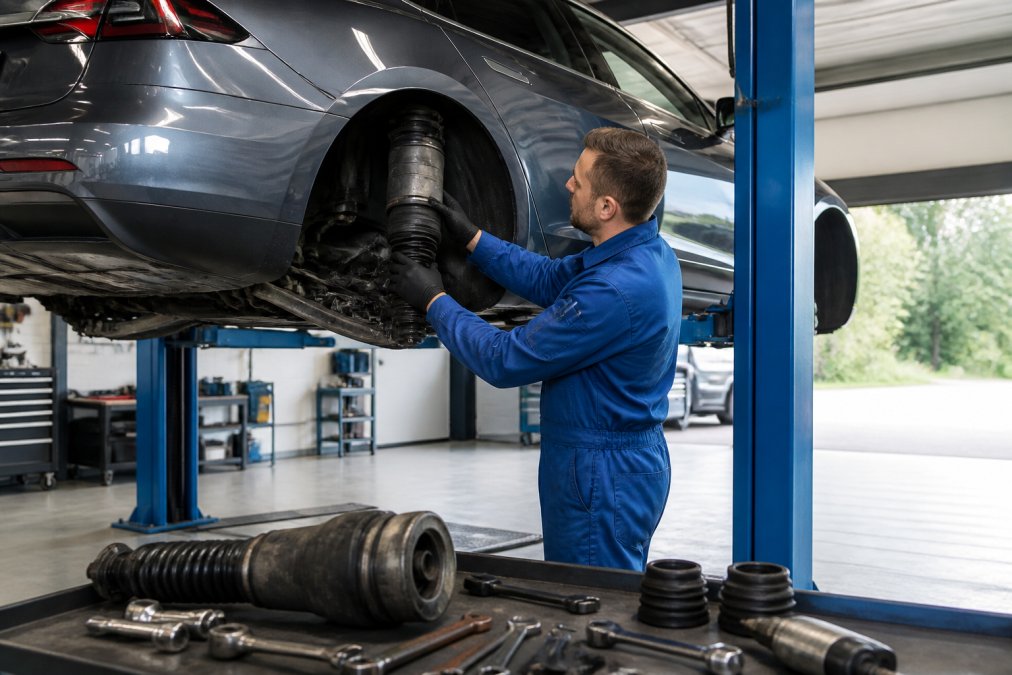
A mechanic in blue overalls inspecting the air suspension strut of a Tesla Model S raised on a two-post lift in a clean independent garage, tools laid out on a nearby bench, natural daylight through the workshop door
A common mistake is replacing the strut when the real fault is a height sensor or a leaking airline. Diagnose the system as a whole before buying parts. One customer brought us a 2019 Model S with a sagging rear corner; a thorough diagnosis found the issue and a cost-effective fix rather than a full strut replacement.
3. Tesla Model S Common Problems: Door Handles, Sun Visor Clips and Trim
Tesla Model S common problems after five years cluster around small mechanical parts rather than drivetrain. Retracting door handles stop presenting, sun visor clips snap, and interior trim works loose. None of these strand you, but all of them irritate daily.
Door handle failures usually trace to the switch or the micro-switch wiring rather than the whole assembly. A Tesla Model S Door Handle Switch Fix resolves most presenting faults at a fraction of the cost of a complete handle unit. A replacement Sun Visor Clip is a two-minute job once you have the part.
4. Brake Seizing and Handbrake Motor Failure
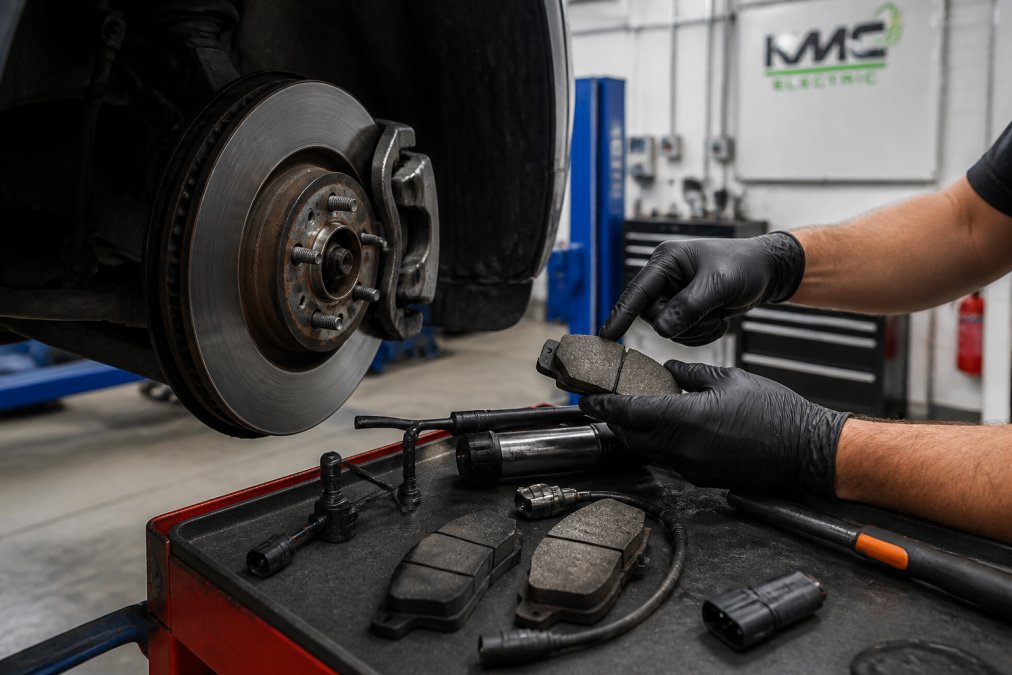
Brake seizing is one of the most predictable faults on a five-year-old EV, precisely because regenerative braking means the friction brakes are used so little. Calipers corrode, pads stick, and the electronic parking brake motor can fail to release.
The handbrake motor is a common culprit. It sits exposed at the rear, takes on road spray, and its internal gearing wears. Symptoms include a parking brake warning, a rear wheel that drags, or a car that will not roll after being left standing.
Watch OutIgnoring a dragging rear brake overheats the disc and can warp it, turning a simple motor swap into a disc and pad replacement as well.
5. 12V Battery and Pyro Fuse Faults
The 12V battery is the single most common cause of a five-year-old EV refusing to start, and it has nothing to do with the traction pack. It powers the computers, lights and contactors, and it ages like any lead-acid battery.
The pyro fuse is the other item worth knowing about. It is a one-shot safety device that disconnects the high-voltage system in a crash, and it can also trigger a fault code as it ages. A replacement Pyro Fuse is listed at £39.99.
If your car throws a high-voltage isolation warning, do not keep driving it. Get it diagnosed.
6. Charging Port and Onboard Charger Issues
Charging faults after five years usually trace to the charge port, the onboard charger or the charge port door mechanism. The port takes a physical beating, and its pins and locking mechanism wear with every connection.
Typical symptoms include a car that will not accept AC charging, a port that fails to lock, or intermittent charging that stops partway. In many cases the fault is mechanical rather than electronic, which makes it cheaper to fix than owners fear.
Key TakeawayIf AC charging fails but DC rapid charging still works, the fault is usually in the onboard charger rather than the port or the battery.
7. Software Glitches and Sensor Failures
Software glitches and sensor failures are the hardest of the seven faults to pin down, because they often present as intermittent warnings with no obvious physical cause. Parking sensors, cameras and tyre pressure monitors all age, and their connectors corrode.
A common mistake is assuming every warning means a failed component. Often it is a connector, a ground point or a software version mismatch.
Summary: Fault, Cause and Fix
Fault
Typical Cause
Practical Fix
Battery degradation
Age and cell imbalance
State-of-health check; charging habits
Suspension wear
Weight and ageing air struts
Diagnose system before replacing parts
Door handles and trim
Small mechanical parts
Switch fix or clip replacement
Brake seizing
Low friction brake use
Free off calipers; replace motor
12V and pyro fuse
Age-related failure
Replace battery or fuse
Charging faults
Port and onboard charger wear
Test AC and DC separately
Software and sensors
Connectors and version mismatch
Full multi-module scan
Five years is not the end of an electric car's life. It is the point where small, age-related faults start to appear, and where catching them early keeps them small. KMC Electric provides independent Tesla and EV diagnosis, repair and battery health verification for owners and dealerships in Kettering and across Northamptonshire, with Level 4 Master Technician status in electric vehicles and over 25 years of automotive experience behind every job.
Frequently Asked Questions
Do electric cars have more problems after 5 years?
Not more than petrol or diesel cars, but different ones. Electric vehicle faults after five years cluster around battery degradation, suspension wear, brake seizing and 12V failures rather than engine or exhaust issues. Because EVs carry extra weight and use regenerative braking, some components wear in ways owners do not expect. A planned inspection at the five-year mark catches most of these before they become expensive.
What is the most common failure in an electric vehicle?
The 12V auxiliary battery is the single most common failure point. It powers the computers, lights and contactors that wake the main pack, and it fails on the same three to five year cycle as a conventional car battery. A failing 12V unit often mimics a much bigger fault, with error messages, a car that will not start, or modules that drop offline. Testing it first saves diagnostic time and money.
Do EV batteries degrade significantly after 5 years?
Most packs lose a small percentage of usable capacity over five years, and the rate depends heavily on charging habits, climate and how often the car was rapid charged. A proper EV battery health check UK owners can rely on measures actual usable capacity and cell balance rather than trusting the dashboard estimate. Degradation is usually gradual, but a sudden drop in range often points to a module or software issue worth diagnosing.
What should I check on my Tesla Model S after 5 years?
Prioritise the air suspension, door handles, sun visor clips and brake components, since these are the recurring Tesla Model S common problems at this age. Ask for a battery state-of-health report, a 12V battery test, and a check of the pyro fuse and charging hardware. Booking an inspection before the warranty ends means anything found can still be claimed, and KMC Electric can advise on what is covered.
Are independent EV specialists better than main dealers for out-of-warranty repairs?
For out-of-warranty work, an independent specialist often gives a clearer diagnosis and a more cost-effective repair because they are not tied to replacing whole assemblies. KMC Electric holds Level 4 Master Technician status in electric vehicles and has worked on Tesla systems since 2016, so complex fault codes are handled directly rather than passed between departments. You get a straight answer on what needs fixing and what can wait.