What Determines Tesla Model 3 Brake Pad Replacement Cost
Tesla Model 3 brake pad replacement cost in the UK depends on far fewer variables than most owners expect, because the pads themselves are not the expensive part. This guide from KMC Electric breaks down where the money actually goes. The real drivers are labour time, disc condition, and whether corroded hardware forces a bigger job than the pads alone.
A brake pad replacement cost for a Model 3 typically splits into three parts: the pads, the labour to fit them, and whatever else the workshop finds once the wheels are off. On a petrol car, that last category is usually small. On a Model 3, it is often the whole story.
Parts: Pads, Discs, and Hardware
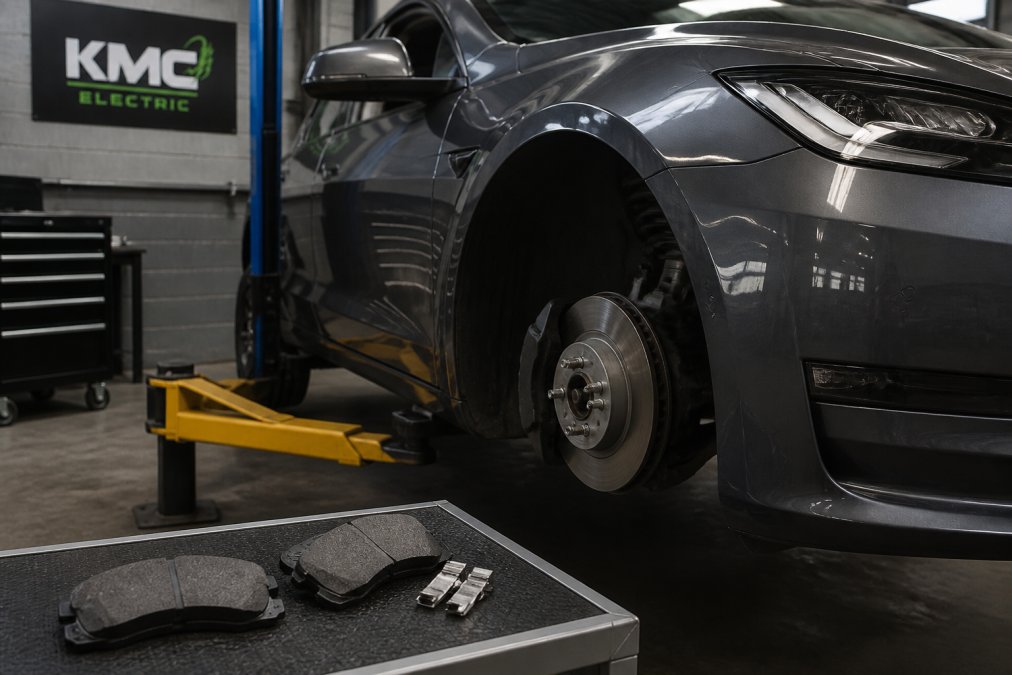
Front and rear pad sets are modestly priced compared with most premium saloons, and aftermarket equivalents sit well below main dealer parts pricing. Where costs climb is when the discs are scored or corroded and need replacing alongside the pads.
Small components matter too. The hand brake electric motor on the rear calipers is a known wear item on Model 3 and Model Y, and KMC Electric supplies a replacement hand brake motor at £60.00. A seized or noisy parking brake actuator turns a straightforward pad swap into a two-part repair.
Labour Rates and Workshop Time
Labour is where independent specialists separate themselves from main dealer networks. A pad change on a Model 3 is not a long job, but it does require lifting equipment, correct torque figures, and an understanding of how the car's electronic parking brake must be retracted before the caliper comes apart.
Get that sequence wrong and you damage the actuator. A common mistake is treating the rear calipers like a conventional cable handbrake. In practice, this means budgeting for more workshop time than a standard hatchback, even though the physical pad swap is quick.
Tesla Regenerative Braking Maintenance and How It Affects Pad Wear
Tesla regenerative braking maintenance is minimal, and that is exactly why pad wear catches owners out. The motor does most of the slowing, so friction brakes on a Model 3 can last far longer than on a combustion car. Pads that would be worn out at 30,000 miles on a petrol saloon may still have material left at double that (Do EVs produce more pollution?).
Long life is not the same as good health. Because the pads are used so rarely, they sit against the discs for months without scrubbing the surface clean. The result is a set of pads with plenty of thickness but a braking surface that has quietly deteriorated.
Watch OutDo not assume low mileage means healthy brakes. Pads that are barely used can still be unsafe if the friction material has separated from the backing plate or the discs have corroded. An inspection is the only way to know.
Tesla Model 3 Brake Disc Corrosion: The Hidden Cost Driver
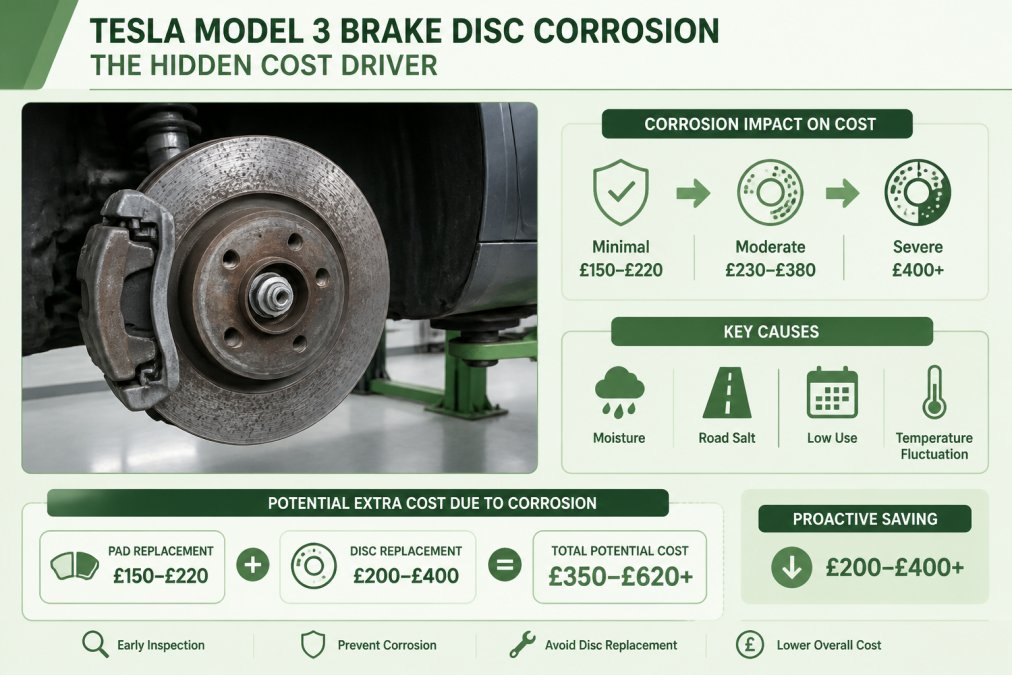
Tesla Model 3 brake disc corrosion is the single biggest reason a cheap-looking pad job becomes an expensive one. Discs are cast iron. When they are not swept by a pad regularly, moisture from rain, road salt, and even humid air settles on the surface and starts to pit it.
Close-up photograph of a Tesla Model 3 brake disc with visible surface corrosion and pitting on the braking surface, wheel removed, car raised on a lift in a clean workshop with overhead lighting
Kettering sits close to a network of A-roads that are gritted through winter, and that salt exposure accelerates the process. A car that does short journeys and charges at home may barely touch its friction brakes for weeks. The discs then corrode from the inside edge outward.
Once pitting is deep enough, resurfacing is not viable and replacement is the only safe route. That is the hidden cost driver: the pads were fine, but the discs were not, and the two are replaced together.
Tesla MOT brake requirements follow the same DVSA standards as any other passenger car, and there is no exemption for electric vehicles. Testers assess braking performance on a roller brake tester where the vehicle layout allows, and they inspect the friction surfaces, discs, pipes, and calipers visually (MOT inspection manual: cars and passenger vehicles - 1. Brakes - Guidance).
Corrosion is a frequent advisory or failure point. A disc with heavy pitting, a pad with a crumbling edge, or a brake pipe with surface rust all attract attention. Because regenerative braking masks poor friction brake performance in normal driving, owners often have no idea there is a problem until the test.
Pro TipBook an MOT with a brake inspection attached rather than a standalone test. Catching corroded discs before the test date gives you time to plan the work instead of paying for a retest.
Independent Tesla Specialist Kettering: Why Owners Choose Us
An independent Tesla specialist in Kettering is worth considering once your car moves outside the manufacturer warranty, or when you want a second opinion before it does. KMC Electric holds Level 4 Master Technician status in electric vehicles, with EV qualifications dating back to 2016 and more than 25 years in the automotive industry.
That experience matters on brakes specifically. Knowing how to retract the electronic parking brake correctly, recognising the difference between cosmetic disc staining and structural corrosion, and advising honestly when a disc can stay are all judgement calls. Our approach is to show you what we find and explain the options before any work is authorised.
One customer put it plainly after an air suspension fault on a 2019 Model S: Tim saw the car at short notice, diagnosed it thoroughly, and offered a cost-effective fix. That same diagnostic-first approach applies to brakes. If you are searching for a Tesla specialist near me in the Kettering area, the difference is a workshop that repairs what is actually wrong.
What's Included in a Professional Brake Pad Replacement
Stage
What Happens
Why It Matters
Diagnostic scan
Fault codes read, parking brake checked
Confirms actuators are healthy before strip-down
Wheel removal and inspection
Pads, discs, calipers, pipes assessed
Identifies corrosion before parts are ordered
Electronic parking brake retraction
Caliper pistons wound back correctly
Prevents actuator damage
Pad and hardware fitment
New pads, clips, and shims fitted
Stops rattles and uneven wear
Disc replacement if required
Corroded or scored discs swapped
Restores full braking surface
Bedding-in and road test
Pads mated to discs under controlled braking
Confirms even contact and pedal feel
A proper job also includes cleaning and greasing the caliper sliders, checking brake fluid condition, and resetting the service indicator. Skipping any of these is how a cheap pad change becomes a repeat visit six months later.
Frequently Asked Questions
How often do Tesla Model 3 brake pads need replacing?
Most Model 3 brake pads last between 60,000 and 100,000 miles, depending on driving style and conditions. Regenerative braking does most of the stopping, so pads wear slowly. However, brake disc corrosion from infrequent use can force earlier replacement. Inspections every 12 months are recommended, especially before an MOT.
Why do Tesla brake pads last longer than petrol cars?
Regenerative braking uses the motor to slow the car, recapturing energy instead of relying on friction. This means the pads engage less often and wear more slowly. The trade-off is that discs can corrode from lack of use, so periodic heavy braking helps keep them clean and functional.
Can I use an independent specialist for Tesla brake repairs in the UK?
Yes. Independent specialists with EV qualifications can service Tesla brakes without affecting your warranty, provided they use correct parts and follow manufacturer procedures. Many owners choose independents for out-of-warranty work because labour rates are lower and turnaround is often faster than main dealer networks.
What is the typical cost of brake pad replacement for a Tesla Model 3?
Costs vary depending on whether the discs need replacing. KMC Electric provides a quote per vehicle after inspection, ensuring you know what your car genuinely needs.