Battery degradation is the single biggest worry for any Tesla owner, yet most guides treat it as a mystery you simply have to accept. The truth is that a Tesla Model 3 battery health maintenance guide is less about complicated rituals and more about understanding a few core principles: how lithium-ion cells age, how your charging habits shape that ageing, and knowing which warning signs actually matter. At KMC Electric in Kettering, Northamptonshire, we've spent years diagnosing Tesla systems across all models, and the pattern is consistent: owners who understand their battery's behaviour avoid the most expensive surprises.
Tesla Model 3 battery health is determined by three interacting factors: charge cycles, temperature exposure, and how long the car sits at extreme states of charge. You cannot stop chemical ageing entirely, but you can slow it dramatically. Below, we'll show you exactly how to protect your investment, what degradation looks like in practice, and when a professional diagnostic service in Kettering is worth the time.
What Determines Tesla Model 3 Battery Health?
Battery health is essentially a measure of usable capacity compared to when the car left the factory. Every charge and discharge cycle causes microscopic wear on the cells, a process that is entirely normal and unavoidable.
The pace of that wear depends on choices you control. Charging to 100% and leaving the car parked for days stresses the cells far more than charging to 80% and driving shortly after. Rapid charging generates heat, and sustained heat accelerates chemical breakdown. Even your driving style matters, though less than you might think.
The good news is that modern Tesla battery management systems are remarkably resilient. The car actively protects its own cells by limiting charge rates when cold, reducing power when hot, and maintaining a buffer you never see. Your job is to work with that system, not against it.
Tesla Model 3 Charging Best Practices for Longevity
The single most effective habit is to set your daily charge limit to 80% and only charge to 100% when you genuinely need the full range for a long journey. Tesla's own guidance has consistently pointed to this approach for daily driving.
A common mistake is treating the battery like a phone and topping it up constantly. Shallow cycles are actually fine; the cells prefer many small charges over fewer deep ones. What they dislike is sitting at extremes. If you arrive home with 10% and won't drive for two days, charge it to 50% or 60% rather than leaving it depleted or immediately pushing it to full.
For overnight charging, use a scheduled departure time in the car's settings. The vehicle then finishes charging just before you leave, rather than sitting at 100% for hours. This simple adjustment reduces stress on the cells with zero effort from you.
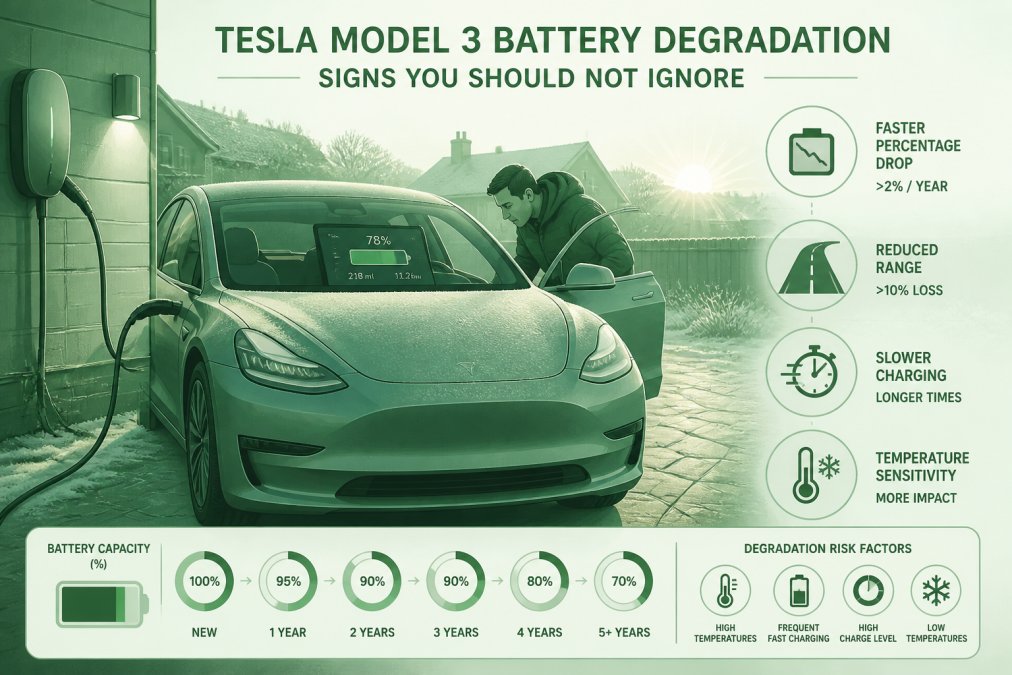
Tesla Battery Degradation Signs You Should Not Ignore
A Tesla Model 3 plugged into a home wall charger on a frosty UK driveway at dawn, light frost on the bonnet, driver leaning through the open door checking the touchscreen charging display
Most degradation is gradual and barely noticeable. You might lose a few miles of rated range over a year. That is normal ageing, not a fault. The signs that deserve attention are different: a sudden drop in range over weeks rather than months, charging speeds that fall sharply, or error messages about battery health appearing on the screen.
A battery that degrades evenly and slowly is doing exactly what physics predicts. A battery that loses capacity abruptly, or that shows inconsistent behaviour between charges, may have a genuine issue with individual cells or modules. That distinction matters because it changes the repair strategy entirely.
Range Loss vs. Sudden Drops: What is Normal?
Tesla's range estimates are calculated from a combination of driving history, temperature, and battery state. In winter, every EV loses range because cold reduces chemical activity and you're running heating. A 20% winter range reduction in the UK is unremarkable (gov.uk).
What is not normal is a 10% loss over a single month with no change in weather or driving habits. If you notice that pattern, or if your displayed range at 100% charge drops noticeably between one week and the next, book a diagnostic check rather than assuming it's just ageing.
Watch OutIgnoring a sudden range drop can turn a recoverable issue into a costly one. A failing cell module left untreated puts extra strain on the rest of the pack, and what might have been a targeted repair can escalate into a much larger problem.
Tesla Winter Battery Maintenance UK: Seasonal Adjustments
British winters are not extreme, but they are cold enough to affect battery behaviour. The most important adjustment is to precondition the car while it is still plugged in. Using the app to warm the cabin and battery before you drive draws power from the mains, not the battery, and brings the cells up to an efficient operating temperature.
Regenerative braking will feel weaker when the battery is cold, which is the car protecting the cells from charge rates they cannot safely accept. This is normal, not a fault. Similarly, you may notice Supercharging is slower on a cold battery until it warms up.
For owners across Northamptonshire and Leicestershire, the practical advice is simple: keep the car plugged in overnight during winter, even if you don't need a full charge. The battery management system uses mains power to keep the pack warm, which protects your range and your battery health.
The Value of a Tesla Battery Health Diagnostic Service
A professional diagnostic service measures the actual state of health of your battery, giving you a clear picture of remaining capacity rather than relying on the car's sometimes optimistic display. This matters most in two situations: when you're buying a used Model 3 and when your warranty is approaching its end.
For buyers, an independent battery health check before purchase is the difference between confidence and guesswork. A used Model 3 with high mileage can still have excellent battery health if it was charged sensibly. Equally, a low-mileage car that spent years parked at 100% could be in worse shape. The mileage tells you less than the battery's actual condition.
For owners nearing warranty expiry, a diagnostic identifies potential faults while Tesla is still responsible for fixing them. Catching a degrading module before the warranty lapses can save thousands. This is where an independent specialist near me in Kettering earns its keep, providing an authoritative assessment without the main dealer markup.
Understanding Your Battery Warranty and Degradation Limits
Tesla's battery warranty in the UK covers the Model 3 battery for a specific period and mileage, whichever comes first, with a guarantee that the battery retains at least 70% of its original capacity during that time (tesla.com). If your battery degrades below that threshold within the warranty period, Tesla is responsible for repairing or replacing it.
The key detail is that the 70% figure is the threshold for warranty action, not a sign of failure. Most batteries never come close to that level within the warranty window. Normal degradation of a few percent per year is expected and covered by the warranty's terms, which simply guarantee the battery stays above the threshold.
Tesla's official UK warranty documentation sets out the precise terms, and it is worth reading the battery section carefully before your warranty expires. If you suspect your battery is degrading faster than it should, have it independently tested before contacting Tesla, so you go in with data rather than a vague concern.
Maintaining Battery Health for Long-Term Ownership
The practical habits that protect your Tesla Model 3 battery health are not demanding. Keep the daily charge limit at 80%, avoid letting the car sit at very low or very high charge for extended periods, precondition while plugged in during winter, and don't obsess over every mile of range loss.
The overarching principle is that the battery prefers to be used and kept at moderate temperatures. A car driven daily and charged sensibly will outlast a car that sits idle at full charge. The battery management system handles the fine details; your role is to avoid the extremes that cause premature ageing.
For owners in Kettering and the wider East Midlands, KMC Electric offers exactly this kind of long-term support. With over 25 years of automotive experience, Level 4 Master Technician status in electric vehicles since 2016, and specialist knowledge of Tesla systems across all models, we provide independent battery health verification and practical repairs that extend the service life of your vehicle.
Battery Concern
Typical Cause
Recommended Action
Gradual range loss over years
Normal chemical ageing
No action needed; monitor annually
Sudden range drop in weeks
Possible cell or module fault
Book a professional diagnostic
Reduced winter range
Cold temperatures
Precondition while plugged in
Slower Supercharging when cold
Battery protection
Normal; allow battery to warm
Whether you're buying a used Model 3, approaching the end of your warranty, or simply want peace of mind about your battery's condition, an independent diagnostic from KMC Electric gives you the facts. We identify potential faults before they become expensive repairs, offering a transparent, cost-effective alternative to main dealer servicing across Northamptonshire and Leicestershire.
Frequently Asked Questions
How can I check the battery health of my Tesla Model 3?
You can start by checking the range displayed on the touchscreen at 100% charge, but this is not always accurate. The most reliable method is a professional diagnostic that reads the battery management system data directly. This provides a precise state of health (SoH) percentage and identifies any cell imbalances. An independent Tesla battery health diagnostic service offers a detailed report without the main dealer premium.
Does frequent Supercharging damage Tesla Model 3 battery health?
Frequent use of Superchargers, especially for short top-up sessions, can accelerate battery degradation compared to slower AC charging. This is because high-speed DC charging generates more heat. While Tesla's thermal management protects the battery, relying on Supercharging as your primary method for every charge is not ideal. Using a home wallbox or public AC charger for daily needs and reserving Supercharging for long journeys helps maintain long-term battery health.
What are the signs of battery degradation in a Tesla Model 3?
The most obvious sign is a noticeable reduction in your maximum range at full charge. For example, if your car used to show 250 miles at 100% and now shows 230 miles, that indicates degradation. Other signs include reduced power output, slower Supercharging speeds than you previously experienced, and a higher rate of range loss in cold weather compared to similar models. A professional diagnostic can confirm whether these are normal ageing signs or symptoms of a specific cell fault.
How does the UK climate affect Tesla battery performance?
Cold UK winters can temporarily reduce your Tesla's range by 10-30% because the battery chemistry is less efficient in low temperatures and energy is used for cabin and battery heating. This is a temporary seasonal effect, not permanent degradation. To minimise the impact, keep your car plugged in overnight with scheduled departure charging, allowing the battery to warm up while drawing power from the grid rather than the battery itself.
Battery anxiety is understandable, but most of it comes from not knowing the actual state of your pack. The solution is information: sensible charging habits day to day, and a professional health check when it matters. Get started with KMC Electric and book a battery diagnostic in Kettering to know exactly where your Tesla Model 3 battery health stands before the warranty clock runs out.