Knowing how to extend Tesla battery life is one of the most practical things any Tesla owner can do to protect their investment. The battery pack is the single most expensive component in any electric vehicle, and degradation is inevitable, but the rate at which it happens is largely within your control. This guide covers strategies that genuinely move the needle, drawing on specialist knowledge of Tesla systems across all models.
Here's what most guides get wrong: they treat all Tesla batteries the same. They don't. The chemistry inside your pack changes everything about how you should manage it, and that single distinction explains why advice that works for one owner can actively harm another's battery.
How to Extend Tesla Battery Life: Understanding Battery Degradation
Battery degradation is the gradual, irreversible loss of a lithium-ion cell's ability to hold charge over time. It happens through chemical side reactions, mechanical stress on electrode materials, and electrolyte breakdown, resulting in reduced kilowatt-hours capacity and shorter driving range.
Tesla batteries degrade through two primary forces: calendar ageing (time at high or low states of charge) and cycle ageing (cumulative stress of charging and discharging). Both can be slowed significantly with the right habits. According to Tesla battery longevity research published by Plug In America, Tesla vehicles retain strong capacity even after high mileage, but the difference between well-managed and poorly managed batteries is substantial.
LFP vs. NCA/NCM Battery Chemistry: Why It Matters
Tesla uses two distinct battery chemistries depending on the model and market:
Lithium Iron Phosphate (LFP): Found in Standard Range variants of Model 3 and Model Y (particularly those built after late 2021). LFP cells are more tolerant of high states of charge and designed to be charged to 100% regularly.
NCA (Nickel Cobalt Aluminium) and NCM (Nickel Cobalt Manganese): Found in Long Range and Performance variants. These offer higher energy density but are more sensitive to sustained high voltage. Charging them to 100% regularly accelerates degradation.
The practical implication is direct: if you own an LFP-equipped Tesla, Tesla's guidance recommends charging to 100% at least once a week for battery management system recalibration. If you own an NCA or NCM vehicle, that same behaviour will shorten cycle life.
Pro TipCheck your Tesla's battery type in Settings > Software. The battery chemistry determines your entire charging strategy.
Tesla Daily Charging Limit: Finding Your Optimal Range
The Tesla daily charging limit setting is one of the most effective tools available to owners. Sustained high voltage is one of the primary drivers of battery degradation in NCA and NCM chemistries.
Recommended Daily Charge Limits by Battery Type
Battery Type
Daily Charge Limit
Weekly Full Charge
Deep Discharge
LFP (Standard Range)
100% recommended
Yes, for BMS calibration
Avoid below 10%
NCA / NCM (Long Range, Performance)
80-90% for daily use
Occasional only
Avoid below 10%
For NCA and NCM owners, setting the daily charge limit to 80% covers the vast majority of daily driving needs without subjecting cells to sustained high voltage.
The Importance of Keeping Your Vehicle Plugged In
Keeping your Tesla plugged in at home is better for the battery than leaving it unplugged at a partial state of charge. When plugged in, the battery management system actively regulates cell temperature and maintains stable voltage. A plugged-in Tesla can precondition its battery pack before departure, reducing thermal stress and preserving range.
Impact of Supercharging on Tesla Battery Health
Supercharging is convenient, but frequency matters. DC fast charging pushes high current through cells rapidly, generating heat and accelerating chemical side reactions. Over many cycles, this causes measurable battery degradation compared with regular AC home charging.
Charging Speed, Amperage, and Long-Term Effects
The relationship between amperage and degradation is straightforward: higher current means more heat, and more heat means faster cell wear. A Level 2 AC charger operating at 7-11 kW overnight is the gold standard for daily charging.
Practical guidance for managing charging speed:
Use home AC charging (7-11 kW) for daily top-ups
Limit Supercharger use to long-distance journeys
Avoid remaining plugged in after reaching your charge limit
Set a maximum amperage in the Tesla app if your home charger supports adjustable output
Allow the battery to cool for 30 minutes after a long motorway run before plugging in
Watch OutFrequent Supercharging is one of the fastest ways to accelerate battery degradation in NCA and NCM vehicles. If your daily commute involves a regular Supercharger stop when home charging is available, switching to overnight AC charging will extend your battery's cycle life meaningfully.
Thermal Management: Temperature's Role in Battery Longevity
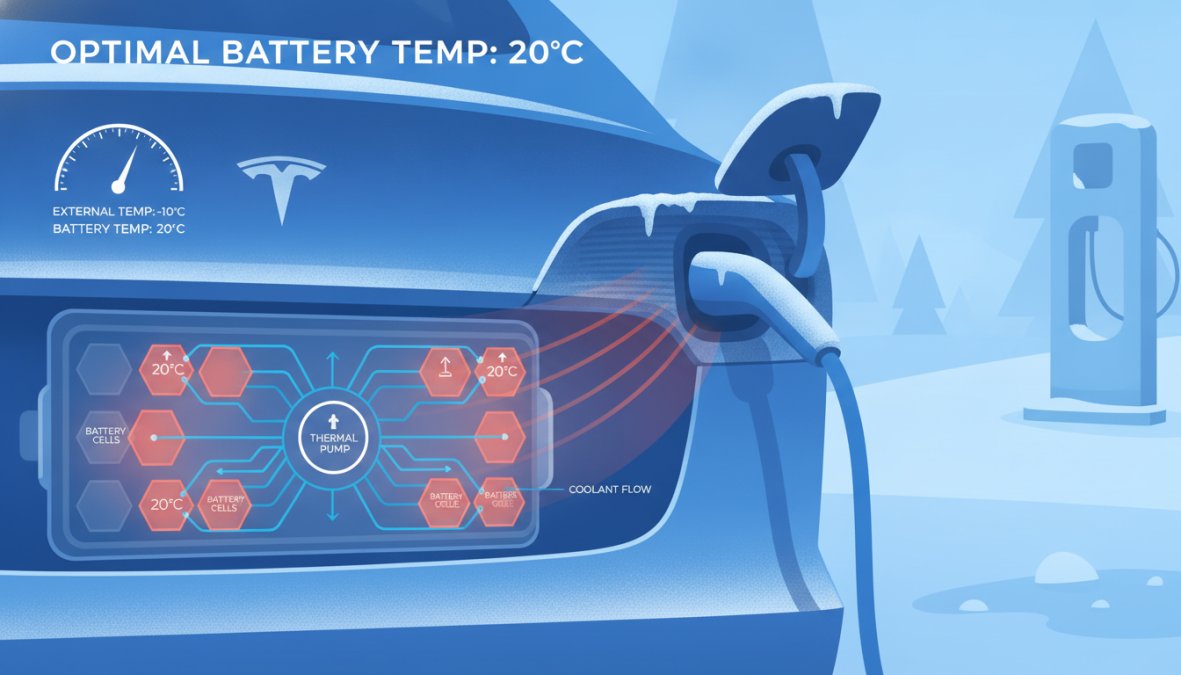
Temperature is the variable most owners underestimate. Lithium-ion cells perform and age best within a moderate temperature band, roughly 15°C to 35°C. Cold temperatures temporarily reduce available kilowatt-hours and increase internal resistance. Heat is more damaging: sustained high ambient temperatures accelerate electrolyte breakdown and increase calendar ageing, particularly at high states of charge.
Close-up of a Tesla charging port in cold winter conditions with frost visible on the surrounding bodywork, the charge cable connected and the charge port light glowing blue
Ambient Temperature and Preconditioning Strategies
Tesla's thermal management system keeps the high voltage battery within its optimal range, but it needs power to do so. Keeping the vehicle plugged in allows the system to draw from the grid rather than the battery itself, meaning thermal regulation costs nothing in range.
Preconditioning warms or cools the battery before a journey or charging session. Tesla's scheduled departure feature handles this automatically: set your regular departure time in the Tesla app, and the vehicle will precondition the cabin and battery pack to optimal temperature when you leave. For owners who park outdoors in winter, preconditioning is essential. A cold battery charges more slowly, accepts less regenerative braking energy, and degrades faster under load.
Avoiding Extreme States of Charge and Deep Discharge
The two states that cause the most cumulative damage to a lithium-ion battery are sustained high state of charge (above 90% for NCA/NCM) and deep discharge (below 10%). Both create voltage stress on cells that accelerates degradation.
Deep discharge is particularly damaging because it forces cells to operate at very low voltage, causing irreversible structural changes to electrode materials. Regularly running the battery down to single digits creates unnecessary stress.
Battery Management System (BMS) and Voltage Stability
The battery management system (BMS) monitors individual cell voltages, balances charge across the pack, regulates temperature, and protects cells from operating outside safe parameters. It is why a Tesla battery lasts as long as it does under normal use.
The BMS relies on accurate state-of-charge data to function correctly. For LFP batteries, a full charge to 100% once a week provides the reference point the BMS needs. For NCA/NCM batteries, occasional charges to 90-100% serve the same purpose without the sustained high-voltage penalty of daily charging to 100%.
How to Store Tesla for Long Periods: Maintenance Best Practices
Long-term storage requires the right approach to avoid accelerated degradation. Store at a moderate state of charge and keep the vehicle plugged in if possible.
Cycle Life Preservation During Seasonal Storage
For owners who store a Tesla over winter or leave it unused for extended periods:
Charge to 50% state of charge before storage, the sweet spot for minimising calendar ageing
Keep the vehicle plugged in at low amperage if possible, allowing the BMS to maintain the battery without cycling it
Disable Sentry Mode and any scheduled features that draw power continuously
Store in a garage or covered location to reduce ambient temperature extremes
Check state of charge monthly and top up to 50% if it has dropped significantly
Before returning to regular use, allow the battery to reach operating temperature before a fast-charging session
Storing at 50% rather than 100% reduces the rate at which calendar ageing consumes charge cycles during periods of inactivity.
Tesla Battery Health Check: Monitoring and Tools
Knowing your battery's current condition is the foundation of any long-term management strategy. A Tesla battery health check gives you a baseline, tracks degradation over time, and flags abnormal decline before it becomes expensive.
Using the Tesla App and Third-Party Diagnostics
The Tesla app provides basic state-of-charge information but does not display raw battery capacity directly. To get a meaningful health figure, use one of two approaches:
Rated range comparison: Charge to 100% and compare the displayed rated range against the original specification. A meaningful gap indicates degradation.
Third-party diagnostic tools: Applications such as Tessie or TeslaFi connect via the Tesla API and log battery data over time, building a degradation curve that reveals whether your pack is ageing normally.
For a definitive, independent battery health verification, particularly when buying or selling a used Tesla, a professional diagnostic from a specialist is the most reliable option.
Sentry Mode and Phantom Drain Impact on Battery
Sentry Mode keeps the vehicle's cameras active when parked. It draws continuous current from the high voltage battery, and over days and weeks, this phantom drain can pull the state of charge down to levels that stress cells. For owners who park in a secure location, disabling Sentry Mode during extended storage reduces unnecessary drain.
Additional phantom drain sources to manage:
Scheduled climate control left active when not needed
Third-party app polling via the Tesla API at high frequency
Cabin overheat protection (useful but draws power continuously in hot weather)
Key TakeawaySentry Mode is one of the least-discussed contributors to battery degradation. Owners who leave it enabled during weeks of inactivity are cycling their battery unnecessarily. Disable it during storage and re-enable it when the vehicle returns to regular use.
Regenerative Braking and Driving Habits for Battery Preservation
Regenerative braking recovers kinetic energy during deceleration and returns it to the battery as electrical current, reducing brake wear and the number of charge cycles required over a given distance.
Maximising regenerative braking is straightforward: use one-pedal driving where traffic conditions allow, anticipate stops early, and reduce motorway speeds where practical. Each kilometre covered with regenerative braking instead of friction braking reduces net energy drawn from the battery.
Beyond braking, driving style affects how hard the battery works:
Smooth acceleration reduces peak current draw and heat generation
Consistent motorway speeds are more efficient than repeated acceleration and braking
Pre-planning routes to avoid unnecessary stops reduces cumulative cycle stress
Avoiding maximum-performance acceleration reduces peak voltage sag
The throughline across all strategies is the same: the battery lasts longest when it operates within a moderate, stable range, away from temperature extremes, voltage extremes, and high current spikes.
Strategy
Primary Benefit
Frequency
Set charge limit to 80-90% (NCA/NCM)
Reduces high-voltage stress
Daily
Charge to 100% weekly (LFP only)
BMS calibration
Weekly
Use AC home charging over Supercharger
Reduces heat and current stress
Daily
Enable scheduled departure / preconditioning
Thermal management before driving
Daily
Store at 50% SOC with Sentry Mode off
Minimises calendar ageing
During storage
Monitor battery health via app or diagnostic
Early fault detection
Monthly
Maximise regenerative braking
Reduces net cycle consumption
Every journey
Battery degradation is the one cost that catches Tesla owners off guard, because it is invisible until it isn't. If you want a clear, independent picture of your battery's current health, KMC Electric offers professional battery health verification backed by Level 4 Master Technician status in electric vehicles and EV qualifications dating to 2016. Whether you're managing a vehicle approaching the end of its warranty or verifying the condition of a used Tesla before purchase, an independent assessment removes the guesswork. Submit your enquiry to KMC Electric and get an honest, expert evaluation of your battery's condition.
Frequently Asked Questions
What is the ideal charge limit for Tesla daily driving?
For NCA/NCM batteries, maintain a daily charge limit of 80% to minimise lithium-ion degradation. LFP batteries tolerate 100% charge without significant damage. Most owners find 80% sufficient for daily driving and commuting. This state of charge (SOC) sweet spot balances range availability with long-term battery health, extending the kilowatt-hours available over your vehicle's lifecycle.
Does Supercharging damage Tesla battery life?
Occasional supercharging is safe and designed into your battery management system (BMS). However, frequent high-voltage charging generates heat and accelerates battery degradation. Reserve supercharging for long trips. For daily use, slower AC charging at home preserves cycle life significantly better. Limiting supercharging to 20-80% state of charge further reduces thermal stress on the high voltage battery.
How often should I check my Tesla battery health?
Monitor battery health quarterly using the Tesla app or third-party diagnostics like Scan My Tesla. Track range loss over time, expect 2-3% degradation in the first year, then stabilise. Independent battery health verification becomes critical before buying or selling. At KMC Electric in Kettering, our Level 4 Master Technician team can provide detailed battery diagnostics to identify potential faults before warranty expiry.
Should I leave my Tesla plugged in when not driving?
Yes, keeping your vehicle plugged in is beneficial for battery health. Plugged-in vehicles maintain optimal temperature through thermal management and prevent deep discharge. However, avoid leaving it at 100% state of charge for extended periods. Set your charge limit to 80% for daily use, or lower (50-60%) if storing for weeks. This practice extends overall cycle life and maintains peak power delivery.