Cold temperatures drain EV batteries faster than most drivers expect, making it essential to extend EV battery range cold weather through proven techniques. When the mercury drops, your Tesla Model 3 or Model Y loses usable range because the battery chemistry itself slows down. Cold makes the electrolyte inside the battery thicker and less conductive.
This isn't a fault. It's physics. But the effect is real and measurable. Many EV owners in Kettering and across Northamptonshire report losing 20-40% of their advertised range in winter months. The loss depends on how cold it gets, how far you drive, and whether you're using the cabin heater.
Here's what happens: your battery's internal resistance increases in cold weather. The car's management system throttles power output to protect the cells. Meanwhile, cabin heating draws significant energy directly from the battery. Combine these factors and you're looking at noticeably shorter journeys before you need to charge again.
The good news is you can extend EV battery range cold weather and minimise this loss with the right approach. Understanding how cold affects your battery, then applying practical techniques, can recover much of that lost range.
EV Preconditioning in Winter: The Essential First Step
EV preconditioning is the practice of warming your vehicle's battery and cabin while it's still plugged in, using grid power instead of battery power. This is the single most effective winter technique for extending EV battery range in cold weather.
When you precondition, you're using electricity from the charger to heat the battery pack and cabin. Once you unplug and drive, your battery is already at an efficient temperature. You don't waste stored energy getting the battery warm enough to perform properly.
Start preconditioning 10-15 minutes before you plan to leave. This gives the system time to bring the battery temperature up to the optimal range. Your Tesla will charge faster too, because a warm battery accepts charge more efficiently than a cold one.
How to Precondition Your Tesla Model 3 or Model Y
Access the climate controls on your Tesla's touchscreen while the car is plugged in. Navigate to the climate menu and select "Precondition Battery". The system will begin heating the battery pack and cabin.
You can also schedule preconditioning in advance:
Open the Tesla app on your phone
Tap "Climate" and then "Precondition Battery"
Set your desired departure time
The car will warm up automatically at the right moment
For maximum benefit, precondition while your car is charging. The charger supplies the energy, not your battery. This is the key difference between preconditioning and simply turning on the heater after you've unplugged.
If you're charging at a public charger or at work, use the in-car touchscreen to start preconditioning manually. Even 10 minutes makes a measurable difference to your available range once you start driving.
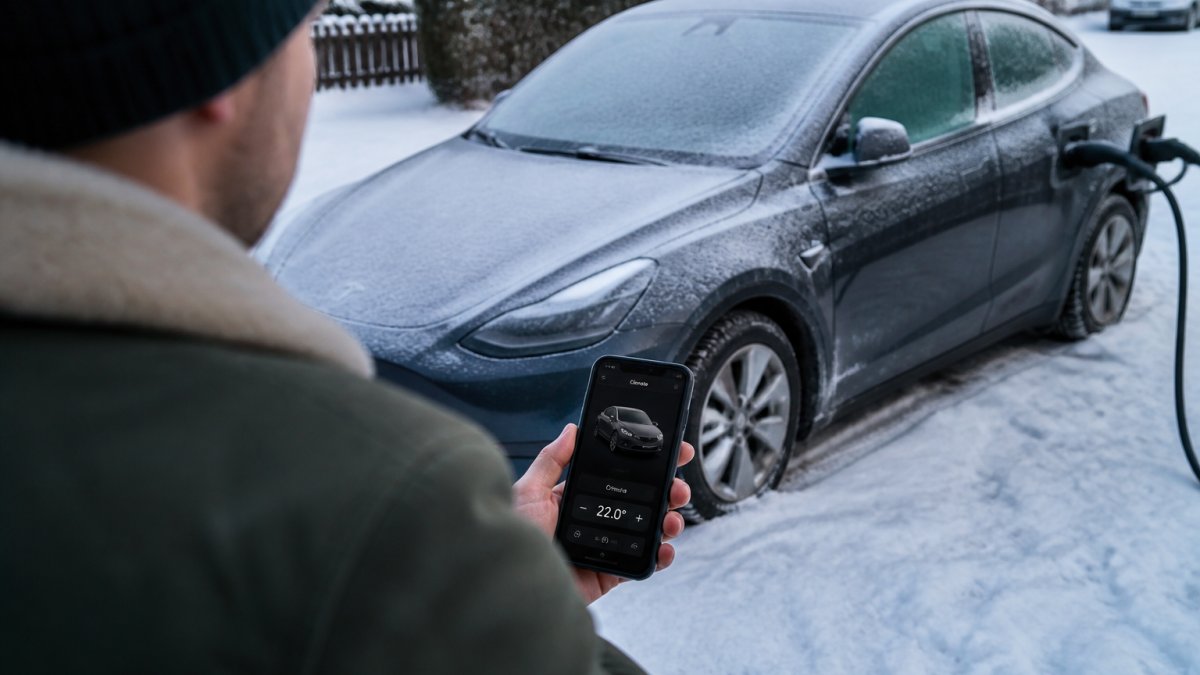
Tesla Model 3 parked in snow with frost on windows, owner using smartphone to precondition vehicle while charger cable is connected
Pro TipSet a phone reminder to precondition 15 minutes before you leave. Most EV owners forget this step and lose range they could easily have kept. It's the simplest win in winter driving.
Does Heating Affect Electric Car Range and How to Minimise Impact
Yes, heating affects electric car range significantly. Cabin heating is one of the largest energy draws in cold weather, sometimes using as much power as the motor itself during city driving.
When you blast the heater at full temperature, you're pulling 5-10 kW of power continuously. Over a 30-minute drive, that's a substantial drain on your battery. In winter conditions, cabin heating can reduce your range by 10-20% on its own.
The solution is to use heat strategically, not to avoid it entirely. You need warmth to stay safe and comfortable. The trick is to use the most efficient heating methods available.
Using the OTC Heater Efficiently
An OTC heater is an auxiliary heating system that supplements or replaces the main cabin heater in some electric vehicles. It's more efficient than relying solely on the main resistive heater, especially in very cold conditions.
If your Tesla Model 3 or Model Y is equipped with a heat pump, you already have an efficient heating system. The heat pump moves warmth from the battery and motor rather than generating it electrically. This saves significant energy compared to a resistive heater.
To minimise heating impact on your range:
Set the cabin temperature to 20-21°C rather than maximum heat
Use seat heaters instead of cabin heating when possible, they warm you directly and use less power
Enable heated steering wheel only when needed
Close air vents you're not using to maintain warm air where you sit
Precondition the cabin while plugged in, as noted above
Seat heaters are dramatically more efficient than cabin heating. A heated seat uses 100-150W. The cabin heater uses 5,000-10,000W. If you're warm enough with the seat heater running, you've just saved enormous amounts of battery energy.
Watch OutRunning the cabin heater at maximum temperature in very cold weather can reduce your range by 25% or more. This is the single biggest drain on winter battery performance after cold battery chemistry itself. Use seat heaters and lower cabin temperatures instead.
EV Cold Weather Charging: Optimising Battery Performance
Cold weather changes how your battery accepts a charge. A frozen battery charges more slowly and less completely than a warm one. Understanding this helps you plan charging sessions and protect long-term battery health.
When you charge a cold battery, the car limits the charging current to prevent damage. This is a safety feature. A battery that's too cold can't accept charge efficiently, and forcing current through it causes internal stress.
Precondition your battery before charging whenever possible. Plug in your car, start preconditioning, and wait 10-15 minutes before beginning a full charge session. The battery will warm up slightly and accept charge faster.
For overnight charging in winter:
Plug in as soon as you arrive home
Start preconditioning immediately
Let the car sit for 15 minutes to warm the battery
Then begin charging to your target level
This approach means your battery wakes up warm and ready, rather than trying to charge from a deeply cold state.
Avoid rapid DC charging when the battery is very cold. If you've just arrived at a charger and the car is freezing, precondition for 10-15 minutes first. The slight delay saves the battery from stress and improves the charging speed overall.
For EV owners in Kettering needing professional advice on battery health during winter, KMC Electric offers independent battery health assessments.
Tesla Model 3 Winter Range: What to Expect and How to Maximise It
The Tesla Model 3 loses roughly 20-30% of its EPA-rated range in cold weather, depending on the exact temperature and your driving style. If your Model 3 is rated for 400 km of range, expect closer to 280-320 km in winter.
This loss is unavoidable. Cold battery chemistry is the root cause. But you can recover much of it through the techniques covered here.
Start with preconditioning. That alone recovers 5-10% of lost range by ensuring your battery and cabin are warm before you drive. Add efficient heating practices and you're back another 5-10%. Combine these with careful driving technique and you can recover 15-20% of the winter loss.
Plan your winter journeys with margin. If you normally drive 300 km between charges, reduce that to 250 km in winter. This keeps you out of the battery's low-power zone and ensures you reach a charger with confidence.
Use the Tesla navigation system's range prediction. It accounts for cold weather automatically. Trust its estimates rather than summer range figures.
For Model Y owners, the same principles apply. The Model Y is heavier and uses slightly more energy overall, but the percentage range loss in cold weather is similar to the Model 3.
Key TakeawayCold weather reduces Tesla Model 3 and Model Y range by 20-30%. Preconditioning, efficient heating, and careful driving can recover 15-20% of that loss. Plan journeys with a safety margin and you'll stay comfortable and confident all winter.
Winter Driving Techniques to Preserve Battery Energy
How you drive in winter affects your range as much as the cold itself. Aggressive acceleration, high speeds, and harsh braking all waste battery energy.
Accelerate gently. EV motors are most efficient at moderate acceleration. Flooring the accelerator draws peak power and drains your battery quickly. Ease onto the throttle instead.
Maintain steady speeds. Motorway driving at 60 mph uses less energy than constant acceleration and braking in town.
Regenerative braking recovers energy when you slow down. Let the car coast and brake gently whenever possible. Avoid hard braking, which wastes the kinetic energy you could have recaptured.
Use one-pedal driving if your Tesla supports it. Lifting off the accelerator triggers strong regenerative braking, slowing the car while recovering energy.
Plan your route to avoid steep hills if possible. Climbing hills uses significant energy.
Reduce tyre pressure slightly in winter, but only to the minimum recommended by Tesla. Colder air contracts, lowering pressure naturally. Under-inflated tyres increase rolling resistance and waste energy.
Keep your windscreen and headlights clear of ice and snow. Aerodynamic drag increases with ice buildup. Clean snow and ice off your car before driving.
Monitoring and Maintaining Your EV Battery in Winter
Winter is when battery problems become visible. Cold temperatures stress the battery and reveal weaknesses that might not show in summer. Monitor your battery health closely.
Check your battery's state of health using the Tesla diagnostics menu. This shows you the battery's current capacity relative to when it was new.
If you notice permanent capacity loss, your maximum range is lower in spring than it was last spring, your battery may be degrading.
Avoid letting your battery drain completely in winter. Cold batteries under heavy discharge stress degrade faster. Keep your charge level above 20% in winter when possible.
Don't charge to 100% every night. Charging to 80% and leaving it there is gentler on the battery, especially in cold weather.
For used EV buyers in the Midlands, battery health assessment is critical before purchase. Cold weather can mask battery problems or exaggerate normal winter range loss.
Extending your EV battery range in cold weather comes down to three practices: precondition before driving, heat efficiently, and drive smoothly.
If you're buying a used Tesla or managing an out-of-warranty vehicle, understanding your battery's actual health is essential.
Frequently Asked Questions
How much range does an EV lose in cold weather?
Electric vehicles typically lose 20-40% of their range in freezing conditions, depending on temperature, heating use, and driving style. Tesla Model 3 and Model Y owners often see the most significant losses when cabin heating is active. The battery itself becomes less efficient in cold, and heating the cabin draws substantial energy. Preconditioning whilst plugged in and minimising cabin heat use can recover some of this lost range.
Should I precondition my EV before driving in cold weather?
Yes, preconditioning is one of the most effective ways to extend EV battery range in cold weather. By warming the battery and cabin whilst your vehicle is still plugged in, you avoid draining the battery for heating during your journey. For Tesla Model 3 and Model Y, activate preconditioning through the climate menu 10-15 minutes before departure. This ensures the battery reaches optimal operating temperature and reduces the energy needed for cabin heating once you're driving.
Does using the heater reduce EV battery range significantly?
Heating has a substantial impact on electric car range, particularly cabin heating. In cold weather, cabin heating can consume 20-30% of your battery's available energy. Using seat heaters and steering wheel heaters instead of cabin heating is more efficient, as they warm you directly rather than heating the entire cabin. The OTC Heater and heat pump systems (where fitted) are more efficient than traditional resistance heaters, but any heating draws power that would otherwise extend your driving range.
What's the best way to charge an EV in cold weather?
For EV cold weather charging, precondition your battery before plugging in if possible, as this optimises charging efficiency. Charge to 80% rather than 100% in winter, as cold batteries charge more slowly and charging to full capacity stresses the battery in low temperatures. Keep your vehicle in a sheltered location or garage if available. Allow extra charging time compared to summer months, and avoid rapid DC charging in extreme cold unless necessary, as it can stress the battery. Check your Tesla Model 3 or Model Y's climate settings to ensure the thermal management system is active during charging.