Why High Voltage Safety Training Matters for Automotive Technicians
Working on electric vehicles demands a completely different skill set than traditional petrol cars. The moment you connect to a high voltage system without proper training, you're working with lethal energy. A single mistake can cause serious injury or death.
High voltage safety training for automotive technicians is not optional. It's the foundation of safe EV work. The difference between a trained technician and an untrained one isn't just competence, it's survival.
The stakes are straightforward: electric vehicles carry voltages that can kill instantly. A Tesla battery pack runs at 400 volts. That's enough to stop your heart. Proper high voltage safety training teaches you how to isolate systems, wear the right protective gear, and respond to emergencies before they become disasters.
Understanding the EV High Voltage Isolation Procedure
The EV high voltage isolation procedure is your first line of defence. It's the process of disconnecting and securing all high voltage power before you touch anything.
Most technicians think this is simple. It's not. Isolation requires specific steps in the correct order, proper lockout procedures, and verification that the system is actually dead before you proceed.
Identifying the High Voltage System
Before you isolate anything, you need to locate the high voltage system. On a Tesla, this includes the main battery pack, the high voltage contactor, and the charging system. Different EV models have different layouts, so you must know your vehicle.
The high voltage system is usually colour-coded orange on modern EVs. Follow the orange cables. They lead you to the components that can kill you.
Never assume you know where the high voltage system is. Check the vehicle's technical manual. Confirm visually. Ask yourself: am I looking at the right component? Uncertainty is dangerous. Certainty requires training.
Isolation Steps and Lockout Procedures
Isolation happens in stages. First, you disconnect the 12-volt battery. This disables the vehicle's control systems. Second, you locate and open the high voltage disconnect switch. This physically separates the battery from the rest of the system.
The lockout procedure is critical. After isolation, you apply a padlock to the disconnect switch. The padlock stays there until your work is finished. No one else can reconnect the system without your permission.
This is not paranoia. This is procedure. Multiple technicians working on the same vehicle have died because someone reconnected the system while another person was still working on it.
Verification comes next. Use a multimeter to confirm zero voltage across the high voltage terminals. Test twice. Document your results. Only then do you begin work.
High Voltage PPE for EV Technicians: What You Need
Personal protective equipment for high voltage work is not casual. It's engineered to survive electrical contact and protect your body.
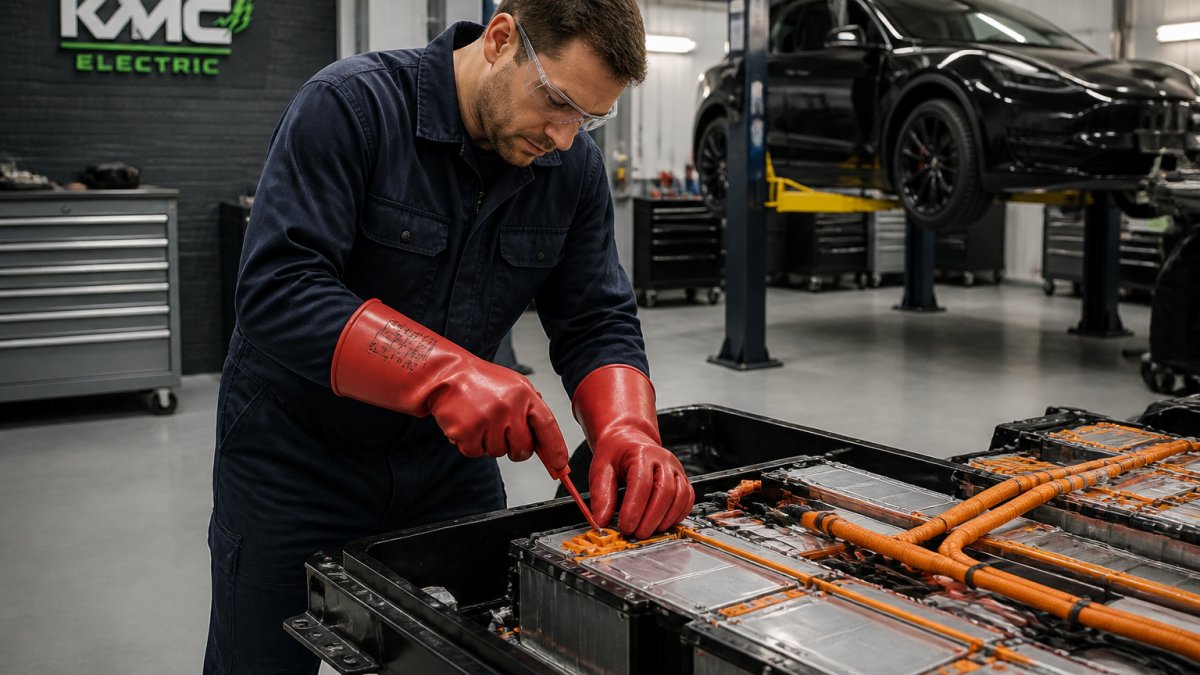
Technician wearing high voltage PPE gloves and gear while working on an exposed electric vehicle battery pack
Personal Protective Equipment Specifications
High voltage gloves are the most critical piece. They must be rated for the voltage you're working with. For EV work, that's typically 400-600 volts. Ordinary work gloves offer zero protection.
Insulated gloves come in different ratings:
Class 0: 500 volts
Class 1: 7,500 volts
Class 2: 17,500 volts
Class 3: 26,500 volts
For EV work in the UK, Class 0 or Class 1 gloves are standard. They're bulky. They reduce dexterity. You'll find them uncomfortable. That discomfort keeps you alive.
Arc-rated clothing is your second layer. This includes long-sleeved shirts and trousers made from fire-resistant material. If electrical contact occurs, this clothing prevents burns. It buys you seconds to break contact.
Safety goggles with side shields protect your eyes from arc flash. An arc flash happens when current jumps across a gap. It's bright enough to cause permanent eye damage. The side shields protect against flying debris.
Insulated boots with conductive soles ground your body safely. They prevent static buildup and ensure proper electrical grounding during work.
Inspection and Maintenance of PPE
PPE fails silently. A small hole in a glove. A crack in the sole of a boot. You won't notice until it's too late.
Inspect your PPE before every use:
Check gloves for tears, punctures, and thin spots
Test the flexibility of the material
Verify that seams are intact
Look for discolouration or brittleness
Confirm that size and fit haven't changed
Replace PPE annually or immediately after any incident. Don't wash high voltage gloves. Don't repair them. Replace them.
Store PPE away from direct sunlight and extreme temperatures. UV light degrades the material. Heat makes it brittle. Cold makes it stiff. Proper storage extends the life of your equipment.
IMI Level 4 EV Technician Training: The Gold Standard
The Institute of the Motor Industry (IMI) Level 4 qualification in electric vehicle technology is the gold standard for EV technician training in the UK. It's the certification that separates specialists from amateurs.
Level 4 covers everything: high voltage systems, battery chemistry, thermal management, charging architecture, and fault diagnosis. It's not a weekend course. It's a serious qualification that takes months to complete.
KMC Electric's technicians hold Level 4 status. This qualification is not just a credential. It's proof that we understand EV systems at a depth that most technicians never reach.
The training includes practical work on real vehicles. You don't learn high voltage safety from a textbook. You learn it by doing the work under supervision. You practice isolation procedures. You handle high voltage PPE. You respond to simulated emergencies.
Without this training, you're guessing. With it, you're working from proven procedures and deep technical knowledge.
Electric Vehicle Technician Training in the UK: Pathways and Requirements
The UK has clear pathways for EV technician training. The Institute of the Motor Industry sets the standards. The Health and Safety Executive (HSE) enforces the regulations. Your employer has a legal duty to ensure you're properly trained.
Recognition and Certification Levels
IMI qualifications come in levels:
Level 2: Basic EV knowledge and safety awareness
Level 3: Intermediate EV system diagnosis and repair
Level 4: Advanced EV systems, high voltage work, and specialisation
Level 4 is where high voltage safety training becomes mandatory. You cannot legally work on high voltage systems without this certification. The HSE doesn't recommend this. It requires it.
Certification is not permanent. You must maintain your skills. The industry changes rapidly. New vehicle models arrive with new systems. Your training must keep pace.
Refresher Training and Ongoing Competence
Refresher training is required every two years. This isn't bureaucracy. It's necessity. Vehicles evolve. Procedures improve. Safety standards tighten.
At KMC Electric, we maintain ongoing training schedules. Our technicians complete refresher courses regularly. We track competence across every technician. We verify that everyone meets current standards.
Ongoing competence means you understand the latest EV models. You know the newest diagnostic tools. You follow the most current safety procedures. You stay ahead of the vehicle technology.
Emergency Response Protocols and Safety Checks
Emergencies happen. A technician collapses. A fire starts. A high voltage arc occurs. Your response in the first seconds determines whether someone lives or dies.
Pre-Work Safety Verification
Before you touch anything, run through a safety checklist:
Confirm the vehicle is in Park with the parking brake engaged
Verify the 12-volt battery is disconnected
Check that the high voltage disconnect switch is open
Test for zero voltage using a calibrated multimeter
Confirm that all high voltage connections are visible and accessible
Ensure emergency equipment is nearby and accessible
Brief all team members on the work plan and emergency procedures
This checklist takes five minutes. Skipping it takes five seconds. The difference is catastrophic.
Incident Response and First Aid for High Voltage Exposure
If someone contacts high voltage, your first action is to break the contact. Do not touch the person directly. Use an insulated object to push them away from the source.
Call emergency services immediately. Provide them with exact details: voltage, duration of contact, visible injuries. High voltage injuries often cause internal damage that's not visible on the skin.
First aid for high voltage exposure includes:
CPR if the person is unresponsive
Recovery position if they're breathing but unconscious
Monitoring for cardiac arrhythmias
Keeping the person warm and calm
Never leaving them unattended
High voltage injuries are serious. Even if the person seems fine, they need hospital assessment. Internal burns can develop hours after contact.
Common Mistakes in High Voltage Safety Training
Most mistakes happen because people underestimate the danger. They think they understand the risk. They don't.
The first mistake is skipping isolation. Someone is in a hurry. They think they can work quickly without full isolation. Electricity doesn't care about your schedule. It kills just as fast when you're rushing.
The second mistake is trusting visual inspection. You look at a high voltage connector and assume it's isolated. You don't test it with a multimeter. You proceed anyway. Then you touch it and discover it was still live.
The third mistake is reusing old PPE. Gloves get thin. Boots crack. You've used them a hundred times without incident. You assume they're fine. Then they fail, and you don't get a second chance.
The fourth mistake is working alone. If something goes wrong, there's no one to help. No one to call emergency services. No one to perform CPR. Always work with another trained technician present.
The fifth mistake is incomplete training. Someone takes a basic course and thinks they're ready for high voltage work. They're not. Level 4 training exists because basic training is insufficient. The complexity of EV systems demands specialised knowledge.
High voltage safety training for automotive technicians is not negotiable. It's the difference between a career and a tragedy. The procedures are specific. The equipment is essential. The training must be current.
If you're working on electric vehicles in Kettering, Northamptonshire, or across the Midlands, ensure your team has proper high voltage safety training. At KMC Electric, we've maintained Level 4 technician status since 2016. We understand EV systems at a depth that protects your vehicles and your people. Contact KMC Electric to discuss your team's training needs and get your technicians properly certified.
Frequently Asked Questions
What high voltage training do automotive technicians need to work on electric vehicles?
Technicians must complete high voltage awareness training as a minimum, which covers identification of high voltage systems, basic safety principles, and hazard recognition. For hands-on work on high voltage components, IMI Level 3 or Level 4 EV technician training is required. Level 4 represents full competence and is the standard expected by independent specialists like KMC Electric. The specific level depends on the work scope: diagnostics and repairs require higher certification than awareness-only roles.
What does high voltage awareness training cover?
High voltage awareness training teaches technicians to identify high voltage systems in electric vehicles, understand the hazards of working with these systems, recognise warning labels and colour coding, and know when to involve a qualified technician. It covers basic electrical principles specific to EVs, the layout of high voltage circuits in common vehicle types, and the importance of isolation procedures. This foundation is essential even for technicians who don't directly work on high voltage components.
How often should automotive technicians refresh their high voltage safety training?
High voltage safety training should be refreshed every 24 months to maintain competence and compliance with industry standards. However, if a technician hasn't worked on high voltage systems for more than 12 months, a refresher is strongly recommended before resuming work. Changes in vehicle technology, new safety procedures, and regulatory updates make regular refresher training essential. KMC Electric maintains current certifications and refresher training schedules to ensure technicians stay current with evolving EV standards.
What safety checks should technicians complete before working on an electric vehicle?
Before starting work, technicians must verify the vehicle is in Park (or Neutral), disable the high voltage system using the correct isolation procedure, confirm isolation with a multimeter, and lock out the system to prevent accidental re-energisation. Visual inspection of the battery pack, connectors, and wiring is essential to identify damage or corrosion. Check that all high voltage warning labels are visible and intact. Only after these checks are complete should any work begin. KMC Electric follows these protocols on every EV that enters the workshop.