Demand for alternatives to main dealer Tesla servicing has grown significantly across the UK, driven by long wait times at Tesla Service Centers, rising repair costs, and a maturing fleet of out-of-warranty vehicles. This guide from KMC Electric, an independent EV specialist based in Kettering, Northamptonshire, covers every option available to Tesla owners in 2026: from vetted independent garages to selective DIY tasks. Below, we'll show you exactly how to choose the right service route, what the law says about your warranty, and how to vet a qualified technician near you. The one thing most guides get wrong? They treat this as a binary choice between Tesla and "everyone else." The reality is far more nuanced.
Why Tesla Owners Are Exploring Alternatives to Main Dealer Servicing
Tesla's direct-service model was a genuine innovation when the fleet was small. Now it's a bottleneck. Owners across the UK report waiting weeks for routine appointments at Tesla Service Centers, and the pricing for out-of-warranty repairs can be substantial. For Model S and Model X owners in particular, whose vehicles are now well beyond the standard warranty period, the case for independent Tesla servicing has never been stronger.
The right to repair movement has reshaped the landscape considerably. As documented in UK Right to Repair regulations overview, consumers have strengthened protections around accessing independent repair services, and automotive manufacturers cannot legally void warranties solely because a vehicle was serviced outside their network. That changes the calculation entirely.
There are three practical reasons Tesla owners in Kettering and across Northamptonshire are actively seeking alternatives:
Cost: Independent specialists typically charge lower labour rates than main dealer networks
Availability: Local independent garages often have faster booking slots
Expertise: A growing number of EV-specialised technicians now hold formal qualifications, including Level 4 Master Technician status
The throughline of this guide is simple: independent servicing is not a compromise. For the right vehicle, at the right mileage, with the right technician, it is often the better choice.
Tesla Warranty Coverage and Independent Service: What the Law Actually Says
Understanding Tesla warranty coverage for independent service is the first thing every owner should sort before booking anywhere other than a Tesla Service Center.
Does Using an Independent Shop Void Your Tesla Warranty?
Using an independent shop does not automatically void your Tesla warranty. Under UK and EU consumer protection law, a manufacturer cannot void a warranty simply because a vehicle was serviced outside its authorised network, provided the work was carried out to the correct standard and using appropriate parts. This principle is reinforced by Competition and Markets Authority guidance on warranties and repairs.
The practical caveats are worth knowing:
If an independent shop causes damage through poor workmanship, Tesla can legitimately decline to cover that specific fault under warranty
Software updates and over-the-air firmware changes remain under Tesla's control regardless of who services the vehicle
Warranty claims involving high-voltage battery pack components may receive additional scrutiny if non-OEM parts were used
The safest approach: keep detailed service records from any independent shop, ensure they use OEM parts or approved equivalents, and confirm the technician holds recognised EV qualifications.
Out-of-Warranty Vehicles: Where Independent Shops Truly Shine
Once a Tesla is out of warranty, the main dealer argument weakens considerably. Tesla Service Center pricing for out-of-warranty repairs reflects main dealer overhead. Independent EV repair shops, by contrast, can offer the same diagnostic capability at a meaningfully lower cost.
This is where KMC Electric's model is particularly well-suited. With over 25 years of automotive experience and EV qualifications dating to 2016, the Kettering-based team handles out-of-warranty repairs across all Tesla models, including Model 3, Model Y, Model S, and Model X. Independent battery health verification is one of the most requested services for vehicles in this category, particularly for owners buying or selling used Teslas.
Pro TipBefore your Tesla's warranty expires, book an independent pre-expiry health assessment. A qualified technician can identify developing faults that are still covered, saving significant cost compared to addressing them post-warranty.
Tesla Service Center vs. Independent EV Repair Shop: A Direct Comparison
The choice between a Tesla Service Center and an independent EV repair shop comes down to what your vehicle needs, not brand loyalty.
A professional EV technician working at an independent specialist has access to the same diagnostic data as a main dealer, provided they use the right tools. Tesla's official web-based platform, Tesla Toolbox 3, is available to independent shops and provides access to fault codes, system tests, sensor calibrations, and live CAN bus data. Third-party tools such as the LOKI Diagnostic Tool offer an alternative for shops that prefer a dedicated hardware solution, covering key programming and self-test functions across Model 3, Model Y, Model S, and Model X.
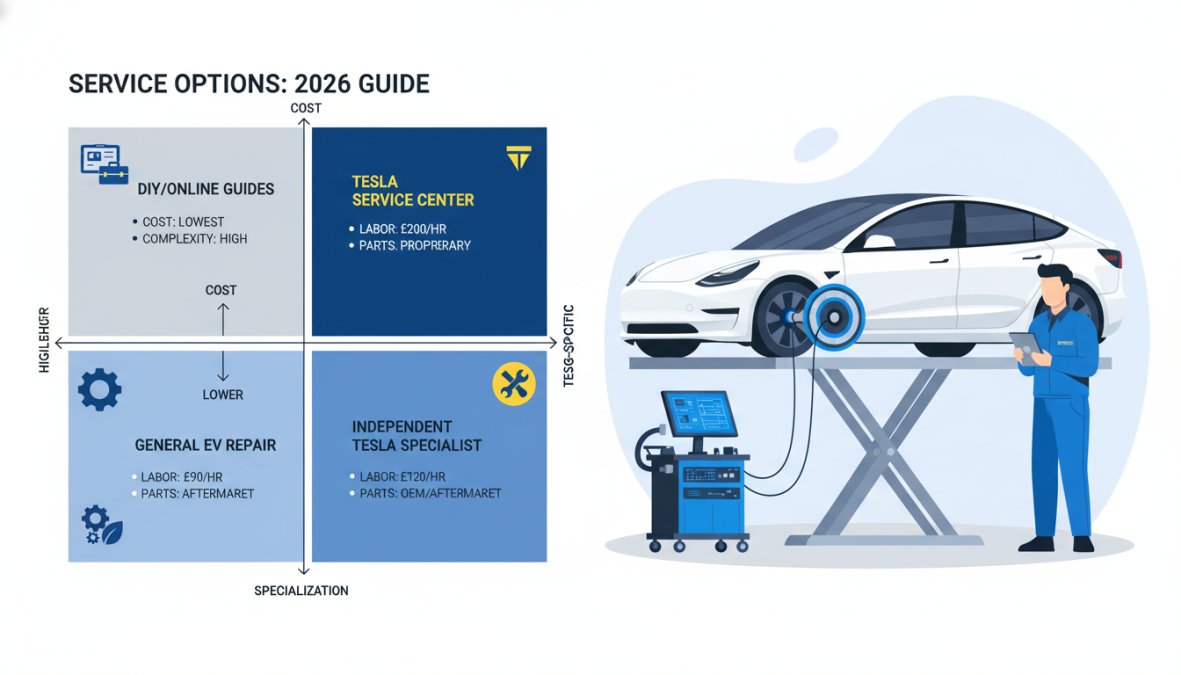
Visual comparison chart showing Tesla Model for alternatives to main dealer Tesla servicing
Pros and Cons of Each Option
Factor
Tesla Service Center
Independent EV Specialist
Booking availability
Often 2-4 weeks
Typically faster
Labour cost
Main dealer rates
Generally lower
OTA software updates
Full access
Via Toolbox 3 or mobile service
Warranty work (in-warranty)
Preferred route
Legally valid alternative
Out-of-warranty repairs
Available, higher cost
Strong value proposition
High-voltage battery work
Full capability
Depends on technician qualification
Local convenience
Limited locations
More geographically distributed
Personalised service
Standardised process
Direct technician relationship
Tesla Service Center: Pros
Direct access to proprietary repair authorisation for warranty claims
Guaranteed use of OEM parts
Over-the-air software update integration
Tesla Service Center: Cons
Long wait times in many UK regions
Higher labour rates, particularly for out-of-warranty vehicles
Service bay availability varies significantly by location
Independent EV Specialist: Pros
Faster turnaround on routine maintenance and diagnostics
Cost-effective for out-of-warranty repairs
Technicians with Tesla-specific training provide comparable diagnostic depth
Independent EV Specialist: Cons
Quality varies: vetting is essential (see the checklist below)
High-voltage battery replacements require specialist equipment not all shops carry
Some insurance policies specify authorised repairers
Tesla Annual Maintenance Cost: Dealership Prices vs. Independent Specialists
Tesla's maintenance requirements are genuinely lower than those of combustion-engine vehicles, but the annual maintenance cost still adds up, particularly for older models. The comparison between main dealer and independent pricing is where the financial case for alternatives becomes concrete, and where most guides stop short by listing tasks without attaching real numbers or a decision framework.
Common Maintenance Tasks: Typical Cost Ranges and Who Should Do Them
The table below reflects typical UK market pricing as of 2026. Tesla Service Center pricing is based on published rates and widely reported owner experience. Independent specialist pricing reflects the range you should expect from a qualified EV-specific garage; a general mechanic quoting below this range for high-voltage-adjacent work is a red flag, not a bargain.
Task
Frequency
Tesla Service Center (est.)
Independent EV Specialist (est.)
DIY Viable?
Tyre rotation
Every 10,000-12,000 miles
£50-£80
£30-£55
Yes, with lifting pucks
Wheel alignment
As needed / annually
£80-£120
£55-£90
No
Brake fluid flush
Every 2 years
£120-£180
£70-£110
No, HV risk
Cabin air filter (standard)
Every 2 years
£60-£90 incl. parts
£35-£60 incl. parts
Yes
Cabin air filter (HEPA, Model S/X)
Every 3 years
£150-£220 incl. parts
£90-£140 incl. parts
Yes, with care
Drive unit fluid check/top-up
Every 4 years or as flagged
£80-£130
£50-£85
No, requires diagnostics
Battery health assessment
Pre-sale / post-4 years
£150-£250
£80-£150
Partial (Scan My Tesla)
Wiper blade replacement
Annually
£30-£60
£20-£40
Yes
Handbrake motor replacement (Model 3/Y)
As needed
£200-£350 incl. labour
£100-£180 incl. parts from ~£60
No
Ranges reflect variation by region, model, and individual shop. Always request a written quote before authorising work.
The Cost Decision Framework: When Independent Wins, When It Doesn't
The financial case for independent servicing is not uniform across every task. Use this logic to decide:
Independent specialist is the clear choice when:
The vehicle is out of warranty and the task is routine (tyre rotation, fluid flush, filter replacement)
You need a battery health assessment for a purchase or sale decision, independent reports carry no conflict of interest
You are in a region where the nearest Tesla Service Center requires a round trip of more than 60-90 minutes, making the time cost of a main dealer visit disproportionate to the task
The repair involves a known wear item (handbrake motor, door handle mechanism on older Model S) where parts are now widely available through independent distributors
Tesla Service Center remains the better choice when:
The vehicle is within its New Vehicle Limited Warranty and the fault is likely warranty-covered, independent repair of a warranty fault, even if legally valid, adds friction to the claim process
The repair requires a software authorisation token that Tesla has not yet made available through Toolbox 3 (certain module replacements still fall into this category as of 2026)
The work involves a recall or service bulletin that Tesla is completing at no charge
The break-even calculation most owners miss: For a Model 3 Long Range out of warranty, a typical two-year maintenance cycle (brake fluid flush, cabin filter, tyre rotation twice, alignment check) costs roughly £350-£480 at a Tesla Service Center versus £200-£310 at a qualified independent specialist. Over a five-year post-warranty period, that differential compounds to a meaningful saving, before accounting for any unscheduled repairs where independent labour rates provide additional headroom.
Pro TipKMC Electric stocks Tesla drive unit fluid at £16.99 and handbrake motors for Model 3, Model Y, Model S, and Model X at £60.00. If you are comparing quotes from independent specialists, these are useful reference points for parts cost, a shop charging significantly above these figures for the same OEM-specification components warrants a follow-up question.
Watch OutNever allow a general mechanic without EV-specific training to perform a brake fluid flush or any procedure near the high-voltage system. Incorrect handling of high-voltage components carries serious safety risk and can cause expensive ancillary damage that will not be covered by any warranty.
What the Cost Comparison Doesn't Capture
Raw labour and parts cost is only part of the picture. Two factors that owners consistently underweight:
Booking lead time as a cost. A four-week wait at a Tesla Service Center for a brake fluid flush means four weeks of a service interval overrun. For owners who cover high annual mileage, that delay has a real maintenance consequence, not just an inconvenience cost.
Service record quality as a resale asset. A detailed, itemised service record from a qualified independent specialist, one that includes the technician's EV qualification level and the part specifications used, is increasingly valued by used Tesla buyers and finance providers. Owners who treat independent servicing as a cost-cutting measure but maintain rigorous documentation often recover that value at point of sale.
How to Find and Vet a Qualified Independent Tesla Mechanic
The biggest mistake Tesla owners make when seeking independent service is treating EV qualification as a binary yes/no question. The depth of training matters enormously, particularly for anything beyond routine maintenance.
A common approach is to search "Tesla mechanic near me" or "independent Tesla service Kettering" and book the first result. That approach works fine for tyre rotation. It is not sufficient for diagnostics, high-voltage work, or battery health assessments.
Regional Vetting Checklist: What to Ask Before You Book
Use this checklist before committing to any independent Tesla service provider:
Does the technician hold a formal EV qualification? Ask specifically for the level (Level 3 minimum; Level 4 Master Technician for complex work)
What year did they gain their EV qualification? Experience since 2016 or earlier indicates a practitioner who has worked through multiple Tesla generations
Do they have access to Tesla Toolbox 3 or an equivalent diagnostic tool capable of reading and clearing Tesla-specific DTCs?
Can they provide evidence of Tesla-specific training, not just general EV awareness?
Do they stock or have reliable access to OEM Tesla parts?
Will they provide a written service record suitable for warranty documentation?
Are they insured for high-voltage EV work?
Can they handle the specific model you own? (Model S and Model X have different architectures to Model 3 and Model Y)
Do they have experience with the Cybertruck if applicable?
Community resources such as Tesla Motors Club UK forum are genuinely useful for regional recommendations. Members frequently share first-hand accounts of independent specialists, including specific feedback on diagnostic capability and pricing.
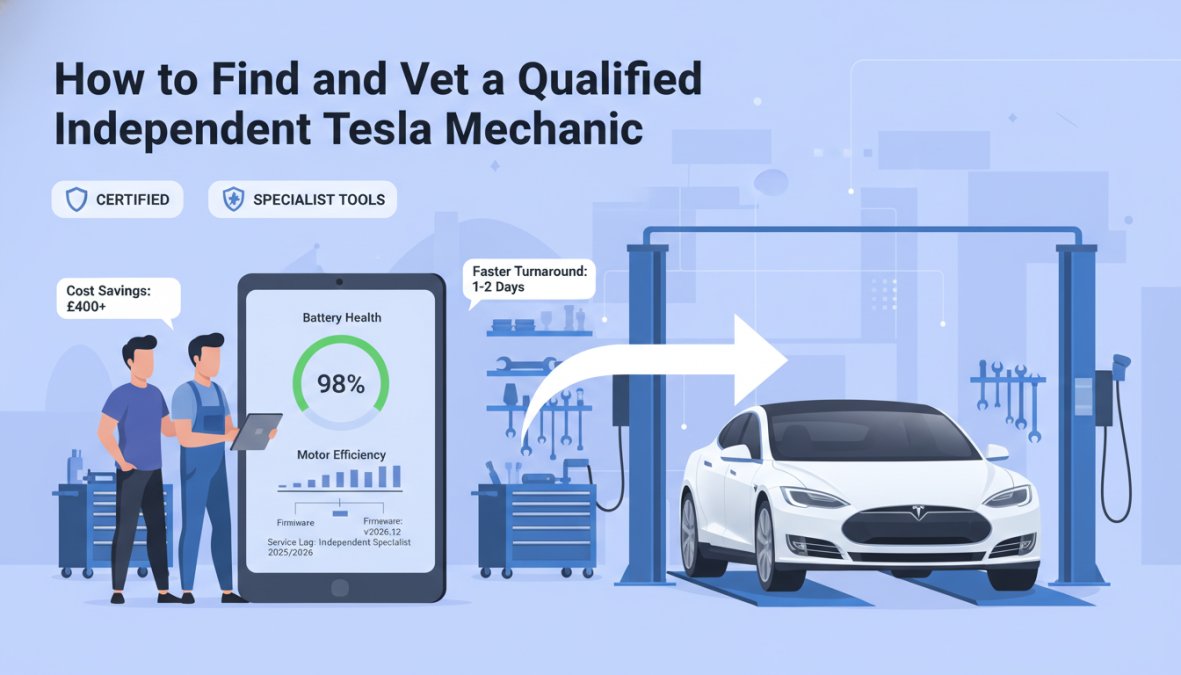
Step-by-step visual guide for alternatives to main dealer Tesla servicing
Tesla DIY Maintenance Guide: What You Can Do Yourself
Some Tesla maintenance tasks are straightforward enough for a confident owner to handle without professional help. Others carry real risk if approached without the right knowledge or tools. The distinction is not always obvious.
Safe DIY tasks for most Tesla owners include cabin air filter replacement, windscreen washer fluid top-up, and tyre pressure checks. Tyre rotation is achievable at home provided you use Tesla-specific lifting pucks to avoid damaging the battery pack during jacking. Apps such as Scan My Tesla, which connects via a Bluetooth OBD-II adapter, provide real-time battery temperature, voltage, and charging statistics without requiring workshop access.
What most guides miss is the importance of long-term data logging. TeslaMate, a free open-source self-hosted logger, tracks battery degradation, charging session history, and software update history over time. For owners planning to sell, this data provides independent battery health verification that commands buyer confidence.
DIY vs. Independent vs. Dealer: A Decision Matrix
Task
DIY
Independent Specialist
Tesla Service Center
Cabin air filter
Yes, straightforward
Yes
Yes
Tyre rotation
Yes, with lifting pucks
Yes
Yes
Brake fluid flush
No - high-voltage risk
Yes, with qualified tech
Yes
Drive train oil check
No - requires diagnostics
Yes
Yes
Battery health assessment
Partial (Scan My Tesla)
Full independent report
Yes
Fault code diagnosis
Read-only (Scan My Tesla)
Full read/clear/repair
Yes
Warranty repair
No
Yes (legally valid)
Preferred route
Software update
No
Via Toolbox 3
Yes (OTA)
Hand brake motor replacement
No
Yes - parts available from £60
Yes
For Model 3 and Model Y owners, the hand brake electric motor is a known wear item. KMC Electric stocks this part at £60.00, and the same part is available for Model S and Model X at the same price point, making independent repair a straightforward cost comparison against main dealer labour rates.
Key TakeawayThe DIY vs. independent vs. dealer decision is not about brand loyalty. Match the complexity of the task to the qualification level of whoever is doing the work. Routine tasks can often be handled independently; anything involving the high-voltage system requires a qualified EV technician.
Access to Diagnostic Equipment, Parts, and Service Manuals
One of the most persistent myths about non-dealership Tesla repairs is that independent shops cannot access the same diagnostic depth as a Tesla Service Center. This is no longer accurate. But diagnostic access is only one part of the equation. The question most guides never answer is: where do independent shops actually get their parts, and does it matter which route they use?
Diagnostic Tools: What Independent Shops Can and Cannot Access
Tesla's repair authorisation framework has evolved significantly. The primary tools available to independent shops are:
Tesla Toolbox 3 is Tesla's official web-based diagnostic platform, available to independent professionals via a paid subscription. It provides factory-level access to fault code reading and clearing, sensor calibrations, actuator tests, live CAN bus data, module programming, and Theory of Operation documentation. A qualified independent technician working through Toolbox 3 is operating from the same diagnostic logic as a main dealer technician.
LOKI Diagnostic Tool is a dedicated hardware alternative favoured by some independent specialists for its offline capability and Tesla-specific coverage across Model 3, Model Y, Model S, and Model X. It covers key programming, self-test functions, and fault code management without requiring a live internet connection, useful in workshop environments with variable connectivity.
Scan My Tesla (via Bluetooth OBD-II adapter) is the owner-facing tier. It provides real-time battery temperature, cell voltage, state of health estimates, and charging statistics. It cannot clear fault codes or perform calibrations, but it is a legitimate first-pass diagnostic tool for owners who want visibility before booking a professional.
The honest limitation: certain module replacement procedures still require a Tesla-issued authorisation token that is only available through Tesla's internal systems, not through Toolbox 3. As of 2026, this applies to a small subset of high-voltage battery management module replacements and some MCU-related programming tasks. A qualified independent shop will tell you upfront if a specific repair falls into this category rather than attempting it without the correct authorisation.
Parts Sourcing: The Guide Most Articles Skip
This is the area where the quality gap between independent shops is most pronounced, and where owners are most exposed if they do not ask the right questions.
Independent Tesla specialists source parts through several distinct channels, each with different implications for quality, warranty documentation, and safety:
Channel 1: OEM parts via authorised distributors A growing number of Tesla OEM components are available through authorised parts distributors to professional independent shops. These are the same specification parts used by Tesla Service Centers, carry the correct part numbers for service documentation, and are the appropriate choice for any safety-critical component. Examples include pyro fuses (available through KMC Electric at £39.99 to OEM specification), drive unit seals, and brake system components.
Owner implication: Ask the shop to confirm the part number and distributor for any safety-critical component. A legitimate shop will provide this without hesitation. This documentation also matters for warranty claims and insurance purposes.
Channel 2: OEM-equivalent parts from specialist EV suppliers For non-safety-critical wear items, cabin air filters, wiper blades, door handle components, certain suspension bushes, OEM-equivalent parts from reputable EV-specialist suppliers are a reasonable and cost-effective choice. The key qualifier is 'reputable': parts sourced from established EV component suppliers with documented specifications are materially different from generic aftermarket parts sourced on price alone.
Owner implication: For these components, ask whether the part meets the original specification and whether the supplier provides a product warranty. A shop that cannot answer this question is sourcing on price, not quality.
Channel 3: Salvage and reconditioned parts For older, out-of-warranty vehicles, particularly Model S and Model X, reconditioned components (drive units, door handles, charge port assemblies) from reputable salvage specialists are a legitimate cost-reduction option. The risk is traceability: a reconditioned part without a documented service history introduces uncertainty about its remaining service life.
Owner implication: If a shop proposes a reconditioned part for a safety-adjacent system, ask for the source, the reconditioning process, and whether a warranty applies to the reconditioned unit. For cosmetic or low-criticality components, reconditioned parts are often entirely appropriate.
Channel 4: Generic aftermarket parts, the category to treat with caution Generic aftermarket parts for Tesla vehicles exist in the market, particularly for suspension components, brake pads, and cabin filters. The risk is not that aftermarket parts are inherently inferior, but that Tesla's vehicle geometry and regenerative braking system place specific demands on components that not all aftermarket manufacturers have validated against. Brake pads designed for a combustion vehicle's braking profile, for example, may not perform optimally on a vehicle where friction braking is used primarily for low-speed and emergency stops.
Owner implication: For brake system components and suspension geometry items, insist on OEM or OEM-equivalent parts with documented specifications. The cost saving on a generic brake pad is not worth the performance uncertainty on a vehicle where regenerative braking changes the wear pattern entirely.
Service Manuals and Technical Bulletins
Service manuals for Tesla vehicles are accessible through Tesla's official service information portal Tesla's official service information portal. Independent shops with Toolbox 3 access can also view technical service bulletins (TSBs) relevant to specific fault codes and model years, the same bulletins that inform Tesla Service Center repair decisions.
For owners who want to understand what a technician should be referencing during a specific repair, asking 'is there a TSB for this fault?' is a legitimate and useful question. A qualified independent technician will know whether one exists and will have access to it.
Insurance and Repair Authorisation: What Independent Owners Should Know
Insurance implications are the angle most guides on this topic ignore entirely, and they matter more than most owners realise.
Some UK motor insurance policies include clauses specifying that repairs must be carried out by an 'authorised repairer.' This does not automatically mean a Tesla Service Center, but the definition varies by insurer. The practical breakdown:
Accident damage repairs: This is where authorised repairer clauses most commonly apply. If your policy specifies an authorised repairer network for bodywork and structural repairs, check whether your insurer recognises Tesla-certified body shops as an alternative to Tesla Service Centers. These are distinct from general independent mechanical garages and hold specific certification for Tesla structural repair procedures.
Mechanical maintenance and non-accident repairs: Most standard UK motor insurance policies do not restrict which workshop you use for routine maintenance, provided the work is carried out competently. Keeping a detailed service record from a qualified independent specialist, including the technician's EV qualification level and part specifications, is the practical safeguard if a question ever arises.
Extended warranty policies: These vary significantly. Some cover repairs by any qualified technician; others specify authorised networks. If you are purchasing a used Tesla with a third-party extended warranty, clarify the repairer requirements before the sale completes. A warranty that requires Tesla Service Center repairs for all claims materially changes the cost calculation for out-of-warranty ownership.
According to Association of British Insurers guidance on vehicle repairs, policyholders retain the right to choose their repairer in most circumstances, though insurers may apply different excess levels depending on the repairer used. The key action: read your policy's repairer clause before you need it, not after an incident.
Pro TipWhen requesting a quote from an independent specialist, ask them to confirm in writing: (1) the source and part number of any components they plan to use, (2) their diagnostic tool and whether it includes Toolbox 3 access, and (3) whether they carry professional indemnity insurance for high-voltage EV work. A shop confident in its capability will provide all three without hesitation.
Choosing the Right Alternative to Main Dealer Tesla Servicing: Final Verdict
The best alternative to main dealer Tesla servicing depends on three variables: the age of your vehicle, the complexity of the work required, and the qualification level of the independent technician you are considering.
For in-warranty vehicles, independent servicing is legally valid and often more convenient, but choose a technician with formal EV qualifications and insist on OEM parts and written records. For out-of-warranty vehicles, the case for independent specialists is strong on both cost and availability grounds. For complex high-voltage work, battery diagnostics, or pre-sale health assessments, the technician's qualification level is the deciding factor, not the brand above the door.
The EV maintenance schedule for a Tesla is genuinely simpler than a combustion vehicle, but the high-voltage systems involved mean that "simpler" does not mean "anyone can do it." Preventive maintenance carried out by a qualified EV-specialised technician extends vehicle service life and surfaces faults before they become expensive.
For Tesla owners in Kettering, Northamptonshire, and the surrounding region looking for a qualified independent option, the vetting checklist above provides a reliable framework for finding a trustworthy alternative near you.
Finding a qualified, cost-effective alternative to main dealer servicing is the practical challenge every Tesla owner faces as their vehicle ages. KMC Electric, based in Kettering, Northamptonshire, provides professional diagnosis, repair, and long-term maintenance for Tesla and other electric vehicles, backed by Level 4 Master Technician status in EVs and over 25 years of automotive experience. From independent battery health verification to out-of-warranty repairs across all Tesla models, the team offers a technically rigorous alternative to main dealer networks. Get in touch with KMC Electric to book a health assessment and find out exactly where your Tesla stands.
Frequently Asked Questions
Does using an independent mechanic void my Tesla warranty?
In the UK and EU, consumer protection law generally prevents manufacturers from voiding a warranty solely because you used an independent garage for servicing, provided OEM-equivalent parts and correct procedures were used. Tesla's warranty terms focus on damage caused by improper repairs rather than who performed them. For in-warranty vehicles, always confirm the scope of work with your chosen specialist and keep detailed service records. For out-of-warranty Teslas, this concern largely disappears, making independent specialists a straightforward alternative to main dealer Tesla servicing.
Are independent Tesla repair shops safe for high-voltage EV work?
Yes, provided the shop employs technicians with verified EV qualifications and high-voltage safety training. Unlike conventional ICE vehicles, Tesla models require specialists who understand battery systems, high-voltage safety protocols, and Tesla-specific diagnostic equipment. When vetting an independent EV repair shop, ask about their technician's qualification level, whether they hold Level 3 or Level 4 EV Master Technician status, and how long they have been working specifically on Tesla vehicles. A qualified specialist can safely handle everything from routine maintenance to complex drivetrain diagnostics.
What maintenance does a Tesla actually need each year?
Tesla annual maintenance costs are relatively low compared to ICE vehicles because there is no engine oil, timing belt, or exhaust system to service. Routine tasks include tire rotation, wheel alignment checks, cabin air filter replacement, brake fluid flush (typically every two years), and battery health assessments. Wiper blades and brake pads also need periodic attention, though regenerative braking significantly extends brake pad life. Independent specialists can handle all of these tasks, often at a lower cost than a Tesla Service Center, without affecting your warranty coverage for out-of-warranty vehicles.
Can I do any Tesla maintenance myself at home?
Yes, several tasks are well within reach for a confident DIY owner. Cabin air filter replacement, wiper blade changes, and tyre pressure checks require no specialist tools. Monitoring battery health using apps like Scan My Tesla is also straightforward. However, anything involving the high-voltage system, brake fluid, or diagnostic software should be left to an EV-specialized technician. Using correct lifting equipment such as Tesla-specific jack pucks is essential before working underneath any Tesla model to avoid damaging the battery pack.
How do I find a certified independent Tesla repair shop near me?
Start by searching for garages that hold recognised EV qualifications, such as Level 3 or Level 4 IMI EV Master Technician status. Community resources like the Tesla Motors Club forum and owner groups often include regional recommendations. Ask any prospective shop whether they have access to Tesla Toolbox 3 or equivalent diagnostic equipment, whether they stock or can source OEM parts, and whether they carry appropriate insurance for high-voltage EV work. In the Kettering and Northamptonshire area, KMC Electric is an established independent specialist with Level 4 Master Technician credentials and EV qualifications dating to 2016.