Registration Accepted.
Password reset email sent.
Blog >
EV Specialist Garage in Kettering: Your Complete Guide EV Specialist Garage in Kettering: Your Complete Guide
May 14, 2026 by Tim (KMC Electric)
Table of Contents
Last Updated: May 14, 2026
Finding a trustworthy ev specialist garage in kettering is harder than it should be. Most general garages lack the high-voltage training, specialist diagnostic tools, and manufacturer-level knowledge that electric and hybrid vehicles genuinely require. At KMC Electric, we work with EV owners across Northamptonshire every week, and the same problems come up repeatedly: misdiagnosed faults, unnecessary main dealer bills, and warranty concerns that could have been avoided with the right advice early on. Below, we cover everything you need to know about EV servicing in Kettering, from what gets inspected at each visit to how independent servicing protects your warranty.
Why Kettering EV Owners Need a Specialist Garage
Electric vehicles are fundamentally different machines. The powertrain, high voltage battery, inverter, and drive unit all require specific training and equipment to service safely. A general garage without EV qualifications cannot legally or safely work on high-voltage systems, and attempting to do so risks both the vehicle and the technician.
According to the Institute of the Motor Industry's EV technician guidance, working on high-voltage systems above 60V DC requires formal qualification. Most EVs operate at 400V or higher. This is not a technicality; it is a genuine safety boundary.
The growth of EVs on UK roads means demand for qualified technicians is outpacing supply. Kettering and the wider Northamptonshire area are no exception. Many EV owners still drive to Leicester or Northampton for specialist care, unaware that qualified independent options exist locally.
The Difference Between a General Garage and an EV Specialist
A general garage handles combustion engine work: oil changes, exhaust repairs, timing belts. An EV specialist is trained on battery disconnect procedures, high-voltage safety protocols, EV diagnostics software, and the specific failure modes of electric motors and inverters.
The practical difference shows up in fault diagnosis. A combustion-trained mechanic seeing a battery management warning light may replace components unnecessarily. A qualified EV technician reads the underlying data, identifies root causes, and avoids expensive guesswork.
What Qualifications Should an EV Specialist Hold?
The recognised benchmark in the UK is IMI Level 4 (also referred to as Level 4 Master Technician status in electric vehicles). This qualification covers advanced diagnostics, high-voltage battery systems, and safe working procedures for complex EV repairs. KMC Electric holds Level 4 Master Technician status and has held EV qualifications since 2016, well ahead of the mainstream adoption curve.
Pro TipAsk any garage you are considering for their specific EV qualification level before booking. Level 2 covers basic awareness. Level 3 covers repair under supervision. Level 4 is the standard you want for complex diagnostics and battery work.
Electric Car and Hybrid Car Servicing in Kettering
Servicing an electric or hybrid vehicle in Kettering requires more than following a standard checklist. The service scope differs meaningfully between pure EVs and hybrids, and both differ substantially from petrol or diesel servicing.
Electric Vehicle Servicing: What's Covered
Electric vehicle servicing is the scheduled maintenance of a battery-electric vehicle to ensure safe operation, preserve battery health, and maintain manufacturer standards. A standard EV service covers the cooling system, brake fluid condition, tyre pressure and tread depth, wheel alignment, pollen filter replacement, wiper blades, and a full vehicle inspection of lights and safety systems.
What it does not include: oil changes, timing belt replacements, or exhaust checks. These components do not exist in a pure EV. This is why EV servicing typically costs less than equivalent petrol servicing, though battery and drivetrain work can offset that saving when issues arise.
Hybrid Car Servicing: Where It Differs
Hybrid car servicing covers both the combustion engine components and the high-voltage electric system. This means oil changes, coolant checks, and spark plug inspection sit alongside battery health checks, charging system inspection, and EV-specific safety procedures.
The common mistake is treating a hybrid like a standard petrol car. Many hybrids use regenerative braking systems that reduce brake wear significantly. Technicians who do not account for this may recommend unnecessary brake replacements. Equally, the high-voltage battery in a hybrid requires the same qualified handling as a full EV.
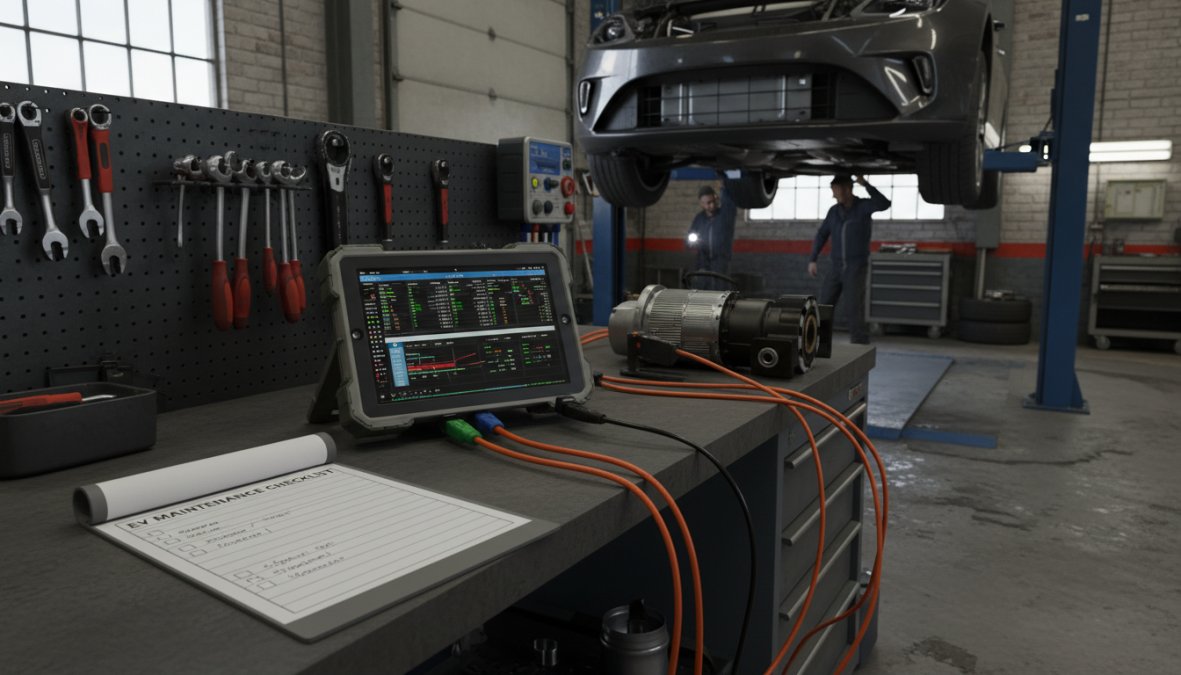
EV Maintenance Checklist: What Gets Inspected at Every Service
A generic EV maintenance checklist tells you very little about what your specific vehicle actually needs and when. The service requirements for a Tesla Model 3 differ meaningfully from those of a Nissan Leaf or a Volkswagen ID.4, and treating them identically is one of the most common ways routine maintenance gets missed.
Below is a structured inspection checklist covering what a thorough EV service at a qualified specialist should include, followed by model-specific notes on the items that vary most between platforms.
Core EV Service Checklist: Every Visit
Battery and Electrical Systems
High voltage battery health check: state of health (SoH) reading at cell level, not just dashboard percentage
Battery management system (BMS) fault log review
12V auxiliary battery condition and voltage test, a failing 12V battery is one of the most common causes of unexpected EV shutdowns across all platforms
High voltage cable and connector visual inspection for damage, corrosion, or chafing
Charging port condition and locking mechanism function
Onboard charger operation check
Cooling and Thermal Management
Battery thermal management coolant level and condition
Drive unit coolant circuit check (where applicable)
Coolant hose condition and connection integrity
Cabin heat pump or HVAC system function check
Drivetrain and Brakes
Drive unit noise assessment under load
Drive unit oil level and condition check (model-dependent, see below)
Brake fluid moisture content test, replace if above 3% water content or every two years
Brake calliper condition and freedom of movement, seized callipers are disproportionately common on EVs due to reduced mechanical brake use
Regenerative braking system function confirmation
Chassis, Tyres, and Safety
Tyre pressure check and adjustment (EV-specific pressures, not standard petrol figures)
Tyre tread depth measurement across all four corners
Wheel alignment check, particularly important given higher kerb weights
Suspension component inspection for wear or damage
Steering system check
All lights and safety systems function test
Pollen filter replacement (typically annual)
Wiper blade condition
Software and Diagnostics
Full vehicle diagnostic scan across all control modules
Pending and stored fault code review
Software version check and update status (where applicable)
Model-Specific Maintenance Notes: What Changes by Platform
This is where generic checklists fall short. The following notes cover the most significant model-specific variations that affect service scope and interval.
Tesla Model 3 and Model Y Drive unit oil is not listed in Tesla's standard service schedule but is widely recommended by independent specialists at 50,000-mile intervals or every four years. The rear drive unit on Model 3 and Model Y uses a sealed gearbox that benefits from oil changes despite Tesla's official 'lifetime fill' position. Brake fluid replacement is recommended every two years. The 12V battery on these models is a lithium-ion unit rather than a traditional lead-acid battery and has a different failure profile, voltage drop symptoms can appear suddenly rather than gradually. Cabin air filter replacement is recommended every two years or 25,000 miles.
Tesla Model S and Model X Older Model S vehicles (pre-2021) with the original rear drive unit have a known history of bearing noise developing over time. Early identification during a routine inspection, typically a faint whine under load, allows for planned repair rather than emergency replacement. The air suspension on these models requires periodic inspection of the compressor and air straws. Drive unit oil changes are recommended at similar intervals to Model 3. The pyro fuse should be inspected for condition; a degraded pyro fuse can trigger fault codes and in rare cases affect battery isolation function.
Volkswagen ID.3 and ID.4 The heat pump system on these models has shown a pattern of faults in colder operating conditions, often presenting as reduced cabin heating efficiency or fault codes in the HVAC module. This is worth checking proactively during winter servicing. Brake fluid replacement follows the standard two-year interval. Software updates for the ID platform have historically addressed charging speed, range estimation, and infotainment stability, confirming update status at each service is worthwhile.
Nissan Leaf (2013-2017, non-thermal management models) Battery capacity degradation is the primary ongoing concern for older Leaf models. Without active thermal management, these packs are more sensitive to DC rapid charging frequency and high ambient temperatures. A battery health check on these vehicles should include a capacity test rather than just a BMS fault scan, as the BMS on early Leaf models does not always flag gradual capacity loss as a fault. Brake fluid and cabin filter intervals follow standard schedules.
Hybrid Vehicles (general) Hybrid service intervals are typically more frequent than pure EVs because of the combustion engine components. Annual servicing is the standard baseline. The high-voltage battery in a hybrid requires the same qualified handling as a full EV battery, and the transition between electric and combustion modes should be verified during the service drive cycle.
How Often Should an EV Be Serviced?
Most electric vehicles should be serviced annually or every 12,000-18,000 miles, whichever comes first. This aligns with the recommended schedule across major manufacturers, though individual models vary as noted above.
Skipping services does not just risk mechanical issues. It can affect manufacturer warranty validity, reduce resale value, and allow early-stage faults to develop into significantly more expensive repairs. A battery cooling system issue caught at a routine service is a minor repair. The same issue left undetected for another 12 months can accelerate cell degradation in ways that are not reversible.
Watch OutSoftware updates are not always included in standard manufacturer service schedules, but they can materially affect battery management, charging performance, and range estimation. Ask your specialist to check software version status at every service visit, not just when a warning light appears.
A practical rule: check your vehicle handbook for the manufacturer's recommended service interval, then confirm with your specialist garage whether any EV-specific checks should be added based on your model's known fault patterns and your charging and driving habits.
How Often Should an EV Be Serviced? A Practical Guide
Most electric vehicles should be serviced annually or every 12,000-18,000 miles, whichever comes first. This is a common service schedule recommended across major manufacturers, though individual models vary.
The EV maintenance schedule is lighter than a petrol equivalent in terms of consumables, but the inspection workload is comparable. Battery health, cooling system condition, brake fluid, and software updates all need regular attention. Skipping services does not just risk mechanical issues; it can affect manufacturer warranty validity and resale value.
Hybrids typically follow a more frequent schedule because of the combustion engine components. Annual servicing is the standard baseline for most hybrid models.
A practical rule: check your vehicle handbook for the manufacturer's recommended service interval, then confirm with your specialist garage whether any EV-specific checks should be added. Software updates, for example, are not always flagged in standard service schedules but can affect battery management and charging performance.
Cost of EV Service in the UK: What to Expect and How to Compare
One of the most persistent myths holding EV owners back from independent servicing is the assumption that specialist work is inherently expensive. The reality is more nuanced, and breaking it down by service type gives a much clearer picture of where you save and where costs genuinely differ from petrol ownership.
Typical EV Servicing Price Ranges: Independent Specialist vs Main Dealer
The figures below represent typical price ranges for common EV service tasks at independent specialists versus franchised main dealers in the UK Midlands region. These are indicative ranges based on commonly published service pricing and should be confirmed with your chosen garage before booking.
Service Type | Independent Specialist (est.) | Main Dealer (est.) | Notes |
|---|
Annual EV inspection (minor service) | £80-£150 | £150-£250 | No oil change required for pure EVs |
Battery health check (SoH report) | £50-£100 | Often bundled or £100-£200 | Insist on cell-level data, not just dashboard reading |
Full diagnostic session | £60-£120 | £100-£200+ | Charged separately at many dealers |
Brake fluid replacement | £40-£70 | £60-£120 | Required every 2 years regardless of brake use |
Drive unit oil change (Tesla) | £80-£150 | £150-£250+ | Not always flagged by dealers at correct intervals |
Pre-purchase battery inspection | £80-£150 | Rarely offered | High value for used EV buyers |
EV MOT preparation check | £40-£80 | £60-£120 | Identifies EV-specific issues before test day |
Pro TipFor pure EVs, the absence of oil changes, timing belts, spark plugs, and exhaust components means annual servicing costs are genuinely lower than petrol equivalents in most cases. The cost difference narrows only when battery or drivetrain work is needed, and catching those issues early through regular health checks is the most cost-effective strategy.
Where EV Costs Are Higher Than Petrol, and Why It Matters
Honest cost transparency means acknowledging where EVs do cost more. High-voltage battery replacement is the most significant potential expense in EV ownership. A degraded battery pack on an older Nissan Leaf, for example, can cost more to replace than the vehicle's market value, which is why battery health checks before purchase and at regular service intervals are genuinely important rather than an upsell.
Drive unit repairs on Tesla models, particularly older Model S rear units, can also carry significant parts and labour costs. Catching early signs of drive unit noise during a routine inspection, before the unit reaches the point of failure, is where the value of specialist servicing is most clearly demonstrated.
The Real Cost Comparison: Independent Specialist vs Main Dealer
Main dealers charge premium rates for several reasons: manufacturer-mandated labour rate floors, higher premises costs, and the assumption that EV owners have no qualified alternative. For vehicles within the manufacturer's new car warranty period, there can be a case for dealer servicing if the terms require it, though as covered in the warranty section below, this is rarely a legal obligation.
For out-of-warranty vehicles, the case for independent specialist servicing is straightforward. The same diagnostic capability, equivalent or genuine parts, and qualified technicians at lower overhead cost. The key questions to ask any garage before booking:
Do they provide a written quote before starting work?
Do they use genuine or quality-equivalent parts, and can they confirm which?
Will they share the full diagnostic report with you?
Are labour rates clearly stated per hour?
Do they issue a full service record suitable for warranty and resale purposes?
According to Which? guidance on EV servicing costs, independent garages can offer significant savings over franchised dealers for routine EV maintenance, provided the technicians hold the correct qualifications.
Key TakeawayThe 'EVs are expensive to service' assumption is partly true for battery and drivetrain repairs, but routine annual servicing at a qualified independent specialist is typically less expensive than petrol servicing at a main dealer. The financial case for choosing an independent EV specialist in Kettering is strongest for out-of-warranty vehicles, where dealer pricing carries no warranty benefit to offset the premium.
EV Diagnostics, MOT Testing, and Common EV Faults by Model
This is where specialist knowledge separates a competent garage from an exceptional one. EV diagnostics, MOT compliance, and model-specific fault patterns all require experience that general garages simply do not have.
Electric Vehicle Diagnostics: How It Works
Electric vehicle diagnostics is the process of connecting specialist software to an EV's onboard control systems to read fault codes, live sensor data, and historical logs from the battery, drive unit, inverter, and charging system.
Unlike combustion engine diagnostics, EV diagnostic systems must communicate with multiple high-voltage modules simultaneously. Generic OBD scanners read only a fraction of the available data. Proper EV diagnostics requires manufacturer-specific or professional-grade tools capable of reading battery cell data, thermal management logs, and motor controller history.
EV MOT Testing: What's Different for Electric Vehicles
EV MOT testing follows the same core framework as a standard MOT but with adaptations for electric drivetrains. There is no exhaust emissions test. Instead, inspectors check the condition of high-voltage cables and connectors, the integrity of the battery housing, warning light status, and the function of regenerative braking systems.
As referenced in DVSA guidance on MOT testing for electric vehicles, EVs must meet the same roadworthiness standards as petrol vehicles, with specific provisions for high-voltage safety components. A specialist garage is better placed to prepare your vehicle for MOT because they can identify and resolve EV-specific issues before the test.
Common EV Faults by Model: Tesla, VW, and Beyond
Different EV platforms have known failure patterns. Understanding these helps owners anticipate costs and spot early warning signs.
Tesla (Model 3, Model Y, Model S, Model X): Common faults include drive unit noise (particularly in older Model S rear units), 12V battery failure causing unexpected shutdowns, suspension component wear, and door handle mechanism failures. The Tesla Model S door handle switch fix and hand brake motor replacements for Model 3 and Y are among the more frequent repairs KMC Electric handles. The pyro fuse is another Tesla-specific component worth checking; a failed pyro fuse can isolate the battery in a crash but also trigger faults if degraded.
Volkswagen ID.3 and ID.4: Known issues include software glitches affecting the infotainment and climate systems, heat pump failures in colder weather, and charging system faults.
Nissan Leaf (older generations): Battery capacity degradation is the primary concern, particularly on models without active thermal management. DC charging rates drop significantly as packs age.
EV Warranty Preservation and Charging Infrastructure Advice
Here is something most garage guides skip entirely, and it genuinely matters for EV owners making long-term ownership decisions.
How Independent Servicing Can Protect Your EV Warranty
A common misconception is that servicing your EV at an independent garage voids the manufacturer warranty. This is not correct under UK consumer law. As clarified by Citizens Advice guidance on vehicle warranties and independent servicing, manufacturers cannot legally require you to use their franchised dealers for routine servicing as a condition of maintaining your warranty, provided the work is carried out to manufacturer standards using appropriate parts.
The practical implication: choosing an independent ev specialist garage in kettering does not put your warranty at risk, provided the garage is qualified, uses appropriate parts, and documents the work properly. KMC Electric issues full service records for every job, which protects your warranty position and supports resale value.
Where warranty becomes genuinely complex is with battery replacement or high-voltage component work. If your vehicle is still within manufacturer warranty for these systems, check the specific terms before authorising any work beyond inspection.
EV Charging Infrastructure: Advice for Kettering and Northamptonshire Owners
Charging habits directly affect battery health, and this is an area where practical advice from a specialist garage makes a real difference.
For Kettering and Northamptonshire EV owners, the public charging network has expanded considerably in recent years. Fast chargers are available at several retail and leisure locations across the town. DC charging is faster but generates more heat; relying on DC charging exclusively accelerates battery degradation faster than a mixed AC and DC charging pattern.
The practical guidance most owners benefit from:
Charge to 80% for daily use; reserve 100% charges for long journeys
Avoid regularly depleting below 10-15% state of charge
Use scheduled charging during off-peak hours where possible to reduce thermal stress
If you notice a significant drop in range or charging speed, book a battery health check rather than waiting for a warning light
Why Choose KMC Electric as Your EV Specialist Garage in Kettering
The strongest argument for KMC Electric is not the marketing; it is the qualification depth and the track record. With Level 4 Master Technician status in electric vehicles and EV qualifications dating back to 2016, KMC Electric was diagnosing and repairing EVs before most garages had even considered the training.
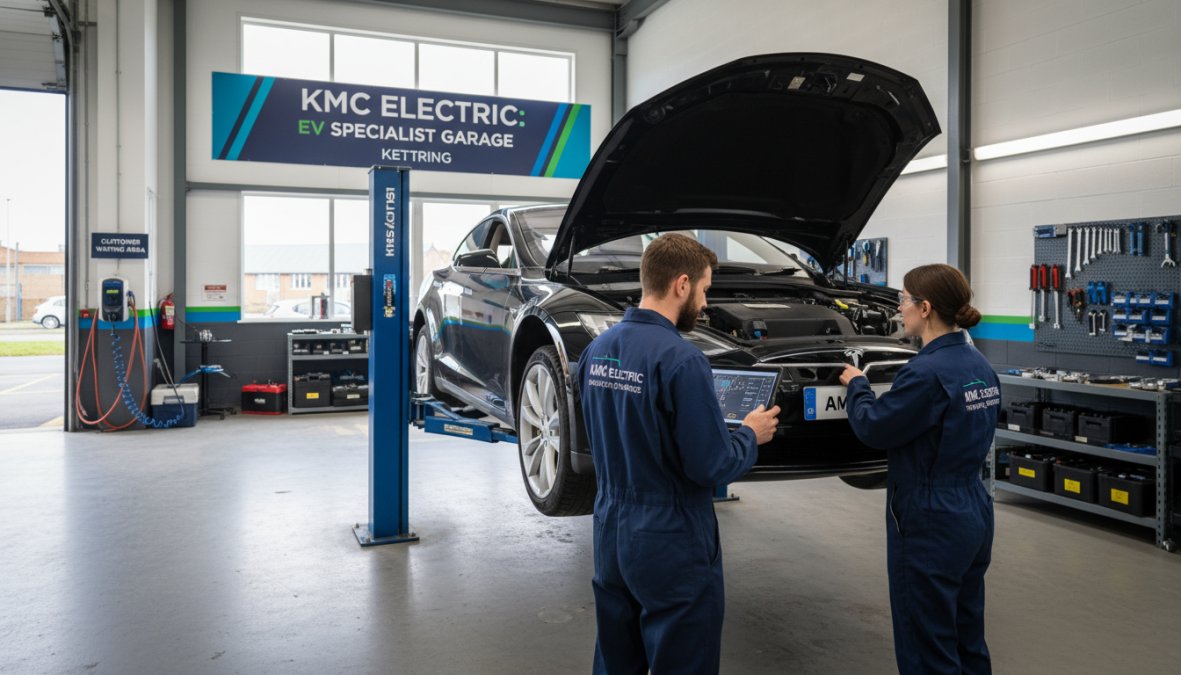
Over 25 years of automotive industry experience underpins the technical work. This matters because EV faults rarely exist in isolation. A battery management warning can trace back to a cooling system issue, a software fault, or a cell-level problem. Correctly identifying the root cause requires broad mechanical knowledge combined with EV-specific diagnostic expertise.
KMC Electric serves as a cost-effective alternative to main dealer networks, particularly for out-of-warranty vehicles where dealer pricing becomes difficult to justify. Independent battery health verification is also available for buyers and sellers, providing an objective assessment before any transaction.
The service range covers Tesla across all models, Volkswagen EVs, and hybrid vehicles. For Tesla owners specifically, the depth of model knowledge, combined with access to quality Tesla-specific parts, makes KMC Electric the most comprehensive local option for ongoing care.
How to Book Your EV Service or Diagnostic Appointment
Booking a service or diagnostic session with an ev specialist garage in kettering is straightforward. The process typically runs as follows:
Contact the garage with your vehicle make, model, year, and the reason for your visit (routine service, specific fault, pre-purchase inspection, or MOT preparation).
Receive a written estimate for the work before anything is confirmed. A reputable specialist will not start work without your authorisation.
Drop off your vehicle at the agreed time. For complex diagnostics, allow a full day.
Review the diagnostic report before any repair work begins. You should receive a clear explanation of any faults found, the recommended action, and the associated cost.
Collect your vehicle with a full written service record for your files.
For Tesla owners and other EV drivers across Kettering and Northamptonshire, booking directly through the KMC Electric website gives you access to the full service range, including battery health checks, drive unit inspections, and EV-specific MOT preparation.
Key TakeawayAn EV specialist garage is not just a convenience upgrade over a general garage. For high-voltage vehicles, it is a safety and financial necessity. Qualified technicians with the right diagnostic tools protect your battery, your warranty, and your long-term running costs.
Finding the right ev specialist garage in kettering is one of the most important decisions an EV owner in Northamptonshire can make. Poor diagnosis, unqualified handling of high-voltage systems, and missed early faults all cost significantly more to resolve later. KMC Electric combines Level 4 Master Technician qualification, over 25 years of automotive experience, and deep Tesla-specific knowledge to offer a genuinely reliable alternative to main dealer servicing. Get in touch with KMC Electric to book your EV service, battery health check, or diagnostic appointment and protect the long-term value and safety of your vehicle.
Frequently Asked Questions
Do electric cars need a special garage for servicing?
Yes. Electric vehicles contain high voltage battery systems, drive units, inverters, and DC charging components that require specialist training and equipment to work on safely. A standard garage without qualified EV technicians risks improper handling of high voltage systems, which is both dangerous and potentially damaging to the vehicle. Always choose a garage with at least IMI Level 3 EV qualifications, Level 4 Master Technician status, like KMC Electric holds, represents the highest level of EV competency available.
How do I find a qualified EV mechanic in Kettering?
Look for a garage in Kettering or Northamptonshire that holds recognised EV qualifications such as IMI Level 3 or Level 4 certification. Ask specifically about their experience with your vehicle make, Tesla, VW, and other brands have distinct systems. KMC Electric is an independent EV specialist garage in Kettering with Level 4 Master Technician status and EV qualifications dating back to 2016, making it one of the most experienced local options for electric and hybrid vehicle servicing.
Are EV services more expensive than petrol car services?
Generally, the routine cost of EV service in the UK tends to be lower than for petrol cars because EVs have fewer moving parts, no oil changes for the combustion engine, no exhaust system, and regenerative braking reduces brake wear. However, specialist tasks like high voltage battery inspection or drive unit diagnostics require expert equipment and training, which can add cost. Independent specialist garages like KMC Electric typically offer more cost-effective EV servicing than main dealer networks without compromising on quality.
How often should an EV be serviced?
Most electric vehicle manufacturers recommend an annual service or one based on mileage intervals, typically every 12 months or 12,000 miles, whichever comes first. An EV maintenance checklist at each service should cover battery health, tyre pressure, wheel alignment, brake fluid condition, cooling system checks, pollen filter replacement, and a full vehicle inspection. Following a regular service schedule is also important for maintaining your warranty and catching common EV faults early before they become costly repairs.
Can an independent garage service my EV without voiding the warranty?
Yes. Under UK consumer law (block exemption regulations), you can have your electric vehicle serviced at any qualified independent garage without voiding the manufacturer warranty, as long as the work is carried out to manufacturer standards and recorded properly. Using a specialist garage like KMC Electric, with Level 4 Master Technician status and manufacturer-standard processes, means your EV warranty remains fully protected while you benefit from more cost-effective, personalised service compared to a main dealer.