Tesla Repair vs Other EV Service: A Complete 2026 Guide
Last Updated: June 29, 2026
Tesla Repair vs Other Electric Vehicle Service: Key Differences
Tesla vehicles operate on fundamentally different diagnostic and repair principles compared to other EV brands like BMW, Volkswagen, and Nissan. Tesla's proprietary systems, software-locked features, and over-the-air update architecture create a service ecosystem unlike anything in the traditional EV market. Your choice of repair provider directly impacts warranty coverage, repair costs, vehicle longevity, and access to critical diagnostic data.
Pro TipThe biggest mistake EV owners make is assuming all electric vehicle maintenance is interchangeable. Tesla's service model is fundamentally different from competitors, understanding why matters before your first repair.
Why Service Models Matter for EV Owners
The service model you choose determines whether you're paying £2,500 or £500 for a battery diagnostic, and whether your vehicle remains fully functional or develops software-related failures that no independent shop can resolve.
Tesla deliberately restricts access to its proprietary diagnostic tools, meaning independent repair shops face genuine technical barriers that don't exist with other EV brands. According to research from right-to-repair advocacy groups, Tesla's software-locked features prevent third-party technicians from accessing vehicle data that other manufacturers routinely expose to independent shops.
Tesla repair through authorised channels typically costs 30-40% more than equivalent work on other EV brands. An independent Nissan Leaf specialist can perform battery health diagnostics, replace high-voltage components, and handle software updates. A Tesla owner seeking the same work outside Tesla's network often faces dead ends.
However, other EV manufacturers are increasingly restricting diagnostic access. Volkswagen and BMW are moving toward Tesla's model, meaning the gap between Tesla and competitors is narrowing. For EV owners in Northamptonshire and beyond, this trend means the independent repair landscape is becoming more fragmented.
EV Maintenance Cost Comparison: Tesla Against the Competition
Tesla owners spend considerably more on preventative maintenance and repairs than owners of equivalent EV models from other manufacturers.
Maintenance Category
Tesla Model 3
Nissan Leaf
BMW i4
VW ID.4
Annual service cost (out-of-warranty)
£400-600
£150-250
£350-500
£200-350
Battery diagnostic fee
£200-400
£80-150
£150-300
£100-200
Brake fluid replacement
£150-250
£100-150
£120-200
£100-180
High-voltage system diagnostics
£300-500
£150-250
£200-400
£150-300
Tesla service costs roughly double the equivalent work on other EV brands. This gap widens significantly for software-related issues, where Tesla's closed ecosystem limits alternatives to official Tesla service.
Tesla owns its entire service chain: parts, diagnostics, software updates, and repairs. Other manufacturers rely on a mix of authorised dealers and independent shops, creating competitive pricing pressure. When you need a Tesla battery diagnostic, you have limited negotiating power.
However, Tesla vehicles require less routine maintenance than other EVs. Fewer moving parts, regenerative braking that reduces brake wear, and over-the-air updates that prevent many software issues mean total cost of ownership can be comparable despite higher per-service costs.
Watch OutOut-of-warranty Tesla repairs can exceed £5,000 for collision damage or high-voltage system failures. Other EV brands typically cost 30-40% less for equivalent damage. This is the single biggest cost differential between Tesla and competitors.
How Often Do Electric Cars Need Service? Tesla vs Other Brands
The frequency of electric vehicle maintenance varies dramatically between Tesla and other EV manufacturers.
Service Intervals and Over-the-Air Updates
Tesla's service schedule is once every 12 months or 16,000 km, whichever comes first. However, many Tesla owners go years without scheduling service because over-the-air updates handle software issues that would require workshop visits on other vehicles.
Traditional EVs like the Nissan Leaf and VW ID.4 follow more conventional maintenance schedules: every 12-15 months or 15,000-20,000 km. Tesla's OTA update capability means potential issues are often resolved remotely, reducing workshop visits.
Other EV manufacturers are slower to adopt OTA updates. BMW and Volkswagen offer limited OTA functionality, and many older EV models require manual software updates at dealerships.
However, when something goes wrong with a Tesla, you can't access diagnostic data independently to monitor battery health or electrical system status the way you can with other EVs. Tesla owners should schedule diagnostic checks every 6-12 months to catch issues before they become expensive problems. Other EV owners can safely extend intervals to 12-18 months because they have better visibility into vehicle diagnostics.
Common Electric Vehicle Repair Issues and Diagnostics
The most frequent EV repair issues differ sharply between Tesla and other manufacturers.
Tesla's most common out-of-warranty issues centre on software-related failures: door handle mechanisms that malfunction due to firmware updates, touchscreen failures, and charging port issues requiring software resets. These issues are nearly unique to Tesla because other manufacturers don't rely as heavily on software-controlled mechanical systems.
Other EV brands face different challenges. Nissan Leaf owners frequently encounter battery capacity loss, which is less pronounced in Tesla vehicles thanks to superior thermal management. BMW i4 and VW ID.4 owners report more traditional mechanical failures in suspension, brake systems, and electrical connectors.
A Tesla door handle replacement requiring software diagnostics costs £150-300. The same component on a VW ID.4 costs £80-150 because the repair doesn't require proprietary software access.
High-Voltage System Diagnostics and Specialized Tools
Professional diagnostic platforms like the Autel MaxiSYS Ultra EV can diagnose high-voltage issues on most EV brands using a single tablet and adapter kit. The tool costs around £4,500-6,000 for a complete setup.
However, Tesla vehicles withhold certain data. Even with professional-grade diagnostics, technicians can read battery pack voltage and cell temperatures on most EVs, but Tesla restricts access to granular cell-level data essential for precise diagnostics.
The consequence is that independent shops often recommend sending Tesla vehicles to Tesla for high-voltage diagnostics, even when equipped to diagnose other EV brands. Other EV manufacturers are more transparent, allowing battery diagnostics at any authorised dealer or independent shop with proper tools. This competition drives prices down, battery diagnostics on a VW ID.4 cost roughly 50% less than equivalent work on a Tesla.
Key TakeawayThe real cost of Tesla ownership isn't the upfront purchase price, it's the diagnostic premium. Every battery, motor, or high-voltage system issue carries a 30-50% cost penalty compared to other EV brands because you have fewer options.
Software-Locked Features and Repair Limitations
Tesla's software architecture creates repair limitations that don't exist on other EV platforms. If your Tesla's touchscreen fails, an independent shop can replace the hardware, but the vehicle won't recognise it without Tesla's software authentication. Other EV manufacturers allow hardware replacement with minimal software involvement.
Battery pack replacement tells a similar story. If your Tesla battery reaches end-of-life and you want to install a third-party replacement, the vehicle's software won't accept it. On a Nissan Leaf or BMW i4, independent shops can source and install aftermarket batteries with full functionality.
This creates a long-term ownership problem: Tesla vehicles become increasingly difficult to repair as they age. A 2015 Nissan Leaf can be serviced today using OEM and aftermarket parts. A 2015 Tesla Model S faces genuine obsolescence if Tesla discontinues support.
Specialized Diagnostic Tools: What Sets Tesla Service Apart
Tesla uses proprietary diagnostic software that only Tesla technicians can access. This software connects to Tesla's cloud servers, meaning diagnostics require internet connectivity and Tesla's authentication. Independent shops cannot replicate this system.
Third-party diagnostic tools like the Launch X431 EV-Kit for battery diagnostics provide deep access to battery data on most EV brands, costing around £800-1,200. For a Nissan Leaf or VW ID.4, independent technicians can perform diagnostics rivalling dealership capabilities.
On Tesla vehicles, the same tool reads only surface-level data. You can see overall battery voltage and temperature, but not individual cell data essential for accurate health assessment. This is Tesla's deliberate restriction of data access.
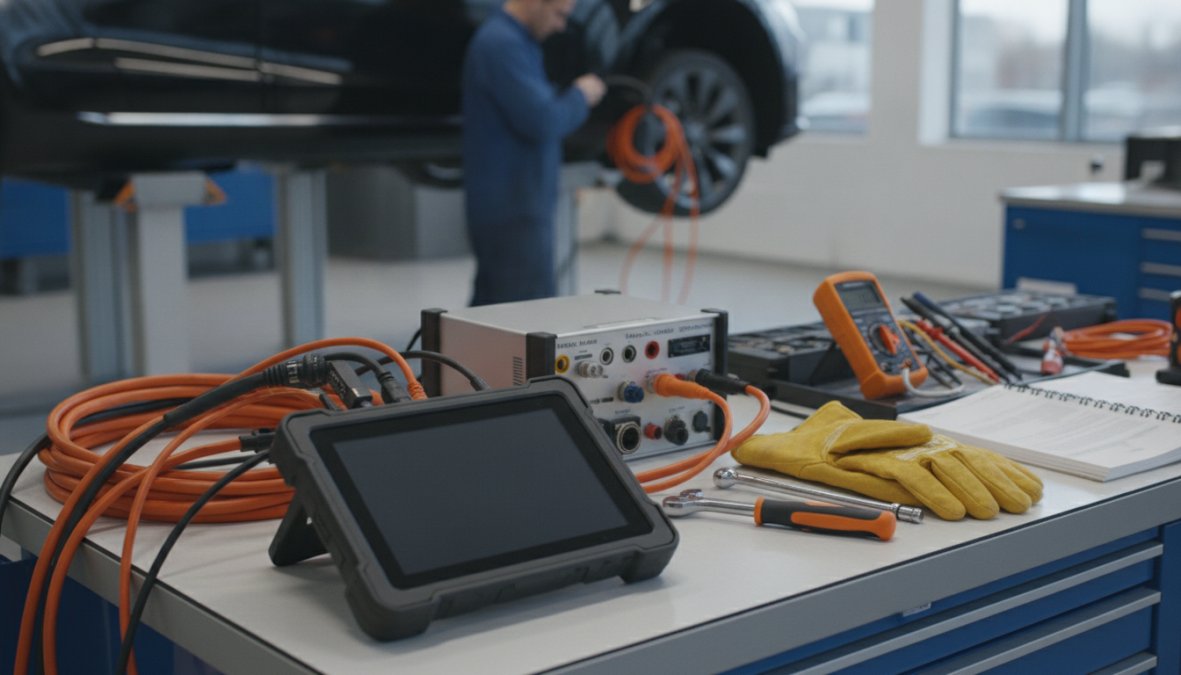
Technician using professional diagnostic tablet with high-voltage testing cables connected to Tesla vehicle in modern workshop, fluorescent lighting illuminating the battery pack area
Independent shops in Kettering and across Northamptonshire face a genuine technical barrier when diagnosing Tesla vehicles. They can perform routine maintenance and body work, but battery diagnostics, software updates, and high-voltage system repairs require either Tesla's equipment or educated guesswork.
Other EV manufacturers are more transparent. BMW and Volkswagen provide diagnostic access to authorised dealers and increasingly to independent shops with proper training and equipment. This openness creates a competitive repair market where independent shops offer genuine alternatives to dealerships.
Warranty Coverage and Third-Party Service Implications
Tesla's warranty explicitly states that unauthorised repairs may void coverage. This language is broader than it sounds. Using a third-party technician for routine maintenance doesn't automatically void your warranty, but it creates ambiguity.
Other EV manufacturers are more explicit: your warranty remains valid regardless of where you service the vehicle, provided the work doesn't directly cause the failure. A BMW i4 owner can have independent service, and if the battery fails, BMW will honour the warranty.
The practical implication is that Tesla owners should use Tesla service for anything warranty-related, which locks you into Tesla's pricing. Other EV owners have genuine flexibility.
Tesla's battery warranty is 8 years or 160,000 km with a guarantee that capacity won't drop below 70%. Other manufacturers offer similar or longer warranties. The difference is in enforcement. Tesla is known for strict interpretation of warranty terms, while BMW and Volkswagen are generally more lenient.
Once your warranty expires, you're free to use any service provider. An out-of-warranty Tesla battery diagnostic costs £200-400 at Tesla, but only £100-150 at independent shops with proper equipment.
Regional Repair Accessibility and Mobile Service Options
Where you live dramatically affects your Tesla repair vs other electric vehicle service options.
Tesla's mobile service units operate in major metropolitan areas. In Kettering and surrounding areas, mobile service is limited. You're expected to drive to the nearest Tesla service centre, typically Birmingham or London, a 1-2 hour drive.
Other EV manufacturers rely on traditional dealer networks, which are more geographically distributed. VW ID.4 owners in Kettering have local VW dealerships within 20 minutes. BMW i4 owners can access BMW service at multiple locations across Northamptonshire.
However, independent repair shops are increasingly bridging this gap. Specialists across Northamptonshire now offer mobile diagnostics for Tesla and other EV brands, performing battery health checks and routine maintenance at your location.
Pro TipIf you own a Tesla in Kettering, negotiate mobile service with independent shops rather than accepting the drive to Birmingham. Competition is increasing, and many specialists now offer on-site diagnostics at competitive rates.
Making the Right Choice for Your EV Service Needs
Choose Tesla service if you're in warranty and want maximum simplicity. The cost premium is the price of that convenience.
Choose independent service if you own an EV from another manufacturer or if your Tesla is out of warranty. The cost savings are substantial, and you gain flexibility in choosing providers and scheduling service.
For EV owners in Kettering and Northamptonshire, the emerging opportunity is hybrid service: routine maintenance and diagnostics from local independent shops, with warranty-related work handled by manufacturers when necessary.
The landscape is shifting. As more independent shops invest in EV-specific training and equipment, the gap between Tesla service and alternatives is narrowing. Within 2-3 years, independent shops with proper certification will offer Tesla diagnostics that rival official channels.
Navigating Tesla repair versus other EV service requires understanding that Tesla's closed ecosystem creates genuine technical barriers that other manufacturers don't impose. Whether you own a Tesla or another EV brand, choose a service provider with transparent capabilities and honest limitations. At KMC Electric, we've invested in professional-grade diagnostics and EV-specific training across all platforms, Tesla, BMW, Volkswagen, and Nissan, to serve owners across Kettering and Northamptonshire with cost-effective alternatives to main dealer networks. Our Level 4 Master Technician status in electric vehicles ensures expert diagnostics and practical repairs that extend your vehicle's service life. Get in touch with KMC Electric today to discuss your EV service needs and discover how independent expertise can save you money while maintaining your vehicle's reliability.
Frequently Asked Questions
Are Tesla repairs more expensive than other electric vehicle service?
Tesla repair costs vary significantly by repair type. Collision repairs and auto body work tend to be more expensive due to specialized materials and repair complexity compared to traditional vehicles. However, routine electric vehicle maintenance is often lower than petrol cars. Independent specialists can offer cost-effective alternatives to Tesla service centres for many repairs, particularly for out-of-warranty vehicles where labour rates and parts availability differ substantially from other EV brands.
How often do electric cars need service compared to traditional vehicles?
Electric vehicles require significantly fewer service intervals than petrol or diesel cars because they have fewer moving parts. Most EVs need servicing every 12-24 months or 10,000-20,000 miles, whereas traditional vehicles often require annual servicing. However, regular battery health checks, brake fluid inspection, and software updates remain important for long-term vehicle longevity and total cost of ownership. Independent specialists can verify battery health and identify potential faults before warranty expiry.
Can I use an independent repair shop for Tesla service, or must I use Tesla service centres?
Independent repair shops can service Teslas, though warranty implications vary depending on the repair type and vehicle age. Many independent specialists now hold EV-specific qualifications and possess the diagnostic software needed to address common issues. However, some warranty-related repairs may require Tesla-certified service centres. It's essential to verify that any independent repair shop has appropriate EV training, diagnostic tools, and understanding of high-voltage systems before authorising work.
What common electric vehicle repair issues should I watch for?
Common EV issues include battery degradation, charging port failures, high-voltage system faults, brake system complications due to regenerative braking, and software-related problems requiring over-the-air updates. Independent battery health verification can identify degradation early, potentially extending vehicle service life. Regular preventative maintenance, including coolant checks for battery thermal management and brake fluid inspection, helps prevent costly repairs. Professional diagnostics using specialised tools can pinpoint faults before they escalate.