Why Tesla Battery Health Matters More After Year Three
Tesla battery health is the measure of how much usable capacity and performance your pack retains as it ages, and it becomes the single biggest factor in your car's value once the first few years are behind you. This guide from KMC Electric covers the practical habits that protect a pack over a decade of ownership, from daily charging routines to what a genuine health check involves. Most of the degradation a long-term owner experiences is not random. It is the accumulation of thousands of small charging and parking decisions, and the good news is that the expensive part of the curve is largely avoidable.
The first three years are forgiving. Cells settle into their chemistry, range loss is gradual, and the manufacturer warranty sits quietly in the background covering you. After year three, the picture changes. Depreciation accelerates, warranty cover approaches its limit, and the decisions you make about charging, storage and climate start to show up in the numbers.
A common mistake is treating battery care as something you think about only when a warning appears. By then, the pattern is set.
Key TakeawayThe cheapest battery maintenance you will ever do is the routine you build in years one to three. Habits formed early compound in your favour for the rest of the car's life.
Optimal Tesla Charging Habits for Daily and Long-Term Use
The best charging routine for longevity keeps the pack in the middle of its range most of the time, avoids unnecessary DC fast charging, and charges to full only when you actually need the range. Lithium-ion cells age fastest at the extremes: sitting at 100% in the heat, or draining to near zero and staying there.
Daily Charge Limits and the 80% Rule
For everyday driving, set your charge limit to around 80% and plug in overnight. This keeps the cells in their least stressful band and is the single habit that matters most for long-term Tesla battery health. If your car uses a lithium iron phosphate pack, the manufacturer's own guidance differs and a full charge is fine and even recommended periodically, so check your model's handbook before assuming the 80% rule applies to you.
Supercharging Frequency and When It Actually Matters
Occasional Supercharging is not the villain it is often made out to be. Heat is the real enemy, and a fast charge on a cool pack in mild weather is far gentler than repeated fast charging in summer or immediately after a hard drive. If you rely on rapid charging weekly, try to arrive with a moderate state of charge rather than a nearly empty pack, and avoid charging to 100% on a rapid charger unless you are setting off straight away.
Habit
What to Do
Why It Matters
Daily charging
Charge to about 80% overnight
Keeps cells in a low-stress band
Rapid charging
Use when needed, avoid in extreme heat
Limits heat-driven ageing
Long-term parking
Leave at roughly 50%
Reduces calendar degradation
Full charges
Only before a long journey
Avoids sitting at 100%
Tesla Battery Degradation Signs You Should Not Ignore
Noticeable range loss, slower charging speeds, a sudden drop in indicated capacity, or the car limiting power under acceleration are the signs worth investigating. Some gradual range reduction is entirely normal and expected. What you are watching for is a step change, not a gentle slope.
A common mistake is confusing cold-weather range reduction with genuine degradation. A pack that shows reduced range on a frosty morning is often just cold, and the indicated figure recovers as it warms. If your range does not recover after a long drive in mild conditions, that is when a proper assessment is worth the time.
Watch for these in particular:
A range figure that drops sharply over a few weeks rather than months
Charging that consistently tapers earlier than it used to
Reduced power output under acceleration that persists when warm
Any warning relating to the high-voltage system
Watch OutIgnoring a persistent fault code can turn a straightforward repair into an expensive one. If a warning appears and stays, get it read rather than waiting for the next service.
How to Get a Tesla Battery Health Check UK Owners Can Trust
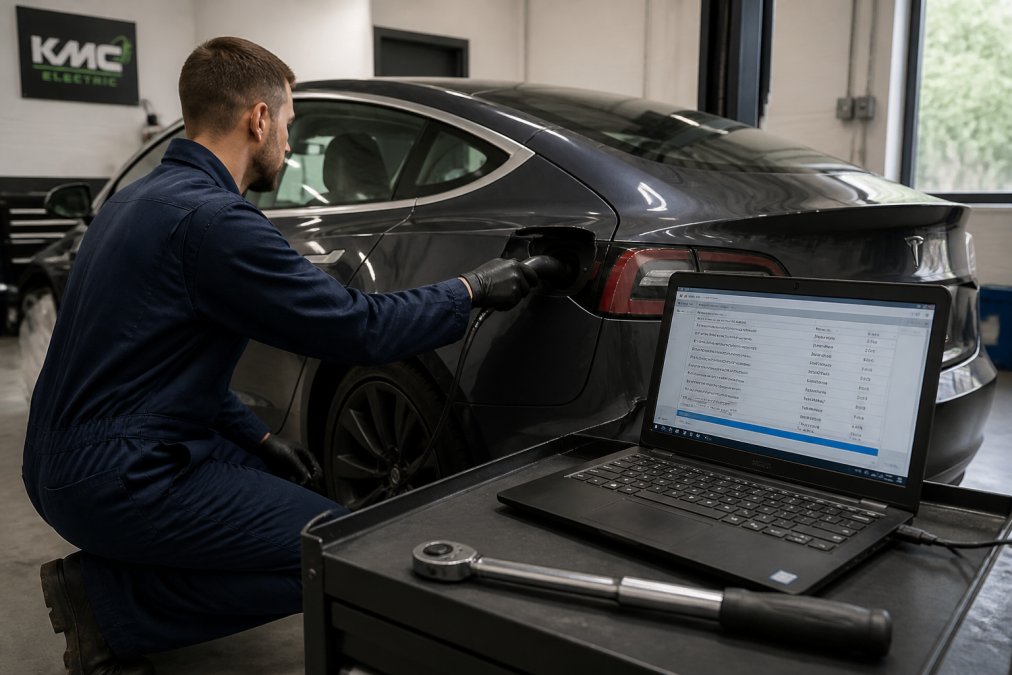
A trustworthy Tesla battery health check reads the pack's own data, not just the range estimate on the dashboard. An independent specialist connects diagnostic equipment to the vehicle, pulls the state-of-health figures the car records internally, and interprets them against the model's expected degradation curve. That is a very different exercise from glancing at the remaining range.
Technician using a diagnostic laptop to check electric vehicle battery health in a modern workshop
This matters most in two situations: buying a used EV and approaching the end of warranty. If you are looking at a used Model 3 with significant mileage, an independent assessment before you buy tells you what you are actually purchasing. If your car is nearing the end of its manufacturer warranty, a check can identify a fault while it is still covered. KMC Electric provides independent battery health verification for exactly these decisions, using diagnostic access to the pack's real data rather than a guess from the range display.
For owners searching for a battery health check near me, the practical test is simple: ask whether the assessment reads live pack data or simply reports the dashboard figure. Only one of those answers is worth paying for.
Tesla Cold Weather Battery Tips for Midlands Winters
Cold weather reduces usable range and slows charging, and a Midlands winter will show you both. The pack is not damaged by the cold in the way heat damages it, but the chemistry slows down, so the car has less available energy and takes longer to accept a charge. Preconditioning the battery before you set off, using the car's scheduled departure or climate settings while still plugged in, warms the cells and restores much of the lost range.
Park indoors or under cover where you can. A garage, even an unheated one, keeps the pack several degrees warmer than a driveway exposed to a Northamptonshire frost. If you cannot, expect the first part of your journey to show reduced range and plan around it rather than worrying about it.
Pro TipSchedule your departure time in the car so it preconditions the pack while still on mains power. You arrive at a warm battery without spending your own charge on heating it.
What Tesla Battery Health Costs Look Like Out of Warranty
Out-of-warranty battery work is where long-term owners feel the most anxiety, and it is also where an independent assessment pays for itself. A full pack replacement is a major expense, but it is far from the only outcome. Many issues that present as battery problems, from a faulty module to a sensor or a charging fault, can be diagnosed and repaired without replacing the whole pack.
That is the practical argument for a proper diagnosis rather than a replacement quote. The difference between "your battery is failing" and "one component has failed" is the difference between a repair and a rebuild, and only a diagnostic read of the pack's data will tell you which you are facing. KMC Electric's approach is built around finding the real fault first, then offering a cost-effective fix rather than the most expensive one.
Pricing for diagnosis and repair depends on the fault, the model and the parts required, so it is best confirmed directly. For a current quote on a battery assessment or repair, speak to the team or submit your details through the website.
Conclusion
The owners who get the most from their Tesla over ten years are not the ones who baby the car. They are the ones who understand which habits actually matter and which fears are overblown, and who act on a warning rather than waiting for it to become a failure. KMC Electric supports that approach with independent Tesla and EV diagnosis, Level 4 Master Technician expertise in electric vehicles, and EV qualifications held since 2016, backed by more than 25 years in the automotive trade. Whether you are buying a used EV, facing the end of warranty, or chasing a fault the main dealer could not pin down, get started with KMC Electric and keep your battery, and your car's value, in good health for years to come.
Frequently Asked Questions
What is the ideal state of charge for long-term Tesla battery storage?
For storage longer than a few weeks, Tesla recommends keeping the battery around 50%. Set the charge limit to 50% in the app, leave the car plugged in if you can, and avoid leaving it at 100% or below 10% for extended periods. If the car will sit for months, a slow top-up every few weeks keeps the cells balanced without stressing them.
Does frequent Supercharging damage Tesla battery health?
Occasional Supercharging is fine. Regular DC fast charging at high rates does put more thermal stress on the pack than a home AC charge, so drivers who Supercharge weekly tend to see slightly faster degradation than those who mostly charge at home overnight. If you can, use a 7kW home charger for daily top-ups and save Superchargers for longer trips.
How can I check my Tesla battery health in the UK?
You can run a rough check yourself using the Tesla app's range estimate or a third-party tool, but those figures are indicative only. For an accurate reading, an independent specialist can pull the battery management system data and give you a real state-of-health figure. This is worth doing before buying a used Model 3 or Model Y, or before your warranty expires.
What are the signs of Tesla battery degradation?
The clearest signs are a noticeable drop in rated range, slower charging speeds at Superchargers, and the car taking longer to reach full charge. You may also see the range estimate fall faster than your actual driving pattern suggests. A sudden drop of more than 10% over a short period is worth investigating, as it can point to a cell imbalance rather than normal ageing.