Do Teslas need servicing? Yes, they do, even though they have far fewer moving parts than a petrol or diesel car. Tesla's own guidance points owners towards a set of checks and replacements rather than the oil-and-filter routine you'd recognise from a combustion engine. At KMC Electric, we've spent years diagnosing and maintaining Tesla models across Northamptonshire and Leicestershire, and the pattern is consistent: cars that get looked at properly last longer and cost less to run.
The confusion comes from marketing language. "Low maintenance" is not the same as "no maintenance." Brake fluid absorbs moisture, cabin filters clog, brake calipers seize when they're barely used, and coolant still degrades. None of that shows up until it becomes a fault.
Below, we'll break down exactly what a Tesla service covers, what the year-by-year schedule looks like, and how to tell whether you actually need a garage visit or just a software update.
What a Tesla Service Actually Covers
A Tesla service is a condition-based inspection and replacement programme covering brakes, fluids, filters, air conditioning, suspension, tyres, and the high-voltage system, rather than a fixed engine maintenance routine. Because there's no oil, no spark plugs, and no timing belt, the checklist is shorter but not empty.
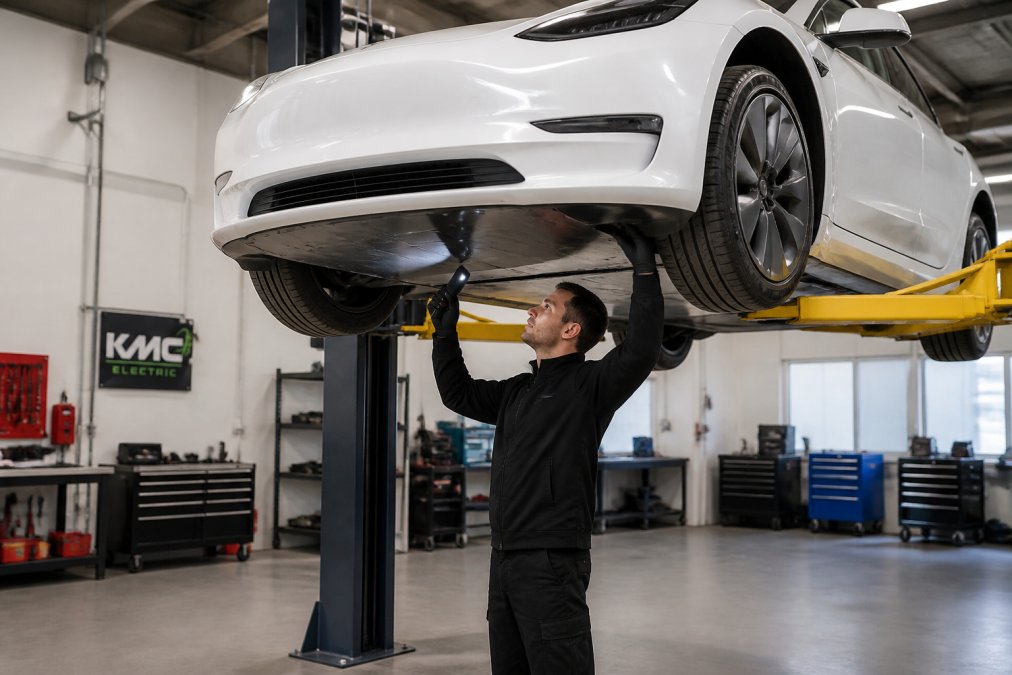
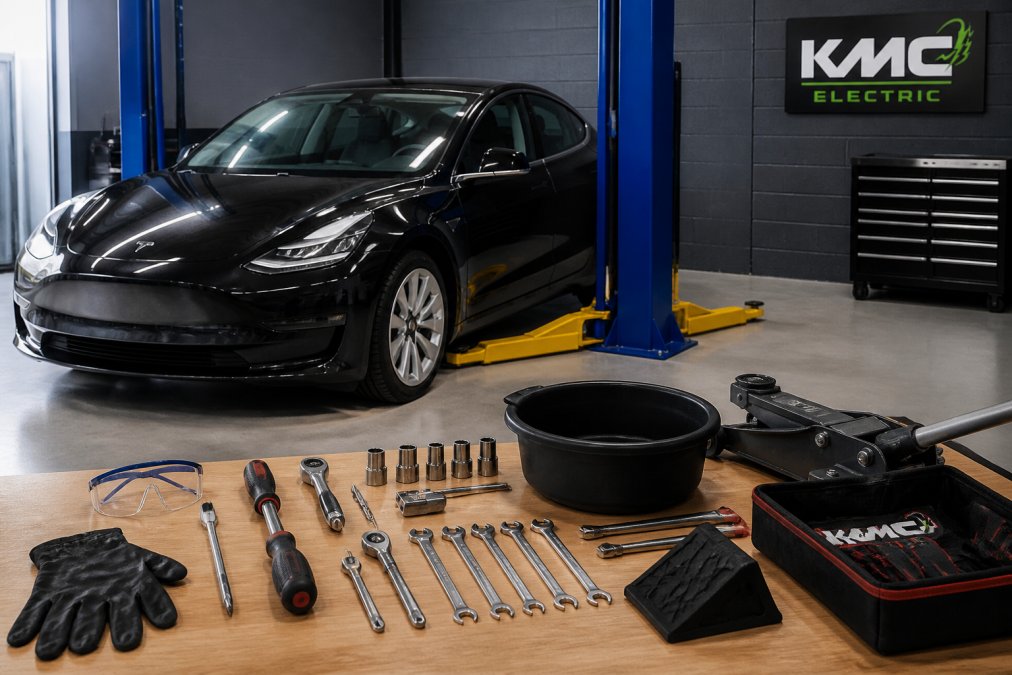
A mechanic in clean workwear inspecting the underside of a Tesla Model 3 on a vehicle lift in a tidy independent garage, with diagnostic equipment visible in the background
A typical inspection covers:
Brake pads, discs, and caliper operation
Brake fluid moisture content
Coolant level and condition
Cabin air filter condition
Air conditioning performance and refrigerant
Suspension components and bushes
Tyre tread, pressure, and wear pattern
High-voltage battery and charging system diagnostics
Software version and fault code review
Why EV Servicing Differs from Petrol or Diesel
The biggest practical difference is brake wear. Regenerative braking does most of the slowing, so pads last far longer than on a combustion car. That sounds like good news, and it mostly is, but it creates a specific problem: calipers that barely move tend to seize. A common mistake is assuming low pad wear means the brakes are fine.
What most guides miss is that EVs need their brakes exercised and inspected, not just measured. We've seen calipers on low-mileage Teslas stick far earlier than the pads would suggest.
Watch OutSkipping brake inspections because your pads still look thick is the most common EV servicing mistake. Seized calipers cause uneven braking, drag, and premature disc replacement, which costs far more than the inspection would have.
Tesla Model S Maintenance Schedule UK: What to Expect Year by Year
Tesla does not publish a rigid annual service interval in the way most manufacturers do, so the practical schedule below reflects what an experienced independent specialist checks and when. Treat it as a sensible baseline rather than a fixed rulebook.
Interval
What Gets Checked or Replaced
Why It Matters
Every 2 years
Brake fluid test and replacement if needed
Fluid absorbs moisture and lowers boiling point
Every 2 years
Cabin air filter replacement
Affects airflow, demisting, and cabin air quality
Every 2-4 years
Air conditioning service
Refrigerant loss reduces cooling and efficiency
Every 4 years
Battery coolant check
Degraded coolant affects thermal management
Annually
Brake caliper inspection and lubrication
Prevents seizing on low-use brakes
Annually
Full diagnostic scan
Catches faults before they become failures
As needed
Tyres, suspension, alignment
Wear items independent of drivetrain
For a Model S specifically, the air suspension is worth watching. It's a known wear area, and it's the kind of fault that develops gradually before it becomes obvious.
"Tim was a pleasure to deal with when I had an issue with the air suspension on my 2019 Model S. He was able to see the car at short notice, thoroughly diagnosed the problem, and offered a cost-effective fix."
That's the value of an inspection regime: catching a slow-developing fault while it's still a repair rather than a replacement.
Tesla Brake Fluid Test Frequency and Other Fluid Checks
Tesla recommends a brake fluid test every two years, with replacement if the fluid fails. This is the single most overlooked item on the EV servicing list, because there's no pedal feel change until the fluid is genuinely degraded.
Brake fluid is hygroscopic, meaning it absorbs water from the atmosphere over time. Water in the system lowers the boiling point and can cause corrosion inside the calipers and ABS unit. On a car that barely uses its friction brakes, you won't notice the early stages.
Beyond brake fluid, the other fluids to track are:
Battery coolant: manages pack temperature; condition degrades over years
Air conditioning refrigerant: small losses reduce cooling and can affect battery thermal performance
Screen wash: trivial, but a failed pump is an MOT-adjacent annoyance
A brake fluid test is quick and non-invasive. It's one of the cheapest ways to avoid an expensive hydraulic repair later.
Pro TipAsk for a brake fluid moisture reading, not just a yes/no answer. A tester that gives you the actual percentage tells you how much margin you have before the next service, which is far more useful for planning.
EV Cabin Air Filter Replacement and Other Wear Items
Cabin air filters on electric vehicles typically need replacing every two years, and more often in dusty or high-pollution areas. It's a straightforward job, but it's frequently skipped because it isn't part of an MOT and doesn't trigger a warning light.
A clogged filter reduces airflow through the heating and ventilation system. In winter, that means slower demisting and a stuffier cabin. On a Tesla, the HVAC system also plays a role in battery thermal management, so restricted airflow is more than a comfort issue.
Other wear items that still apply, regardless of drivetrain:
The DVSA MOT inspection manual sets out the braking and suspension standards your car must meet at its annual test, and those standards apply to EVs exactly as they do to any other vehicle. An MOT pass is not a substitute for a service, though. It checks roadworthiness on the day, not the condition of your fluids or filters.
Choosing an Independent Tesla Specialist in Kettering
Finding an independent Tesla specialist in Kettering matters most once your car moves out of warranty, or when you want a second opinion before it does. Main dealer networks are structured around new car sales and warranty work; independent specialists are structured around diagnosis and repair.
KMC Electric holds Level 4 Master Technician status in electric vehicles, with EV qualifications dating back to 2016 and more than 25 years in the automotive industry. That combination matters because Tesla faults often sit at the intersection of mechanical wear and software behaviour, and reading the fault codes correctly is half the job.
When you're comparing independent options near me, ask these questions:
Do you hold current EV qualifications, and at what level?
Can you carry out an independent battery state-of-health assessment?
Do you work with franchised dealerships on complex fault codes?
Will you show me the diagnostic evidence before recommending a repair?
Can you inspect a car I'm about to buy, before I commit?
That last point is worth emphasising.
Key TakeawayAn independent inspection before buying a used Tesla is the single highest-value check you can commission. It converts an unknown battery condition into a known one, which changes both your negotiating position and your risk.
Servicing Concerns and How to Address Them
The most common concern we hear is straightforward: if Tesla says the car barely needs maintenance, why pay for diagnostics when nothing feels wrong? The answer is that most EV faults are silent until they're expensive. A diagnostic scan and a physical inspection cost far less than a seized caliper, a failed suspension strut, or an out-of-warranty battery repair.
Conclusion
Servicing a Tesla is not the same as servicing a petrol car, but it is not optional either. Brake fluid, cabin filters, coolant, calipers, and the high-voltage system all need attention on a sensible schedule, and the faults that develop quietly are the ones that cost the most to ignore.
Frequently Asked Questions
Do Teslas require an annual service in the UK?
Tesla does not mandate an annual service in the UK, but that does not mean no maintenance is needed. Tesla recommends checking brake fluid every two years, replacing the cabin air filter every two to three years, and inspecting the air conditioning desiccant every four years. Many UK owners choose an annual health check with an independent Tesla specialist to catch small issues early, especially as the vehicle approaches the end of its warranty.
What maintenance does a Tesla Model S actually need?
A Tesla Model S needs less routine maintenance than a petrol or diesel car, but it still requires attention. Key items include brake fluid testing, cabin air filter replacement, air suspension inspection on models so equipped, coolant checks, and software updates. Tyres and brake pads wear differently on a heavy EV, so regular inspection matters. Following a Tesla Model S maintenance schedule UK owners can rely on helps avoid surprise failures.
How often should I change the cabin air filter in my Tesla?
Tesla generally recommends replacing the cabin air filter every two to three years, though this can be sooner if you drive in dusty areas or notice reduced airflow or odours. EV cabin air filter replacement is a straightforward job that an independent specialist can carry out quickly. A clogged filter affects heating, cooling, and air quality inside the cabin, so it is worth checking at each service visit.
Does an independent specialist like KMC Electric affect my Tesla warranty?
No. Under UK law, you are not required to use a main dealer to keep your warranty valid. An independent Tesla specialist using correct parts and procedures will not void your warranty. KMC Electric has Level 4 Master Technician status in electric vehicles and over 25 years of automotive experience, so you get expert care without the main dealer price tag. Always keep records of any work carried out.