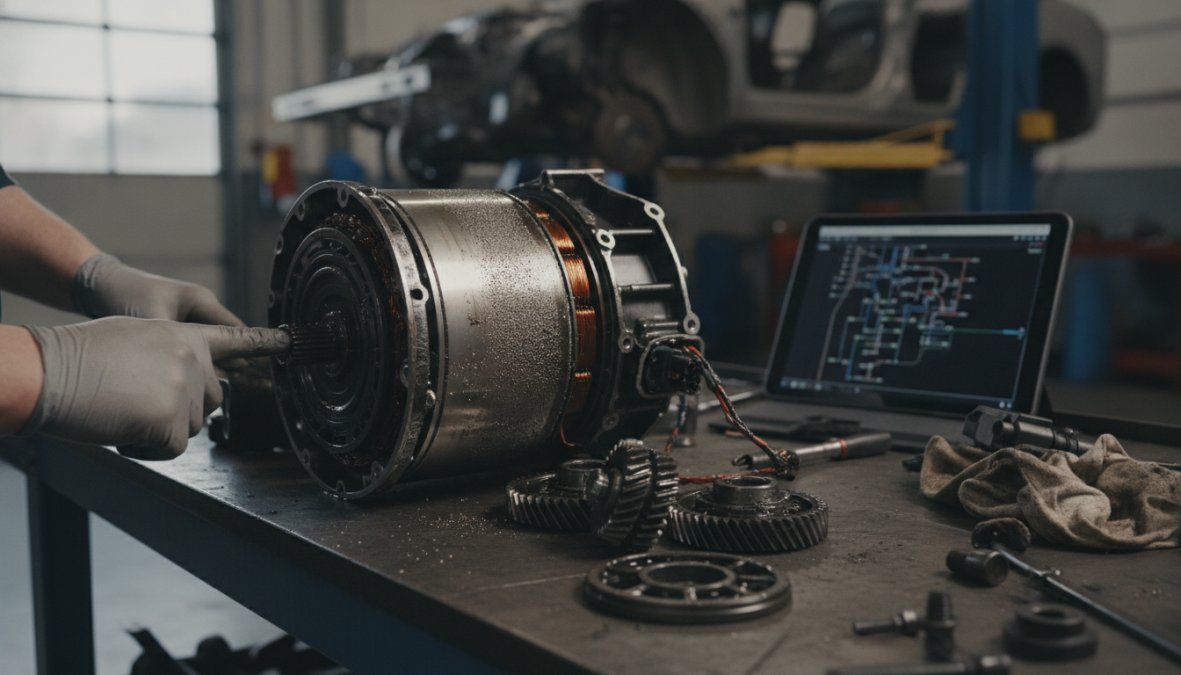
Recognising the signs of tesla drive unit failure early can be the difference between a straightforward repair and a full drivetrain replacement. At KMC Electric, our Level 4 Master Technicians have diagnosed and repaired Tesla drive unit faults across all models since 2016, and the patterns are consistent: most owners notice something is wrong weeks before the fault becomes critical, but they don't know what they're looking at. This guide covers every symptom, cause, and diagnostic step you need, including what it costs to fix and how to make your drive unit last longer.
Tesla drive units are generally reliable, but not indestructible. High-mileage vehicles, thermal stress, and deferred maintenance all accelerate wear. Owners who catch faults early spend far less and keep their cars on the road longer.
The Most Common Signs of Tesla Drive Unit Failure
Tesla drive unit failure is the degradation or malfunction of the electric motor, inverter, gearbox, or associated components that convert electrical energy into wheel torque. When it starts to go, the symptoms are rarely subtle. The most reliable early warning signs fall into two categories: audible and performance-based.
Warning Messages and Error Codes on the Dashboard
Dashboard alerts are the clearest signal your Tesla is flagging a drivetrain problem. The touchscreen displays error codes referencing the powertrain, motor, or drive unit directly, common messages include reduced power alerts, motor faults, or requests to contact service. The Tesla service app also logs fault codes that persist after a restart, a strong indicator the issue is hardware-related rather than a software glitch.
A common mistake is dismissing these warnings after a single occurrence. Intermittent error codes are often early-stage faults. If the same code reappears across multiple drive cycles, treat it as a confirmed fault.
Watch OutIgnoring recurring powertrain error codes and continuing to drive at high loads can accelerate internal bearing and stator damage, turning a repairable fault into a full drive unit replacement.
Performance Issues: Power Loss and Acceleration Shudder
Acceleration shudder, a judder or hesitation when pulling away from a standstill, points to rotor bearing wear or inverter irregularities. Power loss, where the car feels noticeably slower or limits torque output, often accompanies a dashboard alert but can appear alone in early-stage failures.
These symptoms are particularly common on high-mileage Tesla Model S and Model X vehicles, where original drive unit designs saw higher failure rates than later revisions. Model 3 and Model Y owners report them less frequently, though heavy use or repeated fast charging cycles increase risk.
Tesla Whining Noise on Acceleration: What It Really Means
A Tesla whining noise on acceleration is almost always a drive unit issue. The sound originates from the electric motor or gearbox and increases in pitch and volume as vehicle speed rises, it scales with motor RPM, not ground speed, distinguishing it from road or tyre noise.
The critical distinction is whether the noise is constant or intermittent. A constant, progressive whine worsening over weeks points to rotor bearing wear. An intermittent whine under load is more likely an inverter or stator issue. Both warrant inspection, but the repair path differs.
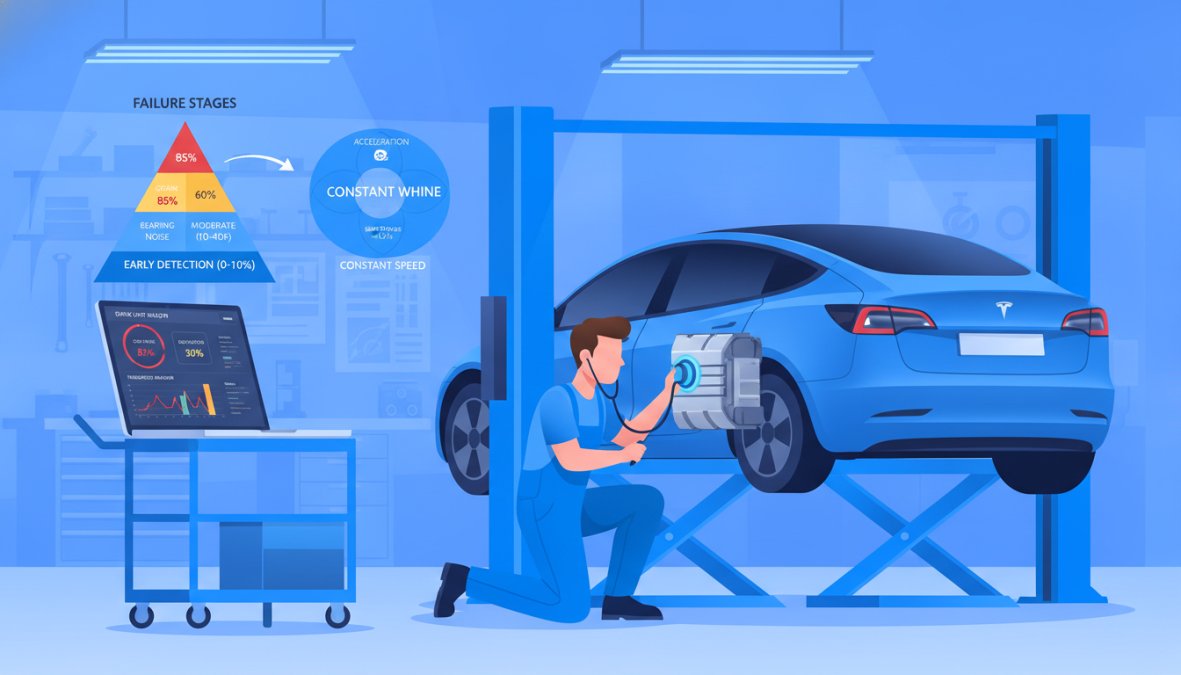
A Level 4 master technician in a professional workshop, crouching beside a Tesla Model 3 raised on a hydraulic lift, pressing an electronic stethoscope against the drive unit casing, diagnostic equipment displayed on a nearby laptop screen, workshop lit with overhead fluorescent lighting
According to Tesla's official service documentation and technical bulletins, drive unit noise complaints have been addressed through multiple software updates, but software cannot resolve mechanical wear. If a software update does not eliminate the whine, the fault is mechanical.
Humming, Grinding, and Clunking: How to Tell the Difference
Not all Tesla drive unit noises are the same, and misidentifying them leads to misdiagnosis.
Whining or humming: High-frequency, scales with motor speed. Points to rotor bearings or gear mesh issues inside the gearbox.
Grinding: Lower frequency, often felt through the floor as well as heard. Suggests advanced bearing wear or debris in the drivetrain.
Clunking: Discrete, knock-like sounds on acceleration or deceleration transitions. Often associated with worn mounts, loose hardware, or backlash in the gear selector mechanism.
Clunking that appears alongside a whining noise usually indicates the fault has progressed beyond early-stage wear.
What Causes Tesla Drive Unit Failure
The real problem with Tesla drive unit failures is not poor component design, it's that EV operating conditions place unique stresses on these components that traditional maintenance schedules don't account for.
Rotor Bearing Wear, Stator Damage, and Inverter Faults
Stator damage is less common but more severe. Insulation breakdown from thermal stress or coolant contamination can cause winding shorts that destroy the motor. Inverter faults sit between the battery and motor; a failing inverter produces erratic torque delivery, manifesting as the acceleration shudder described above.
Coolant Leaks and Thermal Management Issues
Tesla drive units are liquid-cooled. A coolant leak, from a degraded seal, cracked hose, or failing pump, removes thermal protection, elevating operating temperatures that accelerate bearing wear, degrade stator insulation, and shorten inverter life.
Owners of older Tesla Model S vehicles should also check the 12V battery. A failing 12V battery can generate false fault codes that mimic hardware failure. Always rule it out before assuming the drive unit itself is faulty.
Pro TipBefore booking a drive unit inspection, check the 12V battery voltage with a multimeter. A reading below 12.4V at rest is a strong indicator the 12V battery is contributing to the fault symptoms.
How Long Does a Tesla Drive Unit Last: Lifespan by Model
Tesla drive unit lifespan varies significantly by model generation and usage pattern. Early Model S vehicles (pre-2016) saw failure rates Tesla itself acknowledged, leading to design revisions and extended warranty coverage.
Model
Typical Drive Unit Lifespan
Notes
Model S (pre-2016)
60,000-100,000 miles
Higher failure rates, revised under warranty
Model S (2016+)
150,000+ miles
Redesigned unit, significantly improved
Model X
100,000-150,000 miles
Dual motor variants have more failure points
Model 3
150,000-200,000+ miles
Most reliable generation to date
Model Y
150,000-200,000+ miles
Shares architecture with Model 3
Individual outcomes depend heavily on charging habits, climate, and maintenance history. Vehicles that regularly charge to 100% and discharge to near zero experience greater thermal cycling stress on the drivetrain.
DIY Diagnostic Steps: How to Identify Signs of Tesla Drive Unit Failure at Home
Owners can perform meaningful preliminary diagnostics before visiting a service centre. These steps won't replace a professional inspection, but they narrow down the fault and give a technician a useful starting point.
Check the touchscreen for active fault codes. Go to Controls > Service > Service Mode (if accessible) or review any warning banners. Note the exact message wording.
Open the Tesla service app and review the vehicle's reported alerts. Faults logged here persist across restarts and are more reliable than transient dashboard warnings.
Perform a controlled acceleration test. In a safe, empty car park, accelerate smoothly from 0 to 30 mph and listen for whining, grinding, or clunking. Repeat in reverse.
Check for vibration through the steering wheel or floor. Vibration correlating with motor speed (not road surface) points to drivetrain imbalance.
Inspect under the vehicle for fluid. Any fluid beneath the front or rear motor area warrants immediate attention, Tesla drive units are sealed, so visible fluid indicates a coolant leak.
Test in both drive directions. Clunking only on initial pull-away or when transitioning between drive and reverse can indicate mount wear rather than internal drive unit failure.
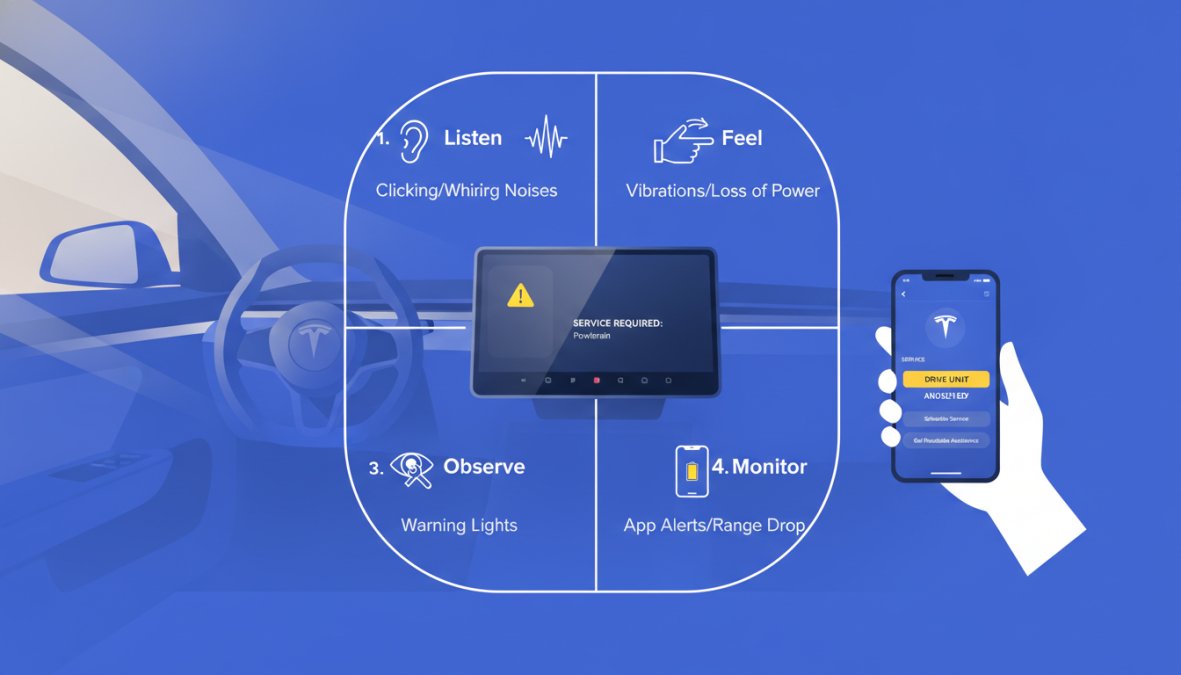
Close-up of a Tesla Model 3 centre touchscreen displaying a yellow powertrain warning alert, with a hand holding a smartphone showing the Tesla service app open beside it, natural daylight coming through the driver's window
Visual Identification Guide: What to Look For Under the Car
With the vehicle safely raised, look for these specific indicators:
Coolant residue: White or greenish staining around the drive unit casing or coolant hose connections.
Oil seepage: A thin film of gear oil around the output shaft seal. Fresh oil appears wet; older seepage leaves a dark residue.
Physical damage: Cracks in the drive unit casing from impact or severe overheating.
Loose mounting hardware: Drive unit mounts should show no visible movement when the drivetrain is loaded by hand.
Drivetrain oil condition is also worth checking on higher-mileage vehicles. Tesla Model 3 and Model Y drive units use a specific drive train oil that degrades over time, accelerating bearing wear. Pairing this with a fresh oil filter is standard practice during any drivetrain service.
Tesla Drive Unit Replacement Cost: Warranty and Out-of-Warranty Breakdown
Tesla drive unit replacement cost is one of the most opaque areas of EV ownership, and the lack of transparency is a genuine problem for owners planning their finances.
Under warranty: Tesla's basic vehicle warranty covers the drive unit for 4 years or 50,000 miles on most models, with the Battery and Drive Unit warranty extending to 8 years on Model 3 and Model Y. Within this period, replacement is covered at no cost. According to Tesla's official warranty documentation, this specifically covers defects in materials or workmanship.
Out of warranty: Main dealer replacement quotes typically run into several thousand pounds, with labour adding substantially to parts cost. The exact figure depends on the model, whether the front or rear unit is affected, and parts availability.
Remanufactured Drive Units vs. New: Which Is Worth It
Remanufactured drive units offer a cost-effective alternative for out-of-warranty vehicles. A remanufactured unit is fully disassembled, inspected, and rebuilt to specification with new bearings, seals, and worn components replaced, typically costing considerably less than a new OEM unit while offering comparable reliability when rebuild quality is high.
For a high-mileage Tesla Model S or Model X, a quality remanufactured unit is often the most sensible choice. For a lower-mileage Model 3 or Model Y with more service life ahead, the calculus changes. The key question is always rebuild standard: a cheaply remanufactured unit with substandard bearings will fail again.
Key TakeawayFor out-of-warranty Tesla drive unit repairs, always ask the repairer to confirm the bearing specification and whether the unit has been tested under load before installation. A reputable specialist will provide this information without hesitation.
Preventative Maintenance to Extend Your Tesla Drive Unit Lifespan
Tesla maintenance is near-zero effort for many systems, but the maintenance that actually matters for drive unit longevity is often overlooked. The following schedule reflects best practice for UK-based Tesla owners:
Every 12 months or 12,500 miles: Inspect drive unit mounts for wear or cracking. Check coolant level, condition, and hoses for brittleness or seepage.
Every 25,000 miles (Model 3 and Model Y): Change drivetrain oil and replace the oil filter. The bolts for the oil pump should be inspected and torqued to specification at this interval.
Every 50,000 miles: Full drivetrain inspection including bearing play check, output shaft seal condition, and inverter cooling circuit integrity.
As needed: Keep firmware current. Tesla regularly releases updates that refine motor control algorithms, and some specifically address noise or torque delivery issues.
Charging habits matter as much as physical maintenance. Keeping the battery between 20% and 80% for daily use reduces thermal cycling stress across the entire powertrain. Frequent high-rate Supercharging generates heat that the thermal management system must dissipate through the same coolant circuit cooling the drive unit. According to the Electric Vehicle Association's guidance on EV battery and drivetrain care, moderate daily charging habits consistently correlate with lower drivetrain fault rates in long-term fleet studies.
Pre-purchase inspections give proactive owners a significant advantage. KMC Electric's independent battery health verification and drivetrain assessment service, available in Kettering and across Northamptonshire, identifies potential faults before they become the new owner's problem. For Tesla owners near Kettering, an annual independent inspection is the single highest-value maintenance action available, it catches developing faults, verifies software currency, and provides a documented baseline for future comparison.
Identifying drive unit problems early is straightforward once you know what to look for, but acting on them requires a specialist who understands Tesla drivetrains at a component level. KMC Electric offers professional diagnosis, repair, and preventative maintenance for Tesla owners in Kettering and across Northamptonshire, with over 25 years of automotive experience and Level 4 Master Technician status in electric vehicles since 2016. Whether you're dealing with a confirmed fault or want an independent assessment before warranty expiry, get in touch with KMC Electric and protect your drivetrain investment before a minor fault becomes a major cost.
Frequently Asked Questions
What are the most common signs of Tesla drive unit failure?
The most common signs of Tesla drive unit failure include a persistent whining or humming noise during acceleration, grinding or clunking sounds at low speeds, sudden power loss or acceleration shudder, and warning messages appearing on the dashboard. High-mileage vehicles, particularly older Tesla Model S and Model X units, are more prone to these symptoms. If you notice any combination of these, it is worth having the drivetrain inspected by a specialist promptly.
How much does Tesla drive unit replacement cost out of warranty?
Tesla drive unit replacement cost out of warranty can vary considerably depending on the model and whether a new or remanufactured drive unit is fitted. As a general guide, out-of-warranty repairs at independent specialists tend to be significantly more cost-effective than main dealer pricing. A remanufactured drive unit is often a practical, lower-cost alternative to a brand-new unit. Getting a transparent, itemised quote from a qualified independent EV specialist is the best starting point.
Does Tesla warranty cover drive unit failure?
Tesla's powertrain warranty typically covers the drive unit for a defined period, which varies by model and year. For many Tesla Model S, Model 3, Model X, and Model Y vehicles, the drive unit is covered for eight years or a set mileage limit. However, warranty coverage depends on the specific vehicle configuration and purchase date. If your vehicle is approaching the warranty boundary, having an independent pre-expiry inspection carried out can help identify faults before coverage lapses.
Can you still drive a Tesla if the drive unit is failing?
In some cases a Tesla with early-stage drive unit issues may remain driveable, but continuing to drive with known symptoms risks causing further damage to the electric motor, inverter, or gearbox components. Dashboard alerts or significant power loss are a signal to reduce driving and seek a diagnostic assessment promptly. Ignoring signs of Tesla drive unit failure can turn a manageable repair into a full replacement, so early intervention is always the more cost-effective approach.
How long does a Tesla drive unit typically last?
Tesla drive unit lifespan varies by model generation and driving conditions. Early Tesla Model S units developed a reputation for premature failure, prompting Tesla to redesign subsequent versions. Later units across Model 3, Model Y, and refreshed Model S and X vehicles are generally considered more durable. With proper preventative maintenance, including drivetrain oil changes where applicable, many owners report drive units lasting well beyond 150,000 miles, though high-mileage vehicles should be monitored closely.