How Common Is Electric Vehicle Inverter Overheating?
Inverter overheating is not a routine fault on most electric vehicles, but it is far from rare in older, high-mileage models, and it is one of the most misunderstood warnings a driver can face. The inverter is the component that converts direct current from the battery into the alternating current that drives the motor, and it generates meaningful heat while doing so (energy.gov). At KMC Electric, our technicians see a steady trickle of these cases across Northamptonshire and Leicestershire, and the pattern is consistent: the fault rarely appears out of nowhere.
Most cases trace back to a cooling system that has quietly degraded over years of service. Coolant loses its properties, pumps wear, and radiators collect debris. The inverter itself is usually the victim, not the cause.
Here is the honest answer to the question in the title: is electric vehicle inverter overheating a common fault on a well-maintained car? No. On a neglected one, or a used EV bought without an inspection, it becomes considerably more likely. That distinction matters, because it means most overheating events are preventable.
Key TakeawayInverter overheating is usually a symptom of a failing cooling system, not a failing inverter. Diagnose the cooling circuit first and you will solve most cases without replacing the expensive part.
Signs of Electric Car Inverter Failure You Shouldn't Ignore
The clearest early sign of electric car inverter failure is a power reduction warning, often paired with a message telling you the vehicle has limited performance. The car is protecting the inverter by cutting current, and ignoring that message is how a cheap fix becomes an expensive one.
Watch for these symptoms:
A sudden drop in acceleration, sometimes called limp mode
Dashboard warnings about motor or inverter temperature
A burning or sweet chemical smell after a drive
Coolant residue or staining around the inverter housing
Intermittent power loss that clears after the car cools down
Unusual noise from the coolant pump when the car wakes up
That last symptom is the one most owners miss. A pump that whines or ticks on startup is often the first physical clue, weeks before any warning light appears. If you notice it, get the cooling circuit checked rather than waiting for the car to tell you.
What Causes an EV Inverter to Overheat?
The dominant cause is degraded coolant flow, and it accounts for the majority of cases we diagnose. The inverter sits in a cooling loop that also serves the motor and, on many Tesla models, the battery. When that loop underperforms, the inverter is often the first component to complain because it runs hot by design.
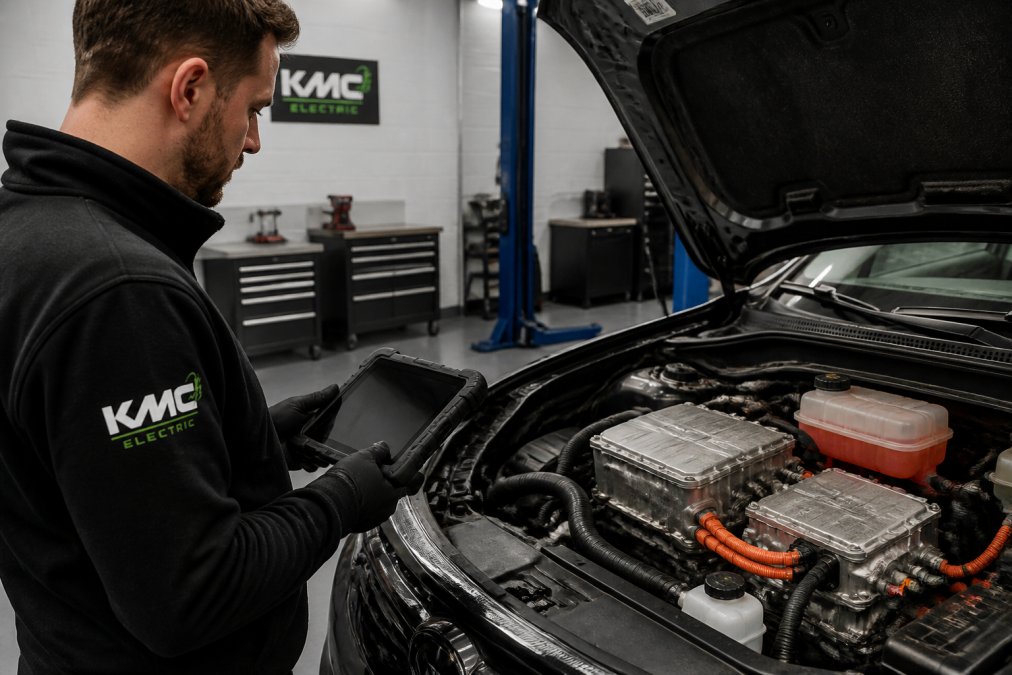
A close-up photograph of a technician's hands using a diagnostic tablet next to an open electric vehicle bonnet, with coolant hoses and a bright workshop background in Kettering
Specific causes we see in the workshop:
Coolant breakdown. Electric vehicle coolant is not lifetime fluid, despite what some owners assume. It degrades and loses heat-transfer capability.
Failing coolant pump. Pumps wear out. A weak pump moves less fluid and the whole loop runs hotter.
Blocked or damaged radiator. Road debris, corrosion and impact damage all reduce airflow.
Air locks after a repair. A cooling system bled incorrectly traps air and creates hot spots.
Sensor faults. Occasionally the inverter is fine and the temperature sensor is lying, which is why proper diagnosis matters.
That last point is worth dwelling on. We regularly see owners quoted for an inverter replacement when the real fault is a sensor or a pump. Diagnosis before replacement is not upselling; it is the difference between a sensible repair and a wasteful one.
Tesla Fault Code Diagnosis: What the Warnings Actually Mean
Tesla fault code diagnosis starts with reading the actual codes, not guessing from the dashboard message. Tesla stores detailed fault data that identifies which subsystem triggered the warning, and that data is what separates a targeted repair from a parts lottery.
Owners often arrive having already searched the code and found conflicting forum answers. The code alone rarely tells the full story. What matters is the freeze-frame data captured at the moment of the fault: coolant temperature, pump speed, ambient conditions and load. A code that reads as an inverter over-temperature fault might have been triggered by a pump running below commanded speed, which points at the pump, not the inverter.
This is where independent diagnosis earns its keep. A franchised dealer network will typically follow a defined replacement path (gov.uk). An independent specialist reads the same data and asks why the temperature rose in the first place. For dealership service managers in the East Midlands dealing with complex Tesla fault codes, that second opinion is often the fastest route to a correct repair.
Pro TipBefore any repair, ask for the freeze-frame data alongside the fault code. If a workshop cannot show you the conditions recorded at the moment of the fault, they are guessing.
EV Inverter Cooling System Maintenance to Prevent Overheating
EV inverter cooling system maintenance is the single most effective way to avoid overheating, and it is straightforward. The work is not exotic; it is the same discipline that keeps any cooling circuit healthy, applied to a high-voltage system that demands proper procedure.
Check coolant level and condition at every service
Test coolant strength and replace it on the manufacturer's interval, not on a guess
Inspect the coolant pump for noise, weepage and correct operation
Clear debris from the radiator and cooling ducts
Pressure-test the system if any loss is suspected
Log coolant temperature behaviour during a diagnostic road test
If you drive a Tesla and want to keep the drivetrain healthy, the parts that support the cooling and lubrication circuits are worth understanding. KMC Electric supplies drive train oil and bolts for the oil pump for owners and independent workshops who prefer to maintain rather than replace.
Neglect is the common thread in nearly every overheating case we handle. Owners who service the cooling system on schedule rarely see this fault at all.
When to Seek Professional Help for Inverter Overheating
You should seek professional help the moment a temperature warning appears more than once, even if performance returns to normal (hse.gov.uk). Intermittent warnings are not a quirk; they are the early stage of a fault that will eventually become permanent.
Book the car in immediately if you experience any of the following:
Symptom
What it usually means
Urgency
One-off warning, clears quickly
Early cooling degradation
Book within weeks
Repeated warnings
Pump or coolant fault
Book within days
Limp mode triggered
Inverter protecting itself
Stop driving, book now
Coolant smell or visible leak
System breach
Do not drive
Warning plus reduced range
Linked thermal management fault
Stop driving, book now
For drivers in Kettering and across Northamptonshire, an independent specialist near me is often the faster and more transparent option than a main dealer queue. KMC Electric holds Level 4 Master Technician status in electric vehicles and has held EV qualifications since 2016, backed by more than 25 years in the automotive industry. That experience matters when a fault code points somewhere unexpected.
If your car is nearing the end of its manufacturer warranty, this is also the moment to have the cooling system and battery checked. Catching a developing fault before the warranty expires is far cheaper than paying for it afterwards.
Inverter overheating is a manageable fault, but only if you treat the warning as a signal rather than an inconvenience. The drivers who avoid expensive repairs are the ones who act on the first symptom and maintain the cooling system on schedule. KMC Electric offers independent Tesla and EV diagnosis, cooling system repair, and battery health verification for owners and dealerships across the Midlands, with practical fixes designed to extend your vehicle's service life rather than replace parts on a hunch. Get started with KMC Electric and book a diagnostic check before a small cooling fault becomes a major repair.
Frequently Asked Questions
What are the symptoms of an electric vehicle inverter overheating?
Common symptoms include a sudden reduction in power, a high-voltage system warning on the dashboard, and the vehicle entering a limited-performance mode. You may also notice unusual noises from the motor area or a burning smell. In some cases, the car may refuse to start or charge. If you see any of these signs, stop driving and arrange a professional inspection, as continued use can cause permanent damage to the inverter.
Can a faulty cooling system cause an EV inverter to overheat?
Yes, a faulty cooling system is one of the most frequent causes. The inverter relies on coolant to dissipate heat. If the coolant level is low, the pump is failing, or there is a blockage in the radiator or hoses, heat cannot escape. Regular EV inverter cooling system maintenance, such as checking coolant levels and inspecting hoses, can prevent this. Ignoring cooling issues often leads to expensive inverter replacement.
Is inverter failure covered under standard UK EV warranties?
Most standard UK EV warranties, including Tesla's, cover inverter failure if the vehicle is within the warranty period and the fault is not due to neglect or accident damage. However, wear-and-tear items like coolant hoses may not be covered. If your car is out of warranty, an independent specialist can diagnose the issue and provide cost-effective repairs. Always check your warranty terms and service history.
What should I do if my dashboard displays a high-voltage system warning?
A high-voltage system warning indicates a serious fault. Safely pull over, turn off the vehicle, and do not attempt to drive further. Contact a qualified EV technician or recovery service. Do not touch any orange cables. If the warning appears alongside reduced power, it may be an inverter overheating issue. Prompt Tesla fault code diagnosis can identify the exact cause and prevent further damage.