Tesla ownership is growing fast across the East Midlands, and the demand for independent tesla service northamptonshire has never been higher. This guide from KMC Electric covers everything you need to know about maintaining your Tesla outside the official network, from routine servicing to MOT testing and battery health checks. The honest truth is this: the official Tesla Service Center model was not built for the volume of vehicles now on UK roads. Waiting times are long, costs are high, and for many owners in Kettering and the surrounding area, a qualified independent specialist is not just a fallback option. It is the better choice.
Below, we cover the real differences between official and independent repair, what UK consumer law says about your warranty, how to find a vetted EV specialist near you in Northamptonshire, and what to budget for common Tesla repairs in 2026.
Why Independent Tesla Service in Northamptonshire Is Worth Considering
The growing gap between Tesla demand and official service capacity has created a genuine problem for owners across the UK. Tesla's network of Service Centers is concentrated in major cities. For drivers based in Kettering, Northampton, or the wider Northamptonshire area, the nearest official center can mean a significant journey, a long wait for an appointment, and a bill that reflects main dealer pricing.
Independent tesla service northamptonshire fills that gap. A qualified independent EV specialist, particularly one holding Level 4 Master Technician status, can diagnose and repair Tesla Model 3, Model S, Model X, and Model Y vehicles to the same technical standard as an official center. The difference is access, cost, and personal service.
The misconception that only Tesla can work on Teslas persists, but it is not accurate. Under UK consumer rights law and the EU Block Exemption Regulation (retained in UK law post-Brexit), vehicle owners have the legal right to use any competent independent garage for servicing without voiding their manufacturer warranty, provided the work is carried out to the manufacturer's specification. According to UK Government guidance on consumer vehicle rights, this principle protects owners from being forced into manufacturer-only service networks.
There is also a practical argument for going independent. Garages specialising in EV diagnostics often identify faults before they escalate, something particularly valuable for Tesla owners approaching warranty expiry. KMC Electric, based in Kettering, offers battery health assessments specifically designed for this pre-expiry window, giving owners a clear picture of their vehicle's condition before the official cover ends.
Key TakeawayIndependent Tesla servicing in Northamptonshire is legal, often faster, and for many owners, more cost-effective than using the official Tesla Service Center network.
Tesla Service Center vs. Independent Mechanic: An Honest Comparison
Most guides on this topic present both options as equally valid without taking a position. Here is a clearer view.
Tesla Service Centers hold one genuine advantage: direct access to Tesla's proprietary software systems and over-the-air update infrastructure. For complex software-related issues or recalls, they remain the primary resource.
Independent mechanics with EV qualifications offer something different. The best ones carry IMI-accredited or Level 4 Master Technician credentials, use professional-grade EV diagnostic tools, and often have deeper hands-on experience with specific fault patterns than a technician rotating through a busy official center.
The real difference between a good independent and a poor one comes down to high-voltage system training. Not every garage that claims to service EVs has the qualifications to work safely on battery packs, inverters, or high-voltage cables. Checking for IMI Level 3 or Level 4 certification in electric vehicle technology is the single most important step before booking.
Watch OutAvoid any independent garage that cannot confirm IMI-qualified technicians for high-voltage EV systems. Working on Tesla battery packs without proper training is a safety risk, not just a quality issue.
Tesla Warranty and Independent Repair: What UK Owners Need to Know
UK law is clear on this point, and it is more owner-friendly than most people assume. The retained Block Exemption Regulation means that using an independent garage for servicing does not automatically void your Tesla warranty, provided the service is carried out using parts of matching quality and follows the manufacturer's maintenance schedule. According to Competition and Markets Authority guidance on motor vehicle block exemption, this framework explicitly protects consumer choice in vehicle servicing.
Understanding Tesla's Warranty Structure
Before discussing documentation, it helps to understand what you are actually protecting. Tesla vehicles sold in the UK come with several distinct warranty components, and the rules around independent servicing interact differently with each one:
New Vehicle Limited Warranty: Covers defects in materials and workmanship for four years or 50,000 miles (whichever comes first) on most current models. Independent servicing does not void this warranty provided the Block Exemption conditions are met, correct parts specification, adherence to the maintenance schedule, and documented service records.
Battery and Drive Unit Warranty: This is the component most owners are most concerned about. Tesla provides an eight-year or mileage-limited warranty on the battery and drive unit (the specific mileage cap varies by model). The warranty covers capacity retention below a defined threshold as well as defects. Independent servicing does not void this warranty for the same reasons as above. However, Tesla may decline a battery warranty claim if it can demonstrate that third-party intervention, for example, incorrect charging equipment, physical damage from improper lifting, or unauthorised modification, directly caused the fault. This is a narrower exclusion than many owners fear, but it is real.
Used Vehicle Warranty: Teslas purchased as certified used vehicles through Tesla's own network carry a separate limited warranty. The same Block Exemption principles apply, but the documentation burden is higher because the vehicle's service history prior to purchase may be incomplete.
The tesla warranty independent repair question becomes most nuanced for battery-related claims. Routine servicing, brake fluid, tyres, cabin filter, visual inspections, carries essentially no warranty risk when carried out by a qualified independent. The risk area is any intervention that involves the high-voltage system itself, where Tesla will scrutinise whether the work was carried out correctly if a related fault subsequently develops.
Key TakeawayUsing a qualified independent garage for routine Tesla servicing does not void your warranty under UK law. The risk area is high-voltage system intervention, not routine maintenance, and even there, the risk is manageable with the right documentation.
Insurance and Warranty Documentation: Protecting Yourself
This is the area where most guides, and many independent garages, fall short. Knowing the legal principle is one thing. Having the paperwork to defend your position when a warranty or insurance claim is disputed is another.
What a compliant service invoice must contain:
For a service record to protect your warranty and support an insurance claim, the invoice from your independent garage should include all of the following:
The garage's full business name, address, and VAT number
The vehicle's registration number, VIN, and recorded mileage at the time of the service
The date the work was carried out
An itemised list of every task performed, described specifically (not just "service", each individual item should be listed)
For every part replaced: the part name, part number, and a statement confirming it meets or exceeds OEM specification
The name and IMI certification number of the technician who carried out the work
A signed declaration that the work was carried out in accordance with the manufacturer's maintenance schedule
If your independent garage provides a single-line invoice saying "Tesla service, £X", that document will not protect you in a warranty dispute. A good independent specialist will produce a detailed, itemised record as standard. If they do not, ask for one explicitly before you pay.
What to keep and where to keep it:
Maintain a physical or digital folder for your Tesla's service history that contains every invoice, every health check report, and any correspondence with the garage about specific faults or recommendations. If you ever need to make a warranty claim, being able to produce a complete, unbroken service history with compliant documentation significantly strengthens your position. If you are selling the vehicle, a documented independent service history from a named, qualified specialist is a meaningful asset, particularly if it includes battery health assessments, which the official service network does not routinely produce as standalone documents.
The insurer dimension:
Most motor insurance policies require the vehicle to be maintained in a roadworthy condition and serviced in accordance with the manufacturer's schedule. They do not require servicing to be carried out at an official Tesla Service Center. However, if a claim arises from a fault that could plausibly be linked to a service item, for example, a brake failure following a recent brake service, the insurer will request the service documentation. Gaps in service history, or records that cannot be verified against a named, qualified technician, can complicate a claim even when the servicing itself was competent.
Some insurers, particularly those offering specialist EV or Tesla-specific policies, are beginning to ask for evidence of EV-qualified technicians in service records. Confirming that your independent garage's invoices include IMI certification numbers is the simplest way to satisfy this requirement.
Watch OutIf you receive a service invoice that does not include the technician's qualification details and an itemised parts list with OEM-equivalence confirmation, request a corrected invoice before leaving the garage. This is not an unusual request, any professional independent specialist will comply without hesitation.
Pre-warranty-expiry battery assessment:
For owners approaching the end of their battery warranty period, a documented independent battery health assessment serves a specific purpose. If the assessment identifies that battery capacity has degraded below Tesla's warranted retention threshold, you have a documented, third-party record to support a warranty claim before the coverage lapses. KMC Electric offers module-level battery health assessments that produce a written report suitable for this purpose, something the official service network does not routinely offer as a standalone product available to any owner on request.
Buying or selling a used Tesla:
For buyers, requesting a pre-purchase independent battery health check from a specialist like KMC Electric provides a documented, third-party assessment of the battery pack's actual condition, not just the dashboard state-of-health percentage, which does not reflect individual module degradation. For sellers, having this documentation available proactively signals transparency and supports a stronger asking price.
Understanding the Tesla Maintenance Schedule for UK Drivers
Tesla markets its vehicles as low-maintenance, and compared to internal combustion engine cars, they are. But low-maintenance is not zero-maintenance. Many Tesla owners are caught out by the assumption that nothing needs doing, which leads to deferred work accumulating and, in some cases, avoidable faults developing.
The tesla maintenance schedule for UK drivers covers several time- and mileage-based tasks that apply regardless of whether the work is done at an official center or by a qualified independent specialist.
Routine Tasks: Brakes, Tyres, Cabin Air Filter, and Brake Fluid
Tyre maintenance is arguably the most frequent requirement. Teslas are heavier than comparable petrol cars due to the battery pack, and regenerative braking changes wear patterns. Tyre rotation is recommended every 10,000 to 12,000 miles. Wheel alignment should be checked annually or after any significant kerb impact.
Brake maintenance on a Tesla is less frequent than on a conventional car because regenerative braking handles most deceleration. However, this means brake calipers can seize if not periodically exercised. Brake fluid flush is recommended every two years regardless of mileage, as brake fluid absorbs moisture over time and its performance degrades.
Cabin air filter replacement is recommended every two years (or annually if the HEPA filter is fitted). This is a straightforward job that any competent independent garage can handle.
Suspension repairs should be inspected if the vehicle has covered significant mileage or if handling changes are noticed. Tesla Model S and Model X air suspension systems require specialist knowledge.
For owners who want to source parts directly, KMC Electric stocks Tesla-specific components including drive train oil and oil filters for Model 3, allowing independent garages or technically confident owners to use correctly specified parts.
Software Diagnostics, Updates, and Mobile Service Options
Software diagnostics are a genuine differentiator between Tesla and traditional vehicles. Tesla's architecture means that many fault codes, battery state readings, and system logs require purpose-built EV diagnostic tools to interpret correctly. A general OBD reader will not surface the full picture.
Qualified independent specialists use professional EV diagnostics platforms that can read Tesla-specific data, including battery module health, charging cycle history, and thermal management system performance. This level of visibility is what separates a genuine EV specialist from a general garage that has added an EV service to its menu.
Tesla's mobile service model handles minor software updates and small repairs at the owner's location. For more involved work, an independent garage in the Northamptonshire area with the right diagnostic equipment is often a faster and more convenient option than travelling to an official center.
MOT Testing for Tesla Owners: A Northamptonshire-Specific Guide
Tesla owners in Northamptonshire often have questions specific to the MOT process for electric vehicles. The MOT test applies to all vehicles over three years old, including Teslas, and the test criteria for EVs differ in several important ways from petrol and diesel vehicles.
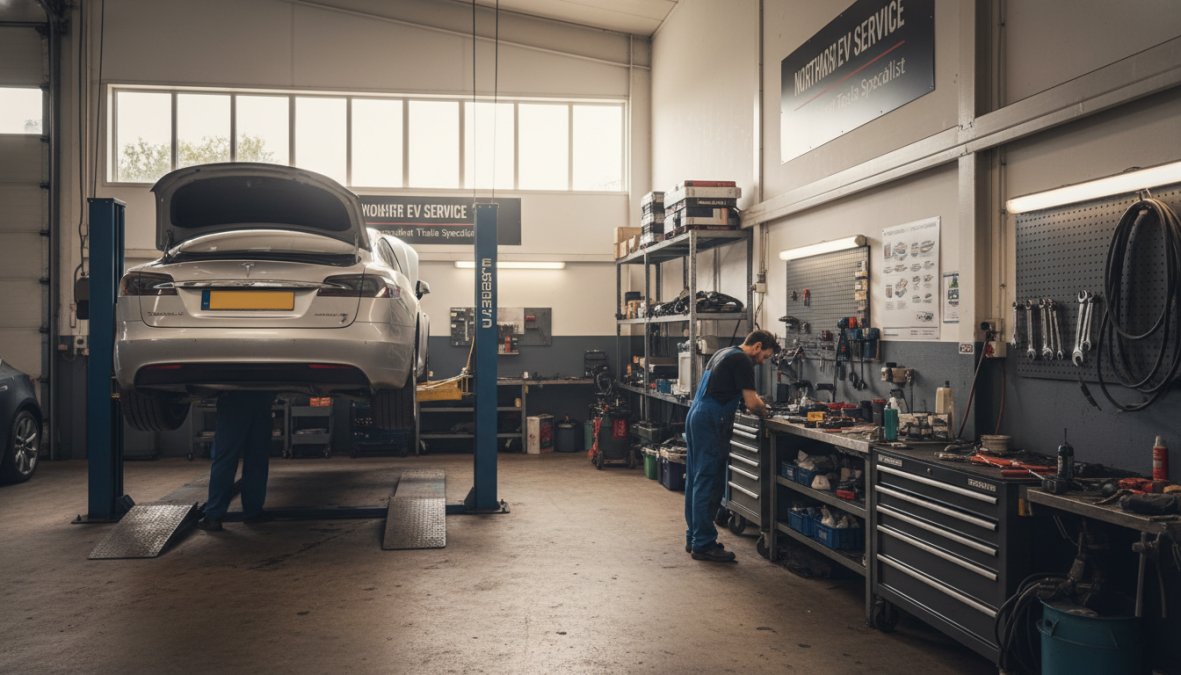
Professional illustration showing Tesla Model, Tesla for independent tesla service northamptonshire
The emissions test section does not apply to pure electric vehicles. However, the following areas are checked and are directly relevant to Tesla owners:
Brakes: Brake performance is tested on a roller brake tester. Seized rear calipers, a known issue on Teslas with infrequently used friction brakes, are a common MOT failure point.
Tyres: Tread depth, condition, and correct fitment are checked. Tesla's heavier kerb weight accelerates inner edge wear, so tyres that look acceptable visually may be borderline on tread depth.
Lights and electrical systems: All exterior lights are checked. Suspension and steering components are inspected for wear or damage.
Suspension: Air suspension on Model S and Model X is checked for leaks and correct operation.
The Battery Pack Jacking Problem: What Most Garages Get Wrong
This is the issue that generates the most anxiety among Tesla owners booking an MOT at a general garage, and with good reason. Tesla vehicles have a large, flat battery pack that runs the full length of the vehicle floor. If a garage uses a standard two-post lift and positions the arms incorrectly, the lift pads can contact the battery pack casing rather than the designated chassis jacking points. The result ranges from cosmetic damage to the battery enclosure through to, in serious cases, structural damage that compromises the pack's integrity and triggers a very expensive repair.
This is not a theoretical risk. It is a documented pattern that has led to costly disputes between Tesla owners and garages that were not familiar with EV-specific lifting procedures.
The correct approach for lifting a Tesla on a two-post or four-post lift:
Tesla publishes model-specific jacking and lifting instructions in its workshop documentation. The key principle is that the lift pads must contact the designated rocker panel reinforcement points, not the battery pack underside. These points are marked on most Tesla models with small triangle symbols on the sill. Before any garage lifts your Tesla, whether for an MOT, tyre rotation, or brake inspection, confirm that the technician knows where these points are and is using appropriately sized rubber lift pucks or adapters to protect the sill.
For Model 3 and Model Y specifically, the rocker panel jacking points are the only safe contact points for a two-post lift. The battery pack sits very close to the vehicle's outer edge in these models, making incorrect pad placement a realistic risk if the technician is working from general EV knowledge rather than Tesla-specific procedure.
How to talk to a local garage about this before you book:
When calling any Northamptonshire garage to book a Tesla MOT, ask two direct questions:
"Do your technicians know the specific jacking points for my Tesla model, and do you have rubber lift pucks or adapters for the rocker sill?"
"Has your garage lifted a Tesla before, or can you confirm you have access to the Tesla workshop lifting procedure for my model?"
A garage that answers both questions confidently and specifically is a garage that has done this before. A garage that gives a vague answer about lifting EVs in general is one to approach with caution. Any garage on the local directory in this guide has the EV-specific knowledge to handle this correctly.
Watch OutNever allow a garage to lift your Tesla using the battery pack underside as a contact point. If you arrive and the technician is unsure of the correct jacking locations, stop the job before the vehicle goes on the lift. Damage to the battery enclosure is not covered under warranty if caused by incorrect workshop handling, and repair costs can be substantial.
Common Tesla MOT Failure Points in Practice
Beyond the lifting question, the following are the most frequently encountered MOT advisory and failure items for Teslas at Northamptonshire garages:
Seized rear brake calipers: Because regenerative braking handles the majority of deceleration in normal driving, the rear friction brakes on many Teslas are rarely used hard. This allows corrosion to build up on the caliper slides and pistons. On the roller brake tester, a seized caliper shows as an imbalance between left and right braking effort, which is a failure. Regular brake caliper servicing, cleaning, lubricating, and exercising the pistons, is the preventive measure. This is a straightforward job for any qualified independent garage.
Tyre inner edge wear: Tesla's kerb weight, combined with the torque delivery characteristics of the electric motors, puts more stress on tyre shoulders than a comparable petrol car. Inner edge wear is common and is not always visible without removing the wheel. A tyre that passes a quick visual check in a car park may fail on tread depth measurement at the inner edge during an MOT.
Suspension wear on higher-mileage vehicles: Model S and Model X air suspension components, including the front lower control arm bushes and rear toe links, are known to show wear at higher mileages. These are inspected during the MOT underside check. If your vehicle has covered significant mileage and has not had a suspension inspection, booking a pre-MOT check at a specialist garage is worth doing.
Windscreen damage: A chip or crack in the driver's direct line of sight is an automatic MOT failure. Tesla windscreens are large and relatively expensive to replace; checking the screen condition before the test avoids a failure on a straightforward item.
Pro TipBook your Tesla's MOT at a garage that also offers EV servicing. If the MOT identifies a brake or suspension issue, having the repair done at the same site by qualified technicians saves time, ensures the work is carried out correctly, and means the technician already knows the vehicle's jacking points and high-voltage system layout.
Pre-MOT Checklist for Tesla Owners
Running through this list before your MOT appointment reduces the chance of a preventable failure:
Check all exterior lights are functioning, including daytime running lights and number plate lights
Check tyre tread depth at multiple points across each tyre, including the inner edge if accessible
Listen for any unusual noises from the suspension over speed bumps or during low-speed turning
Confirm the horn works
Check windscreen for chips or cracks in the driver's eyeline
If the vehicle has not had a brake fluid flush in the last two years, book one before the MOT, degraded brake fluid can affect brake performance test results
Confirm with the garage that they have the correct lifting equipment and know the Tesla-specific jacking points for your model
Tesla Service Cost UK: What to Budget for Independent Repairs
Tesla service cost UK comparisons consistently show that independent specialists offer meaningful savings over official service center pricing, particularly for out-of-warranty vehicles. Without a specific price list from every provider, the following gives a realistic framework based on the services available from Northamptonshire-based independents.
Interim service (fluid checks, brake inspection, tyre rotation, cabin filter): from approximately £175 at local independents.
Full service (all interim items plus brake fluid flush, detailed system diagnostic, battery health check): pricing varies by provider; contact individual garages for quotes.
Brake fluid flush: a standalone two-year service item, typically priced competitively by independent garages.
Battery health assessment: a standalone diagnostic that produces a documented report on individual cell module condition. Particularly valuable pre-sale or pre-warranty expiry.
Specific component repairs: items like the Tesla Model 3 and Model Y hand brake electric motor are a known failure point. Sourcing the part independently and using a qualified local garage significantly reduces the total repair cost compared to the official network.
The general principle holds: the more complex and specialised the repair, the greater the potential saving from using a qualified independent rather than an official Tesla Service Center.
Local Directory: Independent Tesla Specialists in Northamptonshire
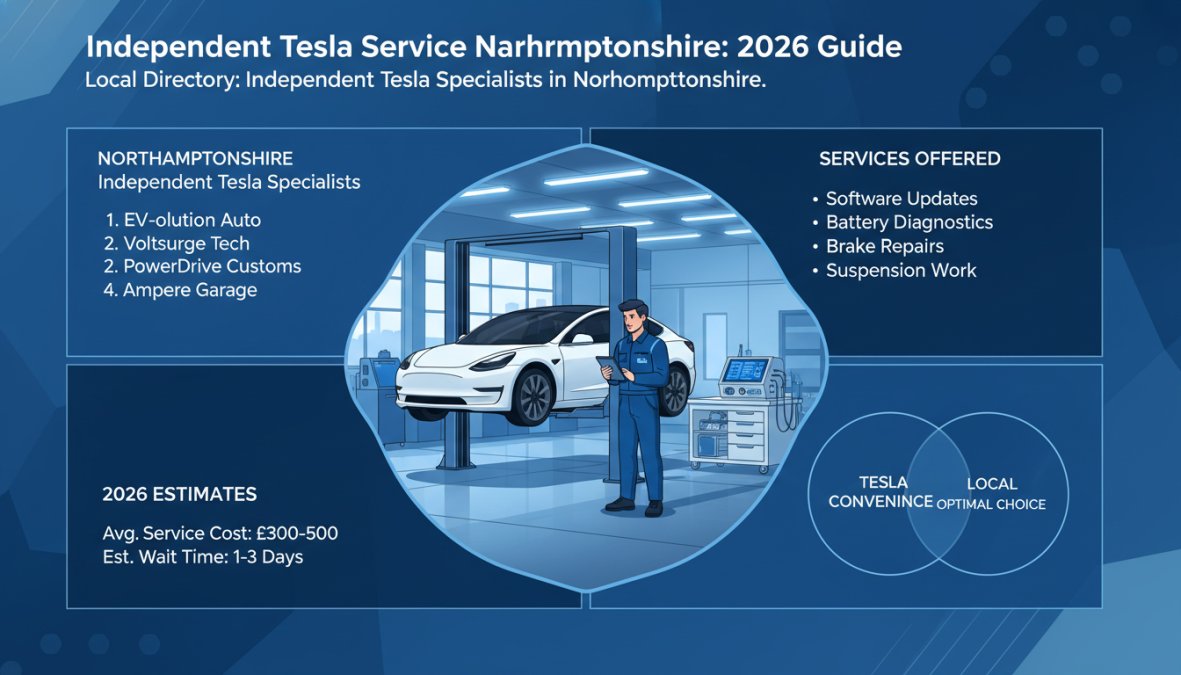
Finding a qualified independent EV specialist near you in Northamptonshire is more straightforward than it was even two years ago. The following garages have documented EV qualifications and serve the Kettering, Northampton, and wider Northamptonshire area.
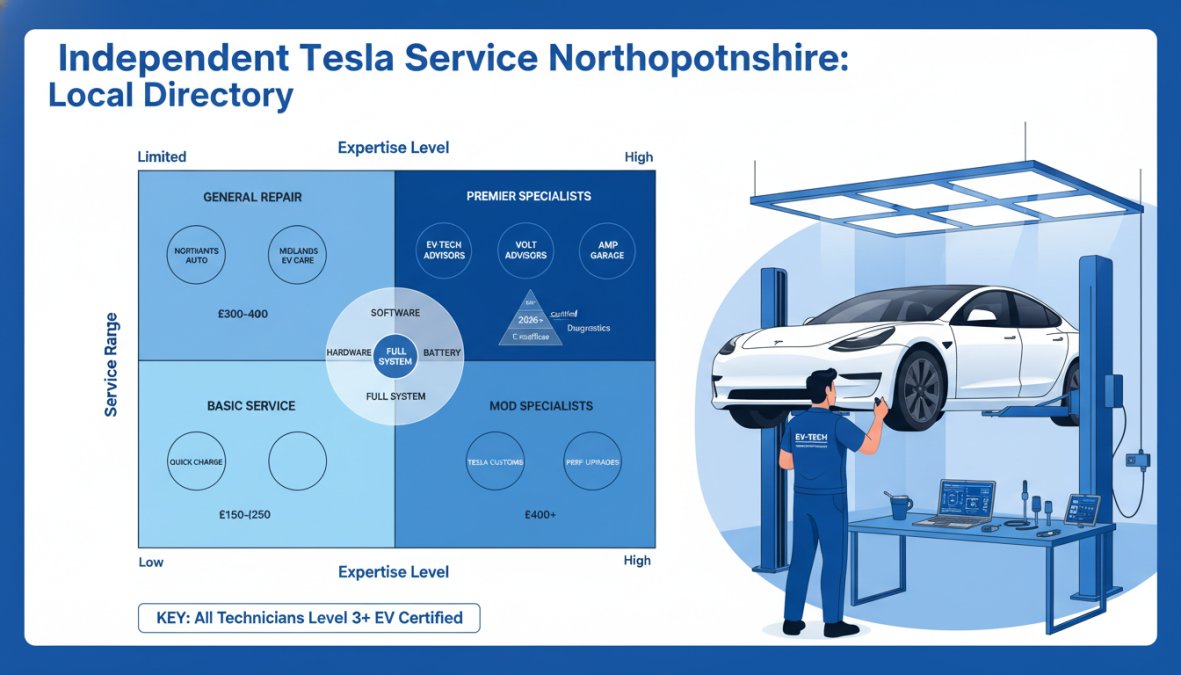
Professional illustration showing Tesla Model, Tesla for independent tesla service northamptonshire
KMC Electric (Kettering): The top recommendation for complex, technical Tesla work. KMC Electric holds Level 4 Master Technician status in electric vehicles, has been delivering EV qualifications since 2016, and brings over 25 years of automotive industry experience to every job. The focus is on deep diagnostic capability, including module-level battery assessment and high-voltage system fault repair. For out-of-warranty vehicles, pre-sale battery verification, or any fault that a general garage has been unable to resolve, KMC Electric is the specialist to call.
Kettering Motorist Centre (Kettering): Offers interim and full Tesla service schedules from £175, with technicians trained by ex-Tesla personnel. Uses genuine Tesla parts or high-quality alternatives, and provides transparent fixed pricing.
Bee Cool ACS (Kettering): A family-run garage near Kettering Railway Station with IMI Level 4 qualified technicians. Three service levels available, manufacturer-compliant servicing, and a collection and delivery service within 10 miles.
Martin's Auto Services (Rushden): Rushden-based, focused on warranty-preserving service schedules and tailored plans for out-of-warranty vehicles.
In Town Automotive (Northampton): A large, RAC-approved independent garage in Northampton with advanced EV diagnostic equipment and a strong reputation for comprehensive vehicle checks.
Motorvation Northampton: Offers short, interim, and full EV service options with IMI-qualified technicians and online booking.
Service MOT Repairs Ltd (Northampton): Bosch-authorized service center with certified technicians and advanced EV diagnostic tools.
How to Choose the Right Independent EV Specialist for Your Tesla
The choice of independent tesla service northamptonshire provider should come down to four criteria:
Qualifications: Confirm IMI Level 3 or Level 4 certification in electric vehicle technology. For high-voltage work, Level 4 is the standard you want.
Diagnostic equipment: Ask specifically whether the garage uses professional EV diagnostic tools capable of reading Tesla-specific fault data, not just a generic OBD reader.
Parts policy: Confirm whether the garage uses genuine Tesla parts or quality-equivalent alternatives, and that this is documented on the service invoice.
Documentation: A good independent specialist provides a full written record of every service, which protects your warranty and supports any future insurance or resale process.
For straightforward routine maintenance, any IMI-qualified garage on the list above is a sound choice. For battery diagnostics, high-voltage system faults, or complex electrical issues, the depth of expertise matters significantly more, and that is where a specialist like KMC Electric becomes the clear option.
Choosing the right independent tesla service northamptonshire provider is not just about cost. It is about finding a technician qualified to work safely and competently on high-voltage systems, who documents their work properly and understands the specific fault patterns of Tesla vehicles. KMC Electric offers Level 4 Master Technician expertise, module-level battery assessment, and over 25 years of hands-on automotive experience, specifically built for owners who need more than a standard service. Contact KMC Electric to book a diagnostic assessment or battery health check and get a clear, documented picture of your Tesla's condition.
Frequently Asked Questions
Can independent garages legally service a Tesla in the UK?
Yes. Independent garages can legally service a Tesla in the UK, provided their technicians hold the appropriate high-voltage qualifications, such as IMI Level 4 EV certification. Under UK and EU block exemption regulations, using a qualified independent specialist for routine maintenance does not automatically void your Tesla warranty, as long as manufacturer-recommended service intervals and approved parts are used and properly documented.
Does using an independent Tesla mechanic void my warranty?
Not necessarily. Under UK block exemption rules, manufacturers cannot void your warranty simply because you used an independent garage rather than an official Tesla Service Center. The key conditions are that the work must be carried out by a qualified technician, the correct parts must be used, and service records must be maintained accurately. Always keep detailed invoices and documentation to protect your warranty position and for insurance purposes.
How much does independent Tesla service cost in the UK compared to a Tesla Service Center?
Independent Tesla service in Northamptonshire can offer meaningful savings compared to official Tesla Service Centers. For example, some local specialists offer interim servicing from around £175. Costs vary depending on the model — Tesla Model 3, Model Y, Model S, or Model X — and the work required. Battery pack diagnostics, brake fluid flushes, and tyre maintenance are typically priced competitively at independent EV specialists, making them a cost-effective alternative for out-of-warranty care.
What should I look for when choosing an independent Tesla specialist in Northamptonshire?
Look for technicians holding IMI Level 4 EV qualifications or equivalent Master Technician status in electric vehicles, which confirms they are trained to work safely on high-voltage systems. Check that the garage has experience specifically with Tesla models — Model 3, Model Y, Model S, and Model X all have unique systems. Ask about their diagnostic equipment, whether they use factory-approved parts, and whether they can provide detailed service records to protect your warranty and insurance cover.
Do Teslas need an MOT, and can an independent garage in Northamptonshire carry it out?
Yes, Teslas registered in the UK require an MOT once they are three years old, the same as any other vehicle. An MOT for a Tesla covers standard vehicle checks — lights, brakes, suspension, tyres, and steering — but does not assess the battery pack or software. Any DVSA-authorised MOT station in Northamptonshire can test a Tesla. However, pairing your MOT with an EV-specialist garage ensures any EV-specific issues flagged during the check are properly understood and addressed.