Buying a used electric vehicle without knowing how to perform an EV pre purchase inspection is one of the costliest mistakes you can make in 2026. The used EV market has expanded rapidly, and with it, the number of vehicles hiding degraded batteries, unresolved software faults, and charging system damage that sellers rarely disclose. This guide from KMC Electric, an independent EV specialist based in Kettering, Northamptonshire, walks you through every stage of a thorough pre-purchase inspection, from pulling the vehicle history report to interpreting battery State of Health data and using your findings to negotiate a better price. Below, we cover exactly what to check, what tools you need, and where most buyers go wrong.
A pre-purchase inspection for an electric vehicle is a systematic technical evaluation of a used EV's battery health, drivetrain, charging system, software, and safety-critical components, conducted before purchase to identify existing faults and predict future repair costs.
The used EV market is not the same as the used petrol car market. The high-voltage battery alone can represent a significant portion of the vehicle's replacement value, and battery degradation is invisible to the naked eye. Most buyers rely on a test drive and a visual check. That is not enough.
Why an EV Pre-Purchase Inspection Is Non-Negotiable in 2026
The used EV market has matured considerably, but buyer protection has not kept pace. Many vehicles are now coming off lease or out of manufacturer warranty, which means the next owner inherits any unresolved issues without the safety net of dealer coverage. According to the UK government's EV market data and consumer guidance, the number of used electric vehicles changing hands has increased substantially year on year, creating a market where uninformed buyers face real financial exposure.
The core problem is this: an EV can appear to drive perfectly while concealing a battery that has lost significant capacity, a thermal management system that struggles in cold Northamptonshire winters, or diagnostic trouble codes (DTCs) that point to imminent component failure.
A professional pre-purchase inspection protects you from three categories of risk:
Hidden battery degradation: A battery showing 80% State of Health (SoH) delivers meaningfully less real-world range than the manufacturer's original figure.
Charging system faults: Damage to the charge port, onboard charger, or DC fast charging circuitry can make the vehicle unusable for rapid charging.
Software and electronics issues: EV-specific electronics often develop faults that only appear under diagnostic scanning, not during a casual test drive.
The thing nobody tells you about buying a used EV is that the inspection process is fundamentally different from checking a petrol car. You need different tools, different knowledge, and ideally a technician with genuine EV qualifications, not just someone who has serviced a Nissan Leaf once.
Watch OutSkipping a professional EV inspection to save the inspection fee can expose you to repair costs that are orders of magnitude higher, particularly if the high-voltage battery requires replacement or reconditioning.
How to Perform an EV Pre-Purchase Inspection: Step-by-Step
Knowing how to perform an EV pre purchase inspection properly requires a structured approach. Rushing through checks in the wrong order wastes time and causes you to miss compound faults where one problem masks another. The following sequence is the one used by qualified EV technicians and can be adapted for either a DIY preliminary check or a full professional evaluation.
Total Time: 2-4 hours for a thorough inspection Difficulty: Intermediate to Advanced (professional recommended for battery diagnostics)
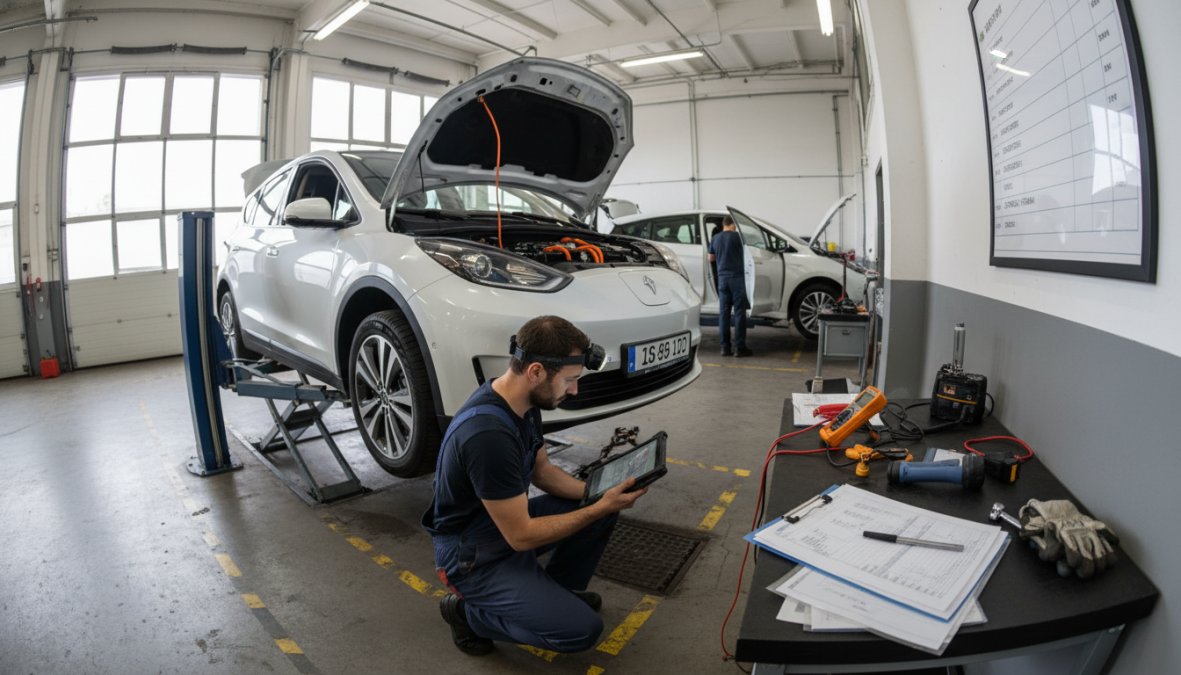
Step-by-step visual guide for how to perform an EV pre purchase inspection
Step 1: Gather the Vehicle History Report and Service Records
Start before you see the vehicle. Request a full vehicle history report and any available service records. Check for:
Previous accident damage, particularly any involving the undercarriage where the high-voltage battery pack is located
Recorded battery replacements or high-voltage system repairs
Outstanding safety recalls specific to the make and model
Number of previous owners and usage patterns (high-mileage fleet use accelerates battery degradation differently than private ownership)
A vehicle history report from a recognised provider gives you the collision and ownership data. Service records tell you whether the thermal management system has been maintained and whether software updates have been applied consistently.
Expected Result: You should have a clear picture of the vehicle's life before you arrive. Any seller who cannot produce service records for an EV warrants serious scrutiny.
Step 2: Inspect Safety-Critical Components and the Undercarriage
The undercarriage inspection is where used EV checks diverge most sharply from petrol vehicle checks. The high-voltage battery pack sits beneath the floor on most modern EVs, making it vulnerable to impact damage from kerbing, speed bumps, and road debris.
Check for:
Physical damage to the battery enclosure, including dents, scrapes, or cracks
Evidence of coolant leaks around the thermal management system pipework
Condition of the orange high-voltage cabling for any signs of chafing or damage
Brake system condition, noting that EVs rely primarily on regenerative braking, so friction brake components often show unusual wear patterns from infrequent use (glazed rotors and seized callipers are common)
Tire wear patterns, which can reveal suspension geometry issues or alignment problems caused by previous impacts
Pyro fuse integrity: the pyro fuse is a critical safety component in the high-voltage circuit that disconnects the battery in a collision
Pro TipOn Tesla models, inspect the front and rear underbody carefully for signs of grounding. Tesla's low ride height makes battery pack contact with road obstacles more common than on higher-riding EVs.
Step 3: Evaluate the Charging System and Charge Port
Charging system faults are among the most expensive and disruptive problems a used EV can carry. Inspect the charge port physically for bent or corroded pins, which are a common result of careless cable insertion or DC fast charging connector damage.
Test both Level 2 charging (AC) and, where possible, DC fast charging to verify that the onboard charger accepts and manages both correctly. Watch the charging rate carefully: a vehicle that accepts Level 2 charging but refuses or throttles DC fast charging points to a fault in the fast-charge circuitry or the onboard charge management system.
Ask the seller directly whether the vehicle has ever been involved in a charging fault, whether the charge port has been replaced, and whether the maximum charging rate has changed over time. Sellers are not always forthcoming, but their hesitation is informative.
Step 4: Run Software Diagnostics and Check for Error Codes
This step separates a proper EV pre-purchase inspection from a superficial visual check. Connecting an OBDII scanner or EV-specific diagnostic tool retrieves stored and active diagnostic trouble codes (DTCs) from the vehicle's control modules.
Many faults in EV-specific electronics do not trigger a visible warning light on the dashboard. They sit in the vehicle's memory as stored codes, invisible unless you actively scan for them. Common findings include:
Battery management system faults indicating cell imbalance
Inverter temperature warnings that suggest thermal management system degradation
Regenerative braking system errors
Onboard charger communication faults
Software updates are also worth checking. Manufacturers regularly release over-the-air updates that address known issues. A vehicle that has not received updates for an extended period may be running software with unresolved bugs affecting range estimation, charging behaviour, or battery management.
Step 5: Conduct a Structured Road Test
The road test for an EV is not the same as for a petrol car. You are not listening for engine noise or feeling for gearbox roughness. You are evaluating the electric drivetrain's response, the regenerative braking feel, and the thermal management system's behaviour under load.
During the test drive:
Accelerate firmly from low speed to check for smooth, linear power delivery from the inverter
Apply regenerative braking at varying intensities to confirm consistent, progressive deceleration
Monitor the range estimation display: watch whether the predicted range drops faster than the actual distance covered, which can indicate battery degradation
Check the heating and cooling system, which in an EV draws from the high-voltage battery and affects real-world range significantly
Drive at motorway speeds if possible to assess stability and confirm the drivetrain is not producing vibration at higher loads
A common mistake during EV test drives is focusing on comfort rather than technical performance. The test drive is a data-gathering exercise, not a pleasure run.
Used EV Battery Health Check: What to Look For and How to Interpret Results
The used EV battery health check is the single most important element of any pre-purchase evaluation. The high-voltage battery is the most expensive component in an electric vehicle, and its condition determines both real-world range and long-term ownership cost.
Understanding State of Health (SoH) and Battery Degradation
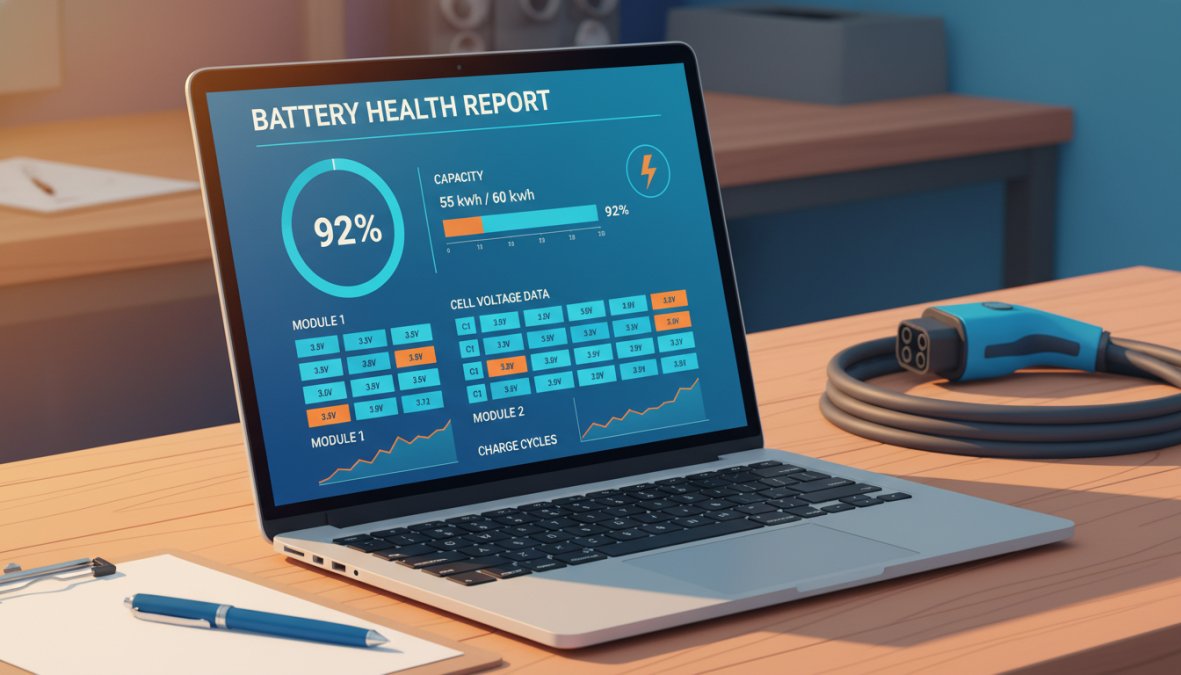
State of Health (SoH) is a percentage figure representing the battery's current usable capacity relative to its original design capacity. A new battery has an SoH of 100%. Battery degradation occurs naturally over time and charge cycles, reducing this figure.
What SoH figures mean in practice:
SoH Range
Condition
Range Impact
Action
95-100%
Excellent
Minimal loss
Buy with confidence
85-94%
Good
Noticeable but acceptable
Check warranty coverage
75-84%
Fair
Meaningful range reduction
Negotiate price significantly
Below 75%
Poor
Substantial range loss
Seek specialist advice before buying
Battery degradation is influenced by charging habits (frequent DC fast charging accelerates degradation), operating temperature, and whether the vehicle has been regularly charged to 100% rather than the recommended 80-90% daily limit.
Interpreting Battery Reports: What the Numbers Actually Mean
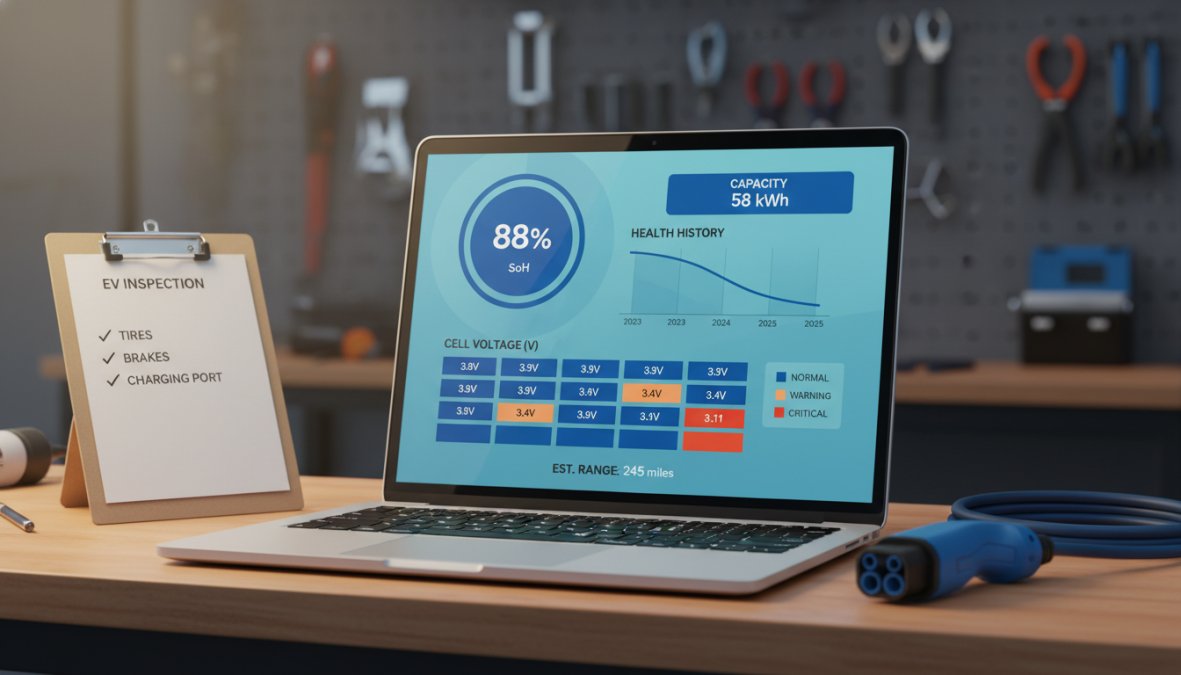
Raw SoH figures only tell part of the story. A battery at 88% SoH on a vehicle with a large original pack may deliver more usable range than a battery at 92% SoH on a vehicle with a smaller pack. Always convert SoH to actual usable kilowatt-hours and compare that against your real-world range requirements.
Step-by-step visual guide for how to perform an EV pre purchase inspection
Look beyond the headline SoH figure and examine:
Cell balance data: Individual cell voltages should be consistent. Large variation between cells indicates degraded or failing cells that will worsen over time.
Charge cycle count: Higher cycle counts correlate with more degradation, though this relationship is not perfectly linear.
Battery warranty status: Many manufacturers offer battery warranties covering degradation below a specified threshold (commonly 70% SoH). Verify whether this warranty is still active and transferable.
Key TakeawayA battery report showing acceptable overall SoH can still hide serious cell imbalance problems. Always request cell-level data, not just the headline percentage.
Electric Vehicle Diagnostic Tools: DIY vs. Professional Inspection
DIY Inspection Checklist: What You Can Check Yourself
A preliminary DIY inspection is a sensible first filter before committing to a professional evaluation. Here is what a non-specialist buyer can assess without specialist equipment:
Physical condition of the charge port pins and housing
Visible undercarriage damage to the battery enclosure
Brake rotor condition (look for heavy surface rust or scoring from disuse)
Tire wear patterns and tread depth
All lights, windows, and interior electronics function correctly
Vehicle history report reviewed for accidents and service gaps
Charging behaviour during a Level 2 charge session (does it accept charge at the expected rate?)
Range estimation consistency during the test drive
Any dashboard warning lights or unusual messages on the infotainment system
Software version and date of last update (check settings menu on most EVs)
A basic OBDII scanner can retrieve generic fault codes on most EVs. However, EV-specific data, particularly battery cell data, SoH readings, and high-voltage system diagnostics, requires manufacturer-specific or professional-grade tools.
Why Traditional Mechanics Struggle With EV Diagnostics
This is the part most guides get wrong. Many buyers arrange a pre-purchase inspection with a general mechanic or a garage that "also does EVs." The result is an inspection that covers the bodywork and brakes competently but entirely misses the high-voltage system.
Traditional mechanics are trained on internal combustion engine diagnostics. EV-specific electronics, battery management systems, inverter diagnostics, and thermal management assessment require separate qualifications and tools. The OBDII port on an EV provides access to generic codes, but the battery management system communicates on proprietary protocols that standard scanners cannot read.
The real difference between an adequate EV inspection and a thorough one comes down to the technician's specific EV qualifications and the diagnostic software available. A Level 4 Master Technician qualified in electric vehicles, working with manufacturer-specific diagnostic platforms, can access data that a standard garage simply cannot.
Common Problems With Used Electric Cars by Model
Understanding model-specific known issues is one of the angles that most generic pre-purchase guides ignore entirely. Different EV platforms carry different failure patterns, and knowing what to look for on a specific model changes the inspection priority order before you even arrive at the vehicle. The table and notes below represent the most common fault patterns seen across popular used EVs in the UK market. Use this as a model-specific inspection overlay on top of the general checklist above.
Tesla Model 3 and Model Y
Inspection priority: Suspension, heat pump, and brake actuator
Known Issue
Affected Vehicles
What to Check
Severity
Lower control arm bushing knock
All years, higher mileage
Listen for clonking over low-speed bumps; inspect bushings visually for cracking
Medium
Heat pump failure
Pre-mid-2021 production
Check cabin heating efficiency in cold conditions; scan for HVAC-related DTCs
High (range impact in winter)
Door seal deterioration
2019-2021 Model 3
Inspect door aperture seals for shrinkage; listen for wind noise at speed
Low-Medium
Electric parking brake motor wear
Higher mileage examples
Test parking brake engagement and release; listen for grinding or slow actuation
Medium
Rear caliper seizure
Vehicles with infrequent brake use
Apply and release brakes firmly; check for uneven rotor wear side to side
Medium
The heat pump issue on pre-mid-2021 Model 3 and Y vehicles is particularly important for UK buyers. In cold Northamptonshire winters, a failing heat pump forces the vehicle to use resistive heating, which can reduce real-world winter range by 30-40% compared to a functioning heat pump system. Always test cabin heating on a cold day, not a mild one.
The Tesla Model 3 and Model Y hand brake electric motor is a replaceable component, but its condition should be assessed during inspection. A sluggish or noisy parking brake actuator is an early indicator of wear that will progress.
Tesla Model S and Model X
Inspection priority: Door handles, drive unit, and air suspension
Known Issue
Affected Vehicles
What to Check
Severity
Door handle mechanism failure
Pre-2021 Model S
Test all door handles for smooth, consistent extension and retraction
Medium
Drive unit bearing noise
Higher mileage Model S (pre-2016 especially)
Listen for whining under load and during regenerative braking
High
Air suspension compressor wear
All Model S/X with air suspension
Check ride height consistency; listen for compressor cycling at startup
Medium-High
12V battery failure
All years
Check 12V battery age in service records; scan for low-voltage DTCs
Medium
MCU (Media Control Unit) eMMC failure
Pre-2018 Model S/X
Check for slow infotainment response, map loading failures, or blank screens
Medium
The MCU eMMC failure on earlier Model S and X vehicles is a well-documented issue where the internal storage chip in the infotainment computer reaches write-cycle limits and fails. Tesla issued a recall (NHTSA recall 21V-045 in the US market) covering some vehicles, but not all affected units were remedied. In the UK, check whether the vehicle's MCU has been replaced or upgraded. A sluggish or rebooting infotainment system on a pre-2018 Model S is a strong indicator of impending MCU failure.
The Tesla Model S and Model X hand brake motor is another component worth checking on higher-mileage examples, particularly on vehicles where the parking brake has been used infrequently.
Inspection priority: Battery SoH and rapid charge acceptance
Known Issue
Affected Vehicles
What to Check
Severity
Accelerated battery degradation
All pre-2018 Leafs, especially in warmer regions or high rapid-charge use
SoH reading via Leaf Spy app or professional diagnostic; check capacity bars on dashboard
High
Rapid charger refusal
Higher-degradation batteries
Attempt a CHAdeMO rapid charge session; note whether vehicle accepts or rejects the session
High
Brake vacuum pump failure
Higher mileage examples
Check brake pedal feel for sponginess; listen for pump cycling noise
Medium
The pre-2018 Nissan Leaf uses passive air cooling for its battery pack, there is no liquid thermal management system. This makes it uniquely vulnerable to heat-related degradation. A Leaf that has spent time in a warmer climate, been used for frequent rapid charging, or been regularly charged to 100% will show significantly higher degradation than its mileage alone suggests. The free Leaf Spy app (used with a compatible Bluetooth OBDII adapter) gives buyers access to the battery's State of Health reading and individual cell data without professional equipment, making the Leaf one of the few used EVs where a meaningful DIY battery check is accessible before paying for a professional inspection.
Pro TipFor Nissan Leaf buyers specifically: download the Leaf Spy app before viewing the vehicle. A compatible OBDII Bluetooth adapter costs very little and gives you direct access to SoH percentage, cell voltage data, and rapid charge count, data that changes the entire negotiation conversation.
Hyundai Ioniq 5 and Kia EV6 (E-GMP Platform)
Inspection priority: ICCU (Integrated Charging Control Unit)
Known Issue
Affected Vehicles
What to Check
Severity
ICCU failure
2021-2023 Ioniq 5 and EV6
Check 12V battery charge level; scan for ICCU-related DTCs; ask seller about any previous 12V battery drain events
High
12V battery drain from ICCU fault
Linked to ICCU issue above
Check whether vehicle has had 12V battery replaced; look for patterns of unexpected power loss in seller's account
High
Heat pump efficiency reduction in cold
All E-GMP vehicles
Test heating in cold ambient conditions; monitor range impact
Medium
The ICCU (Integrated Charging Control Unit) failure on early E-GMP platform vehicles is one of the most significant model-specific issues in the current used EV market. The ICCU manages AC charging and 12V battery maintenance. When it fails, the 12V system loses charge, which can strand the vehicle even with a full high-voltage battery. Hyundai and Kia issued software updates and, in some cases, hardware replacements under warranty. When inspecting an Ioniq 5 or EV6 from the 2021-2023 production window, specifically ask whether the ICCU has been inspected or replaced, and scan for any stored DTCs related to the charging control system.
Renault Zoe (All Generations)
Inspection priority: Battery ownership status and charging system
Known Issue
Affected Vehicles
What to Check
Severity
Battery lease vs. owned battery
Pre-2020 Zoes especially
Confirm in writing whether the battery is owned outright or subject to a lease agreement
Critical
Charge port wear
Higher mileage examples
Inspect Type 2 port for pin wear or damage
Medium
R-Link infotainment failure
Earlier models
Test infotainment responsiveness; check for map update history
Low
The battery lease arrangement on older Renault Zoes is the single most important thing to establish before any other inspection step. A Zoe sold with a battery lease means the buyer takes on a monthly lease payment to Renault for the battery pack. Failure to identify this before purchase has resulted in buyers unknowingly inheriting ongoing financial obligations. Always request written confirmation of battery ownership status from the seller and verify it against the vehicle's documentation.
Chevrolet Bolt EV (for buyers sourcing from US-import or grey-market vehicles)
Inspection priority: Battery recall status
The Chevrolet Bolt EV was subject to a significant battery recall (NHTSA recall 21V-650 and subsequent expansions) covering fire risk in high-capacity battery modules. Any Bolt EV being considered for purchase should have its VIN checked against the recall database to confirm whether the remedy (battery module replacement) has been completed. A Bolt with an unremedied recall represents both a safety risk and a significant future cost.
Watch OutFor any used EV, check the vehicle's VIN against the DVSA recall database (UK) or the manufacturer's recall lookup tool before proceeding with any inspection. An open safety recall on a high-voltage system component is a non-negotiable issue that must be resolved before purchase.
According to the Electric Vehicle Database's model-specific range and specification data, real-world range figures for used EVs can vary significantly from official figures depending on battery condition and configuration. The model-specific fault patterns above should be treated as inspection overlays, they do not replace the general inspection sequence but tell you where to look hardest on each specific platform.
How to Perform an EV Pre-Purchase Inspection: Finding a Certified Technician
Finding the right technician is where many buyers in the Kettering area and across Northamptonshire get stuck. The question is not just "who can inspect an EV?" but "who has the qualifications, tools, and model-specific knowledge to give me a genuinely useful report?"
Look for technicians who hold recognised EV qualifications at Level 3 or above, with Level 4 Master Technician status representing the highest level of independent EV competence. Qualifications should be specific to electric vehicles, not simply an extension of a general automotive qualification.
KMC Electric, based in Kettering, holds Level 4 Master Technician status in electric vehicles and has held EV qualifications since 2016, giving the team over a decade of hands-on experience with real-world EV faults. That depth of model-specific knowledge, particularly across all Tesla variants, means an inspection report from KMC Electric goes beyond a checklist and gives buyers actionable data they can use.
When searching for an EV inspection specialist near me in Northamptonshire, ask prospective technicians directly:
What EV-specific diagnostic software do they use?
Can they provide cell-level battery data, not just a headline SoH figure?
Do they have experience with your specific make and model?
Will they provide a written report with specific readings?
A technician who cannot answer these questions clearly is not the right choice for an EV pre-purchase inspection.
Pro TipAsk for the diagnostic report in writing, with raw data included. A verbal summary is not sufficient for negotiation or for future warranty claims.
EV Inspection Cost: What to Budget and How to Use Results to Negotiate
EV inspection cost varies depending on the depth of the assessment and the technician's qualifications. A basic visual check and generic OBDII scan from a general garage costs less but delivers limited diagnostic value on EV-specific systems. A full professional inspection, including battery diagnostics with cell-level data, high-voltage system assessment, charging system verification, and a written report from a qualified EV specialist, represents a more meaningful investment, but one that pays for itself many times over if it surfaces a serious fault.
As a general guide for UK buyers in 2026:
Basic visual and generic OBDII scan (general garage): Lower cost, limited EV-specific value
Professional EV inspection with battery SoH and DTC report (EV specialist): Higher cost, full diagnostic value
Full inspection with cell-level battery data and written report (Level 3-4 EV technician): Premium cost, maximum negotiation leverage
Factor the inspection fee into your total acquisition budget from the outset. On a vehicle where the battery alone represents a substantial portion of replacement value, independent evaluation is basic financial prudence, not an optional extra.
How to Convert Inspection Findings Into Price Reductions
This is the section most pre-purchase guides skip entirely. Getting the inspection report is step one. Using it to negotiate is where buyers consistently leave money on the table. The following framework converts specific findings into specific negotiation positions.
Principle: Every finding in the inspection report is either a repair cost, a future risk cost, or a utility reduction. Quantify it, then present it calmly and specifically. Sellers respond to data, not to general complaints about the car's condition.
Finding 1: Battery SoH Below Threshold
If the battery SoH comes back below 85%, you have a quantifiable basis for price reduction. The approach:
Establish the vehicle's original usable battery capacity in kWh from the manufacturer's specification.
Calculate the current usable capacity: original capacity × SoH percentage.
Compare the current usable kWh against your real-world range requirements.
Research the cost of battery reconditioning or replacement for that specific model from a qualified specialist.
Example negotiation script (adapt to your situation):
"The independent inspection shows the battery is at [X]% State of Health, which means the usable capacity is approximately [Y] kWh rather than the original [Z] kWh. At current specialist rates, reconditioning or replacement for this model runs to a meaningful cost. I'd like to reflect that in the price, I'm proposing [adjusted figure] to account for the reduced capacity and the future reconditioning cost."
Keep the language factual and reference the written report. Avoid emotional framing. The report does the work.
Finding 2: Stored Diagnostic Trouble Codes
Stored DTCs, even inactive ones, represent documented fault history. The seller may argue they are old or irrelevant. Your position:
"The diagnostic scan found [number] stored codes, including [specific code description, e.g., battery management system cell imbalance, or onboard charger communication fault]. Even if these aren't currently active, they indicate the system has experienced these conditions. I'd want those investigated and resolved before purchase, or I'd need the price to reflect the diagnostic and repair cost."
If the seller cannot explain the codes or refuses to have them investigated, treat that as a red flag, not just a negotiation point.
Finding 3: DC Fast Charging Limitation
A vehicle that cannot accept DC rapid charging at its rated speed, or at all, has a materially reduced utility for most buyers. Quantify this:
Identify the vehicle's rated maximum DC charge rate from the manufacturer's specification.
Note the actual accepted rate observed during the inspection.
Calculate the additional time per charge session the limitation creates.
Consider whether the limitation makes the vehicle unsuitable for your use case entirely.
"The inspection confirmed the vehicle is only accepting DC charging at [observed rate] rather than the rated [manufacturer rate]. For my usage, that significantly increases charge time on longer journeys. I'd need the price adjusted to reflect either the repair cost or the reduced utility."
Finding 4: Missing Software Updates
A vehicle that has not received manufacturer software updates for an extended period may have unresolved bugs affecting battery management, range estimation, or charging behaviour. This is a softer negotiation point but a valid one:
"The vehicle is running software from [date], which is [X] versions behind the current release. Some of those updates address known issues with battery management and charging behaviour. I'd want confirmation that updates can be applied before purchase, or I'd factor in the risk of running outdated software."
Finding 5: Brake System Issues from Regenerative Braking Disuse
Glazed rotors and seized callipers from infrequent friction brake use are common on EVs and straightforward to price:
"The inspection found [glazed rotors / seized rear callipers / uneven pad wear] consistent with the regenerative braking pattern on this vehicle. Replacement parts and labour for this model run to approximately [get a quote from your technician before negotiating]. I'd like to deduct that from the asking price."
The Written Report as a Negotiation Document
A verbal summary from a technician is not sufficient for negotiation or for future warranty claims. Always request the diagnostic report in writing, with raw data included, specifically:
The SoH percentage and the tool/software used to obtain it
Cell-level voltage data if available
A list of all stored and active DTCs with their descriptions
Observed charging rates for both AC and DC sessions
Any physical findings with photographs where relevant
A written report from a qualified technician shifts the negotiation dynamic fundamentally. The seller is no longer dealing with a buyer's opinion, they are dealing with documented technical data from a credentialled specialist. Sellers who know the buyer has professional technical evidence are in a significantly weaker position than those facing an uninformed buyer who "had a look and it seemed fine."
Key TakeawayBring the written inspection report to any price negotiation. Reference specific findings by name and code. Attach estimated repair costs from your technician. A data-led negotiation is harder to dismiss than a general request for a discount.
When to Walk Away Instead of Negotiate
Not every inspection finding is a negotiation opportunity. Some findings are walk-away signals:
Battery SoH below 70% on a vehicle without a remaining manufacturer battery warranty: the reconditioning or replacement cost may exceed the negotiation headroom available on the asking price.
Active high-voltage system fault codes that the seller cannot explain and will not have investigated before sale.
Evidence of undisclosed collision damage to the battery enclosure, particularly if not reflected in the vehicle history report.
ICCU or onboard charger failure on a vehicle where the seller has not acknowledged the fault and the repair cost is substantial.
Open safety recalls on high-voltage components that have not been remedied.
The inspection fee is not wasted when you walk away. It is the cost of avoiding a far larger financial mistake.
According to Which? consumer guidance on used car buying and inspection, buyers who commission independent inspections are significantly better positioned to negotiate or walk away from problematic vehicles. The inspection cost should be viewed as the cheapest insurance available on a used EV purchase.
Frequently Asked Questions
What is the most important thing to check when buying a used EV?
The high-voltage battery is the single most important component to check when performing an EV pre-purchase inspection. Battery degradation directly affects real-world range and resale value. You should request a State of Health (SoH) report from an EV-certified technician who can run proper diagnostics. Also check for any open diagnostic trouble codes (DTCs), the condition of the charge port, and whether the thermal management system shows signs of coolant leaks or damage.
Can a regular mechanic perform an EV pre-purchase inspection?
Generally, no. Traditional mechanics lack the specialist training, safety certifications, and electric vehicle diagnostic tools needed to properly assess a used EV. High-voltage battery systems, inverters, and EV-specific electronics require Level 2 or higher EV qualifications to inspect safely and accurately. A standard OBDII scanner will not retrieve all EV-specific fault codes. Always use an EV-certified technician — ideally one with Level 4 Master Technician status — for a reliable pre-purchase inspection.
How do you check the battery health of a used electric car?
A proper used EV battery health check requires specialist software that reads the battery management system directly, not just a generic OBDII scanner. An EV-certified technician will generate a State of Health (SoH) report showing remaining capacity versus original capacity, cell balance data, and charge cycle counts. You can also compare the car's displayed range at 100% charge against the manufacturer's original rated range as a quick informal indicator, but this should never replace a professional diagnostic report.
How much does an EV pre-purchase inspection cost?
EV inspection cost varies depending on the provider and depth of assessment. In the UK, a basic independent evaluation typically ranges from around £100 to £200, while a comprehensive inspection including full battery diagnostics, software fault code checks, and a detailed written report can cost £200 to £400 or more. This is a worthwhile investment — a single missed fault on a used EV, such as a degraded high-voltage battery or faulty onboard charger, can cost thousands to repair.
Is a pre-purchase inspection worth it for an electric vehicle?
Absolutely. The used EV market carries unique risks that a standard visual check cannot reveal — battery degradation, hidden diagnostic trouble codes, software issues, and charging system faults are all invisible without specialist tools. An independent EV pre-purchase inspection gives you verified data to make a confident buying decision, and critically, it gives you negotiation leverage. If the SoH is below expectations or faults are found, you can negotiate a price reduction or walk away with confidence.
What specific EV components should be inspected besides the battery?
Beyond the high-voltage battery, a thorough EV pre-purchase inspection should cover: the charge port and onboard charger for damage or slow charging rate issues; the inverter and electric drivetrain for unusual noises or fault codes; the thermal management system for coolant leaks; regenerative braking function and friction brake condition; tire wear patterns; software version and pending updates; and all safety-critical components including the pyro fuse and high-voltage disconnect systems. Each of these can carry significant repair costs if overlooked.