Electric Car Service vs Traditional Service: A 2026 Guide
Last Updated: June 30, 2026
Understanding the differences between electric car service vs traditional service has become essential for vehicle owners. At KMC Electric, we've spent over a decade working with both EV and petrol-powered vehicles. The maintenance landscape has fundamentally shifted, affecting everything from annual costs to service frequency.
Electric Car Service vs Traditional Service: Core Differences
Electric vehicles have far fewer moving parts than internal combustion engine vehicles, no oil to change, no spark plugs to replace, no transmission fluid to flush. Instead, EV maintenance focuses on battery health, cooling systems, and high-voltage electrical components.
Traditional vehicles require regular preventative maintenance across dozens of mechanical systems: oil changes every 10,000 kilometres, spark plug replacements, timing belt inspections, and transmission fluid checks. These tasks exist because internal combustion engines generate tremendous heat and friction, requiring constant lubrication and component replacement.
The practical outcome is that EV owners typically spend 40% less on scheduled maintenance than petrol car owners over a vehicle's lifetime. However, when repairs are needed, particularly battery-related work, costs can exceed traditional repairs.
Pro TipMost EV owners are surprised to learn that brake maintenance is less frequent than in petrol cars, thanks to regenerative braking systems that do much of the stopping work. This alone saves hundreds of pounds over five years.
Why EVs Require Less Maintenance
Electric motors have dramatically fewer moving parts than internal combustion engines. Where a petrol engine has thousands of components, an electric motor is essentially a coil spinning inside a magnetic field. This simplicity translates directly into reliability.
Consider what doesn't exist in an EV: no oil that breaks down and requires replacement, no spark plugs that foul, no timing belt that can snap, no transmission fluid that degrades. Electric motors can operate for over 500,000 kilometres without significant wear, compared to petrol engines which typically require major overhauls by 200,000 kilometres.
EV cooling systems manage the battery pack and power electronics at much lower temperatures than engine cooling systems, meaning fewer cooling hose failures and longer intervals between coolant flushes. Regenerative braking captures energy when slowing down, extending brake pad life to 100,000 kilometres or beyond, whereas traditional vehicles typically need new pads every 40,000-60,000 kilometres.
Key TakeawayThe fundamental reason EVs need less maintenance is physics: electric motors are inherently simpler, generate less heat, and operate with fewer mechanical stresses than combustion engines.
What Traditional Vehicles Still Need
Petrol and diesel vehicles demand consistent attention to multiple systems that EVs simply don't have. Oil changes remain the cornerstone of traditional vehicle maintenance, typically every 10,000 kilometres for modern engines.
Beyond oil, traditional vehicles require spark plug replacement every 30,000-50,000 kilometres, air filter changes every 15,000-30,000 kilometres, transmission fluid service every 40,000-60,000 kilometres, coolant flushes every 30,000-50,000 kilometres, timing belt inspection and replacement every 80,000-160,000 kilometres, and brake fluid replacement every 2-3 years.
Traditional vehicle owners typically budget £150-300 annually for scheduled maintenance, plus additional costs for unexpected repairs. Over a vehicle's lifetime, this often exceeds EV maintenance costs by thousands of pounds.
EV Maintenance Schedule: What You Actually Need to Know
Electric vehicle maintenance schedules are dramatically simplified compared to traditional vehicles. Most manufacturers recommend service intervals of 20,000-30,000 kilometres or annually, whichever comes first.
Scheduled Maintenance Intervals for Electric Vehicles
EV service appointments typically involve battery health diagnostics using manufacturer software, coolant inspection and top-up for battery thermal management, brake fluid check and replacement every 2 years, cabin air filter replacement every 15,000-20,000 kilometres, tyre rotation and pressure checks, high-voltage system inspection, and software updates to improve performance and safety features.
The entire process typically takes 1-2 hours, compared to 3-4 hours for a traditional vehicle service. EV owners often see service costs drop 60-70% compared to their previous petrol vehicles. KMC Electric uses advanced diagnostic tools to assess battery condition without requiring physical replacement, providing valuable independent verification when buying or selling an EV.
Battery Pack Health and Long-Term Reliability
Battery degradation is less dramatic than most people assume. Modern EV batteries retain 80-90% of their original capacity after 200,000 kilometres. Manufacturers warrant batteries for 8 years or 160,000 kilometres minimum, with many offering 10-year or 240,000-kilometre coverage. Battery failure before warranty expiry is rare.
Climate significantly affects battery longevity. In cooler UK climates, batteries experience less thermal stress than in hot regions. Charging habits matter too, keeping the battery between 20-80% charge state extends lifespan, though modern EVs manage this automatically.
Watch OutAvoid leaving your EV parked for months without charging. Charge to 50% and leave the vehicle for extended periods as ideal storage practice.
Cost of Electric Car Maintenance vs Gas: Real Numbers
Over a five-year ownership period, the financial differences between EV and traditional vehicle maintenance are substantial.
Total Cost of Ownership Comparison
Maintenance Category
EV (5 years)
Petrol Vehicle (5 years)
Difference
Scheduled servicing
£200-400
£800-1,200
Save £400-800
Oil changes
£0
£300-500
Save £300-500
Spark plugs & air filters
£0
£200-400
Save £200-400
Brake pads & fluid
£150-300
£400-600
Save £250-300
Transmission service
£0
£300-500
Save £300-500
Coolant flushes
£100-200
£200-300
Save £100-100
Total
£450-900
£2,200-3,500
Save £1,300-2,600
This calculation assumes both vehicles travel approximately 15,000 kilometres annually. The EV advantage grows with higher mileage, as fixed costs remain constant while per-kilometre costs approach zero. Over 100,000 kilometres, electricity costs of 3-5 pence per kilometre versus 10-15 pence per kilometre for petrol represent savings of £500-1,200. Over a vehicle's typical 10-year ownership, EV owners save £3,000-5,000 on maintenance and fuel combined.
Do Electric Cars Need Brake Service? Understanding Regenerative Braking
Regenerative braking fundamentally changes how EVs decelerate. This system captures kinetic energy when slowing down and converts it back to battery charge, meaning friction brakes do far less work.
How Regenerative Braking Reduces Brake Wear
In traditional vehicles, every deceleration dissipates energy as heat through friction brakes. Regenerative braking eliminates most of this wear by doing the deceleration work electronically. When you lift off the accelerator in an EV, the electric motor switches to generator mode, creating resistance that slows the vehicle while charging the battery.
The practical result is that EV brake pads last 2-3 times longer than traditional vehicle pads. Many EV owners report brake pad life of 80,000-150,000 kilometres, compared to 40,000-60,000 kilometres for petrol cars.
When Brake Pads and Brake Fluid Still Need Attention
Despite reduced wear, EV brake systems still require maintenance. Brake fluid degrades over time from moisture absorption and thermal stress, requiring replacement every 2 years. Brake pads do eventually wear out and require replacement using identical processes to traditional vehicles. Brake system inspection remains important to catch moisture accumulation, corrosion, and seal degradation before they become safety concerns.
Common EV Maintenance Tasks vs Traditional Vehicle Servicing
The shift from mechanical to electrical maintenance represents a fundamental change in how vehicles are serviced.
What You Won't Need: Oil Changes, Spark Plugs, and Timing Belts
Electric vehicles eliminate entire categories of maintenance that define traditional vehicle ownership. Oil changes are gone entirely, EVs produce no combustion byproducts that contaminate oil. Spark plugs and timing belts serve no purpose in an electric drivetrain. Transmission fluid service also disappears, as most EVs use single-speed transmissions with minimal fluid that rarely requires changing. Air filter replacement becomes less frequent, with only cabin air filters requiring attention every 15,000-20,000 kilometres.
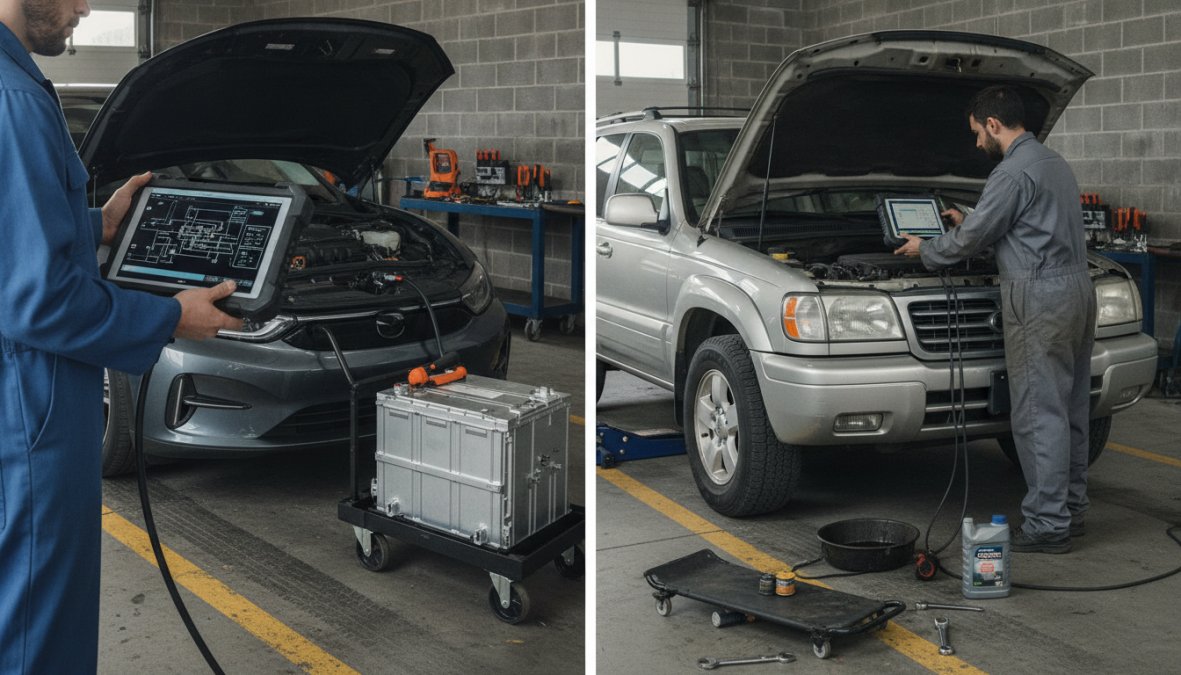
Side-by-side comparison of diagnostic and qualified and technician concepts for electric car service vs traditional service
What You Will Need: Coolant, Filters, and Software Updates
EVs still require coolant for battery pack and power electronics thermal management. Battery thermal management is critical, overheating reduces range and damages cells, while overcooling wastes energy. Coolant in EVs typically lasts longer than in petrol vehicles because operating temperatures are lower and more stable, with replacement recommended every 60,000-100,000 kilometres.
Cabin air filters still require replacement every 15,000-20,000 kilometres. Software updates represent a new maintenance category unique to modern EVs, improving efficiency, adding features, fixing bugs, and enhancing safety systems.
Pro TipCheck your EV manufacturer's app regularly for available software updates. Some can be installed at home via WiFi, while others require a service centre visit.
Warranty Implications and DIY vs Professional Service
EV warranties differ significantly from traditional vehicle coverage, which affects how and where you service your vehicle.
How Warranty Coverage Differs Between EV and Gas Cars
EV warranties typically offer more comprehensive coverage than traditional vehicles, particularly for battery and electrical systems. Most manufacturers warranty batteries for 8-10 years or 160,000-240,000 kilometres, with capacity guarantees. High-voltage electrical components typically carry 8-year warranties, compared to 3-5 year coverage on traditional vehicle powertrains.
However, warranty coverage often requires servicing at authorised centres using approved parts. Attempting DIY repairs on high-voltage systems can void warranty coverage and create safety hazards.
When to Choose Professional Service Over DIY
High-voltage electrical work should always be performed by qualified professionals. EV battery systems operate at 300-400 volts, creating serious electrocution risk. Even with the vehicle powered off, residual charge can remain in high-voltage components.
Thermal management system work and brake service can sometimes be performed by independent mechanics, though some manufacturers recommend authorised service. Software updates and diagnostics require manufacturer-specific equipment that DIY approaches cannot match. Battery health verification is an area where professional service adds genuine value, revealing actual state-of-health useful when buying or selling vehicles.
Regional Climate Factors and Resale Value Impact
Your location significantly affects EV maintenance needs and long-term vehicle value.
How Climate Affects EV Battery and Service Needs
Cold climates reduce battery efficiency and range, but they also reduce thermal stress on battery cells. UK winters are mild by global standards, providing an ideal climate for EV ownership. Humidity affects electrical components more than dry climates, with moisture potentially corroding connectors and seals. Salt exposure from winter road treatment can accelerate corrosion of electrical connections, though EVs' sealed electrical systems are more resistant to salt damage than traditional vehicles' exposed mechanical components.
Maintenance Records and Resale Value
Comprehensive maintenance records significantly boost EV resale value. Buyers want evidence that batteries have been properly managed and electrical systems regularly inspected. Vehicles with gaps in service history typically sell for 10-15% less than equivalent well-documented vehicles. Battery health documentation is particularly valuable, with independent assessments commanding premium prices.
Choosing the Right Service Provider for Your Vehicle
Selecting where to service your EV affects cost, convenience, and long-term reliability.
Independent EV Specialists vs Main Dealer Networks
Main dealership networks offer advantages in warranty coverage and access to manufacturer-specific diagnostic equipment. If your vehicle is under warranty, dealership service ensures coverage remains valid. However, main dealerships typically charge 20-40% more than independent specialists for equivalent work.
Independent EV specialists like KMC Electric offer cost-effective alternatives with genuine expertise. For out-of-warranty vehicles, independent specialists provide exceptional value, focusing on reliability and longevity rather than dealer profit margins. The key is verification: check technician certifications, ask about diagnostic equipment capabilities, and request references from other EV owners.
Technician Certification and Diagnostic Tools
Look for technicians with formal EV qualifications, ideally Level 3 or Level 4 Master Technician certifications in electric vehicles. Diagnostic equipment matters significantly, proper EV diagnostics require manufacturer-specific software and high-voltage testing equipment. Generic diagnostic tools cannot assess battery state-of-health or diagnose high-voltage faults.
Choosing between electric car service and traditional vehicle maintenance is ultimately about understanding your vehicle's actual needs. Modern EVs require fundamentally different care than petrol vehicles, with simpler systems, lower costs, and fewer moving parts creating a maintenance experience that's genuinely different from what most vehicle owners expect.
If you own an EV in Kettering or across Northamptonshire and want specialist service from technicians who understand your vehicle's systems deeply, KMC Electric provides independent diagnosis, repair, and battery health verification. Our Level 4 Master Technician expertise in electric vehicles, combined with over 25 years of automotive experience, means we identify potential faults before warranty expiry and extend your vehicle's service life through practical, cost-effective solutions.
Frequently Asked Questions
Do electric cars require less maintenance than gas cars?
Yes, electric cars require significantly less maintenance than traditional internal combustion engine vehicles. EVs have no oil changes, spark plugs, timing belts, or transmission fluid to service. The electric motor has fewer moving parts than a combustion engine, reducing wear and tear. However, EVs still need scheduled maintenance for coolant systems, cabin air filters, tire rotation, and brake fluid checks. Total cost of ownership is typically lower for electric vehicles over their lifetime due to reduced service frequency and fuel savings.
What is the typical EV maintenance schedule compared to gas cars?
Electric vehicles generally require servicing every 12 months or 20,000 miles, whichever comes first, compared to 6-10 months for traditional cars. EV maintenance focuses on battery pack health verification, coolant flush intervals, brake fluid checks, and software updates rather than engine-related tasks. Preventative maintenance for EVs emphasises battery longevity and high-voltage system safety. Most warranty coverage extends to 8 years or 100,000 miles for battery packs, providing long-term reliability assurance beyond typical service intervals.
Do electric cars need brake service, and how does regenerative braking affect this?
Electric cars still need brake service, but less frequently than gas vehicles. Regenerative braking captures energy during deceleration, reducing reliance on traditional friction brakes and extending brake pad life significantly. However, brake fluid still requires periodic flushing, and brake pads will eventually need replacement depending on driving habits and climate. In regions with frequent stop-start driving, mechanical brakes may last 100,000+ miles. Professional service centres use specialised diagnostic tools to monitor brake system health and identify wear before problems develop.
Is electric car maintenance more expensive than traditional vehicle service?
No. While individual EV service visits may cost slightly more due to specialist technician certification requirements, the overall cost of electric car maintenance is lower. EVs eliminate expensive items like oil changes (£16.99 for drive train oil), spark plug replacements, and timing belt work. Over a vehicle's lifetime, electric cars typically cost 40% less to maintain than gas cars. Out-of-warranty EV repairs at independent specialists like KMC Electric offer cost-effective alternatives to main dealer networks, extending vehicle service life affordably.