Buying a used electric vehicle without a proper inspection is one of the costlier mistakes you can make in 2026. Understanding what is an EV pre purchase inspection is the first step to protecting yourself from a battery pack that has already lost significant capacity, or a high-voltage system with hidden faults. This guide from KMC Electric, an independent Level 4 Master Technician garage based in Kettering, Northamptonshire, walks you through everything a thorough EV pre-purchase inspection covers, what it costs, and how to use the results to negotiate a better price. Below, we'll show you exactly how to read a battery health report, what questions to ask an EV specialist mechanic, and how to turn inspection findings into real money off the asking price.
Here's what most guides get wrong: they treat an EV inspection like a slightly updated version of a standard car check. It isn't. The battery pack alone can account for a significant portion of a vehicle's total value, and its condition is invisible to the naked eye without specialist diagnostic tools.
What Is an EV Pre-Purchase Inspection and Why Does It Matter?
An EV pre-purchase inspection is a specialist diagnostic assessment of a used electric vehicle, carried out before purchase to verify the condition of the battery pack, high-voltage system, drivetrain, charging system, and software, providing an independent evaluation of the vehicle's true technical state.
Unlike a visual walkaround or a standard MOT check, a proper EV pre-purchase inspection uses dedicated diagnostic software to read cell voltage data, State of Health (SOH) figures, diagnostic trouble codes (DTCs), and firmware version status. The result is an objective picture of what you are actually buying, not just what the seller wants you to see.
The stakes are high. Battery degradation in a used EV is permanent and cumulative. A vehicle that shows 200 miles of range on the dashboard may deliver considerably less in real-world use if the battery pack has experienced significant capacity loss. An inspection catches this before you commit to a purchase.
How an EV Pre-Purchase Inspection Differs from an ICE Vehicle Check
The fundamental difference is this: an ICE (Internal Combustion Engine) vehicle inspection focuses on mechanical wear, fluid condition, and exhaust emissions. An EV inspection shifts that focus almost entirely to electrical systems, software, and electrochemical health.
A standard mechanic checking a petrol car will listen for engine knock, check oil viscosity, and inspect the exhaust. None of that applies to an EV. Instead, the inspection centres on:
Battery State of Health (SOH) and individual cell voltage balance
Thermal management system integrity, including coolant leaks around the battery
Charging port condition and onboard charger function
Regenerative braking performance and inverter health
Software diagnostics and any stored diagnostic trouble codes
High-voltage system insulation resistance and safety interlock function
An electric vehicle technician needs EV-specific training and tools to conduct this properly. A general garage with an OBD-II scan tool alone cannot extract the depth of data required for a reliable used EV buying decision.
Watch OutDo not rely on a standard MOT pass as evidence of battery health. An MOT checks roadworthy condition, not battery capacity or high-voltage system integrity. A vehicle can pass an MOT with significant battery degradation that will cost thousands to address.
Understanding the Used EV Battery Health Report
The battery health report is the centrepiece of any credible EV pre-purchase inspection. This document translates raw diagnostic data into a readable summary of the battery pack's current and projected performance.
A thorough used EV battery health report will include the current State of Health percentage, the estimated remaining range at full charge, individual cell voltage readings, the number of charge cycles completed, and any historical fault codes related to the battery management system. It should also note whether the thermal management system is functioning correctly, since coolant leaks or blocked cooling circuits accelerate battery degradation significantly.
State of Health (SOH) and What the Numbers Mean
State of Health (SOH) is the single most important metric in a battery health report. SOH is expressed as a percentage of the battery's original design capacity, indicating how much usable energy the pack can store compared to when it was new.
A brand-new battery has an SOH of 100%. In practice, all lithium-ion batteries degrade over time. The rate depends on charging habits, temperature exposure, and usage patterns. Here is a practical reference for interpreting SOH figures:
SOH Range
Condition
Practical Implication
90-100%
Excellent
Minimal capacity loss, close to new
80-89%
Good
Noticeable range reduction, still practical
70-79%
Fair
Significant range loss, factor into price
Below 70%
Poor
Battery replacement likely needed
Many manufacturers set their battery warranty threshold at 70% SOH. A vehicle sitting at 72% SOH is close to that boundary, and any further degradation may not be covered. Knowing this before you buy gives you real negotiating use.
Key TakeawayAn SOH below 80% should trigger either a meaningful price reduction or confirmation that the battery warranty remains active and transferable. Never accept an SOH figure without seeing the raw diagnostic data that produced it.
Battery Warranty Transferability: A Critical Check Buyers Miss
This is the angle most used EV buying guides ignore entirely. Battery warranty transferability determines whether the remaining manufacturer warranty on the battery pack passes to you as the new owner, or dies with the original registration.
Many EV manufacturers do transfer battery warranties between private owners, but the conditions vary. Some require the transfer to be registered within a set number of days of the sale. Others limit the number of ownership changes. A small number of warranties are non-transferable under any circumstances.
Before you complete a purchase, confirm in writing:
Whether the battery warranty is still active based on age and mileage
Whether it transfers to a second or third owner
What the warranty threshold is (typically expressed as an SOH percentage)
How to register the transfer with the manufacturer
An EV-specific inspection from a specialist garage can pull the warranty status from the vehicle's diagnostic data and cross-reference it against manufacturer records. This one check alone can save a buyer from inheriting a battery replacement bill that runs into several thousand pounds.
Your Complete EV Inspection Checklist: What Gets Examined
A professional EV pre-purchase inspection follows a structured sequence. The checklist below covers the core areas any competent electric vehicle technician should assess.
Professional illustration showing OBD, Tesla for what is an EV pre purchase inspection
Battery and High-Voltage System:
State of Health (SOH) reading via manufacturer-level diagnostic software
Individual cell voltage balance and capacity loss assessment
Thermal management system check for coolant leaks and flow rate
High-voltage system insulation resistance test
Pyro fuse condition (a critical safety component that isolates the battery in a collision)
Battery pack physical inspection for damage or swelling
Charging System:
Charging port condition and locking mechanism function
Onboard charger output verification at AC and DC rates
Charge level acceptance test across the full range
Charging infrastructure compatibility check
Drivetrain and Mechanical:
Inverter function and efficiency
Regenerative braking response and calibration
Motor output and torque delivery
Suspension, brakes, and tyre condition
Electric hand brake motor function (on applicable models)
Software and Infotainment:
Firmware version check against current release
Stored diagnostic trouble codes (DTC) review
Infotainment system function and connectivity
Over-the-air update history
Documentation:
Vehicle history report cross-referenced with odometer
Service history verification
Warranty status confirmation
High-Voltage System and Safety-Critical Components
The high-voltage system in an electric vehicle operates at voltages that are genuinely lethal. Assessing its integrity is not optional. An EV inspection must include an insulation resistance test to confirm that the high-voltage cabling, connectors, and battery pack housing have not been compromised by damage, moisture ingress, or age.
Safety-critical components that deserve specific attention include the pyro fuse, which is a one-shot device that permanently disconnects the battery in a serious collision. If a vehicle has been in a significant accident, the pyro fuse may have triggered. A replacement pyro fuse is relatively affordable, but an untriggered fuse in a crash-damaged vehicle is a serious safety concern that must be investigated. KMC Electric stocks replacement pyro fuses for Tesla vehicles, and a full inspection will confirm whether the existing unit is intact.
The hand brake electric motor is another component worth checking on Model 3 and Model Y vehicles. Failure here is not catastrophic, but it is a known wear item that affects roadworthy status.
Charging System, Software Diagnostics, and Firmware Version
The charging system check goes beyond plugging in a cable and watching the percentage rise. A proper assessment verifies that the onboard charger accepts charge at its rated capacity, that the charging port contacts are clean and undamaged, and that the battery management system is not throttling charge rates due to a stored fault.
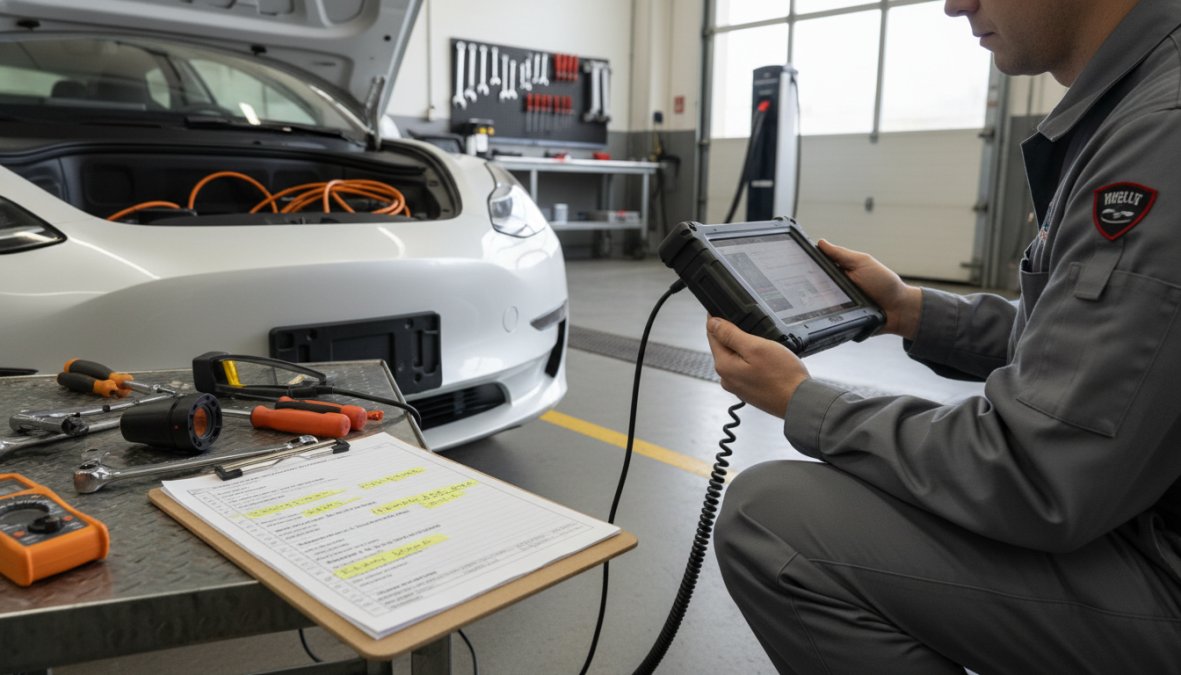
Software diagnostics are equally important. The OBD-II scan tool is the entry point, but manufacturer-level software provides far deeper access. Stored diagnostic trouble codes can reveal past faults that have been cleared from the display but remain in the vehicle's history. A firmware version check confirms whether the vehicle is running current software or an outdated version that may affect range estimation, charging behaviour, or safety features.
EV Pre-Purchase Inspection Cost: What to Budget in 2026
EV pre-purchase inspection cost varies depending on the vehicle make, the depth of the assessment, the diagnostic tools required, and the specialist carrying it out. A basic inspection from an independent EV specialist in the UK typically ranges from around £150 to £300. A comprehensive inspection that includes full battery diagnostic reporting, high-voltage system testing, and a written report will sit at the higher end of that range or above.
This is not a cost to cut. A thorough inspection that reveals a battery at 74% SOH could justify a price reduction of several thousand pounds, or save you from buying a vehicle that needs an imminent battery replacement.
Inspection Type
Typical UK Cost
What's Included
Basic EV check
£100-£150
Visual, OBD scan, basic DTC review
Standard EV PPI
£150-£250
Battery SOH, charging test, software check
Comprehensive EV PPI
£250-£400
Full battery report, HV system test, written report
What Drives the Cost Variation
Not all EVs cost the same to inspect, and understanding why helps you budget accurately and avoid being overcharged for a basic scan dressed up as a comprehensive assessment.
Manufacturer-level software licensing: Accessing deep battery management data on some vehicles requires the inspector to hold a paid software licence. Tesla Toolbox, BMW ISTA, and similar tools carry ongoing subscription costs that independent garages pass on proportionally. A Tesla Model 3 inspection may cost more than a Nissan Leaf inspection partly for this reason.
Battery architecture complexity: A vehicle with a large, multi-module battery pack, such as a Tesla Model S Long Range, takes longer to assess at cell level than a smaller pack in a city EV. More cells mean more data to interpret and more time to produce a reliable report.
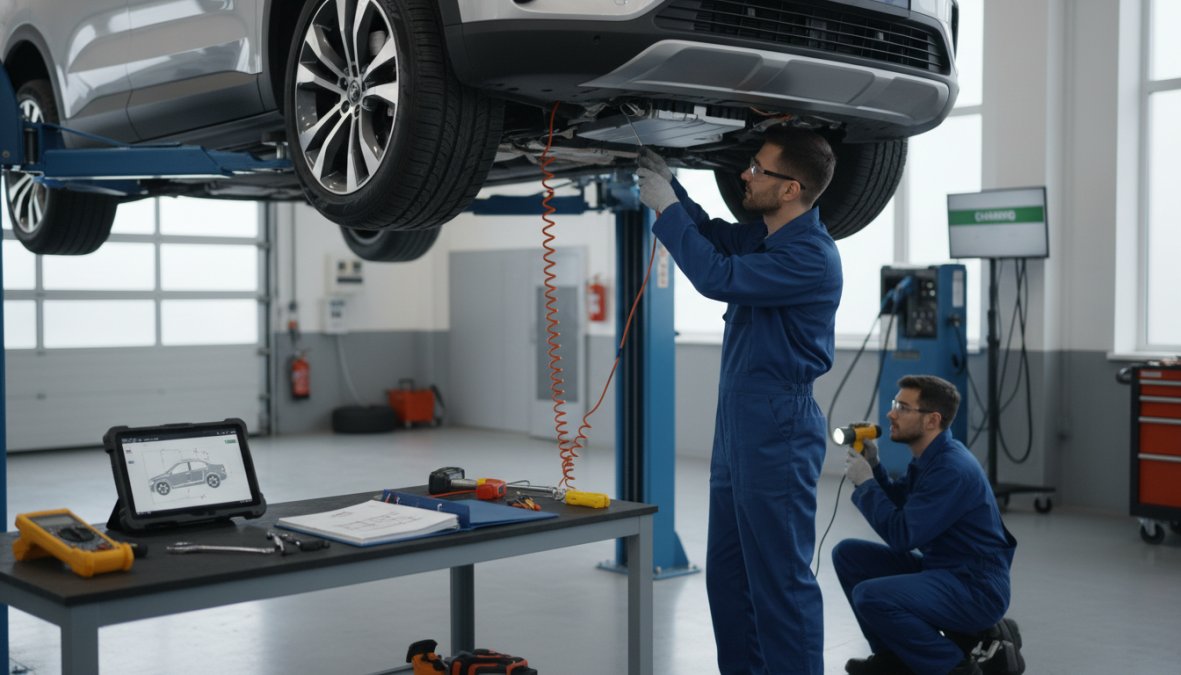
High-voltage system access: Some vehicles require partial disassembly to perform a proper insulation resistance test. If the inspector needs to remove underbody panels to access HV connectors, that labour time is reflected in the price.
Report format: A verbal summary costs less to produce than a written report with raw data tables attached. Always pay for the written report. It is the document you will use in negotiation and the record you will need if a dispute arises after purchase.
Travel and mobile inspection fees: Some EV specialists offer mobile inspections at the seller's location. This is convenient but typically adds a travel surcharge of £30-£80 depending on distance. Weigh this against the cost of transporting the vehicle to a workshop, particularly if you are buying from a private seller who is unwilling to move the car.
The DIY Pre-Screen: Decide Before You Pay
This is the step most guides skip entirely, and it is genuinely useful. Before you pay for a professional inspection, a basic DIY pre-screen can tell you whether the vehicle is worth the inspection fee at all. Think of it as a filter, not a replacement.
You will need a consumer-grade OBD-II Bluetooth adapter (widely available for under £30) and a compatible app. For Tesla vehicles, apps such as Scan My Tesla or TeslaFi provide accessible battery data. For non-Tesla EVs, apps such as EVBatMon, Leaf Spy (for Nissan Leaf), or generic OBD apps with EV-specific plugins can pull basic State of Health data and read stored fault codes.
What a DIY pre-screen can reliably tell you:
Approximate State of Health percentage (treat this as indicative, not definitive)
Whether any diagnostic trouble codes are currently stored
Estimated range at full charge based on current battery capacity
Charge cycle count on vehicles where this is accessible
What a DIY pre-screen cannot tell you:
Individual cell voltage balance and variance (requires manufacturer-level software)
High-voltage system insulation resistance (requires specialist test equipment)
Whether stored fault codes have been cleared from the display but remain in history
Firmware version status and whether the vehicle is running outdated software
Thermal management system integrity
Pro TipUse the DIY pre-screen as a go/no-go filter. If the basic SOH reading is below 70%, or if multiple fault codes are present, you have grounds to either walk away before spending money on a professional inspection, or to negotiate the asking price down before commissioning one. If the basic data looks reasonable, proceed to the professional inspection with confidence.
Is the Inspection Fee Worth It? A Simple Return-on-Investment Frame
The inspection fee is best understood as insurance against a much larger loss. Consider the following scenarios:
A used EV is listed at £18,000. A comprehensive inspection costs £300. The inspection reveals an SOH of 76% and two stored fault codes related to the onboard charger. Using the negotiation approach covered later in this guide, the buyer secures a £1,500 price reduction. The net return on the £300 inspection fee is £1,200 in the first transaction alone, before accounting for the avoided risk of purchasing a vehicle with undisclosed charging faults.
Alternatively, the inspection reveals that the battery SOH is 91%, the high-voltage system is clean, and the firmware is current. The buyer pays the asking price with confidence, knowing the vehicle's condition is verified. The £300 fee bought certainty, which has real value in a private sale where the seller provides no warranty.
The only scenario where the inspection fee is genuinely hard to justify is on a very low-value vehicle where the inspection cost represents a disproportionate share of the purchase price. On any EV priced above £8,000, a comprehensive inspection is almost always financially rational.
Key TakeawayBudget for a comprehensive inspection, not a basic one. The difference between a £150 basic scan and a £300 full report is the difference between knowing the vehicle has no obvious faults and knowing the vehicle's battery, high-voltage system, software, and charging infrastructure are all verified. On a purchase of this size, that difference is worth every pound.
Finding an EV Specialist Mechanic You Can Trust
The most common mistake buyers make here is booking an inspection with a general mechanic who claims to handle EVs. A general garage with a basic OBD-II scan tool is not the same as an electric vehicle technician with manufacturer-level diagnostic access and formal EV qualifications.
Professional illustration showing customer and ev and specialist concepts for what is an EV pre purchase inspection
The Qualification Tiers That Actually Matter
In the UK, EV technician qualifications are structured around the Institute of the Motor Industry (IMI) Awards framework. Understanding the tiers helps you filter out garages that have attended a half-day awareness course from those with genuine diagnostic competency:
IMI Level
What It Covers
Inspection Suitability
Level 2
Awareness of EV safety, basic hazard identification
Not suitable for PPI
Level 3
EV system maintenance, basic diagnostics
Acceptable for basic checks only
Level 4
Advanced EV diagnosis, battery management, HV system testing
Recommended for full PPI
In the United States, the equivalent benchmark is the ASE L3 certification (Light Duty Hybrid/EV Specialist). An ASE L3-certified technician has passed a proctored examination covering battery system diagnosis, high-voltage safety, and drivetrain electronics. When searching for an inspector in North America, ASE L3 is the minimum credential worth accepting for a comprehensive pre-purchase inspection.
According to the Institute of the Motor Industry's EV technician competency framework, Level 4 EV qualifications represent the highest level of electric vehicle technical competency currently available in the UK, covering high-voltage system diagnosis, battery management, and advanced software diagnostics.
For buyers outside Kettering, the IMI's technician finder tool at theimi.org.uk allows you to search by postcode and filter by qualification level. In the United States, the ASE technician locator at ase.com lists certified specialists by zip code and certification type.
How to Vet a Mechanic Before You Book: Six Questions That Reveal Everything
Do not rely on a garage's website claims alone. Call ahead and ask these six questions directly. The answers will tell you more than any certification badge:
"Which diagnostic software do you use for [specific make]?" A credible EV specialist will name the manufacturer-level tool, for example, Tesla Toolbox for Tesla vehicles, ISTA for BMW i-series, or GDS2 for Vauxhall/Opel EVs. A vague answer like "our OBD scanner" is a red flag.
"Can you provide a written report with the raw SOH data attached?" Any specialist worth hiring will say yes without hesitation. If they offer only a verbal summary or a pass/fail sheet, look elsewhere.
"Have you inspected this specific model before?" EV architecture varies significantly between manufacturers and even between model years. A technician who has inspected multiple examples of the exact vehicle you are buying will know the known failure patterns for that model.
"Do you have any commercial relationship with the seller or the dealership?" This should be an obvious no. Independence is non-negotiable. A dealer-recommended inspector is not an independent inspector.
"Can you perform an insulation resistance test on the high-voltage system?" This requires specialist equipment beyond a standard OBD-II scan tool. If the answer is no, the inspection cannot be considered comprehensive.
"What is included in your written report, and how long after the inspection will I receive it?" A professional report should be delivered within 24 hours and include SOH percentage, cell voltage balance data, DTC history, firmware version, and a summary of any findings with estimated rectification costs.
Known Model-Specific Failure Patterns to Raise With Your Inspector
This is the angle most guides ignore entirely. Certain EV models have documented failure patterns that a qualified inspector should proactively check. Raising these in advance confirms the inspector's depth of experience:
Nissan Leaf (pre-2018, non-e+ variants): Passive thermal management means these vehicles are disproportionately susceptible to battery degradation in warm climates or with frequent rapid charging. Ask specifically about cell balance variance and whether the battery has experienced significant heat exposure.
Renault Zoe (ZE40 and ZE50 variants): The battery lease model on earlier examples means some vehicles were sold with batteries that are not owned outright. Confirm battery ownership status before any inspection takes place.
Tesla Model S (pre-2016): Earlier 85 kWh packs have a known history of module failures. Ask the inspector to check for any replaced modules and whether the pack is original or has had cells substituted.
BMW i3 (60Ah and 94Ah variants): The carbon fibre reinforced plastic (CFRP) body makes collision repair expensive and affects how structural damage is assessed. Ask the inspector to check for any signs of CFRP repair or panel misalignment.
Hyundai Kona Electric (2019-2021): This model was subject to a significant battery recall in multiple markets. Confirm with the inspector whether the recall work has been completed and documented.
Watch OutIf an inspector is unfamiliar with the known failure patterns for the specific model you are buying, treat that as a signal to find a more experienced specialist. Generic EV knowledge is not the same as model-specific diagnostic experience.
For Buyers in Kettering and Northamptonshire
For buyers in Kettering and across Northamptonshire, KMC Electric offers professional EV pre-purchase inspections carried out by technicians holding Level 4 Master Technician status in electric vehicles, with EV qualifications dating to 2016 and over 25 years of combined automotive experience. That depth of specialist knowledge matters when you need an independent evaluation you can actually rely on. KMC Electric provides written reports with raw diagnostic data attached, and the team is familiar with the specific failure patterns of the most commonly traded used EVs in the UK market.
Pro TipIf you are buying remotely and cannot attend the inspection in person, ask the specialist to provide a timestamped video walkthrough alongside the written report. This is standard practice for reputable EV inspection garages and gives you a defensible record if the seller disputes findings later.
How to Use Inspection Results to Negotiate a Lower Price
The inspection report is not just a safety document. It is a negotiating tool, and most buyers leave money on the table by not using it properly.
The negotiation logic is straightforward. Every fault, every percentage point below 90% SOH, and every outstanding software issue represents a real cost to you as the incoming owner. Your job is to quantify those costs and present them calmly as the basis for a price adjustment.
Start by listing every finding from the inspection report in three categories: safety-critical issues that must be fixed before the vehicle is roadworthy, performance issues that affect range or charging capability, and cosmetic or minor issues that are inconvenient but not urgent. Focus your negotiation on the first two categories. Sellers find it difficult to argue against documented technical findings from an independent specialist.
Post-Inspection Negotiation Scripts That Actually Work
Most buyers approach this conversation apologetically. That is the wrong posture. The inspection data is objective. Use it that way.
Script 1: Battery SOH reduction
"The inspection report shows the battery State of Health is at [X]%. At this level, the real-world range is approximately [Y] miles rather than the [Z] miles advertised. Replacing or reconditioning the battery would cost in the region of [£amount]. I'm prepared to proceed at [reduced price], which reflects that cost."
Script 2: Stored fault codes
"The diagnostic report identified [number] stored diagnostic trouble codes, including [specific code]. Clearing these and investigating the root cause will require specialist time. I'd like to adjust the price by [£amount] to account for that work."
Script 3: Warranty non-transferability
"I've confirmed that the battery warranty does not transfer to a second owner. That removes a significant protection that was factored into the asking price. I'd like to renegotiate on that basis."
The key principle: every request for a reduction must be anchored to a specific finding and a realistic cost estimate. Vague requests based on "the inspection found some issues" rarely succeed.
Watch OutNever use the inspection as a reason to walk away without attempting negotiation first, unless the findings reveal safety-critical faults that the seller refuses to address or discount. Walking away from a repairable vehicle because of fixable faults is a common and expensive mistake.
Common Mistakes Buyers Make When Skipping or Rushing an EV PPI
The pressure to move quickly on a desirable used EV is real. Popular models in good condition sell fast, and sellers know it. This is exactly when buyers make decisions they later regret.
A common mistake is accepting the seller's own battery health screenshot as evidence of SOH. Screenshots can be taken at any time, from any charge level, and do not capture the full picture of cell balance or historical fault codes. An independent evaluation from a qualified technician is the only evidence worth accepting.
Another frequent error is assuming that a low-mileage vehicle is automatically a healthy one. Battery degradation is driven by charging behaviour and temperature exposure as much as by distance. A low-mileage vehicle that spent years being charged to 100% daily and parked in direct sunlight may have worse SOH than a higher-mileage vehicle with careful charging habits.
Buyers in Kettering and the wider Northamptonshire area sometimes assume that main dealer inspections provide the same depth as specialist EV assessments. They typically do not. Main dealer pre-sale checks are designed to confirm roadworthy status, not to provide the granular battery and software data that a specialist EV pre-purchase inspection delivers.
Finally, many buyers skip the vehicle history report entirely. Cross-referencing the odometer reading against a full history report is a basic step that catches clocked mileage and undisclosed accident damage before you commit to anything. According to HPI Check's used car data for the UK market, a significant proportion of used vehicles on the UK market have hidden history that affects their value or safety.
Buying a used electric vehicle represents a significant financial commitment, and the condition of the battery pack can make or break the ownership experience. KMC Electric, based in Kettering, provides independent EV pre-purchase inspections carried out by Level 4 Master Technician qualified specialists with over 25 years of automotive experience and EV qualifications since 2016. From battery health verification to high-voltage system assessment and post-inspection support, the team gives buyers the independent evaluation they need to buy with confidence. Book your EV pre-purchase inspection with KMC Electric and know exactly what you are buying before you sign anything.
Frequently Asked Questions
What is included in an EV pre-purchase inspection?
An EV pre-purchase inspection covers battery State of Health (SOH), diagnostic trouble codes (DTC), charging port condition, thermal management system checks, coolant leaks, regenerative braking function, software and firmware version, high-voltage system integrity, and safety-critical components. A specialist will also review the vehicle history report and check warranty status. The goal is to give you an independent evaluation of the used EV before you commit to buying it.
Why is an EV pre-purchase inspection different from a gas car inspection?
Unlike an ICE (Internal Combustion Engine) vehicle check, an EV pre-purchase inspection focuses heavily on the battery pack, high-voltage system, inverter, and software diagnostics rather than engine oil, exhaust, or fuel systems. Capacity loss and battery degradation are the primary concerns. An EV-specific inspection requires specialist tools such as an OBD-II scan tool configured for electric vehicles, and ideally a Level 4 Master Technician with EV qualifications to interpret the data accurately.
How much does an EV pre-purchase inspection cost?
EV pre-purchase inspection cost varies by provider and depth of check. A basic visual and OBD-II scan from an independent EV specialist typically ranges from around £100 to £250 in the UK. A comprehensive inspection including a full battery health report, software diagnostics, and written report can cost more. Given that battery degradation and hidden faults can mean thousands in repair costs, the EV pre-purchase inspection cost is almost always worth it on a used EV purchase.
Can a regular mechanic perform an EV pre-purchase inspection?
Not reliably. A standard mechanic without EV-specific qualifications may miss critical issues such as cell voltage imbalances, firmware faults, or high-voltage system problems. Finding an EV specialist mechanic with recognised qualifications — ideally Level 4 Master Technician status in electric vehicles — is strongly recommended. General garages lack the specialist software, training, and diagnostic tools needed to produce a trustworthy used EV battery health report or assess safety-critical EV components properly.
How long does an EV pre-purchase inspection take?
A thorough EV pre-purchase inspection typically takes between one and three hours, depending on the vehicle model and the depth of checks required. A basic OBD-II scan and visual walkthrough may take under an hour, while a full inspection covering battery health, charging system diagnostics, software diagnostics, drivetrain, and a written report will take longer. Always allow adequate time — a rushed inspection increases the risk of missing faults that could prove costly.
What is the most important part of an EV inspection?
Battery health is widely considered the most important element of any EV pre-purchase inspection. The battery pack is the most expensive component in an electric vehicle, and capacity loss directly affects range estimation and long-term usability. A used EV battery health report showing State of Health (SOH) below acceptable thresholds is a strong reason to renegotiate the price or walk away. Always request a documented SOH reading from a qualified electric vehicle technician before purchasing any used EV.