Registration Accepted.
Password reset email sent.
Blog >
Electric Car Maintenance for Beginners: 2026 Guide Electric Car Maintenance for Beginners: 2026 Guide
May 17, 2026 by Tim (KMC Electric)
Table of Contents
Last Updated: May 17, 2026
Electric Car Maintenance for Beginners: What You Actually Need to Do
Electric car maintenance for beginners is genuinely simpler than most people expect, but that doesn't mean it's zero work. This guide from KMC Electric, an independent EV specialist based in Kettering, Northamptonshire, covers everything a new electric vehicle owner needs to know to keep their car running reliably and cost-effectively. Below, we'll walk through service schedules, battery care, brake maintenance, DIY tasks, and the critical question of when to handle something yourself versus when to call a specialist. The one thing most beginner guides get wrong is implying that EVs are entirely maintenance-free. They're not. They're just differently maintained.
Electric vehicle maintenance is the practice of systematically caring for an EV's battery, drivetrain, braking system, tyres, and cabin components to preserve performance, safety, and long-term resale value.
The difference between an EV and a petrol car isn't that one needs maintenance and the other doesn't. It's that the EV has eliminated roughly 20 major service items (oil changes, spark plugs, timing belts, exhaust systems) while keeping several others that owners often overlook. Get those remaining items right and your EV will outlast most expectations.
Why EV Maintenance Is Simpler Than You Think (But Not Zero)
The popular assumption is that electric cars are set-and-forget. That's mostly true for the powertrain. No combustion means no engine oil to degrade, no fuel filters to clog, and no catalytic converters to replace. The regenerative braking system also dramatically reduces wear on brake pads and rotors compared to a conventional vehicle.
But here's where it gets interesting: the items that remain are often the ones owners least expect. Cabin air filters, HEPA filters, tyre rotation, brake fluid, and suspension components all need regular attention. Battery health management is also an active discipline, not a passive one. New EV owners who ignore these areas end up with avoidable repair bills.
The core EV maintenance list, stripped to essentials:
Tyre rotation and pressure checks
Brake fluid replacement
Cabin air filter and HEPA filter replacement
Wiper blade replacement
Battery thermal management system checks
Suspension and steering inspections
Drivetrain oil (on applicable models)
Your Electric Car Service Schedule Explained
An electric car service schedule is a manufacturer-defined maintenance timeline specifying which components require inspection or replacement at set mileage or time intervals. For most EVs, this runs on annual or 12,500-mile cycles, whichever comes first. But knowing the intervals is only half the picture. The more useful skill for a beginner is knowing which items on that schedule are genuinely safety-critical, which are warranty-protective, and which you can legitimately defer or handle yourself without consequence.
The key difference from a petrol schedule is what's absent. There's no engine oil service interval. But the remaining intervals are non-negotiable for safety and warranty compliance. Skipping brake fluid checks, for example, is a common mistake that creates real risk, since brake fluid absorbs moisture over time regardless of how little the physical brakes are used.
Annual and Mileage-Based Service Intervals
Most EVs follow a structured schedule that looks roughly like this:
Every 12 months or 12,500 miles:
Tyre rotation and pressure inspection
Brake fluid condition check (test strip, not visual)
Cabin air filter inspection
Wiper blade condition assessment
Visual suspension and steering check
Battery cooling system inspection
Every 2 years:
Brake fluid replacement (regardless of test strip result, time-based replacement is the safer standard)
HEPA filter replacement (on applicable models, including Tesla Model S and Model X)
Air conditioning service
Full drivetrain diagnostic scan
Every 4 years or 50,000 miles:
Brake caliper cleaning and lubrication
Coolant system flush (battery thermal loop and cabin heating loop are separate circuits on most EVs, both need attention)
Full suspension component inspection with torque verification
These intervals vary by manufacturer and model. Always cross-reference with your owner manual or the relevant workshop manual for your specific vehicle. The UK Government's MOT and vehicle maintenance guidance also outlines minimum legal requirements for roadworthiness that apply regardless of powertrain type.
How to Read a Service Schedule Against Your Warranty Terms
This is the part most beginner guides skip entirely, and it's the part that costs owners real money.
Most EV manufacturers offer two distinct warranty layers:
Standard vehicle warranty: Typically 3-5 years, covering manufacturing defects in non-powertrain components.
Battery and drive unit warranty: Typically 8 years or 100,000-150,000 miles (varies by manufacturer and market), covering capacity loss below a defined threshold and drive unit failures.
The service schedule is directly linked to both. If a warranty claim is made and the manufacturer can demonstrate that a scheduled maintenance item was skipped, particularly brake fluid replacement, tyre rotation, or cooling system service, the claim can be challenged. This doesn't mean it will always be refused, but it creates a dispute you don't want to be in.
Practical rule: Treat every item on the 2-year schedule as warranty-protective, not optional. Treat every item on the annual schedule as safety-critical. The cost of a brake fluid test strip is negligible. The cost of a disputed warranty claim on a battery replacement is not.
What a Service Appointment Actually Covers vs. What It Doesn't
Tesla's service manual is a comprehensive technical document covering torque specifications, fastener grades, wiring diagrams, flat rate labour times, and collision repair procedures for each model. For owners, the practical takeaway is that a standard Tesla service appointment typically covers:
Diagnostic scanning for stored fault codes
Brake fluid moisture testing
Tyre rotation
Software updates and any open service bulletins
Visual inspection of high-voltage components
What a standard service appointment does not always include:
An independent battery capacity assessment (the onboard readout shows estimated range, not verified cell capacity)
Suspension torque verification
Caliper cleaning (unless flagged by the diagnostic)
A written record of all items inspected (always request this in writing)
The gap between what a service appointment covers and what your vehicle actually needs is where independent EV specialists add genuine value. A pre-warranty-expiry inspection, carried out in the final 3 months before the battery warranty ends, is one of the highest-return maintenance investments an EV owner can make. It gives you documented evidence of any capacity degradation or component issues while the manufacturer is still obligated to act.
Service Cost Benchmarks: What to Expect
Without inventing specific figures, the general pattern across the UK independent EV servicing market is:
Annual inspection (no fluid replacement): Significantly less than a main dealer equivalent, particularly at independent EV specialists.
Brake fluid replacement: A straightforward job; the main cost variable is whether the vehicle requires a diagnostic tool to open the ABS bleed valves (most modern EVs do).
HEPA filter replacement: Parts cost varies by model; labour is minimal if you do it yourself using the DIY steps in this guide.
Coolant flush: More involved on EVs than petrol cars due to dual-loop systems; this is a job for a specialist with the correct vacuum fill equipment.
Main dealer flat rate times for these jobs are set by the manufacturer and are non-negotiable. Independent specialists using the same flat rate data but lower labour rates deliver the same technical outcome at a lower total cost, which is why the independent route makes particular sense for out-of-warranty vehicles.
How to Extend EV Battery Life: Practical Tips for New Owners
Battery health is the single most important factor in an EV's long-term value, and most new owners manage it poorly without realising it, not because they're careless, but because the advice they receive is correct without being explained. Knowing what to do is less useful than knowing why it works and what the stakes are if you don't.
The battery management system (BMS) in modern EVs is sophisticated, but it works best when owners understand the underlying mechanisms it's trying to protect.
Why Charging Habits Matter: The Mechanism, Not Just the Rule
Lithium-ion cells degrade through two primary mechanisms that owners can directly influence:
1. High state-of-charge stress When a lithium-ion cell is held at or near 100% charge, the cathode material is under elevated chemical stress. This accelerates a process called electrolyte oxidation at the cathode surface, which permanently reduces the cell's capacity to hold charge. The effect is cumulative and irreversible. This is why the 80% daily charge limit exists, it keeps the cathode in a lower-stress electrochemical state during the hours the car sits idle.
2. Thermal stress during fast charging DC rapid charging pushes high current through the cells in a short time. Current flow generates heat, and heat accelerates the same degradation reactions. Most modern EVs have active thermal management that limits charge rates when the battery is cold or hot, but repeated rapid charging still accumulates more thermal cycles than AC home charging. The practical implication is not that you should never use a rapid charger, it's that using one as your primary charging method over several years will produce measurably more degradation than predominantly charging at home on AC.
Charging habits that preserve battery health:
Set your daily charge limit to 80% for routine use. Reserve 100% charges for long journeys, and aim to depart shortly after reaching 100% rather than leaving the car sitting at full charge.
Avoid frequent DC fast charging where your routine allows. Home AC charging overnight is the lowest-stress option available.
Don't regularly let the battery drop below 10-15%. Deep discharges stress the cells at the anode end of the electrochemical cycle.
If storing the vehicle for more than two weeks, leave the battery between 50-60% state of charge. This is the lowest-stress resting point for lithium-ion chemistry.
Use your vehicle's pre-conditioning feature before DC fast charging sessions. Warming the battery to its optimal operating temperature before charging reduces thermal stress and also improves the charge rate you'll actually receive.
Pro TipMost modern EVs allow you to set a charge limit directly in the vehicle's touchscreen or companion app. Set it once to 80% and leave it. You will not need to remember to change it for daily use, only override it manually the night before a long journey.
The Battery Warranty Threshold: What It Means in Practice
This is the angle most beginner guides ignore entirely, and it's the one with the most direct financial consequence.
Most EV manufacturers warrant the battery against capacity loss below a defined threshold, commonly 70% of original capacity, for 8 years or a set mileage limit. What this means practically:
If your battery degrades to 69% of its original capacity within the warranty period, you have a valid warranty claim for a battery repair or replacement.
If it degrades to 71% and stays there, you do not, even if the range loss is significant to you.
If it degrades to 65% after the warranty expires, the repair cost falls entirely on you.
The charging and thermal habits described above directly influence which side of that threshold your battery lands on at warranty expiry. Poor charging habits over 8 years can push a battery that would have remained above 70% to below it, but outside the warranty window where the manufacturer is no longer liable.
Pre-warranty-expiry battery health check
In the 3-6 months before your battery warranty expires, commission an independent battery health assessment. This gives you:
Verified capacity data (not the vehicle's estimated range readout, which is influenced by recent driving patterns)
Documented evidence of any degradation that may support a warranty claim
A baseline record for resale purposes
KMC Electric provides battery health verification assessments specifically for this purpose, giving buyers, sellers, and warranty-expiry owners verified capacity data rather than relying on onboard estimates.
Watch OutThe vehicle's displayed range figure is not a reliable measure of battery health. It is calculated from recent energy consumption patterns and can vary significantly based on driving style, temperature, and recent trip types. A battery at 78% of original capacity can display a healthy-looking range estimate if recent trips have been short and slow. Only a diagnostic capacity test reveals the true state of health.
Temperature Management: The Factor Most Owners Underestimate
Lithium-ion cells degrade faster when charged or discharged at temperature extremes. In the UK climate, cold is the more common concern. Charging a cold battery at high rates, particularly DC rapid charging in winter, is harder on the cells than the same session in moderate temperatures.
Practical steps for temperature management:
Pre-condition before rapid charging: Most modern EVs support battery pre-conditioning, either automatically when a rapid charger is set as a navigation destination, or manually via the app. Use it. A battery pre-conditioned to its optimal operating range before a rapid charge session will charge faster, stress the cells less, and deliver better real-world results.
Avoid leaving the vehicle at 0% in freezing temperatures: A deeply discharged battery in extreme cold is under compounded stress. If you know you won't be driving for several days in winter, leave the battery at 30-50%.
Park in a garage where possible in winter: Ambient temperature at the start of a charge session affects how hard the thermal management system has to work. A garage-stored vehicle starts every session at a less extreme temperature than one left outside overnight.
According to the UK's Energy Saving Trust guidance on EV ownership, smart charging habits also reduce running costs and grid strain simultaneously, so the habits that protect your battery also reduce your electricity bill and support off-peak grid use.
Used EV Buyers: Battery Health Before Purchase
If you're buying a used EV, the battery's state of health is the single most important variable in the vehicle's value and your future running costs. A used EV with a battery at 75% capacity is a fundamentally different purchase from one at 92% capacity, even if the asking prices are similar.
Request an independent battery health report before purchase. Do not rely on the seller's range estimate, the onboard display, or a basic OBD readout from a generic scan tool. A proper battery health assessment uses manufacturer-level diagnostic access to read individual cell group voltages and capacity data, the kind of assessment that reveals whether a pack is degrading evenly or has weak cell groups that will accelerate overall decline.
Electric Vehicle Brake Maintenance: What Beginners Need to Know
Electric vehicle brake maintenance is an area where EV owners consistently underestimate the need for attention. The regenerative braking system does reduce physical brake use significantly, but it also creates a specific problem: the calipers, pads, and rotors can corrode from inactivity rather than wear.
This is the part most guides get wrong. They tell you EVs have less brake wear, which is true, and then imply you can ignore the brakes entirely, which is dangerously false.
Brake Fluid Checks and Brake Caliper Cleaning
Brake fluid is hygroscopic. It absorbs moisture from the atmosphere regardless of whether you're pressing the brake pedal. Over time, water contamination lowers the fluid's boiling point, which reduces braking effectiveness under hard use. The recommendation across most manufacturers is to replace brake fluid every two years.
Brake caliper cleaning is equally important on EVs. Because regenerative braking handles most deceleration, the physical calipers can go weeks without fully engaging. This allows surface corrosion to build on the rotors and causes calipers to stick. A stuck caliper creates uneven braking, tyre wear, and in serious cases, a dragging brake that generates heat and reduces range.
Brake caliper cleaning process (basic overview):
Remove the wheel using the correct metric socket and torque specifications from your service manual
Inspect the caliper slides and pistons for corrosion
Clean caliper slides with brake cleaner and a wire brush
Apply fresh caliper grease to the slide pins
Retract the piston (use a caliper wind-back tool for electric handbrake models)
Refit and torque wheel nuts to specification
Watch OutOn Tesla Model 3 and Model Y, the electric handbrake motor must be retracted via software before physically compressing the rear caliper pistons. Attempting to compress the piston without doing this first will damage the hand brake motor. This is a common and expensive mistake for DIYers working without proper diagnostic access.
For the electric handbrake motor itself, KMC Electric stocks replacement units for both the Model 3 and Model Y as well as the Model S and Model X, available directly through the parts catalogue.
EV Tire Rotation Frequency and Suspension Checks
EV tyre rotation frequency should be every 6,250 miles or 6 months, whichever comes first. This is more frequent than many petrol car recommendations, and for good reason: EVs are significantly heavier than equivalent petrol vehicles due to battery pack weight, and they deliver instant torque that accelerates front or rear tyre wear depending on drivetrain configuration.
Skipping tyre rotation on an EV is one of the fastest ways to generate an avoidable cost. Uneven wear across an axle means replacing two tyres when you could have extended the full set by several thousand miles.
EV tyre rotation checklist:
Check tyre pressure cold before rotation (EVs often specify higher pressures than petrol equivalents)
Inspect tread depth across all four corners before and after rotation
Check for uneven wear patterns that indicate suspension or alignment issues
Torque wheel nuts to manufacturer specification using a calibrated torque wrench
Re-check tyre pressure after rotation and adjust to correct specification
Suspension checks matter more on EVs than many owners realise. The added weight of a battery pack places greater sustained load on suspension bushes, ball joints, and control arm bearings. A worn suspension component that might last another 20,000 miles on a lighter petrol car can deteriorate faster under EV loads. On models like the Tesla Model X with its falcon wing doors and complex rear suspension geometry, this is particularly relevant.
The Tyre Industry Association guidance on EV tyre management provides additional detail on load ratings and inflation pressures specific to electric vehicles.
DIY Maintenance Guides: Cabin Air Filter, HEPA Filter, and Wiper Blades
Several EV maintenance tasks are genuinely DIY-friendly, require no special diagnostic equipment, and can be completed in under 30 minutes. Cabin air filter replacement, HEPA filter replacement, and wiper blade swaps fall into this category.
Cabin air filter replacement:
Locate the filter housing (typically behind the glovebox or under the bonnet, depending on model)
Open the housing clips or screws, noting the orientation of the existing filter
Remove the old filter and check the housing for debris
Insert the new filter in the correct airflow direction (usually marked with an arrow)
Reseal the housing and test the climate system
HEPA filter replacement (Tesla-specific):
Access the HEPA filter housing, which on Model S and Model X is located in the front trunk area
Remove the retaining clips and slide out the filter assembly
Note the filter orientation before removal
Insert the replacement HEPA filter, ensuring the seal is fully seated
Replace the retaining clips and verify there are no gaps in the seal
Wiper blade replacement:
Lift the wiper arm away from the windscreen
Press the release tab on the blade connector
Slide the blade off the arm hook
Attach the new blade until it clicks securely
Lower the arm gently back to the screen
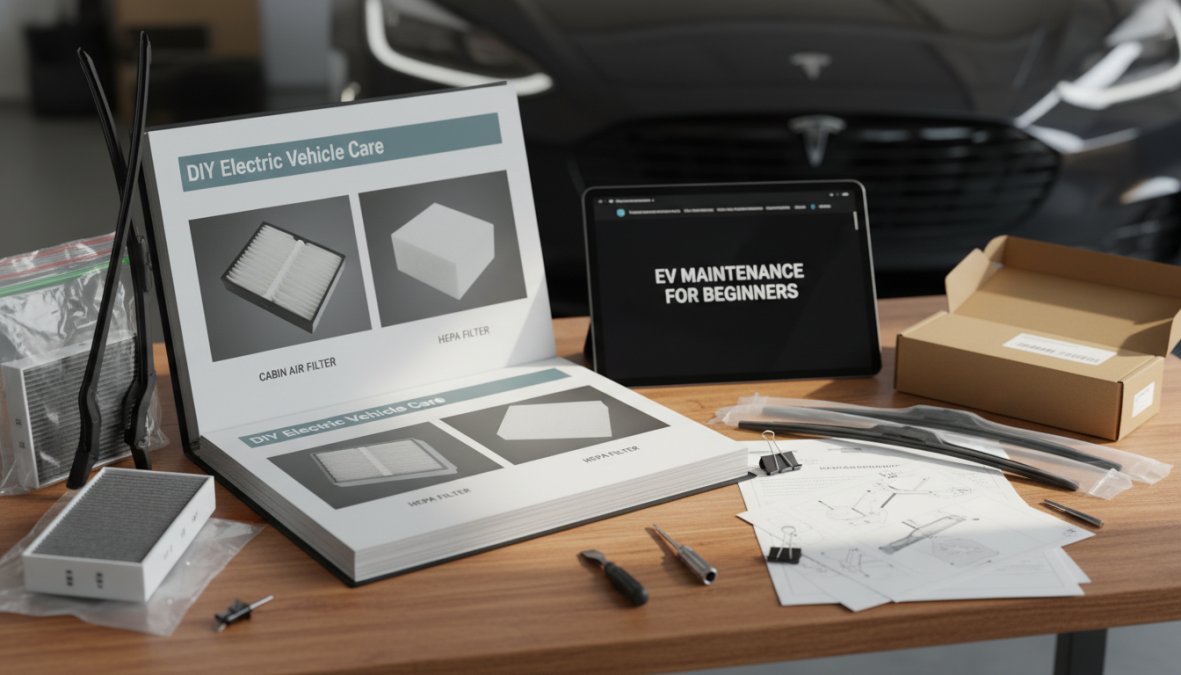
A common mistake is starting a DIY maintenance task without the right tools and improvising. On an EV, improvising with incorrect tools on fasteners or electrical components creates damage that costs far more to fix than the original job.
Basic EV DIY toolkit:
Task | Required Tool | Notes |
|---|
Wheel removal | Torque wrench + metric sockets | Torque to manufacturer spec, not by feel |
Caliper service | Caliper wind-back tool | Essential for electric handbrake models |
Filter access | Trim removal tools | Avoids cracking plastic clips |
Brake fluid test | Brake fluid test strips | Check moisture content before deciding on replacement |
Fastener inspection | Crowsfoot wrench set | Useful for recessed fasteners in tight spaces |
Tyre pressure | Digital tyre gauge | More accurate than forecourt gauges |
An offset wrench and a crowsfoot wrench set are worth having for EV work specifically, because battery pack proximity often means fasteners are in awkward positions that a standard socket set can't reach cleanly.
Common DIY Troubleshooting and Mistakes Electric Car Beginners Make
The thing nobody tells you about electric car maintenance for beginners is that the most expensive mistakes aren't the ones involving complex repairs. They're the ones involving simple tasks done incorrectly.
Mistake 1: Ignoring brake fluid because the brakes "feel fine" Brake feel is not a reliable indicator of fluid condition. Moisture contamination is invisible and the degradation in boiling point happens gradually. Test the fluid with a moisture test strip annually and replace on schedule regardless of pedal feel.
Mistake 2: Using the wrong torque values for wheel nuts EV alloy wheels often use specific torque values that differ from petrol equivalents. Under-torquing can allow wheel movement; over-torquing can crack the alloy or stretch wheel studs. Always use a calibrated torque wrench and verify the specification in the owner manual or workshop manual for your specific model.
Mistake 3: Attempting caliper service on electric handbrake models without software access Covered above, but worth repeating: compressing rear caliper pistons on Model 3, Model Y, and other EVs with electronic parking brakes without first retracting the motor via diagnostic software is a reliable way to destroy the hand brake motor.
Mistake 4: Charging to 100% daily This is the single most common battery health mistake. Lithium-ion cells experience accelerated degradation when held at maximum charge for extended periods. Set the charge limit to 80% in your vehicle's charging settings.
Mistake 5: Skipping the parts catalogue and using non-specification fasteners EV assembly uses metric fasteners with specific grade ratings. Substituting a lower-grade bolt in a suspension or drivetrain application is a safety risk. Always cross-reference the parts catalog for your model before sourcing replacement hardware.
For owners in Kettering and across Northamptonshire, KMC Electric's Level 4 Master Technician team handles diagnostic troubleshooting for cases where the fault lies beyond DIY scope, including wiring diagram interpretation, battery diagnostic scanning, and suspension geometry checks.
Warranty vs. Out-of-Pocket Costs: When to DIY and When to Call a Specialist
The warranty question is where EV ownership gets genuinely complicated, and most beginner guides avoid it entirely.
Most EV manufacturers provide a separate battery and drivetrain warranty (typically 8 years or 100,000 miles) alongside the standard vehicle warranty. What many owners don't realise is that warranty claims can be refused if the vehicle has been serviced outside manufacturer guidelines, or if non-approved parts have been used in repairs.
This doesn't mean you must use a main dealer for everything. Independent specialists can carry out maintenance work without voiding warranties, provided they use correct specification parts and document the work properly. The UK Competition and Markets Authority guidance on vehicle warranties and independent servicing confirms that consumers have the legal right to use independent garages without automatically invalidating manufacturer warranties.
Decision framework: DIY, independent specialist, or main dealer?
Task | DIY | Independent Specialist | Main Dealer |
|---|
Cabin/HEPA filter | Yes | Optional | Unnecessary |
Wiper blades | Yes | Optional | Unnecessary |
Tyre rotation | Yes (with tools) | Good option | Unnecessary |
Brake fluid test | Yes | Yes | Yes |
Brake fluid replacement | Possible | Recommended | Recommended |
Caliper service | Only with correct tools | Recommended | Recommended |
Battery diagnostic | No | Recommended | Yes |
Collision repair | No | Specialist only | Yes |
Suspension geometry | No | Recommended | Yes |
Software/diagnostic | No | Yes | Yes |
Out-of-warranty vehicles are where independent specialists genuinely earn their place. Main dealer flat rate times and labour rates make out-of-warranty repairs expensive. An independent EV specialist with the same diagnostic capability and genuine parts access can deliver the same technical outcome at a significantly lower cost.
Key TakeawayThe most cost-effective approach to EV ownership is handling simple consumable tasks yourself, using an independent EV specialist for scheduled maintenance and complex repairs, and reserving main dealer visits for in-warranty warranty claims only.
For owners in Kettering and the surrounding Northamptonshire area looking for a reliable EV specialist near me, KMC Electric offers independent battery health verification, full diagnostic capability, and access to genuine parts, making it a practical alternative to main dealer pricing for both in-warranty and out-of-warranty vehicles.
Conclusion
EV ownership rewards the owners who take maintenance seriously, and the learning curve for electric car maintenance for beginners is shorter than most people expect once the key differences are understood. The challenge is knowing which tasks you can handle confidently, which require specialist diagnostic access, and how to protect your warranty without paying main dealer rates for everything.
KMC Electric, based in Kettering, Northamptonshire, is an independent EV specialist with Level 4 Master Technician status and over 25 years of automotive experience, providing professional diagnosis, cost-effective repairs, and independent battery health assessments as a reliable alternative to main dealer networks. Contact KMC Electric to book a vehicle health check or battery assessment and get a clear picture of your EV's condition before the next service interval.
Frequently Asked Questions
Do electric cars require less maintenance than petrol or diesel cars?
Generally, yes. Electric cars have far fewer moving parts, no oil changes, no exhaust systems, no timing belts. However, electric car maintenance for beginners still includes regular tasks like tire rotation, brake fluid replacement, cabin air filter changes, and battery health monitoring. The overall cost and frequency of servicing is typically lower, but it is not zero. Staying on top of your EV's service schedule helps avoid more costly repairs later.
How often should you service an electric car?
Most electric vehicles follow an annual service interval or one based on mileage, whichever comes first. A typical electric car service schedule includes checks on brake fluid (usually every two years), tire rotation (every 6,000 to 8,000 miles), wiper blade condition, cabin air filter or HEPA filter replacement, and suspension components. Tesla models also recommend periodic drivetrain oil and brake caliper cleaning. Always refer to your owner manual or a qualified EV specialist for model-specific intervals.
How often should EV tires be rotated?
EV tire rotation frequency is generally every 6,000 to 8,000 miles, though some manufacturers recommend as frequently as every 5,000 miles. Electric vehicles tend to wear tires faster than petrol cars due to the instant torque delivery and the additional weight of the battery pack. Regular rotation extends tyre life, improves safety, and maintains even tread wear. Always check your specific model's owner manual or service documentation for the recommended interval.
Do electric car batteries need special maintenance?
Electric car batteries do not need hands-on maintenance in the traditional sense, but how you use and charge them significantly affects their long-term health. To extend EV battery life, avoid regularly charging to 100% unless needed for a long trip, try to keep the charge between 20% and 80% for daily use, avoid frequent rapid charging where possible, and park in moderate temperatures when you can. An independent battery health check from a specialist can give you a clear picture of your battery's condition.
What are the most common problems with electric cars that beginners miss?
Common issues that beginners overlook include degraded brake performance from lack of use (regenerative braking reduces wear but calipers can still seize), low or contaminated brake fluid, worn cabin air or HEPA filters affecting air quality, uneven tyre wear from skipping rotation, and early signs of suspension wear. On Tesla models specifically, falcon wing door sensors and door handle mechanisms can develop faults. A diagnostic check by a qualified EV technician can catch these before they become expensive repairs.
Is it cheaper to service an electric car at an independent specialist rather than a main dealer?
In many cases, yes. Independent EV specialists like KMC Electric in Kettering, Northamptonshire, often offer more competitive flat rate times and labour costs compared to main dealer networks, particularly for out-of-warranty vehicles. The key is choosing a specialist with genuine EV qualifications, ideally Level 4 Master Technician status, and experience with your specific model. For warranty repairs, always check whether independent servicing affects your warranty terms before booking.