Is Professional Car Diagnostic Worth It? Understanding What You're Actually Paying For
Asking whether is professional car diagnostic worth it is one of the most common questions vehicle owners face after a dashboard warning light appears. The honest answer: it depends on what you think you're paying for. At KMC Electric, we've worked through hundreds of diagnostic cases across Tesla, hybrid, and conventional vehicles, and the single biggest source of wasted money is owners confusing a quick code read with an actual diagnosis. Those are two completely different things. Below, we'll show you exactly how to tell them apart, what professional diagnostics actually cost in 2026, and when skipping one will cost you far more than the fee itself.
A car diagnostic test is a systematic evaluation of a vehicle's electronic control systems, using specialist equipment to read diagnostic trouble codes (DTC), analyse real-time data from sensors, and interpret fault patterns in context. It is not simply plugging in a code reader and writing down a number.
This distinction matters enormously. A code tells you a system has reported a fault. A diagnosis tells you why. The gap between those two things is where most unnecessary repair bills originate.
What a Professional Diagnostic Test Actually Includes
A professional diagnostic goes well beyond reading an OBD-II port. A qualified technician will connect a professional-grade scan tool, review live sensor data streams, check freeze-frame data captured at the moment of fault, and cross-reference codes against known failure patterns for your specific vehicle. They will also perform physical inspection of wiring harnesses, connector integrity, and related components.
The process typically covers:
Full system scan across engine, transmission, ABS, airbag, and body control modules
Live data analysis of fuel system, ignition system, and sensor outputs
Freeze-frame data review to establish fault conditions
Guided testing of suspect components using proprietary software
Written fault report with a prioritised repair estimate
For electric vehicles and hybrids, this extends to battery management system (BMS) analysis, thermal data, cell balance readings, and high-voltage system integrity checks. Standard scan tools cannot access these systems.
Code Reading vs. Diagnostic Accuracy: A Critical Difference
Here's the part most guides skip entirely. Reading a code and performing a diagnostic are not interchangeable, and treating them as equivalent is the root cause of what technicians call the "parts cannon" approach.
A P0420 code, for example, indicates catalyst system efficiency below threshold. That code could stem from a failing catalytic converter, a faulty oxygen sensor, an exhaust leak, or even engine oil contamination. Replacing the catalytic converter on the basis of the code alone, without further testing, is a gamble. A professional technician uses the code as a starting point, not a conclusion.
Diagnostic accuracy is the ability to identify the root cause of a fault, not just its symptom. This requires technician expertise, access to manufacturer data, and equipment capable of reading proprietary systems.
Watch OutReplacing parts based solely on a DTC code without further diagnosis is one of the most expensive mistakes vehicle owners make. A single misdiagnosed sensor failure can lead to three or four unnecessary parts replacements before the real fault is found.
Cost of a Car Diagnostic Test: What to Expect in 2026
Professional diagnostic fees vary considerably depending on vehicle type, location, and the depth of assessment required. Understanding the structure of these fees helps you evaluate whether you're getting fair value.
Typical Price Ranges for Professional Diagnostics
At independent garages and main dealers across the UK, a standard diagnostic check generally falls within the following ranges:
Diagnostic Type
Typical Fee Range
What's Included
Basic OBD-II scan (independent)
£45 - £85
Code read, brief report
Full system diagnostic (independent)
£75 - £150
Multi-module scan, live data
Main dealer diagnostic
£100 - £200+
Proprietary software access
EV/hybrid specialist diagnostic
£95 - £175
BMS, HV system, full scan
Pre-purchase health assessment
£120 - £200
Full vehicle condition report
The diagnostic fee is often offset against repair costs if you proceed with the work at the same garage. Many independent specialists in Kettering and across Northamptonshire apply this model, making the upfront cost more palatable.
Labour rates in the East Midlands tend to sit below London averages, which means a thorough professional diagnostic in Kettering will typically cost less than the same service from a main dealer in a major city.
How Vehicle Type Affects Diagnostic Fees, Including EVs and Hybrids
Vehicle-specific diagnostic complexity is the factor most cost guides ignore. A 2019 Tesla Model 3 and a 2019 Ford Focus share almost nothing in terms of diagnostic architecture. The Tesla requires access to proprietary software, high-voltage safety protocols, and specialist knowledge of Tesla's battery management and drive unit systems. A generic scan tool will return minimal useful data on a Tesla.
For EV and hybrid owners, this means the diagnostic fee reflects genuine specialist capability, not inflated labour rates. According to the Society of Motor Manufacturers and Traders (SMMT) EV guidance, the technical complexity of electric vehicle systems requires technicians to hold specific EV qualifications, which represents a real investment in training and equipment that mainstream garages often lack.
Owners of out-of-warranty Teslas in Kettering face a particular challenge: main dealer diagnostics are expensive and often involve long lead times. An independent EV specialist with Level 4 Master Technician status offers the same depth of access at a more competitive fee.
Professional vs DIY Car Diagnostic Tools: Pros, Cons, and Real Limitations
Most people asking whether is professional car diagnostic worth it have already tried a cheap OBD-II reader from an online retailer. That's a reasonable starting point. But understanding what those tools actually do, and don't do, reframes the question entirely.
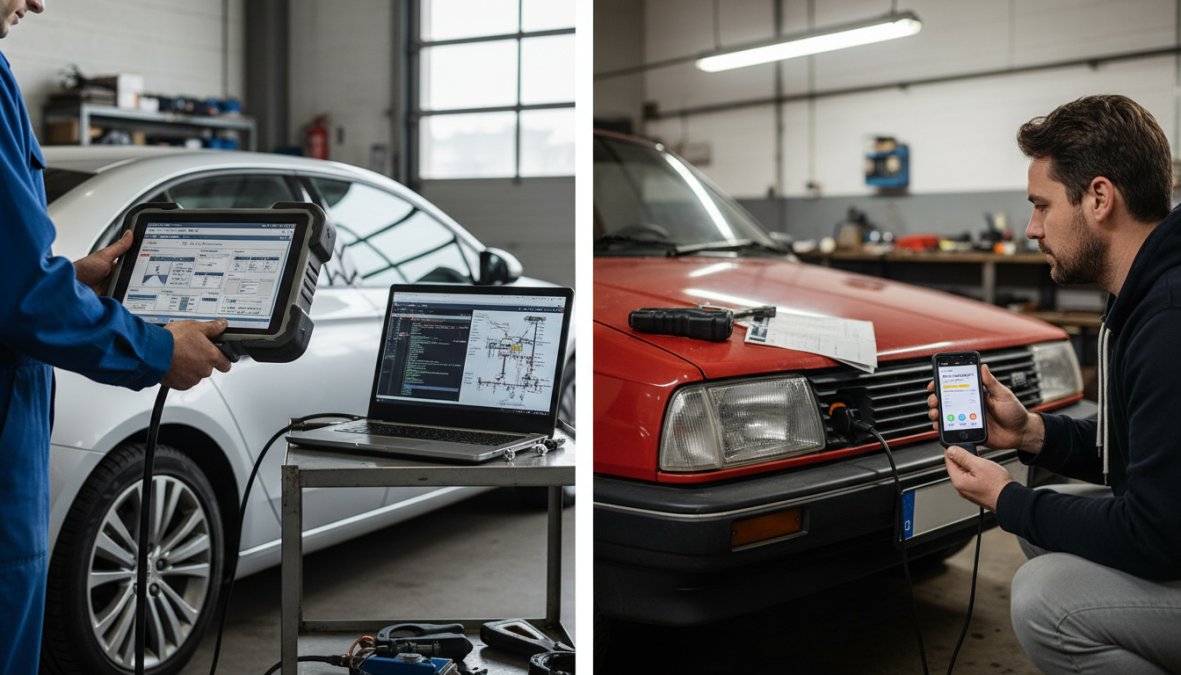
A professional mechanic in a well-lit workshop connects a professional-grade scan tool to a vehicle's OBD-II port, with a laptop displaying real-time diagnostic data streams alongside the car. The difference between that setup and a £25 Bluetooth dongle is not just price.
Side-by-side comparison of OBD for is professional car diagnostic worth it
What Cheap OBD-II Code Readers Can and Cannot Tell You
A consumer-grade OBD-II code reader connects to the OBD-II port and retrieves stored DTCs from the engine control module. For straightforward faults on older, simpler vehicles, this is genuinely useful. It costs nothing beyond the tool purchase and can confirm whether a check engine light is something minor before booking a garage visit.
What cheap code readers do well:
Read and clear stored engine fault codes
Display basic live data (RPM, coolant temperature, vehicle speed)
Confirm whether an emissions-related fault is present
Identify obvious sensor failures on simple systems
What they cannot do:
Access ABS, airbag, transmission, or body control modules on most vehicles
Perform guided diagnostics or component activation tests
Interpret fault context using real-time data correlation
The gap widens significantly on modern vehicles. Post-2018 cars, and virtually all EVs and hybrids, use proprietary communication protocols that consumer tools simply cannot read. On a Tesla, a £25 dongle will return almost nothing actionable.
The 'Parts Cannon' Trap: Why Guessing Costs More Than Diagnosing
The parts cannon trap is what happens when a vehicle owner (or an underprepared garage) replaces components sequentially, hoping to clear a fault, rather than diagnosing its root cause first. It is remarkably common, and remarkably expensive.
A common sequence looks like this: check engine light appears, code reader shows a misfire on cylinder 3, owner replaces spark plug, light returns, owner replaces ignition coil, light returns, owner replaces fuel injector. Total spend: potentially several hundred pounds. Actual fault: a hairline crack in the wiring harness causing an intermittent signal loss. A professional diagnostic with live data monitoring would have identified the wiring fault in one session.
Pro TipBefore purchasing any replacement part based on a fault code, ask a professional to confirm the root cause with live data testing. The diagnostic fee is almost always less than the cost of one unnecessary part.
The cost-benefit analysis is straightforward. A £95 professional diagnostic that correctly identifies a £40 sensor failure saves you from buying a £300 catalytic converter you didn't need.
How to Interpret OBD2 Trouble Codes Without Getting Misled
OBD-II trouble codes are the most misunderstood output in consumer automotive diagnostics. Understanding their structure is useful. Understanding their limits is essential. Most guides stop at the structure. This section goes further.
The Code Structure: A Quick Reference
Every OBD-II code is a five-character string: one letter followed by four digits.
P = Powertrain (engine, transmission, fuel system)
B = Body (airbags, climate control, lighting)
C = Chassis (ABS, steering, suspension)
U = Network/communication (module-to-module faults)
The first digit tells you whether the code is generic (0) or manufacturer-specific (1, 2, or 3). Generic codes are readable by any OBD-II tool. Manufacturer-specific codes require proprietary software to interpret correctly, a consumer dongle will display the code string but cannot tell you what it means for your specific vehicle.
The remaining three digits identify the fault subsystem and the specific condition. According to the SAE International OBD-II standard documentation, thousands of defined codes exist across the generic and manufacturer-specific ranges, and the same code number can describe meaningfully different faults depending on make, model, year, and engine variant.
Why the Same Code Can Mean Completely Different Things
This is the part most guides omit, and it is the most important thing to understand before acting on any code.
Take P0171: System Too Lean, Bank 1. This is one of the most commonly retrieved codes in independent workshops. It tells you the engine control module has detected that the air-to-fuel mixture on bank 1 is running leaner than the target ratio. That is all it tells you. The underlying cause could be any of the following:
A vacuum leak downstream of the mass airflow (MAF) sensor, allowing unmetered air into the intake
A faulty or contaminated MAF sensor reporting lower airflow than is actually present
A failing fuel pump unable to maintain adequate fuel pressure under load
A clogged or stuck-open fuel injector on one or more cylinders
A failing oxygen sensor providing incorrect feedback to the ECM
An exhaust leak near the upstream oxygen sensor skewing the air-fuel reading
Each of these causes produces the same P0171 code. Each requires a different repair. Replacing the MAF sensor because P0171 appeared, without testing fuel pressure, checking for vacuum leaks, or monitoring live oxygen sensor data, is a coin flip. A professional diagnostic uses the code as a starting point and then applies live data analysis to isolate which of these mechanisms is actually responsible.
Watch OutA stored DTC is a record that a threshold was crossed. It is not a record of why that threshold was crossed. Treating a code as a repair instruction rather than a diagnostic lead is the single most reliable way to spend money on parts you did not need.
Stored Codes vs. Pending Codes: A Distinction That Changes Your Response
Most consumer code readers display stored codes, faults that have triggered the check engine light because they have occurred on two or more consecutive drive cycles. Fewer users know that scan tools also retrieve pending codes: faults that have occurred once but have not yet met the threshold to illuminate the warning light.
Pending codes matter because they represent faults in their earliest stage, before they escalate. A pending P0300 (random misfire) that has not yet triggered the check engine light is an early warning of a developing ignition or fuel system problem. Catching it at the pending stage and investigating the root cause is substantially cheaper than waiting until the fault becomes stored, the light comes on, and the misfire has been stressing the catalytic converter for additional drive cycles.
If your scan tool supports it, always check for pending codes alongside stored ones.
Manufacturer-Specific Codes: When Generic Tools Become Unreliable
The generic OBD-II standard covers emissions-related systems because that is what the legislation mandated. Everything else, transmission shift logic, body control functions, advanced driver assistance systems (ADAS), battery management on EVs and hybrids, sits in the manufacturer-specific code range, accessible only with proprietary or licensed diagnostic software.
On a post-2018 vehicle, a significant proportion of the fault data that matters to a technician is in the manufacturer-specific range. A consumer tool reading only generic codes is seeing a partial picture. On a Tesla, that picture is almost entirely blank, the vehicle's most critical systems communicate over proprietary protocols that standard OBD-II tools cannot access at all.
This is why the code structure framework below has a hard boundary built into it:
A practical framework for using OBD-II codes correctly:
Read the code and record whether it is generic (P0XXX) or manufacturer-specific (P1XXX and above)
Check for both stored and pending codes, note all of them before researching any single one
Research the code specifically for your make, model, year, and engine variant, not generically
Identify every plausible root cause for that code on your specific vehicle, not just the most common one
If the code is manufacturer-specific, involves an EV or hybrid system, or if multiple codes are present simultaneously, treat this as a signal that professional live-data diagnosis is required
If the same code has returned after a previous repair, the root cause was not addressed, a professional diagnostic is non-negotiable at this point
The framework's value is in step 4. Most DIY approaches stop at step 3, find the most commonly cited cause online, and order the part. The professional approach maps all plausible causes and then uses live sensor data, component activation tests, and freeze-frame analysis to eliminate them systematically until one remains. That process is what you are paying for when you book a professional diagnostic.
Factors That Influence Whether Professional Diagnostics Are Worth It
The value of a professional diagnostic is not fixed. Several factors shift the cost-benefit calculation significantly, and understanding them helps you make a more informed decision.
Vehicle-Specific Diagnostic Complexity: Standard Cars vs. EVs and Hybrids
Standard petrol and diesel vehicles built before 2015 are generally well-served by independent garages with mid-range scan tools. The diagnostic architecture is relatively open, generic codes cover most faults, and experienced technicians can resolve the majority of issues without proprietary software.
Post-2018 vehicles, and all EVs and hybrids, are a different matter entirely. Modern automotive computer systems use encrypted communication protocols, require software subscriptions to access, and generate fault data that only makes sense in the context of the vehicle's full operational history. For Tesla owners in Kettering and across Northamptonshire, this means a standard garage diagnostic is often incomplete or misleading.
KMC Electric holds Level 4 Master Technician status in electric vehicles, with EV qualifications dating to 2016 and over 25 years of automotive industry experience. For out-of-warranty Tesla owners, this level of specialist access is equivalent to what a main dealer provides, at a fraction of the cost and with faster turnaround.
Long-Term ROI: Calculating the True Cost of Skipping a Professional
Here's a framework for calculating whether a professional diagnostic makes financial sense for your situation:
The Diagnostic ROI Calculation:
Estimated diagnostic fee: £X
Cost of most likely repair if correctly diagnosed: £A
Cost of parts cannon scenario (average 2-3 unnecessary parts): £B
Cost of fault escalating due to delayed diagnosis: £C
If (A + X) is significantly less than (B or C), professional diagnosis is the correct financial decision.
Many vehicle owners treat the diagnostic fee as an optional cost. Experienced technicians treat it as insurance against a far larger bill. A minor coolant system fault left undiagnosed because the owner cleared the code and drove on can escalate to a head gasket failure. The diagnostic fee for the original fault would have been a fraction of the resulting repair.
Key TakeawayThe long-term ROI of professional diagnostics is strongest for vehicles over three years old, EVs and hybrids at any age, and any vehicle where the fault has returned after a DIY repair attempt.
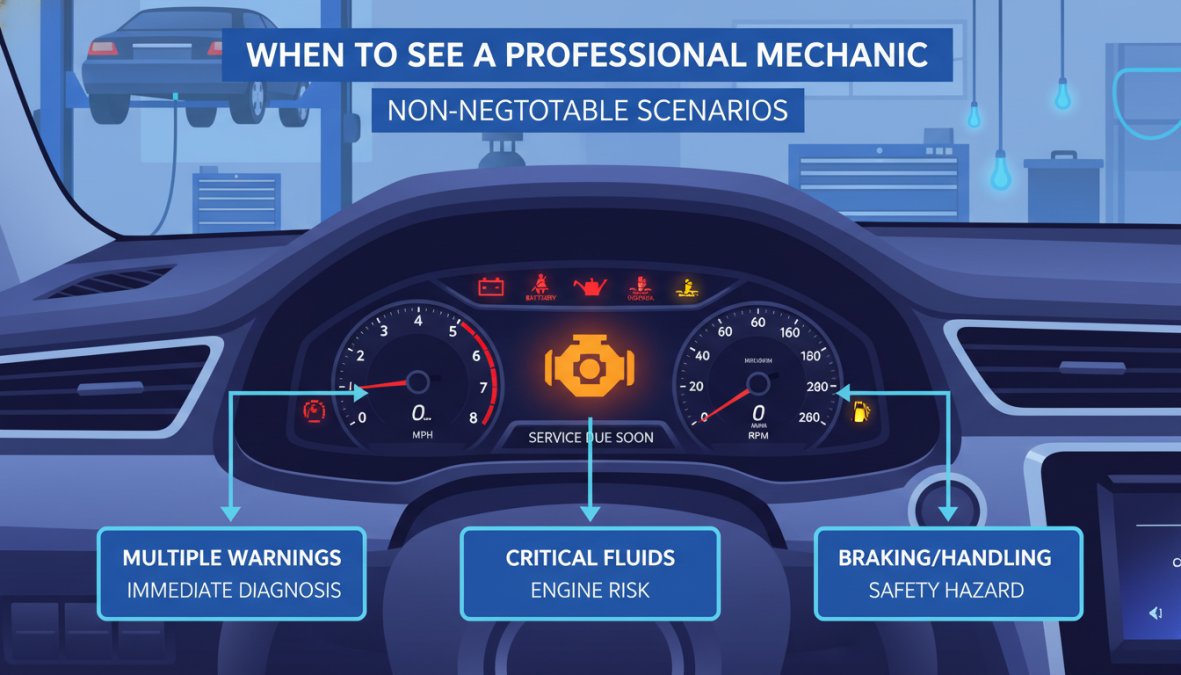
When to See a Professional Mechanic: Non-Negotiable Scenarios
Some situations make professional diagnostics non-negotiable. The question of whether is professional car diagnostic worth it has a clear answer in each of these cases: yes, without qualification.
The following scenarios require professional attention:
Multiple warning lights illuminated simultaneously - This indicates a cascading fault or a communication network failure, neither of which a consumer tool can diagnose
Check engine light accompanied by drivability symptoms - Rough running, hesitation, or power loss alongside a DTC indicates an active fault requiring real-time data analysis
Any fault on an EV or hybrid high-voltage system - These systems require specialist equipment and safety protocols; DIY diagnosis is not appropriate
Intermittent faults that clear and return - These are the hardest faults to diagnose and almost never resolve correctly without professional live data monitoring
Pre-purchase inspection of a used EV or hybrid - Independent battery health verification is essential before buying any used electric vehicle
Fault codes returning after DIY repair - If you've replaced a part and the code came back, the root cause has not been addressed
Emissions test failure - Passing an emissions test requires the fault to be genuinely resolved, not just the code cleared
Professional illustration showing is professional car diagnostic worth it
The consequences of ignoring these scenarios range from failed MOT tests to dangerous vehicle failures. For EV owners, an undiagnosed high-voltage fault is a safety issue, not just a mechanical one.
Free Auto Parts Store Scans: What They Miss and Why It Matters
Free OBD-II scans at auto parts retailers are one of the most widely used first responses to a check engine light, and one of the most widely misunderstood. The service is genuinely useful in a narrow set of circumstances. Outside that narrow set, it can actively mislead you, not because the scan is performed badly, but because of what the tool is structurally designed to do and what happens next at the counter.
What a Parts Store Scan Actually Does
The scan tools used at parts retailers are consumer-grade OBD-II readers configured to retrieve stored diagnostic trouble codes from the engine control module (ECM). They connect to the OBD-II port, pull the codes, and display them on a screen. The associate behind the counter reads the code and, in most cases, cross-references it against a parts lookup system.
That last step is where the structural problem begins. The parts lookup system is designed to suggest replacement parts, not to diagnose root causes. The associate is not a diagnostic technician. They are performing a code retrieval and making a parts recommendation based on the most common repair associated with that code. For a small subset of straightforward faults on older, simpler vehicles, that recommendation will be correct. For anything more complex, it is an educated guess with a commercial incentive attached.
This is not a criticism of parts store staff, it is a description of what the service is. The problem arises when vehicle owners treat it as something it is not.
The Systems a Free Scan Cannot See
The generic OBD-II standard was designed around emissions compliance. It mandates that all vehicles sold in the UK and EU expose emissions-related engine data through a standardised port. It does not mandate access to any other system. As a result, consumer-grade tools reading the generic OBD-II protocol have no visibility into:
ABS and traction control modules, brake system faults, wheel speed sensor failures, and stability control issues are invisible to a generic scan
Airbag and supplemental restraint systems (SRS), a fault in the airbag system will not appear on a parts store scan, even if the airbag warning light is illuminated
Transmission control modules, shift quality issues, solenoid faults, and clutch pack data require manufacturer-level access
Body control modules (BCM), lighting faults, central locking issues, and comfort system errors are outside the generic OBD-II scope
ADAS and safety system modules, lane assist, automatic emergency braking, and parking sensor systems on post-2018 vehicles communicate over proprietary networks
EV and hybrid battery management systems, high-voltage system data, cell balance readings, and thermal management faults are completely inaccessible to standard OBD-II tools
On a modern vehicle, the check engine light is one of many warning indicators. A free scan that returns a single engine code while missing concurrent ABS, SRS, or transmission faults gives you an incomplete picture that can feel like a complete one. That false completeness is the real risk.
The 'Code Cleared, Problem Solved' Illusion
Most consumer scan tools and parts store readers can clear stored codes as well as read them. This creates a specific failure mode that experienced technicians encounter regularly: the owner retrieves a code, clears it, the warning light goes off, and they assume the problem is resolved. It is not. The underlying fault condition still exists. The code will return when the ECM detects the fault again, typically within one to three drive cycles.
More importantly, clearing a code resets the vehicle's OBD-II readiness monitors, the internal self-tests the ECM runs to confirm each emissions-related system is functioning correctly. After a code clear, these monitors need to complete a full drive cycle before they report ready. If the vehicle is presented for an MOT emissions check before the monitors have completed, it will fail on readiness grounds regardless of whether the underlying fault has been repaired. UK government MOT testing guidance on OBD readiness monitors confirms that incomplete readiness monitors are a direct cause of MOT failure.
Watch OutClearing a fault code without repairing the underlying fault does not fix the vehicle. It removes the warning. The fault remains active and will return. If the vehicle is tested for emissions before readiness monitors complete, it will fail the MOT regardless of the repair status.
A Decision Framework: When a Free Scan Is Enough and When It Is Not
Rather than dismissing free scans entirely, the more useful approach is a clear decision rule for when they are sufficient and when they are the wrong tool for the situation.
A free parts store scan is a reasonable starting point if:
The check engine light is the only warning light illuminated
The vehicle is driving normally with no drivability symptoms
The vehicle is a petrol or diesel model built before approximately 2015
The code returned is a well-understood generic code (P0XXX) with a small number of common causes
You are using the result to decide whether to book a garage appointment, not to decide which part to buy
A free scan is insufficient and a professional diagnostic is required if:
Multiple warning lights are illuminated simultaneously
The check engine light is accompanied by rough running, hesitation, power loss, or unusual noise
The code is manufacturer-specific (P1XXX or above) and the tool cannot interpret it for your vehicle
The vehicle is an EV, hybrid, or any post-2018 model with ADAS systems
The same code has returned after a previous repair attempt
The warning light is an ABS, SRS, or transmission indicator rather than, or in addition to, the check engine light
You are considering a used vehicle purchase and want to understand its actual fault history
Pro TipUse a free scan to answer one question: is there a stored engine code that might explain this warning light? Use a professional diagnostic to answer the question that actually matters: what is the root cause, and what does it cost to fix correctly?
The free scan is a triage tool. It tells you whether a fault has been logged. It cannot tell you why, how serious it is, or whether other systems are also affected. For the triage function, it is genuinely valuable and costs nothing. For anything beyond triage, it is the wrong instrument, and treating it as a diagnosis is the first step toward spending money on parts that will not solve the problem.
Conclusion: Making the Right Call for Your Vehicle
The core argument of this guide is simple: is professional car diagnostic worth it is the wrong question if you're comparing it to doing nothing. The real comparison is between a professional diagnostic and the cost of misdiagnosis, unnecessary parts, and faults that escalate because they weren't properly identified.
For EV and hybrid owners in Kettering and across Northamptonshire, the stakes are higher than for conventional vehicle owners. Standard garages lack the proprietary software access, high-voltage safety training, and specialist knowledge that modern electric vehicles require. KMC Electric provides professional diagnosis, repair, and long-term maintenance for Tesla and other electric and hybrid vehicles, with Level 4 Master Technician status in EVs and over 25 years of automotive industry experience. For out-of-warranty vehicles especially, an independent specialist diagnostic is both the most thorough and the most cost-effective option available. Book a diagnostic with KMC Electric and get a clear, accurate picture of your vehicle's condition before a small fault becomes an expensive one.
Frequently Asked Questions
What does a professional car diagnostic test include?
A professional car diagnostic test goes well beyond reading fault codes. A qualified technician connects proprietary software and a professional scan tool to your vehicle's automotive computer system, retrieves diagnostic trouble codes (DTCs), reviews real-time data from sensors, and performs a physical inspection. They assess the fuel system, ignition system, wiring harness integrity, and engine performance to identify the root cause — not just the symptom. This level of diagnostic accuracy is what separates a professional from a basic code reader.
How much does a professional car diagnostic cost in the UK?
The cost of a car diagnostic test in the UK typically ranges from £50 to £150 at an independent garage, with main dealers often charging £100 to £200 or more. Electric vehicles and hybrids can attract higher diagnostic fees due to the complexity of their systems and the need for specialist software. Some garages apply the diagnostic fee toward the repair cost if you proceed with the work, making it a more cost-effective investment overall.
What is the difference between a cheap OBD2 scanner and a professional diagnostic tool?
A cheap OBD2 code reader retrieves generic diagnostic trouble codes from the engine control unit but cannot access manufacturer-specific sub-systems, live sensor data streams, or perform active tests. Professional diagnostic tools use proprietary software to communicate with every module in the vehicle — including battery management systems in EVs — and can pinpoint faults like sensor failure, wiring harness issues, or calibration errors. For complex vehicles, a basic scan tool gives you a starting point, not an answer.
Can I diagnose my car problems myself with a DIY OBD2 tool?
You can read basic diagnostic trouble codes yourself using an affordable OBD-II scan tool, which is a useful first step for simple issues. However, interpreting OBD2 trouble codes correctly requires understanding what triggered the code, which systems are affected, and whether there are related faults. Without technician expertise and access to real-time data, DIY diagnostics risk misdiagnosis — leading to the 'parts cannon' trap where you replace components unnecessarily. For dashboard warning lights on modern, complex, or electric vehicles, professional diagnostics are strongly advisable.
Is it worth paying for a diagnostic if the check engine light is on?
In most cases, yes — professional car diagnostic is worth it when the check engine light is on. A check engine light can indicate anything from a loose fuel cap to a serious engine performance or emissions issue. A professional mechanic can distinguish between a minor fault and a developing problem that could cause expensive damage if ignored. The diagnostic fee is a small cost compared to the potential repair bill from a misdiagnosed or undetected fault, particularly on electric and hybrid vehicles with complex automotive computer systems.
How long does a professional car diagnostic take?
A standard professional car diagnostic typically takes between 30 minutes and 1.5 hours, depending on the number of fault codes, the complexity of the vehicle, and whether additional physical inspection is required. Electric vehicles and hybrids may take longer due to the additional systems involved, such as battery management and regenerative braking. Some garages offer same-day diagnostics, while others may need to book the vehicle in for a longer assessment if multiple systems require investigation.